The 30 Minute Rule begins July 15 at 7:00 PM EDT. An Initial Bid Must Be Placed By July 15 at 6:00 PM EDT To Participate After 6:00 PM EDT
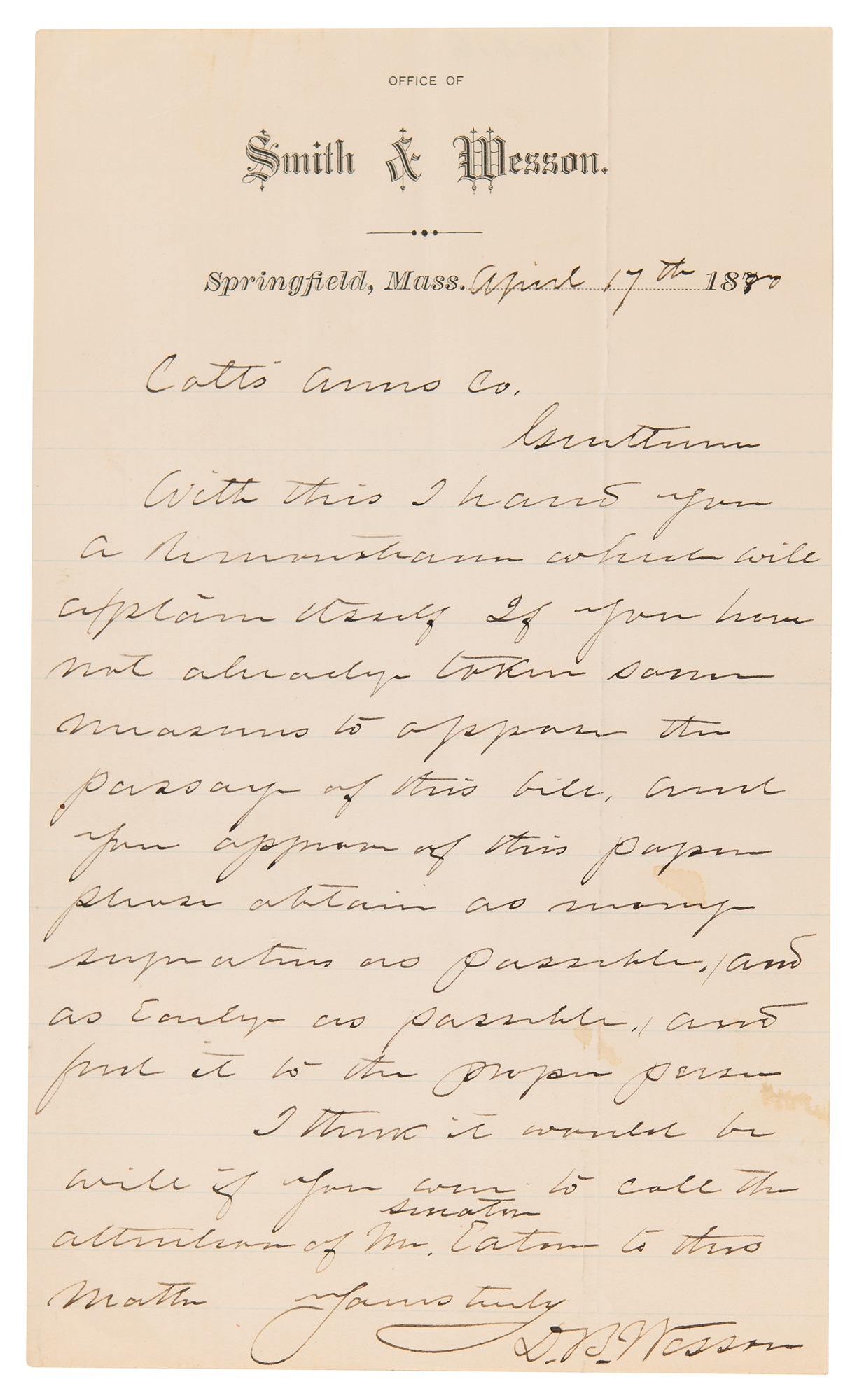
Rare ALS signed “D. B. Wesson,” one page, 5.25 x 9, Office of Smith & Wesson (Springfield, Massachusetts) letterhead, April 17, 1880. Handwritten letter to "Colt's Arms Co.," in full: "With this I hand you a Remonstrance which will explain itself. If you have not already taken some measures to oppose the passage of this bill, and you oppose this purpose please obtain as many signatures as possible, and fwd it to the proper person. I think it would be well if you were to call the attention of Mr. Eaton to this matter." In fine condition.
Daniel B. Wesson’s letter to Colt’s Arms Co. documents an apparent coordinated effort among major American firearms manufacturers to oppose pending legislation affecting the arms industry. Although the specific “bill” referenced in the letter has not been conclusively identified, and the accompanying “Remonstrance” mentioned by Wesson is not known to survive, the surviving correspondence offers important insight into political organization within the American firearms trade during the late 19th century.
Addressed directly to Colt’s Arms Co. in Hartford, the letter reflects communication between two of the nation’s foremost firearms manufacturers at a time when Smith & Wesson and Colt were dominant forces in the American arms industry. Wesson writes that if Colt has not already taken measures to oppose the bill, they should “obtain as many signatures as possible, and fwd it to the proper person,” language indicating an organized lobbying effort already underway within the trade. The request for signatures suggests that the legislation was considered significant enough to unite otherwise competing manufacturers in coordinated opposition.
Wesson further advises Colt to call the matter to the attention of Senator William Wallace Eaton of Connecticut, then serving in the United States Senate, implying that the measure may have been federal in scope or tied to national commercial interests. While the precise subject of the legislation remains unknown, the circumstances suggest it likely concerned manufacturing or commercial issues affecting the firearms trade, potentially taxation, procurement, patent matters, tariffs, or regulations affecting arms manufacture or distribution.
While the precise subject of the legislation remains unknown, the document offers a glimpse into political coordination within the American firearms industry during the late 19th century, illustrating how leading manufacturers responded collectively to legislation affecting shared commercial interests. As such, the letter survives as an uncommon piece of early American firearms-industry history, linking two of the nation’s most important arms makers in a moment of coordinated action.

This item is Pre-Certified by PSA/DNA
Buy a third-party letter of authenticity for
(inquire for price)
*This item has been pre-certified by a trusted third-party authentication service, and by placing a bid on this item, you agree to accept the opinion of this authentication service. If you wish to have an opinion rendered by a different authenticator of your choosing, you must do so prior to your placing of any bid. RR Auction is not responsible for differing opinions submitted 30 days after the date of the sale.
Third-party authentication service applies only to signatures and handwriting, and does not cover the addition of sketches, artwork, musical quotations, etc.

