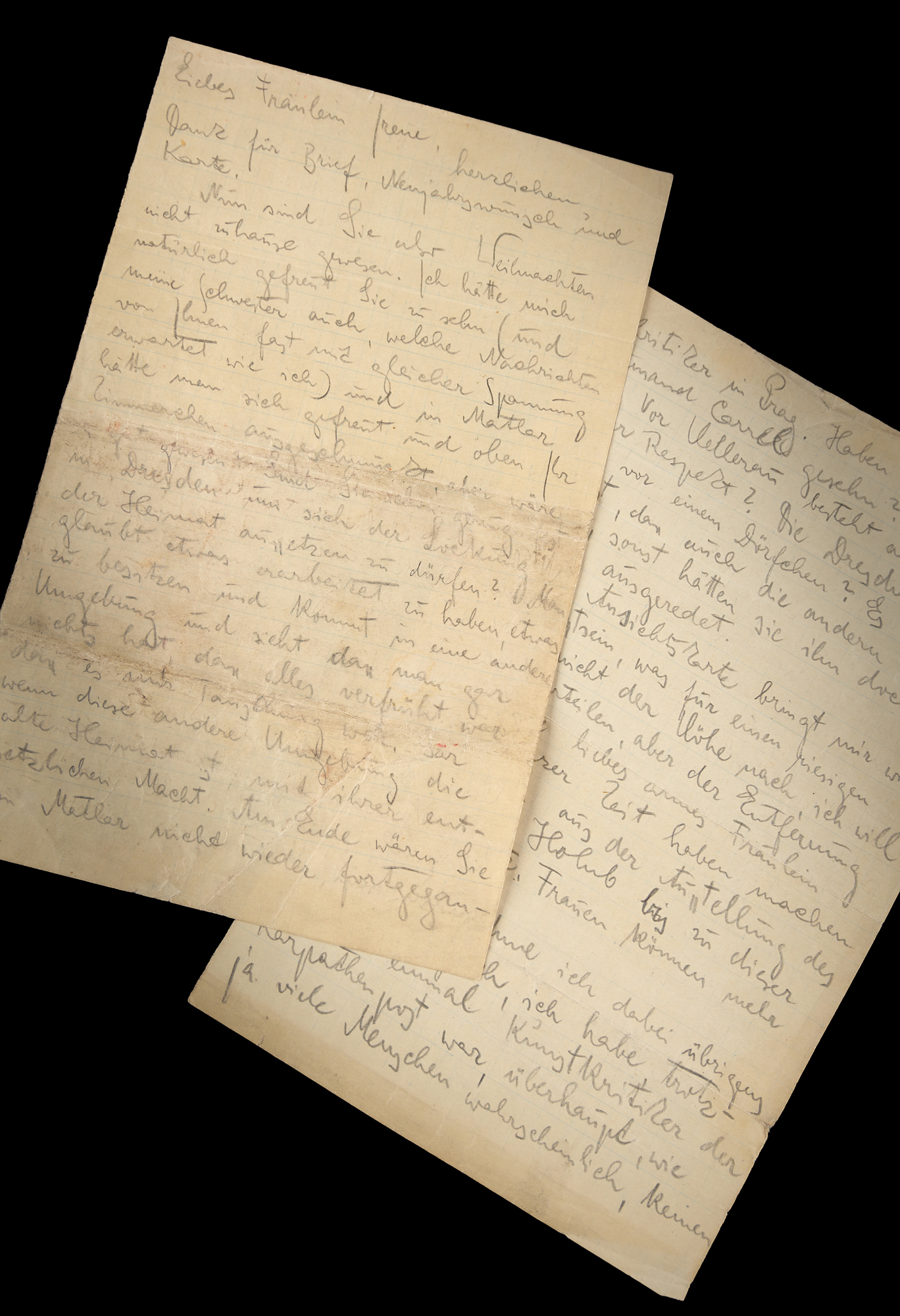
Influential Czech-born writer (1883–1924) whose man-turned-insect story Metamorphosis (1915) and novel The Trial (1925) have earned a permanent and prominent place in the canon of modern literature. Unsigned handwritten draft of letter in German by Franz Kafka, two pages both sides, 5.5 x 9, January 1922. Handwritten draft of a letter to "Fräulein Irene," Irene Bugsch, who was part of Kafka's inner circle of friends during his convalescence at the sanatorium in Tatranské Matliare. She had applied in the autumn of 1921 for admission to the Dresden Academy of Fine Arts and had been supported in this endeavor by Kafka—who, however, considered her completely devoid of talent.
In part (translated): "So, you weren’t at home for Christmas after all. Naturally, I would have been delighted to see you (and so would my sister, who awaits news from you with almost as much eagerness as I do); and back in Matlar, people would have been happy to see you—they would have even decorated your little room upstairs—but would it have been a good thing? Are you already sufficiently ‘firmly rooted’ in Dresden to risk exposing yourself to the allure of your homeland? One believes one has earned something, that one possesses something, only to arrive in a different environment and realize that one has nothing at all—that it was all premature, that it was merely an illusion. Especially when that ‘different environment’ happens to be one’s old homeland, with its terrifying power.
In the end, you might never have left Matlar again (though, admittedly, Klopstock is still there to send you packing). And besides: up to now—at least as far as one can judge from a distance (though, admittedly, one sees nothing at all from a distance, and it is very foolish to write like this)—you have achieved almost everything without a struggle: such academic successes—and they are successes, there is no doubt about that—successes both in your studies and in your dealings with people… and yet you already want to reward yourself by going home? Not yet, dear Fräulein Irene—not until Rade looks at one of your drawings and says: ‘Well, that is absolutely dreadful.’ Of course, if you were to wait for that to happen, you might never make it home at all…
That postcard brings home to me once again what a tremendous leap—not in terms of quality (that is not for me to judge), but in terms of sheer distance—you, my dear, poor Fräulein, have had to make in such a short time: a leap, for instance, from the exhibition of Captain Holub all the way to this very postcard. Women are capable of more than men. Incidentally, I do not offer myself as a point of comparison here; for despite having once served as the art critic for the 'Karpathenpost,' I possess—as do many people, I suspect—absolutely no innate, ‘primary’ eye for the visual arts. The only thing I love in paintings is the love they have awakened in people who do possess that primary eye (insofar as I am able to grasp the nature of those people). And that takes time…
I am, for instance, almost indifferent to a painting by Klee. The colors probably wouldn’t make much difference. Oh, Rade—even though he likely doesn’t care for Klee at all." In very good to fine condition, with light creasing and soiling.
Captain Anton Holub, a Czech officer, was—like Kafka and his friend Klopstock—a patient at the sanatorium in Tatranské Matliare and dabbled as a musician and artist; in April, Kafka had anonymously, and not entirely seriously, reviewed an exhibition of Holub’s landscape paintings in the German-language newspaper 'Karpathen-Post' (Vol. 42, No. 17, dated April 23, 1921), which he references here. He also makes mention of Carl Rade, a professor at the academy who headed specialized classes for porcelain painting, textile art, and fashion design, as well as the influential abstract artist Paul Klee.

This item is Pre-Certified by PSA/DNA
Buy a third-party letter of authenticity for
(inquire for price)
*This item has been pre-certified by a trusted third-party authentication service, and by placing a bid on this item, you agree to accept the opinion of this authentication service. If you wish to have an opinion rendered by a different authenticator of your choosing, you must do so prior to your placing of any bid. RR Auction is not responsible for differing opinions submitted 30 days after the date of the sale.
Third-party authentication service applies only to signatures and handwriting, and does not cover the addition of sketches, artwork, musical quotations, etc.

