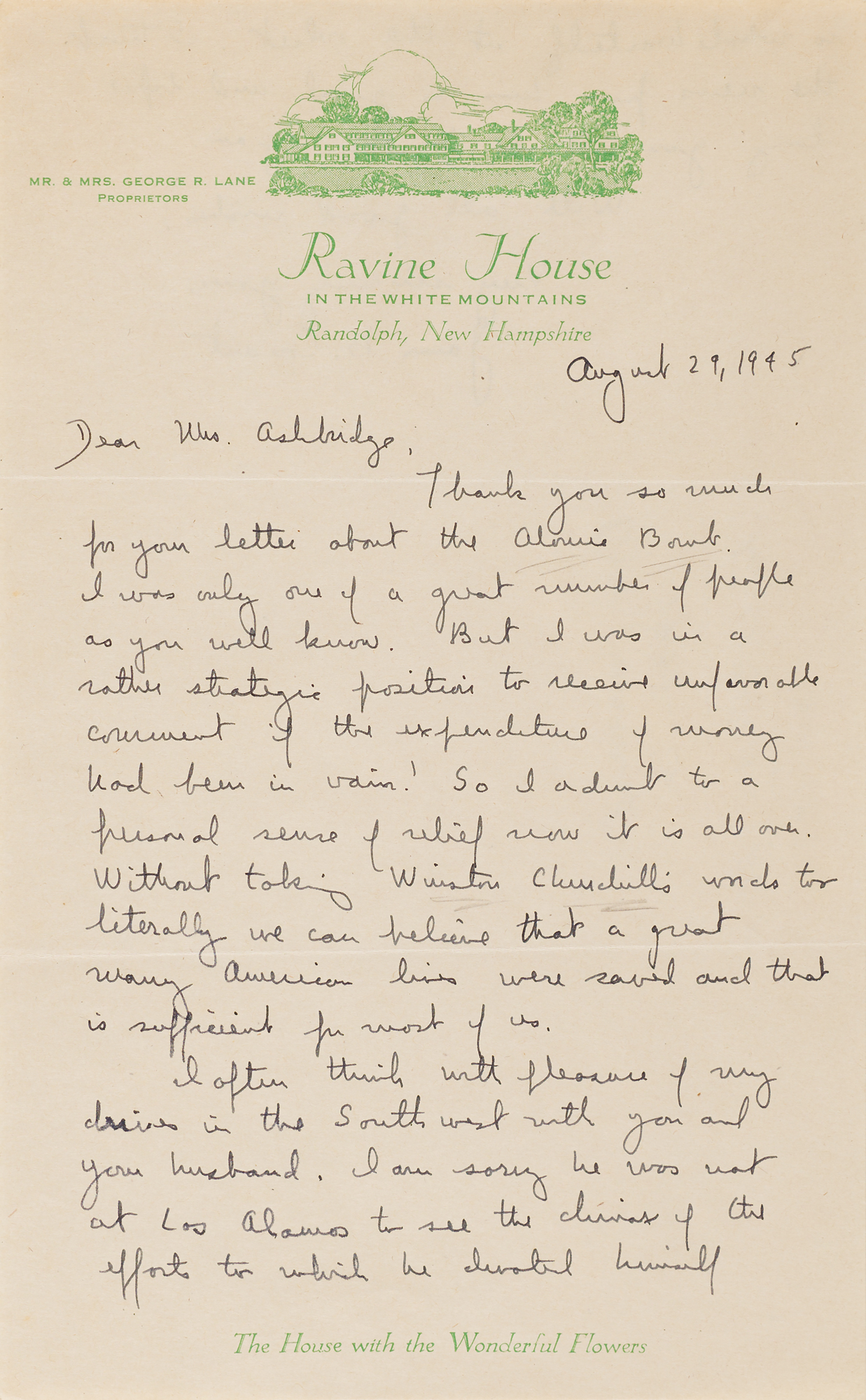
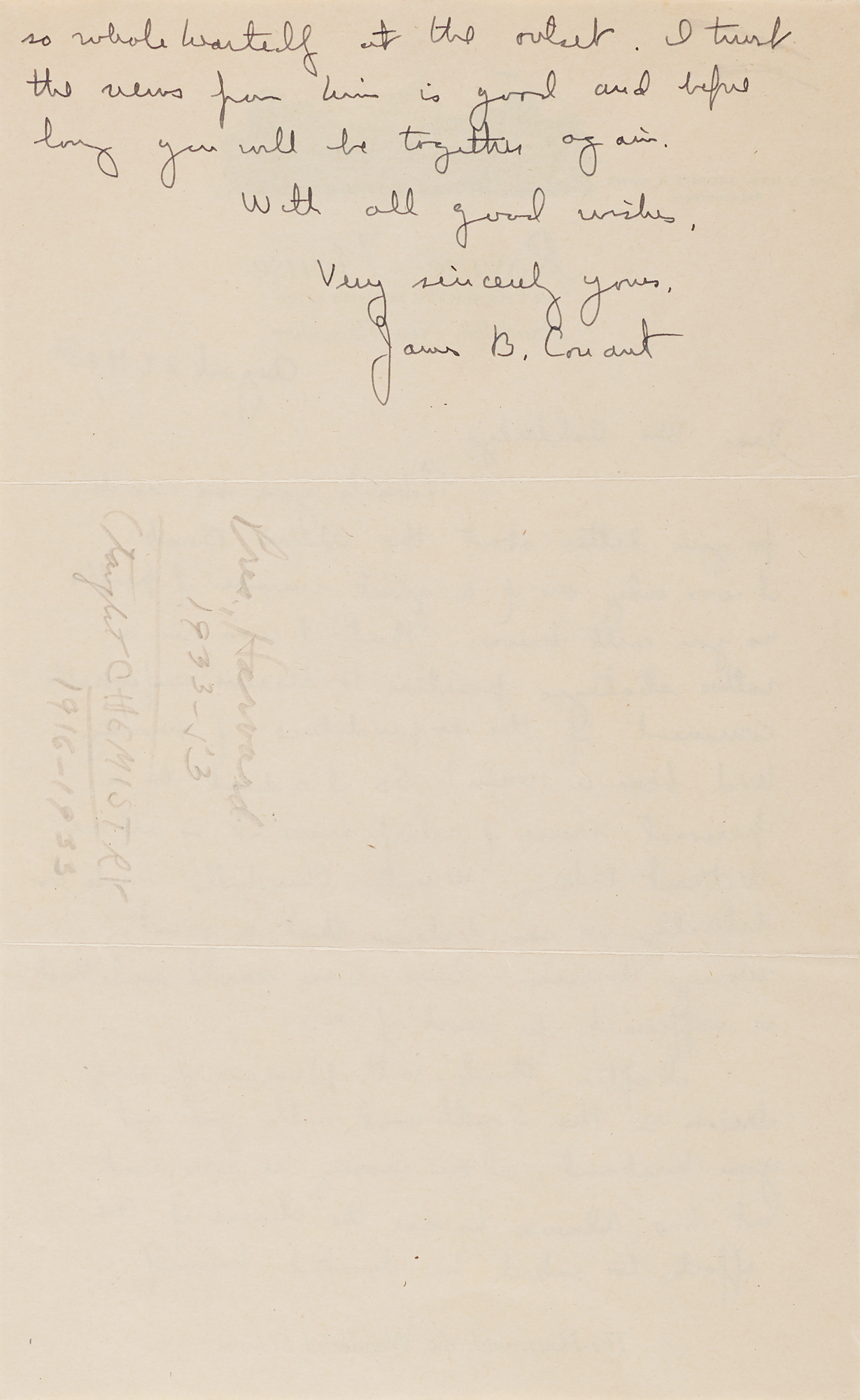
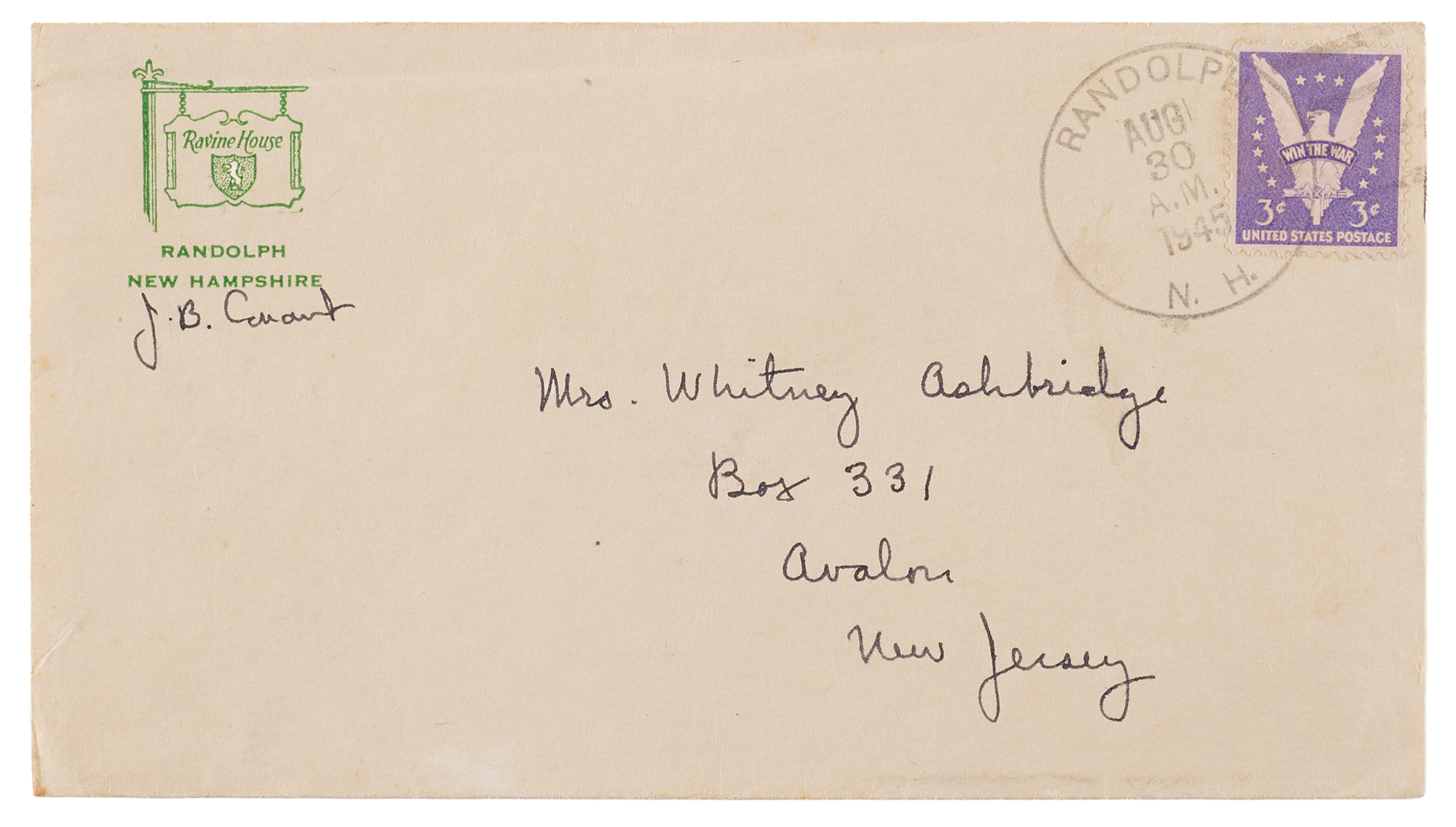
World War II-dated ALS, one page both sides, 5.75 x 9.5, Ravine House in the White Mountains (Randolph, New Hampshire) letterhead, August 29, 1945. Handwritten letter to Mrs. Ashbridge, the wife of Lt. Col. Whitney Ashbridge, the former military commander of the Army Post at Los Alamos during the Manhattan Project, penned just weeks after the atomic bombings of Hiroshima and Nagasaki, at a moment when the world was still grappling with the unprecedented scale and consequences of the event. As global leaders, scientists, and citizens alike struggled to process the ethics, devastation, and implications of atomic warfare, Conant’s remarks offer a revealing glimpse into how one of its key architects privately rationalized and compartmentalized the immense human and moral weight of the decision.
In full: “Thank you so much for your letter about the Atomic Bomb. I was only one of a great number of people as you well know. But I was in a rather strategic position to receive unfavorable comment if the expenditure of money had been in vain! So I admit to a personal sense of relief now it is all over. Without taking Winston Churchill’s words too literally we can believe that a great many American lives were saved and that is sufficient for most of us. I often think with pleasure of my drives in the Southwest with you and your husband. I am sorry he was not at Los Alamos to see the climax of the effort to which he devoted himself so wholeheartedly at the outset. I trust the news from him is good and before long you will be together again.” In fine condition. Accompanied by the original mailing envelope, hand-addressed by Conant, who incorporates his signature into the return address field, "J. B. Conant."
James Bryant Conant (1893–1978) stood at the center of the American scientific and military establishment during World War II, serving as chairman of the National Defense Research Committee and as a key member of the Interim Committee, the high-level advisory body that recommended the use of the atomic bomb against Japan. In this capacity, Conant was among the small circle of senior civilian officials who exercised oversight over the Manhattan Project and its enormous financial and strategic stakes. His remark in this letter that he was “in a rather strategic position to receive unfavorable comment if the expenditure of money had been in vain” is thus strikingly candid: a private acknowledgment that his own reputation, and that of the scientific leadership, rested in part on the success of the $2 billion project.
Conant’s correspondent, Mrs. Whitney Ashbridge, was closely tied to the inner workings of Los Alamos through her husband, Lt. Col. Whitney Ashbridge, who served as military commander of the Army post there during the critical 1943–1944 buildup under Groves and J. Robert Oppenheimer. Ashbridge played an important role in establishing and maintaining the remote and highly secret installation during its most formative period, but he was reassigned before the Trinity test in July 1945 and was no longer at Los Alamos at the time of its success. In this context, Conant’s sympathetic line, “I am sorry he was not at Los Alamos to see the climax of the effort to which he devoted himself so wholeheartedly at the outset,” carries added weight, reflecting both Ashbridge’s early role at Los Alamos and Conant’s evident personal regard for him.
Conant’s reference to Winston Churchill’s words likely alludes to the prime minister’s ‘Where Do We Stand?’ address before the House of Commons on August 16, 1945, in which Churchill forcefully defended the use of the atomic bomb, asserting that its deployment may have spared ‘a million American, and a quarter of a million British lives’ that would otherwise have been lost in an invasion of Japan. Conant’s careful qualification of “without taking…too literally” suggests a private skepticism toward such precise casualty figures, even as he accepts the broader conclusion that the bomb’s use shortened the war and saved lives.
Handwritten Conant letters that explicitly discuss the atomic bomb, particularly those written within weeks of Hiroshima and Nagasaki and addressed to individuals within the Manhattan Project’s inner circle, are seldom encountered. This example, combining Conant’s high-level perspective with a personal connection to one of Los Alamos’s key early figures, represents an exceptionally scarce and revealing artifact from the dawn of the atomic age.
This item is Pre-Certified by PSA/DNA
Buy a third-party letter of authenticity for
(inquire for price)
*This item has been pre-certified by a trusted third-party authentication service, and by placing a bid on this item, you agree to accept the opinion of this authentication service. If you wish to have an opinion rendered by a different authenticator of your choosing, you must do so prior to your placing of any bid. RR Auction is not responsible for differing opinions submitted 30 days after the date of the sale.
Third-party authentication service applies only to signatures and handwriting, and does not cover the addition of sketches, artwork, musical quotations, etc.

