Sold For $11,526
*Includes Buyers Premium
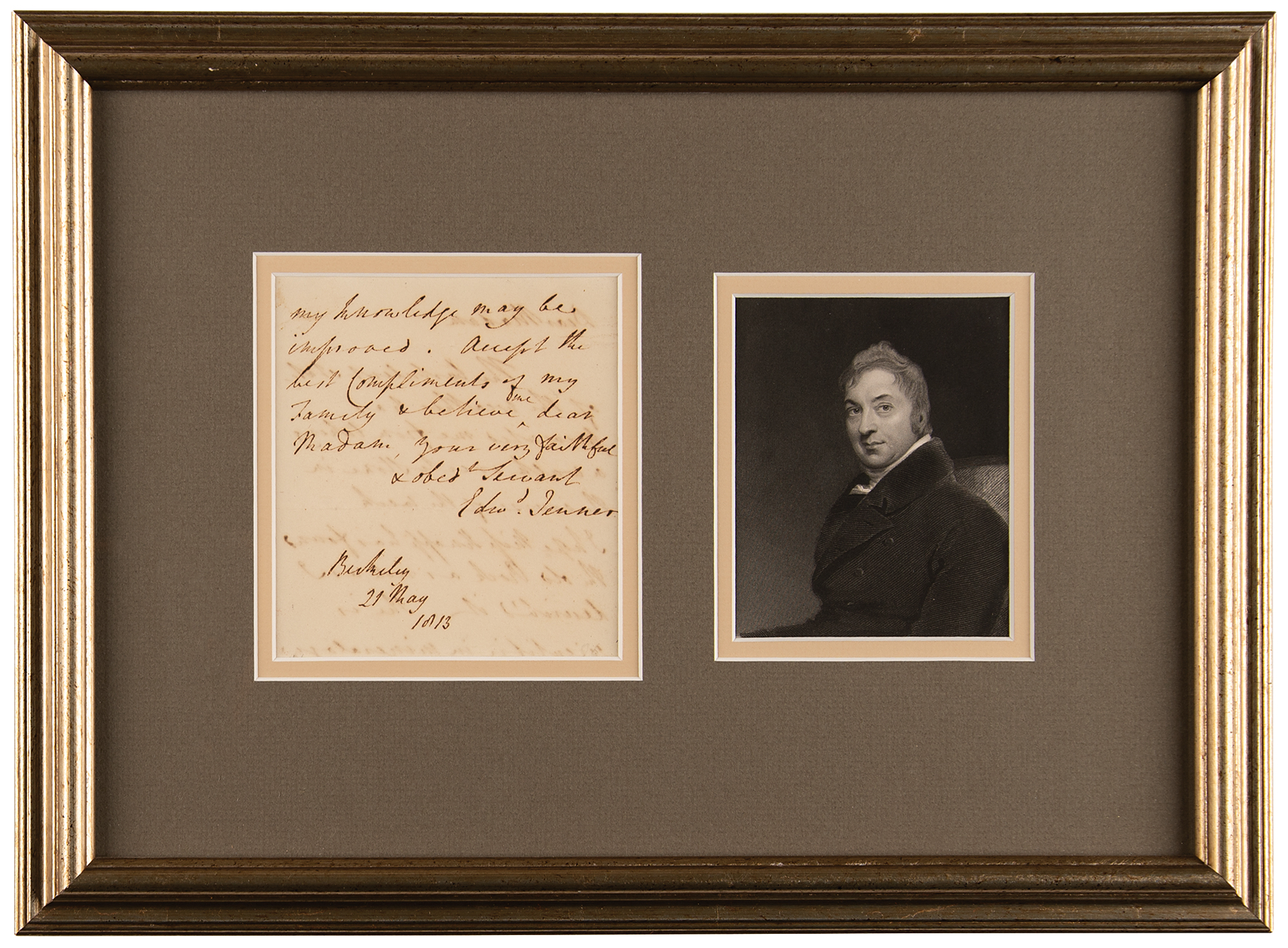
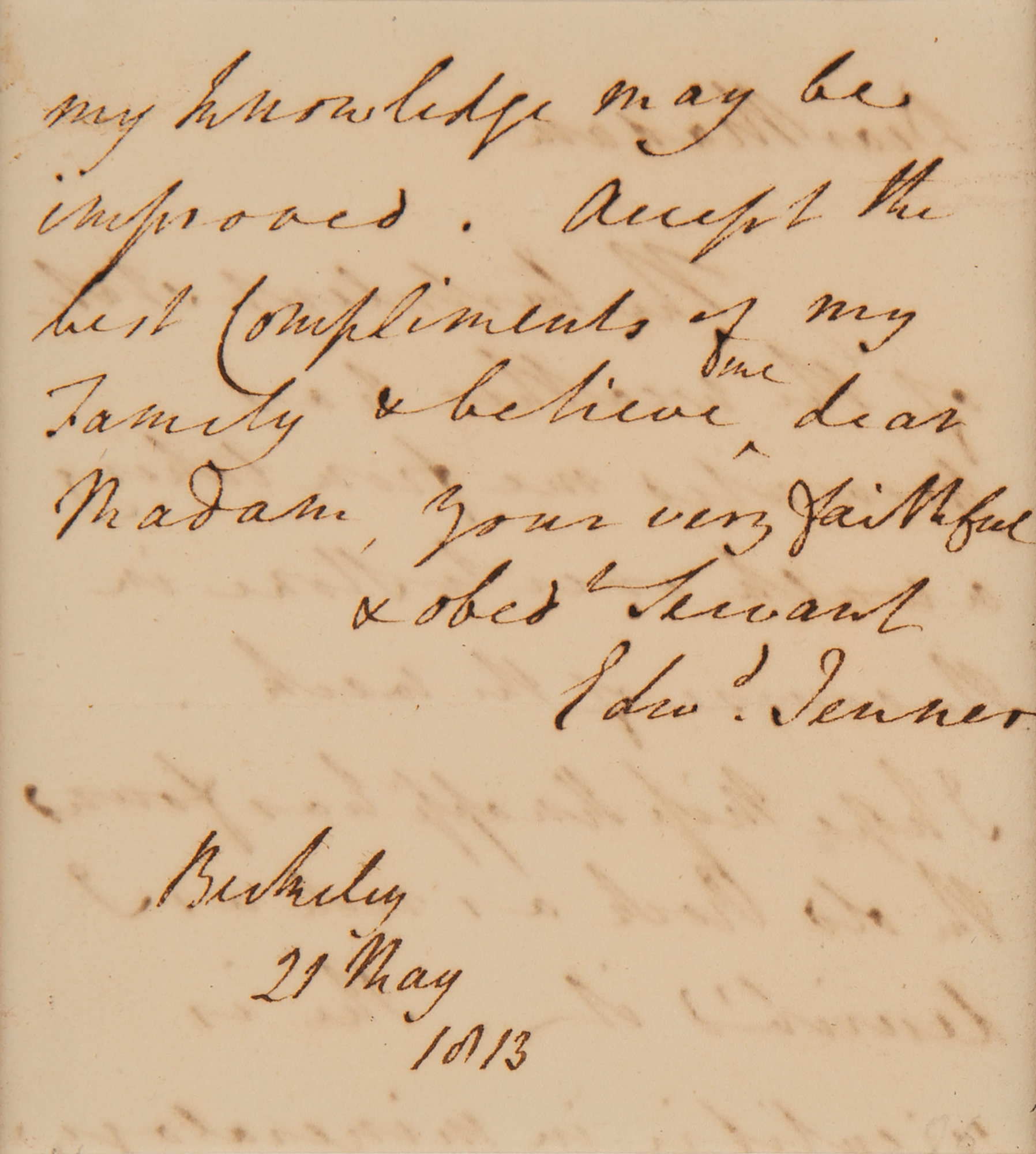
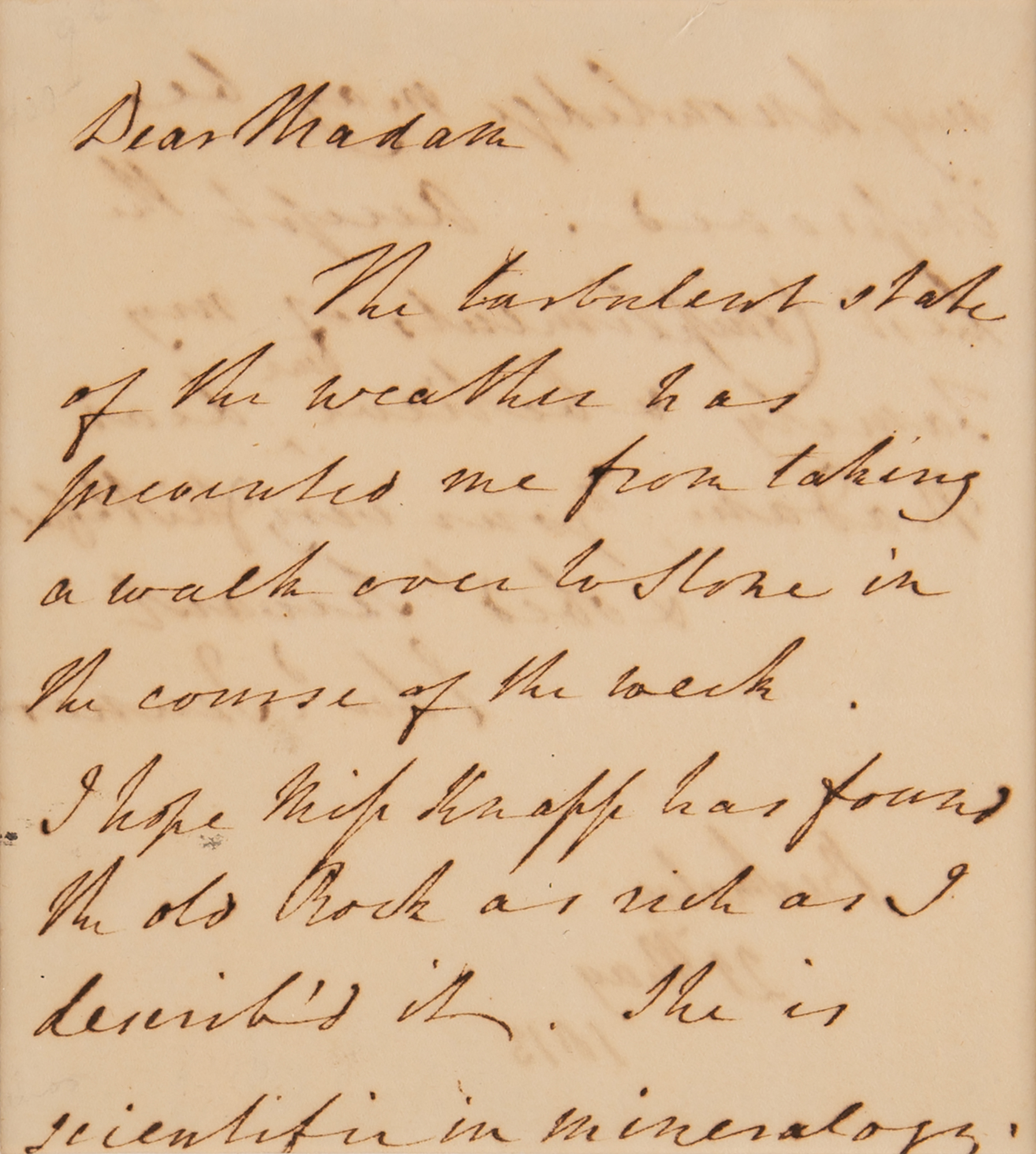
English physician and scientist (1749–1823) often called the ‘father of immunology,’ who successfully tested his smallpox inoculation in 1796. ALS signed “Edw'd Jenner,” one page both sides, 4.25 x 5, May 21, 1813. Handwritten letter to a lady, possibly a fellow fossil hunter and member of the Barrow Hill Club. In part: "The turbulent state of the weather has prevented me from taking a walk over to Stowe in the course of the week. I hope Miss Knapp has found the old Rock as rich as I describ'd it. She is scientific in mineralogy; my knowledge may be improved. Accept the best Compliments of my family." Beautifully double-matted and framed with an engraved portrait to an overall size of 16 x 11.75, with a window in the rear for viewing the front of the letter. In fine condition.
Jenner is renowned for his discovery of the smallpox vaccine. A lesser known fact about the English physician, however, is that long before he began his legendary work in medicine, before the age of nine, he developed a love of nature, which remained with him throughout his life. Growing up in the rural town of Berkeley in Gloucestershire, the young Jenner frequently explored the local geology—the oolite and lias rocks—searching for fossils along the banks of the nearby River Severn. When at school at Cirencester he also searched for fossils, which abound in that neighborhood. It was one of his favorite boyhood activities.
In his adult years, Jenner became a skilled geologist. Sarah Parker, director of the Jenner Museum in Berkeley explains that he kept abreast of the latest geologic theories of his time, reading the works of people such as William Smith, the geologist who developed the concept of stratigraphy and designed the famous 'map that changed the world,' the first geological map. Jenner was 'an astute observer' who noted that the 'oolists' that made up some of the local limestone beds were formed by calcium crystals layered around sand grains or shell fragments. He also protested the quarrying of an outcrop of columnar rock near Berkeley, recognizing it as a rare geological wonder, and saying it was even more impressive than the Giant's Causeway, the famous outcrop of polygonal basalt columns in Northern Island. In 1809, Jenner was elected an honorary member of the Geological Society of London, and from about 1812 to 1814, he belonged to the Barrow Hill Club, a group of friends that met regularly to collect fossils.
Some of Jenner's finds include a fern imprinted on coal, a clam shell, and a shoulder bone from a whale. But his most significant paleontological find came in 1819, when he discovered the remains of a 'sea monster'—a plesiosaur—at the base of Stinchcombe Hill near Berkeley. The find was one of the earliest in Britain and occurred several years before the plesiosaur was officially recognized as a species distinct from the better-known ichthyosaur.
According to Roger Clark, curator of geology at the Bristol City Museum and Art Gallery in England, Jenner gave his plesiosaur specimen to the Bristol Institution, forerunner of the museum, in 1823, but it has since disappeared—most likely a casualty of the World War II bombing of Bristol. In 1816 Jenner wrote, 'Fossils are monuments…to departed worlds.' His statement was contrary to the perception at the time that fossils were either ordinary rocks that somehow mimicked living things, or were the remains of contemporary animals.

This item is Pre-Certified by PSA/DNA
Buy a third-party letter of authenticity for
(inquire for price)
*This item has been pre-certified by a trusted third-party authentication service, and by placing a bid on this item, you agree to accept the opinion of this authentication service. If you wish to have an opinion rendered by a different authenticator of your choosing, you must do so prior to your placing of any bid. RR Auction is not responsible for differing opinions submitted 30 days after the date of the sale.
Third-party authentication service applies only to signatures and handwriting, and does not cover the addition of sketches, artwork, musical quotations, etc.

