Sold For $6,250
*Includes Buyers Premium
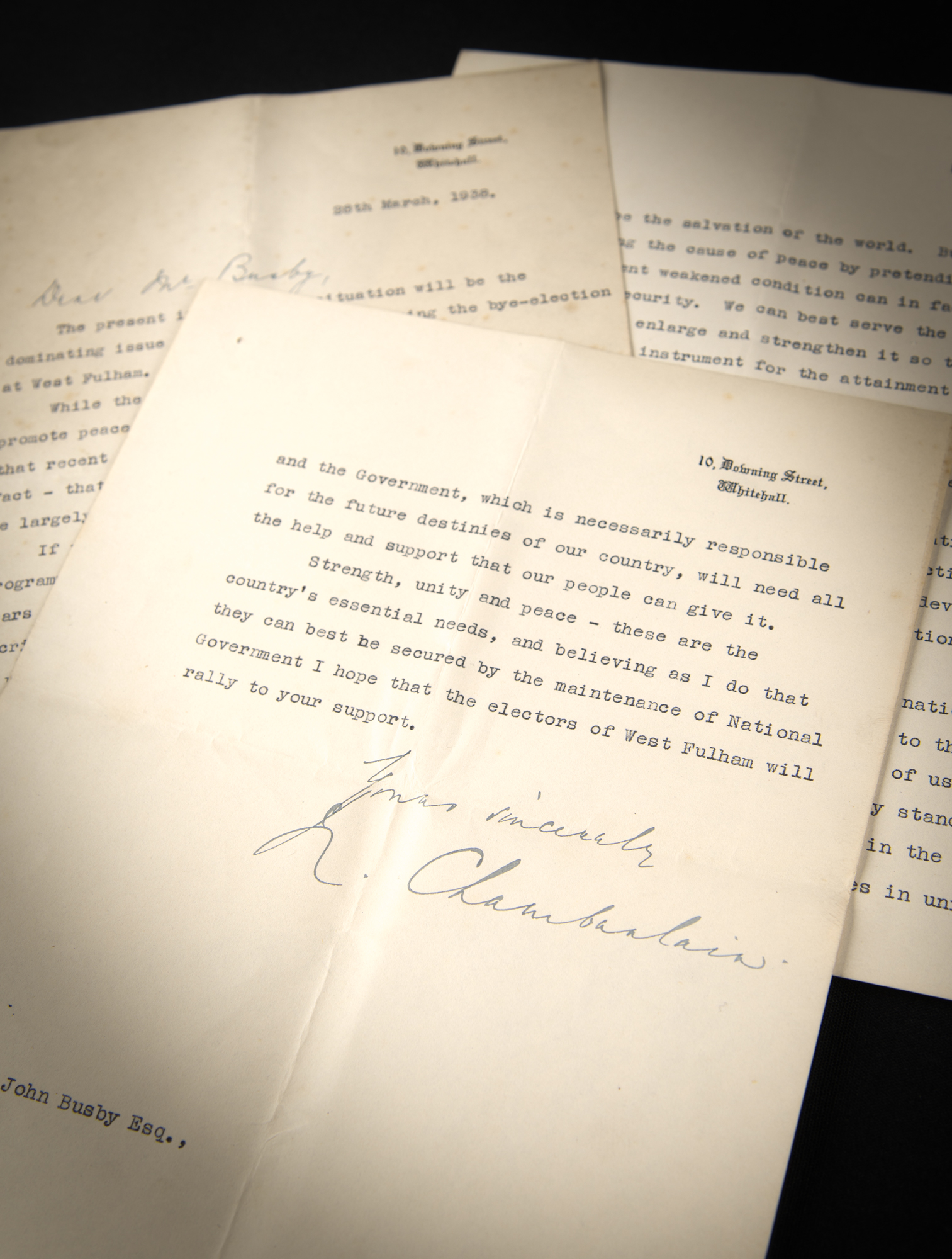
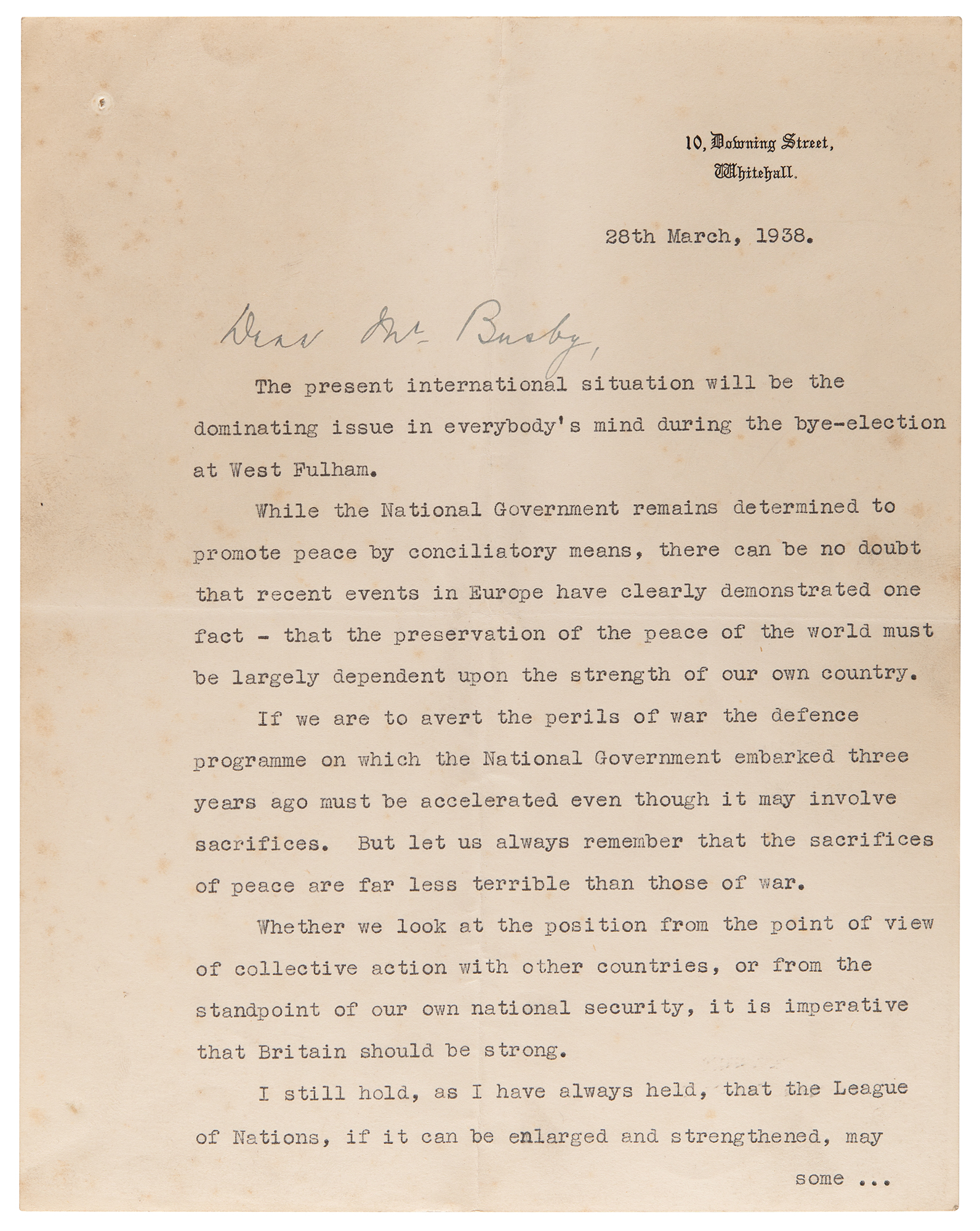
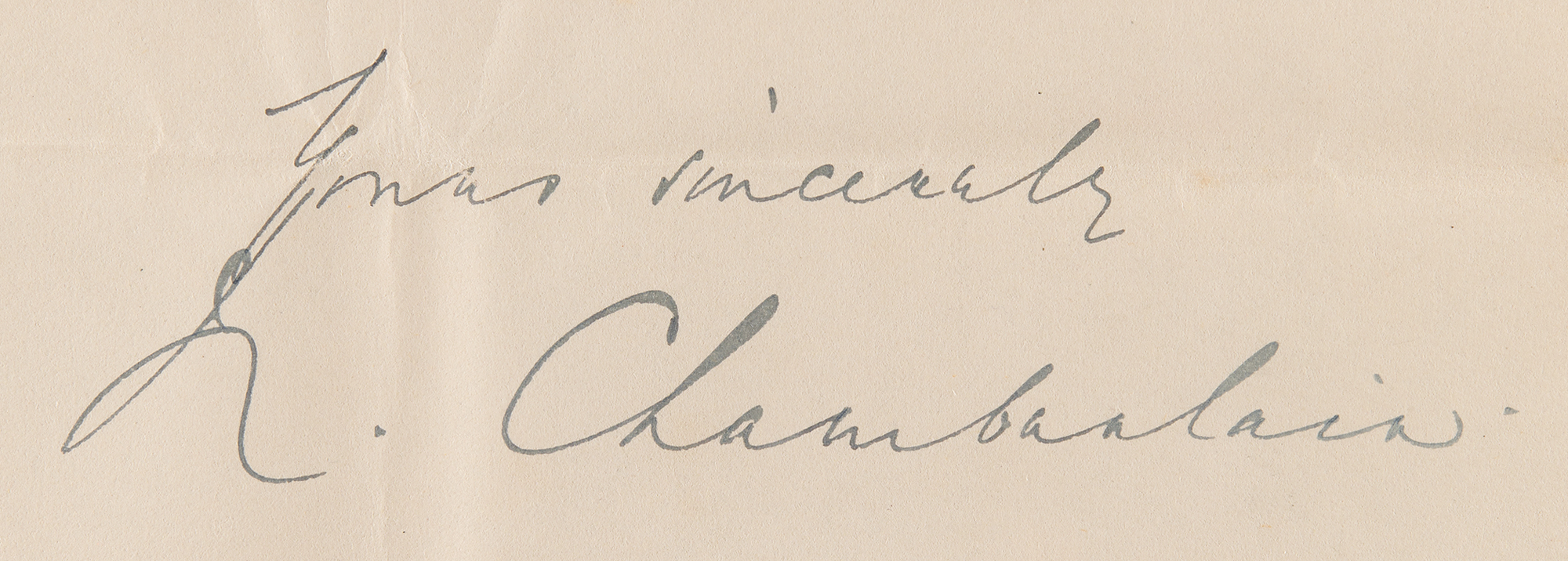
TLS signed “Yours sincerely, N. Chamberlain,” three pages, 7.5 x 9.5, 10 Downing Street letterhead, March 28, 1938. Letter to Conservative Party politician John Busby, written two weeks after the Anschluss—Nazi Germany's annexation of Austria, Hitler's first act of territorial aggression in the series of events that precipitated World War II. In full: "The present international situation will be the dominating issue in everybody's mind during the bye-election at West Fulham.
While the National Government remains determined to promote peace by conciliatory means, there can be no doubt that recent events in Europe have clearly demonstrated one fact—that the preservation of the peace of the world must be largely dependent upon the strength of our own country.
If we are to avert the perils of war the defence programme on which the National Government embarked three years ago must be accelerated even though it may involve sacrifices. But let us always remember that the sacrifices of peace are far less terrible than those of war.
Whether we look at the position from the point of view of collective action with other countries, or from the standpoint of our own national security, it is imperative that Britain should be strong.
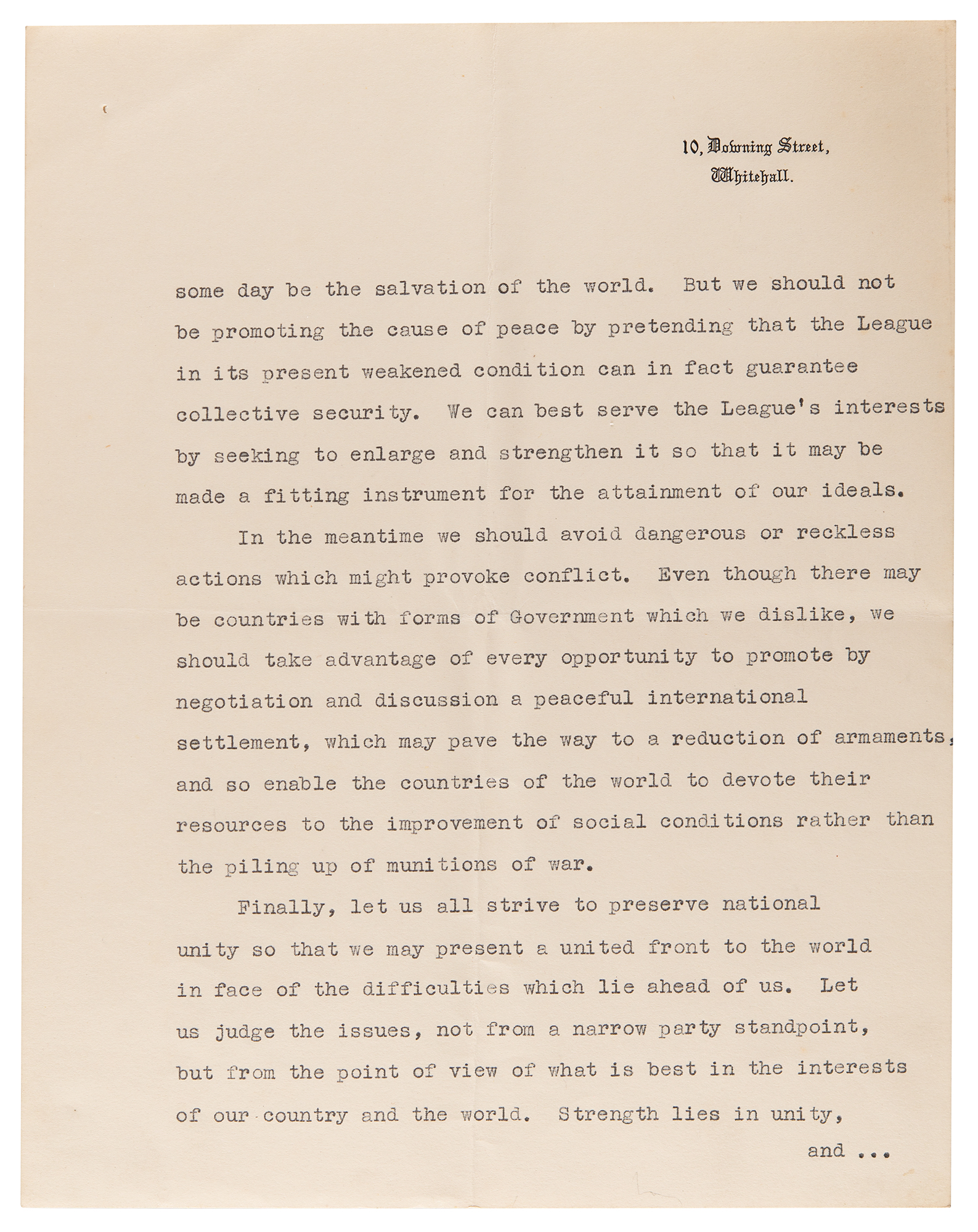
I still hold, as I have always held, that the League of Nations, if it can be enlarged and strengthened, may some day be the salvation of the world. But we should not be promoting the cause of peace by pretending that the League in its present weakened condition can in fact guarantee collective security. We can best serve the League's interests by seeking to enlarge and strengthen it so that it may be made a fitting instrument for the attainment of our ideals.
In the meantime we should avoid dangerous or reckless actions which might provoke conflict. Even though there may be countries with forms of Government which we dislike, we should take advantage of every opportunity to promote by negotiation and discussion a peaceful international settlement, which may pave the way to a reduction of armaments, and so enable the countries of the world to devote their resources to the improvement of social conditions rather than the piling up of munitions of war.
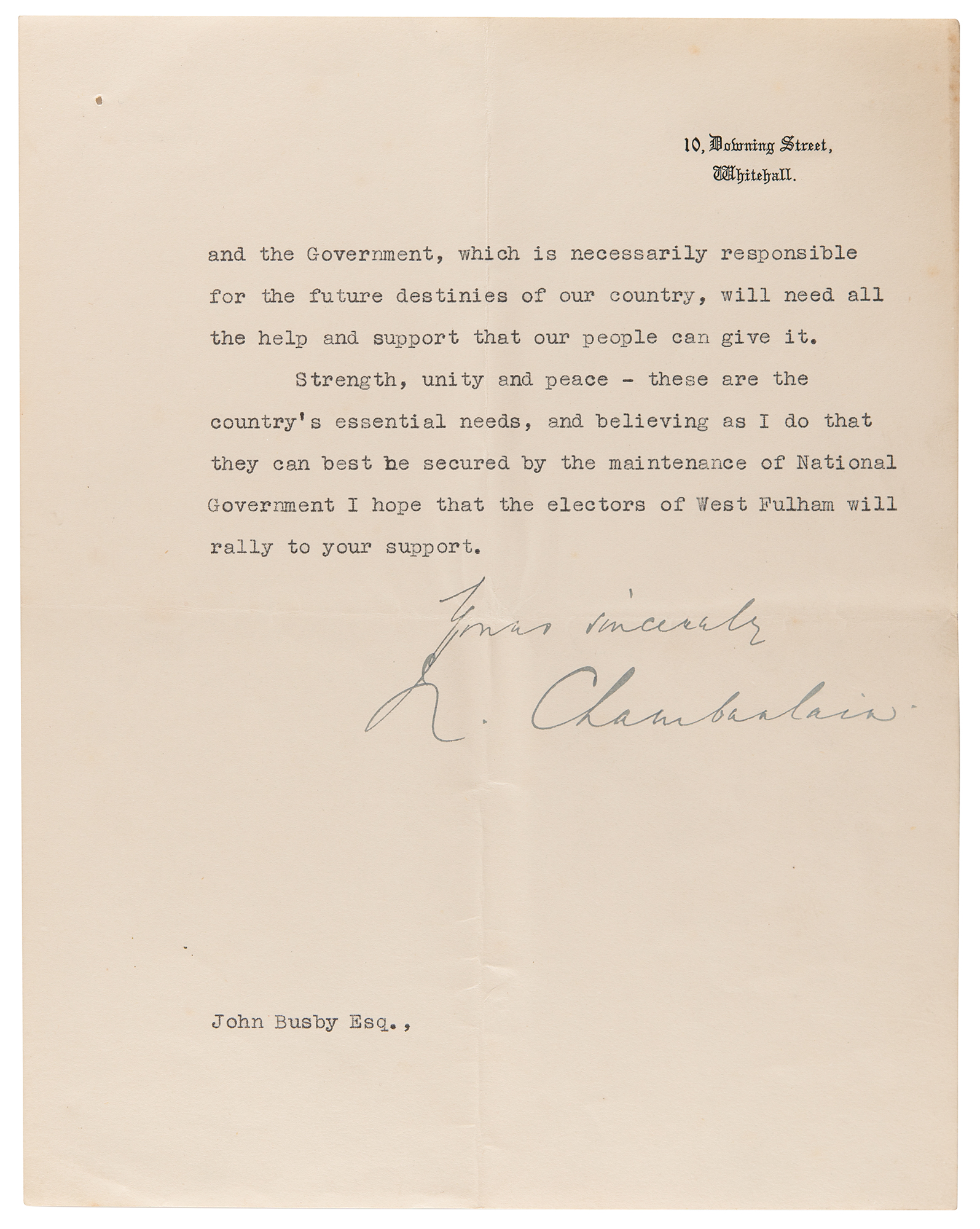
Finally, let us all strive to preserve national unity so that we may present a united front to the world in face of the difficulties which lie ahead of us. Let us judge the issues, not from a narrow party standpoint, but from the point of view of what is best in the interests of our country and the world. Strength lies in unity, and the Government, which is necessarily responsible for the future destinies of our country, will need all the help and support that our people can give it.
Strength, unity and peace—these are the country's essential needs, and believing as I do that they can best be secured by the maintenance of National Government I hope that the electors of West Fulham will rally to your support." In very good to fine condition, with scattered light foxing and staining to the first page.
In March 1938, British Prime Minister Neville Chamberlain's approach toward Nazi Germany was marked by a policy of appeasement—the "conciliatory means" here mentioned—driven by a desire to maintain peace in Europe and avoid another catastrophic war. At this time, Hitler's Germany had just carried out the annexation of Austria, which blatantly violated the Treaty of Versailles and the Treaty of St. Germain. Chamberlain, while uneasy about Hitler's aggression, was not prepared to confront Germany militarily over Austria. He believed that many Germans and Austrians supported the union and saw the Anschluss as an internal German matter rather than grounds for war.
Chamberlain's approach was shaped by his conviction that Germany's grievances, particularly about the post-World War I settlement, could be addressed through negotiation and compromise. He hoped that by allowing certain revisions to the Versailles Treaty, such as the unification of German-speaking peoples, Germany's appetite for expansion would be satisfied. This attitude would continue to define British foreign policy over the next year, leading up to the infamous Munich Agreement in September 1938.

This item is Pre-Certified by PSA/DNA
Buy a third-party letter of authenticity for
(inquire for price)
*This item has been pre-certified by a trusted third-party authentication service, and by placing a bid on this item, you agree to accept the opinion of this authentication service. If you wish to have an opinion rendered by a different authenticator of your choosing, you must do so prior to your placing of any bid. RR Auction is not responsible for differing opinions submitted 30 days after the date of the sale.
Third-party authentication service applies only to signatures and handwriting, and does not cover the addition of sketches, artwork, musical quotations, etc.

