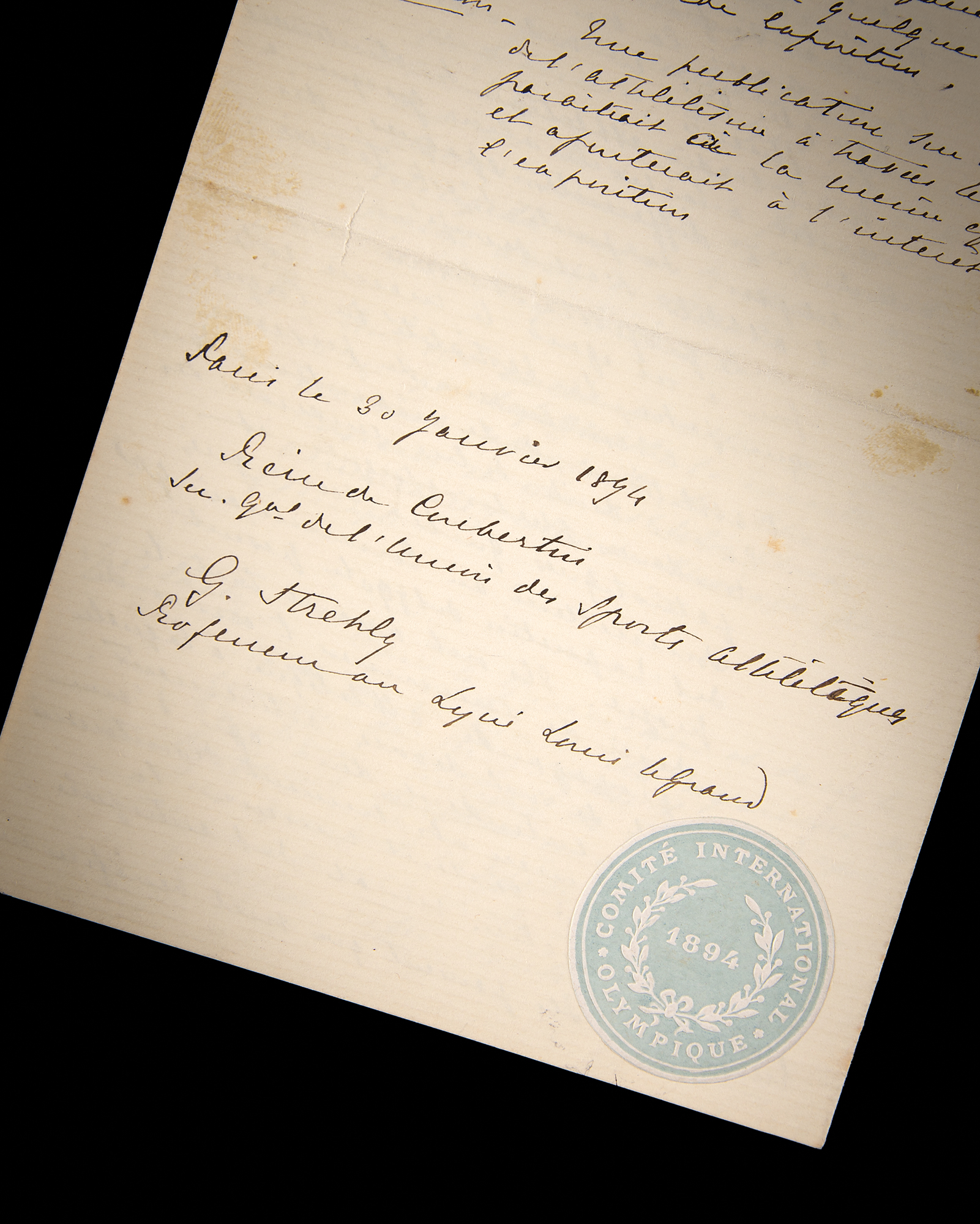
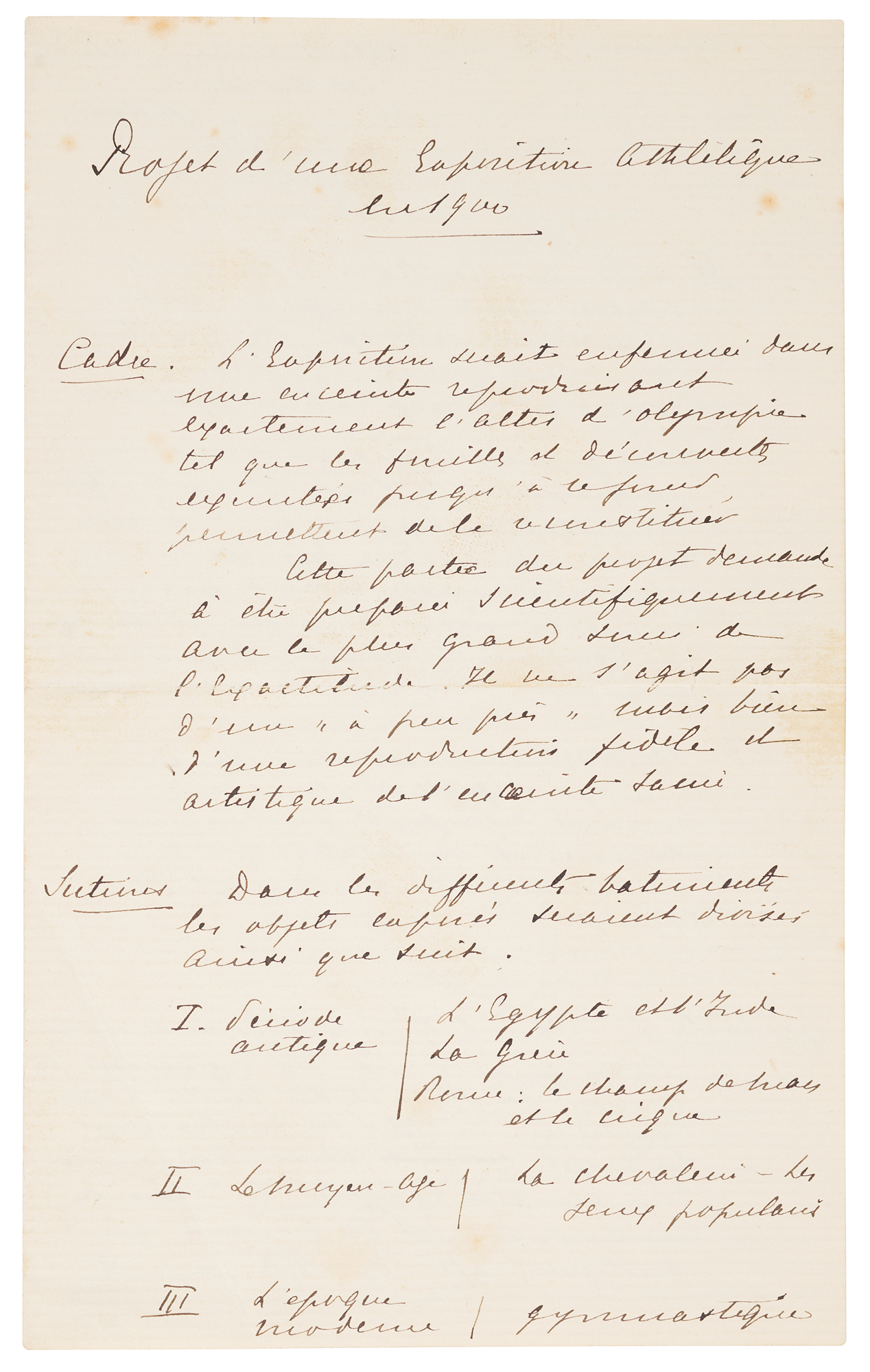
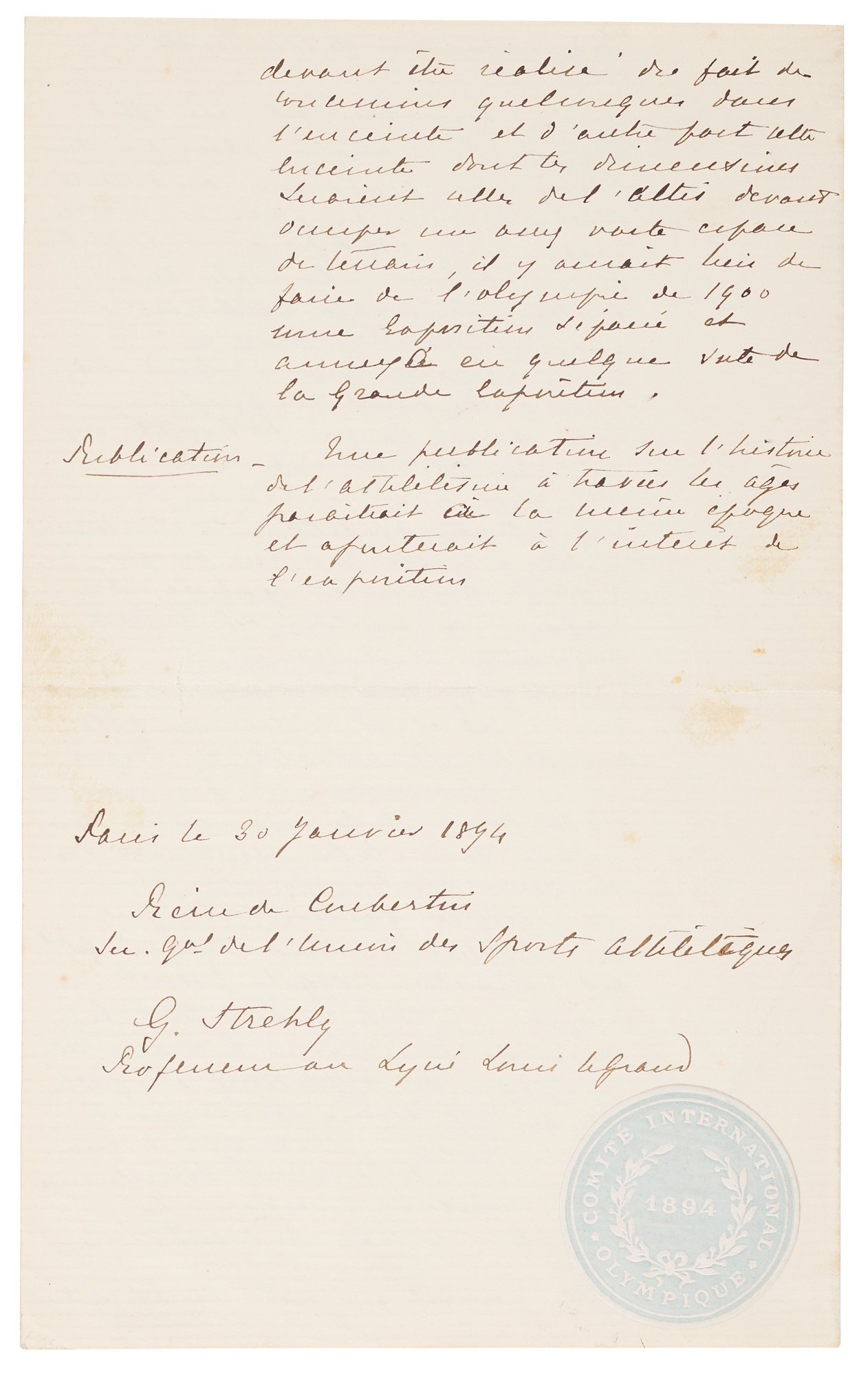
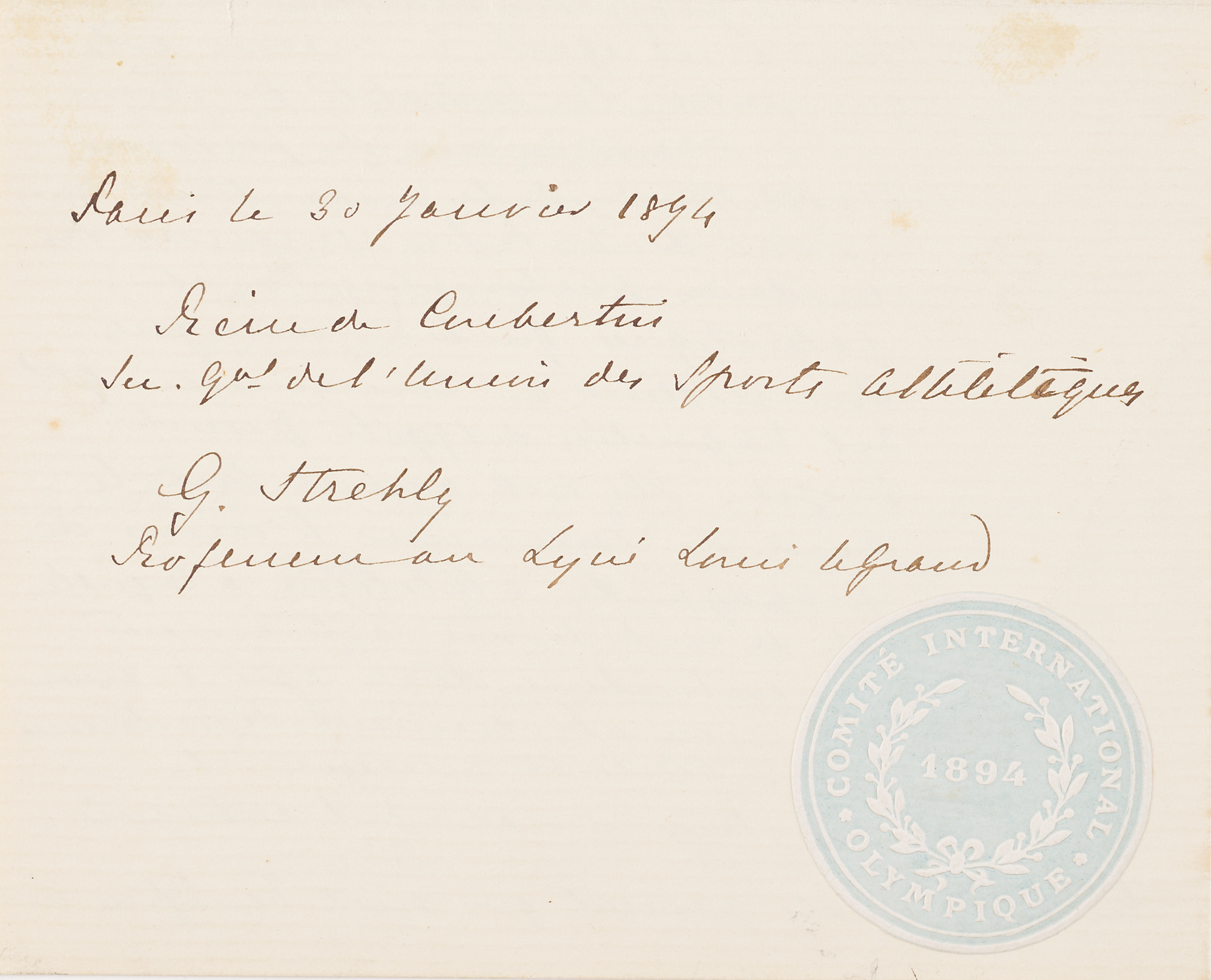
Historically significant ADS in French, signed "Pierre de Coubertin, Sec. G'nl de l'Union des Sports Athietiques," four pages on two adjoining sheets, 5 x 8 January 30, 1894, with a light blue paper "Comité International Olympique, 1894" seal affixed at the conclusion. Pierre de Coubertin outlines his notes and structured concepts for reviving the Olympic Games, preceding the formal creation of the modern Olympics and the International Olympic Committee in June 1894.
The plan, headed "Proposal of an Athletic Exhibition in 1900," reads, in full (translated): "Setting: The exhibition would be in a separate enclosure reproducing exactly the Altis of Olympia as far as the excavation and discoveries up to the day would permit. This part of the project demands to be prepared scientifically with the utmost care for exactness. This is not about an 'almost as' but a true and artistic reproduction of the sacred place.
Displays: The exhibited objects would be divided as follows in the different buildings:
I. Ancient Greece: Egypt and India Period, Rome, Champ de Mars Field and the amphitheater.
II. The Middle Ages: Knighthood—The popular games.
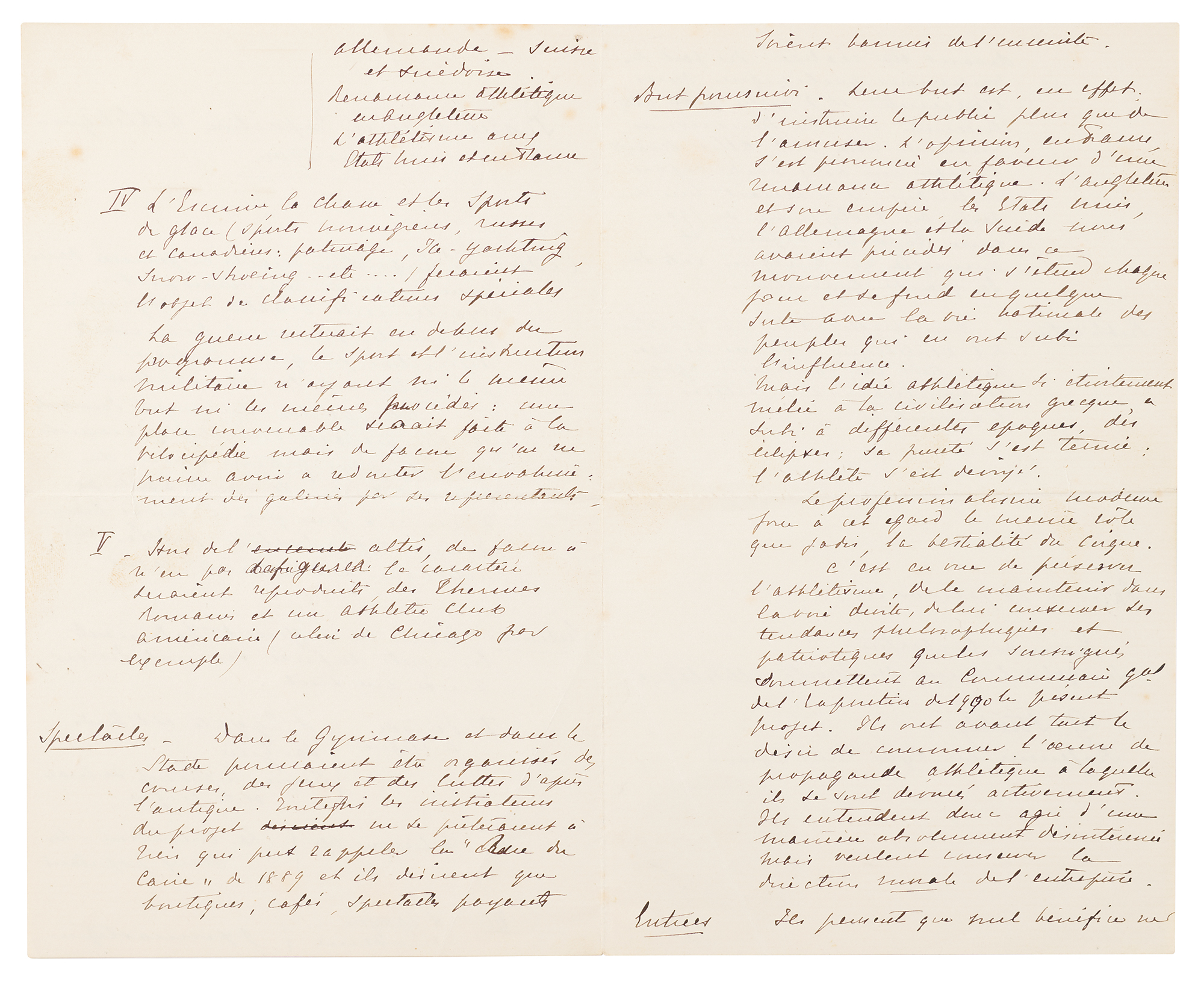
III. The Modern Epoch: German, Swiss and Swedish Gymnastics. The athletic renaissance in England. Athletics in the United States and France.
IV. Fencing, Hunting and the Ice Sports (Norwegian, Russian and Canadian skating, ice-yachting, snow-shoeing, etc.) would be the object of special classifications. [Demonstrations of] War would stay out of the program, a suitable place would be found for Cycling but in a way that the cyclists don't encroach on the display.
V. Outside of the Altis, in a way not to disfigure the character, would be a reproduction of Roman Baths and of an American Athletic Club. (The Club of Chicago for example).
Special: In the Gymnasium and in the Stadium could be organized Races, Games and Fights (wrestling), after the antiquity. In any way the initiators of the project don't want anything which reminds in any way the 'Street of Cairo' of (the Exposition of) 1889…
Goals: The goal is indeed to educate rather than to entertain the public. The public opinion in France is for an athletic renaissance. England and her empire, the United States, Germany and Sweden have preceded us in this movement which grows every day and combines itself with the national life of the people who have influenced it.
But the athletic idea so closely bound to the Greek civilization has, at different epochs, disappeared; its purity has tarnished; the athlete has separated from the idea.
The modern professionalism plays in this regard the same role as, in older time, the bestiality of the circus. This is in respect to preserving athletics, to keep it on the right way, to preserve its philosophic and patriotic tendencies that the undersigned presents the present project to the General Commissioners of the 1900 Exposition. They have foremost the desire to conserve the work of athletic propaganda to which they dedicate themselves actively. They understand to act in a totally disinterested way but they want to preserve the moral direction of the project.
Entry: They think that no benefit would be realized from any concessions into the Exhibit and other parts of it whose dimensions will be those of the Altis (in Olympia). As it occupies such a large space there would be room for a separate exposition of the Olympic Games of 1900 in conjunction with the Grand Exposition.
Publications: A publication of the history of athletics through the Ages would be published at the same time, and would add to the interest of the exposition." Neatly signed at the conclusion in ink by Pierre de Coubertin. In fine condition, with a couple light stains.
This four-page manuscript stands among the foundational documents of the modern Olympic movement—a working blueprint, in Pierre de Coubertin's own hand, for reviving the ancient Games nearly five months before he formally established the International Olympic Committee in June 1894. The document captures Coubertin at the precise moment his vision was crystallizing from abstract enthusiasm into an actionable plan, proposing that the revived Games debut in 1900 as part of the Paris Exposition, staged within a purpose-built recreation of Olympia's sacred Altis. This is not a retrospective account of the Olympic idea; it is the idea itself, still being drafted, evidence of the intellectual scaffolding Coubertin was constructing before the world knew to call it "Olympism."
The content is remarkable for how fully formed Coubertin's philosophy already was. He distinguishes sharply between education and entertainment, between the amateur ideal and the "modern professionalism" he likens to the corrupting spectacle of the Roman circus, and between authentic athletic culture and the exoticized showmanship of exhibitions like the 1889 Paris Exposition's 'Street of Cairo.' His proposed taxonomy of athletic history—from ancient Greece and Rome through medieval chivalry to the German, Swedish, and Anglo-American gymnastic and sporting traditions—reveals the historical and pedagogical framework that would underpin the Olympic Charter itself: sport as a vehicle for moral and civic education, transcending national rivalry rather than serving it. Winter pursuits, fencing, and cycling all appear in embryonic form, years before their eventual place on the Olympic program was settled.
Few Coubertin manuscripts of this depth and this early a date survive outside institutional archives such as those of the IOC and the Bibliothèque nationale de France; a signed and dated planning document from the founding year is exceptionally scarce on the market. It represents not a later reminiscence or ceremonial signature but a primary working document from the genesis of the Games—the kind of material that anchors both serious Olympic-history scholarship and world-class sporting collections.

This item is Pre-Certified by PSA/DNA
Buy a third-party letter of authenticity for
(inquire for price)
*This item has been pre-certified by a trusted third-party authentication service, and by placing a bid on this item, you agree to accept the opinion of this authentication service. If you wish to have an opinion rendered by a different authenticator of your choosing, you must do so prior to your placing of any bid. RR Auction is not responsible for differing opinions submitted 30 days after the date of the sale.
Third-party authentication service applies only to signatures and handwriting, and does not cover the addition of sketches, artwork, musical quotations, etc.

