The 30 Minute Rule begins October 14 at 7:00 PM EDT. An Initial Bid Must Be Placed By October 14 at 6:00 PM EDT To Participate After 6:00 PM EDT
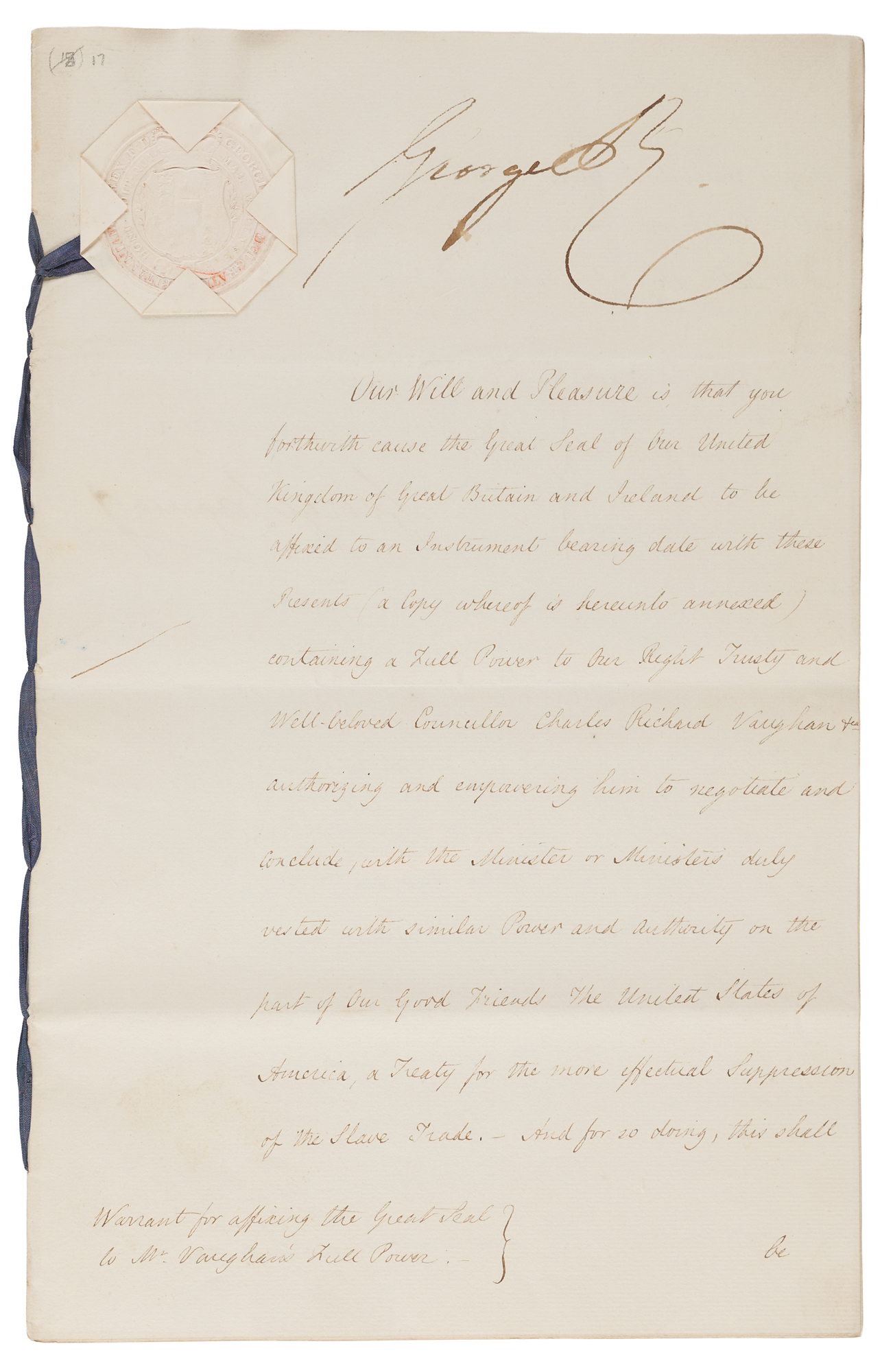
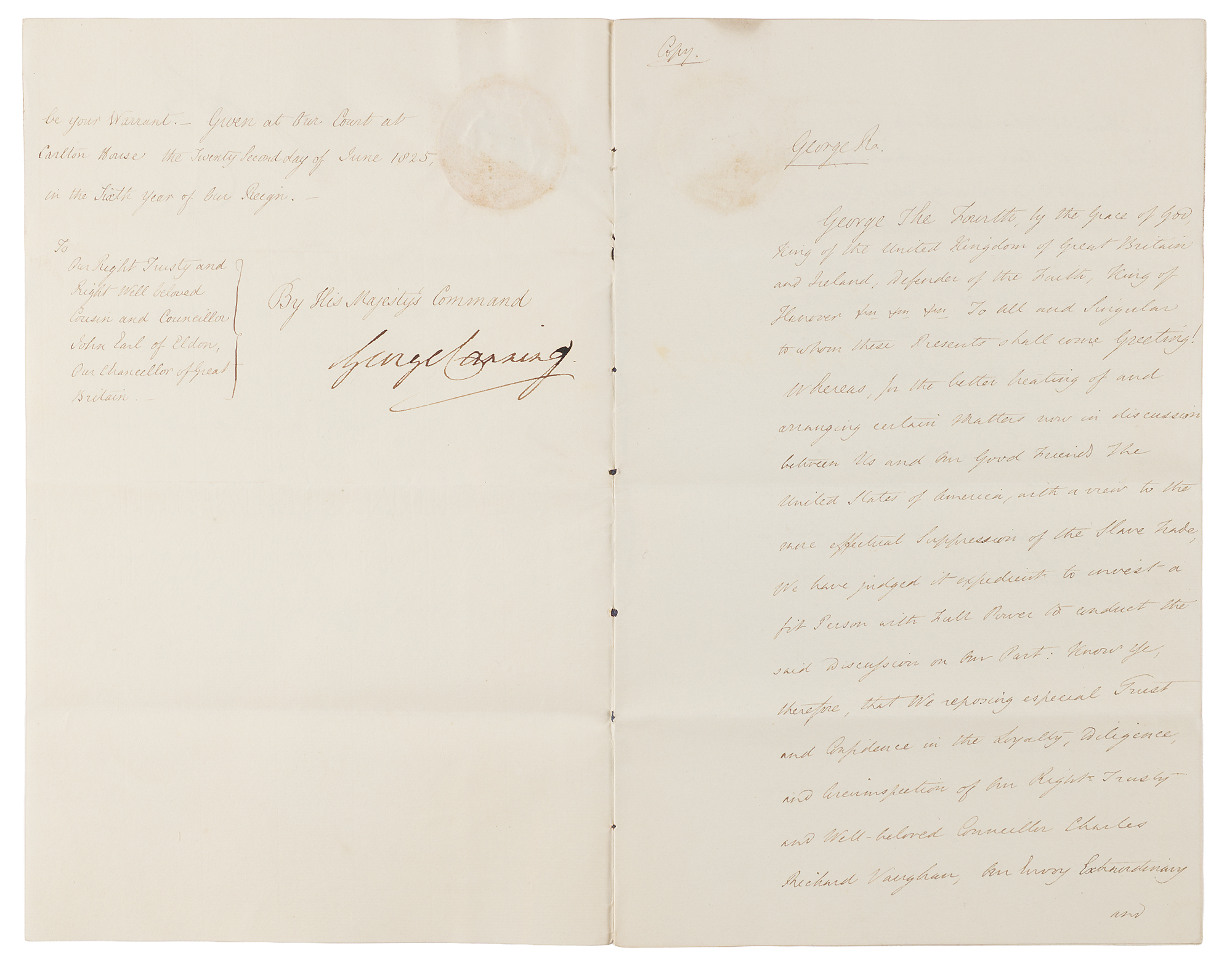
Manuscript DS, signed “George R.,” one page, both sides, 8 x 12.25, June 22, 1825. Royal warrant issued from Carlton House directing the Lord Chancellor to affix the Great Seal of the United Kingdom to an accompanying Full Power authorizing Charles Richard Vaughan, British Envoy Extraordinary and Minister Plenipotentiary to the United States, to negotiate a treaty with the United States for “the more effectual Suppression of the Slave Trade." Signed prominently at the top of the first page by King George IV, and countersigned on the reverse by Foreign Secretary George Canning. The warrant retains its original paper seal, ribbon binding, and its contemporary copy of the Full Power referenced in the text. Opening: “Whereas, for the better discussing of and arranging certain Matters now in discussion between Us and Our Good Friends The United States of America, with a view to the more effectual Suppression of the Slave Trade, We have judged it expedient to invest a fit Person with Full Power to conduct the said Discussion on Our Part.” The instrument appoints Vaughan as Britain’s commissioner and plenipotentiary, empowering him to “treat, adjust, and conclude” with representatives of the United States “any Treaty or Agreement that may tend to the attainment of the abovementioned end.” In fine condition, with a few trivial marks or stains.
Issued in 1825, this royal warrant documents a pivotal stage in Great Britain's diplomatic campaign to secure international cooperation against the transatlantic slave trade. The mission followed the collapse of an earlier Anglo-American convention negotiated in 1824, which sought to classify the slave trade as piracy and grant British and American warships reciprocal rights to search suspected slave vessels. After the U.S. Senate amended the agreement to restrict those search rights to African waters, Britain rejected the changes, and the treaty failed before ratification could be exchanged.
Charles Richard Vaughan, newly appointed British minister to the United States, carried the present Full Power to Washington to reopen negotiations with Secretary of State Henry Clay under the Adams administration. Those efforts ultimately foundered on continuing American opposition to reciprocal search rights, a lingering consequence of tensions left by the War of 1812 and British naval impressment, and the two nations would not conclude a comprehensive slave trade suppression treaty until the Lyons–Seward Treaty of 1862. Countersigned by Foreign Secretary George Canning, who had made suppression of the slave trade a central objective of British foreign policy, this document preserves the royal authorization behind one of the nineteenth-century's most significant, though ultimately unsuccessful, Anglo-American diplomatic initiatives.
This item is Pre-Certified by PSA/DNA
Buy a third-party letter of authenticity for
$150.00
*This item has been pre-certified by a trusted third-party authentication service, and by placing a bid on this item, you agree to accept the opinion of this authentication service. If you wish to have an opinion rendered by a different authenticator of your choosing, you must do so prior to your placing of any bid. RR Auction is not responsible for differing opinions submitted 30 days after the date of the sale.
Third-party authentication service applies only to signatures and handwriting, and does not cover the addition of sketches, artwork, musical quotations, etc.

