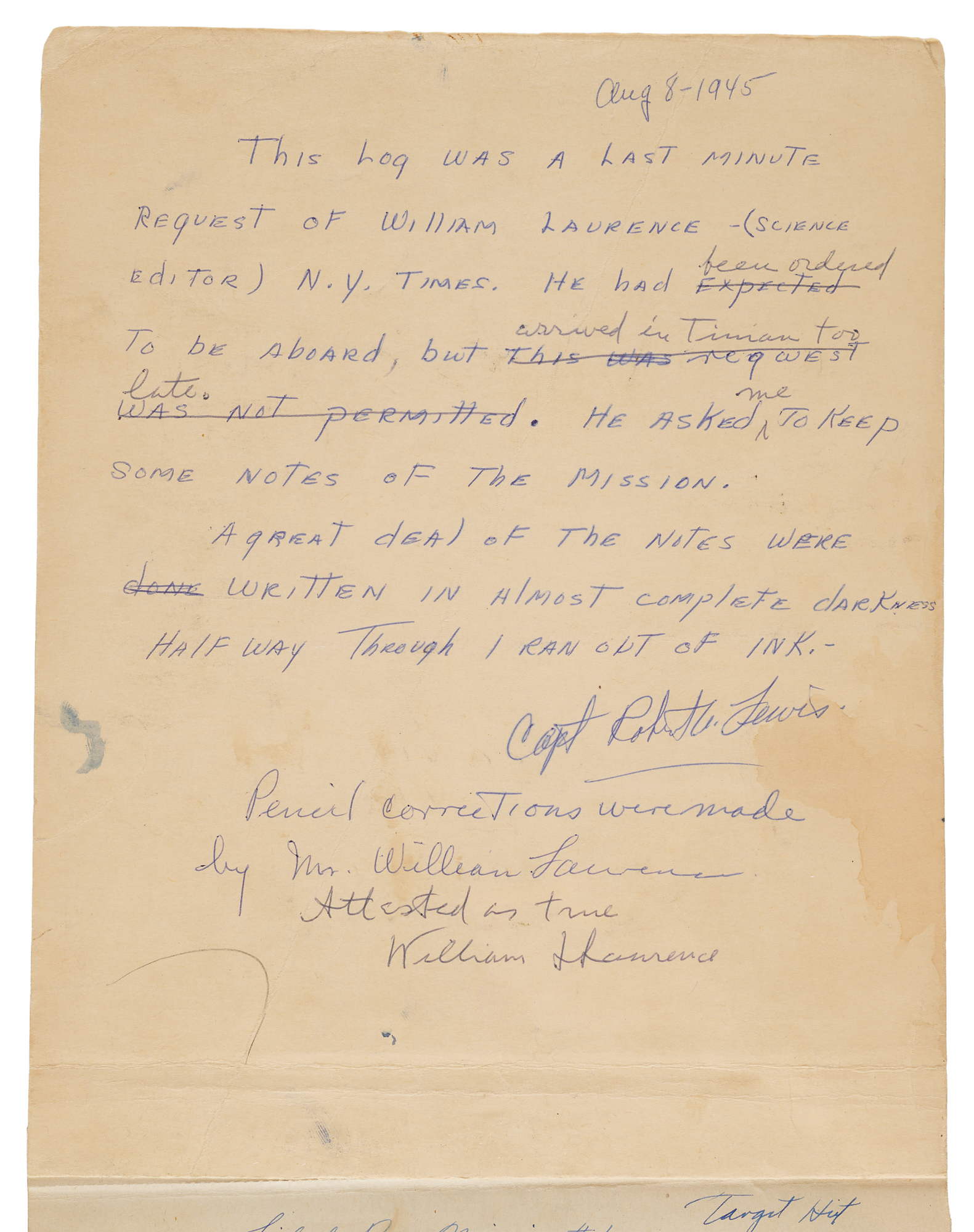
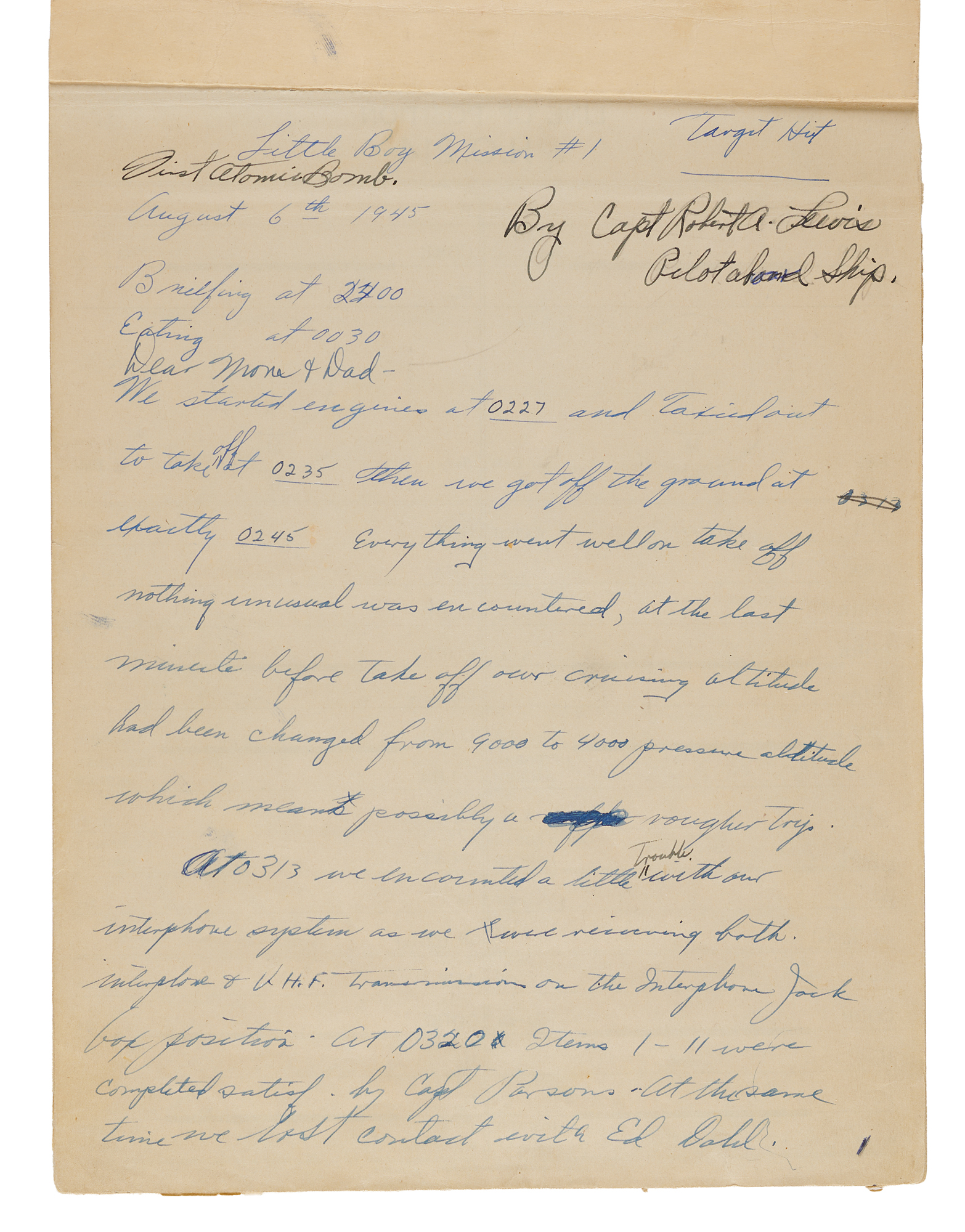
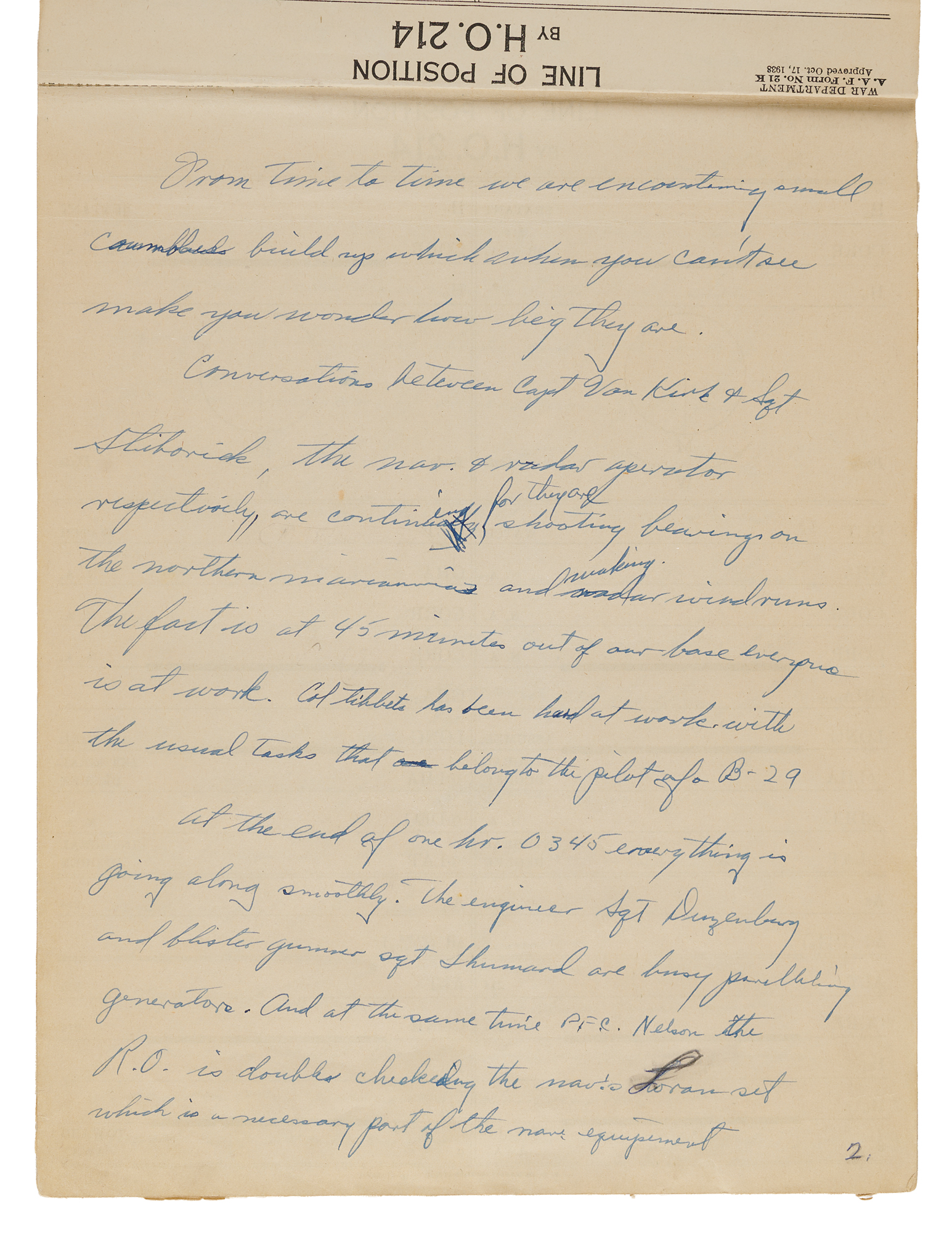
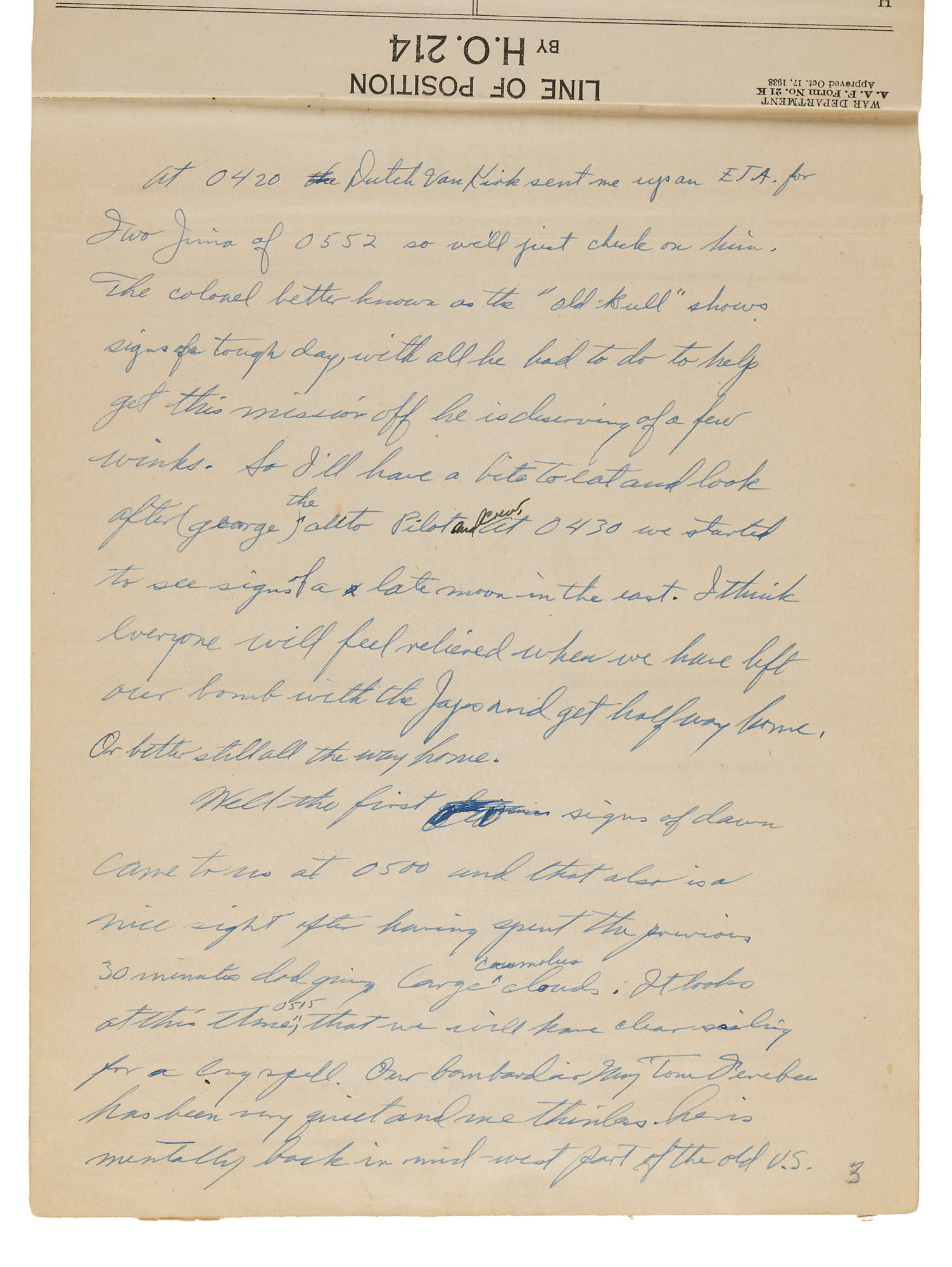
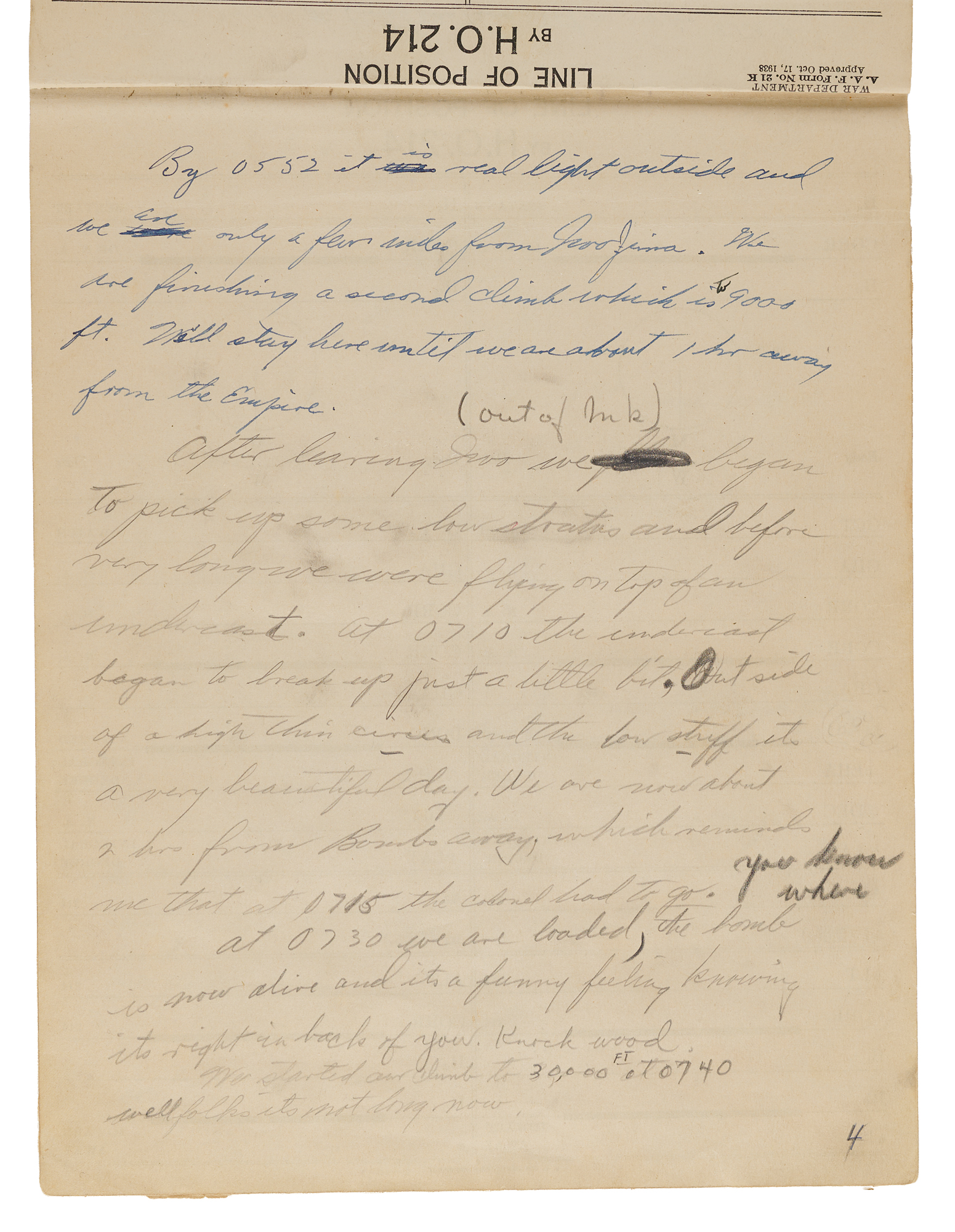
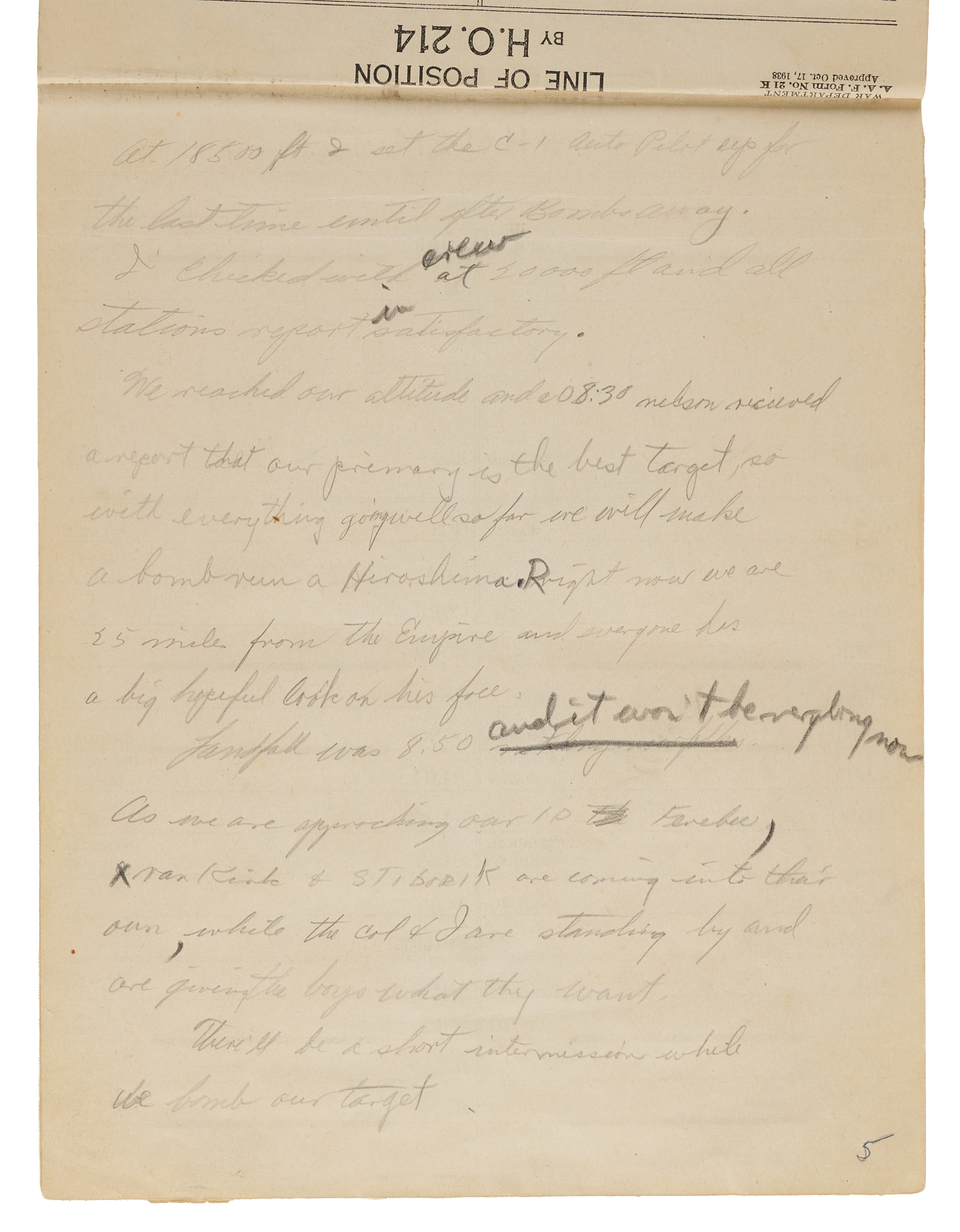
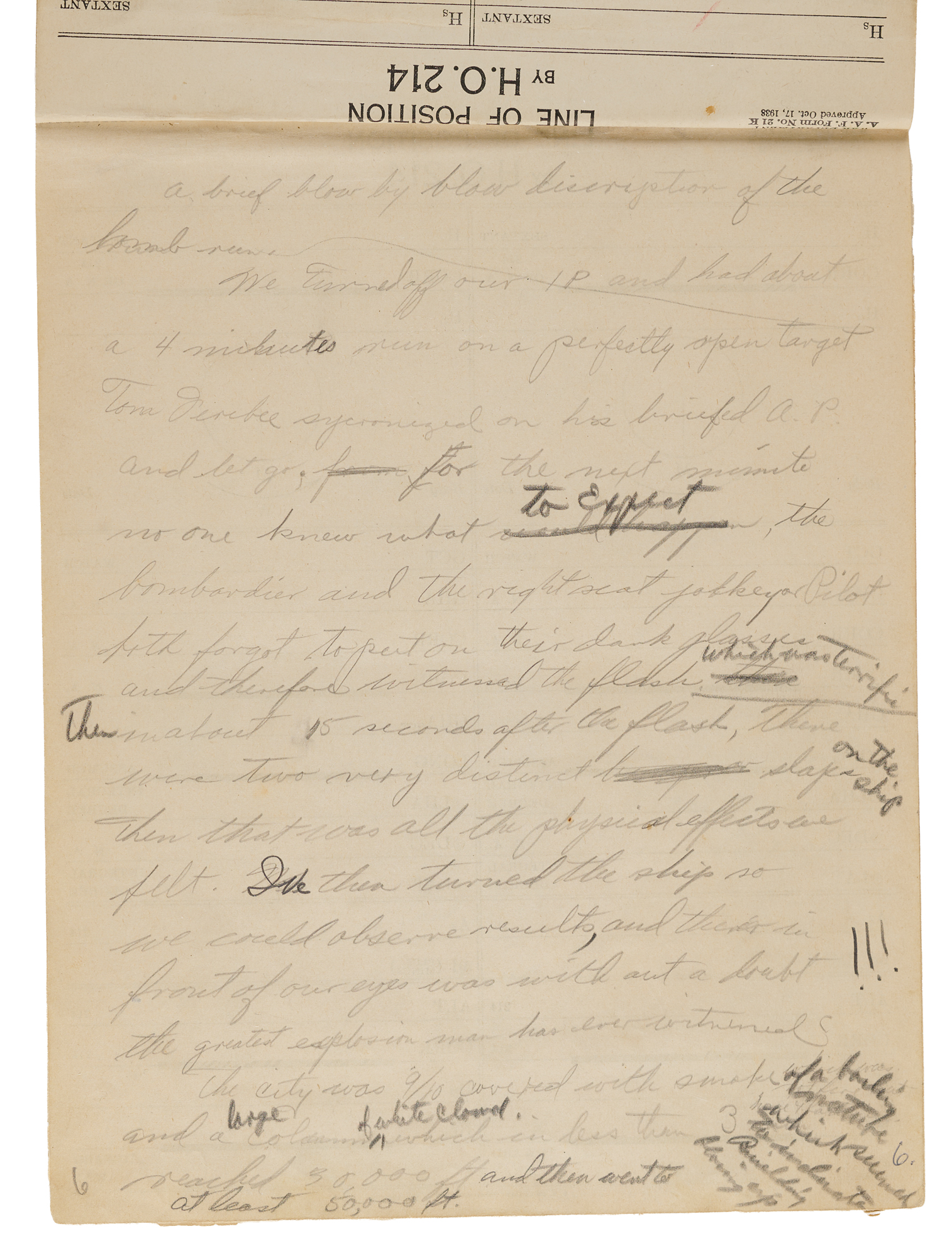
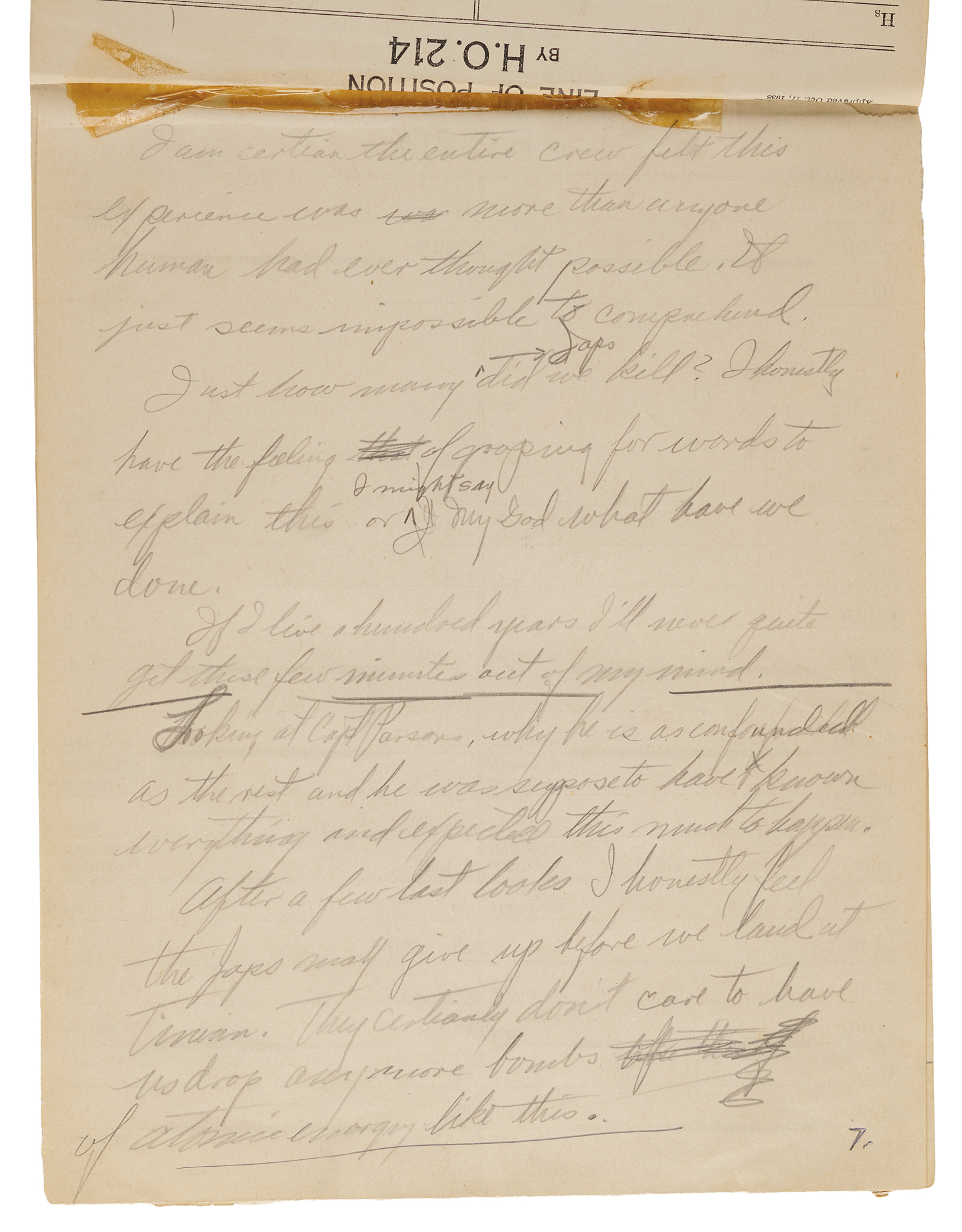
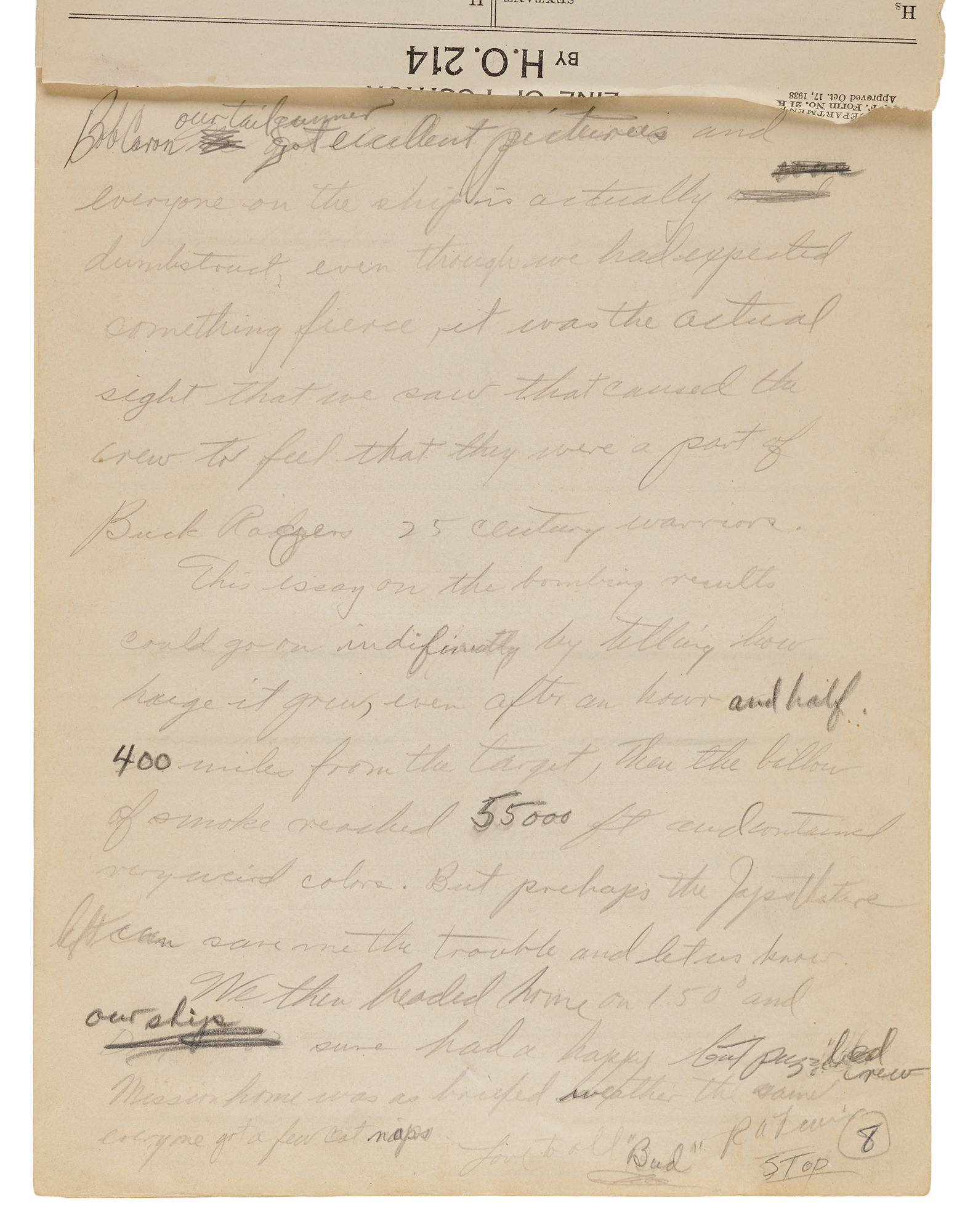
Mission-used flight logbook maintained by Captain Robert A. Lewis, co-pilot of the Boeing B-29 Superfortress bomber Enola Gay during the Hiroshima atomic bombing mission, containing 25 handwritten pages documenting the first wartime use of an atomic weapon. The notebook, 8 x 10.5, opens with an eight-page in-flight account of the Hiroshima mission, written aboard the Enola Gay as events unfolded, followed by a 14-page history of the 509th Composite Group and three additional manuscript pages of later notes and verse. Lewis explains the origin of this extraordinary record in a signed statement on the inside front cover, dated August 8, 1945: "This log was a last minute request of William Laurence—(Science Editor) N.Y. Times. He had been ordered to be aboard, but arrived in Tinian too late. He asked me to keep some notes of the mission. A great deal of the notes were written in almost complete darkness. Half way through I ran out of ink." Lewis signs the statement, "Capt. Robert A. Lewis." The statement itself carries ink revisions in a second hand, ostensibly Laurence's own: "expected" struck through and sharpened to "been ordered," Lewis's original account that the request "was not permitted" replaced with "arrived in Tinian too late," and "me" inserted to specify that Laurence had asked Lewis personally to keep the notes. Laurence signs the attestation: "Pencil corrections were made by Mr. William Laurence. Attested as true. William H. Laurence." These attested pencil corrections, distinct from the ink revisions to Lewis’s statement, are confined to the eight pages of Lewis’s in-flight account.
Lewis's contemporaneous mission diary begins under the heading: "Little Boy Mission #1 / First Atomic Bomb / August 6th 1945 / Target Hit / By Capt. Robert A. Lewis / Pilot aboard Ship." Beginning with the pre-flight briefing and takeoff from Tinian, he records the mission in real time, noting, "We started engines at 0227 and taxied out…then we got off the ground at exactly 0245." Interspersed among the operational entries are Lewis's own observations, including "I think everyone will feel relieved when we have left our bomb with the Japs and get halfway home. Or better still all the way home." Midway through the flight he notes "(out of ink)," then continues the diary in pencil, precisely as he later explained on the inside front cover. Approaching Hiroshima, Lewis writes, "At 0730 we are loaded, the bomb is now alive and it's a funny feeling knowing it's right in back of you. Knock wood… Well folks it's not long now." Upon receiving confirmation that Hiroshima is the primary target, he records that "everyone has a big hopeful look on his face," before adding, "There'll be a short intermission while we bomb our target."
Lewis then provides what he calls "a brief blow by blow description of the bomb run," recalling that after Major Thomas Ferebee released the bomb, "for the next minute no one knew what to expect." He describes the blinding flash, "two very distinct slaps on the ship," and the crew's first view of the destruction: "there in front of our eyes was without a doubt the greatest explosion man has ever witnessed. The city was 9/10 covered with smoke…and a large column of white cloud" rising to an estimated 50,000 feet. A later inserted page preserves Lewis's reflections after news of Hiroshima's destruction had begun to emerge: "I am certain the entire crew felt this experience was more than anyone human had ever thought possible. It just seems impossible to comprehend. Just how many 'Japs' did we kill? I honestly have the feeling of groping for words to explain this or I might say My God what have we done. If I live a hundred years I'll never quite get these few minutes out of my mind." He continues, "Looking at Capt. Parsons, why he is as confounded as the rest and he was suppose to have known everything and expected this much to happen," before predicting, "I honestly feel the Japs may give up before we land at Tinian. They certainly don't care to have us drop anymore bombs of atomic energy like this." Returning toward Tinian, he observes that "everyone on the ship is actually dumbstruck," writes that the crew felt "they were a part of Buck Rodgers 25 Century warriors," and concludes simply: "Love to all, 'Bud' R. A. Lewis."
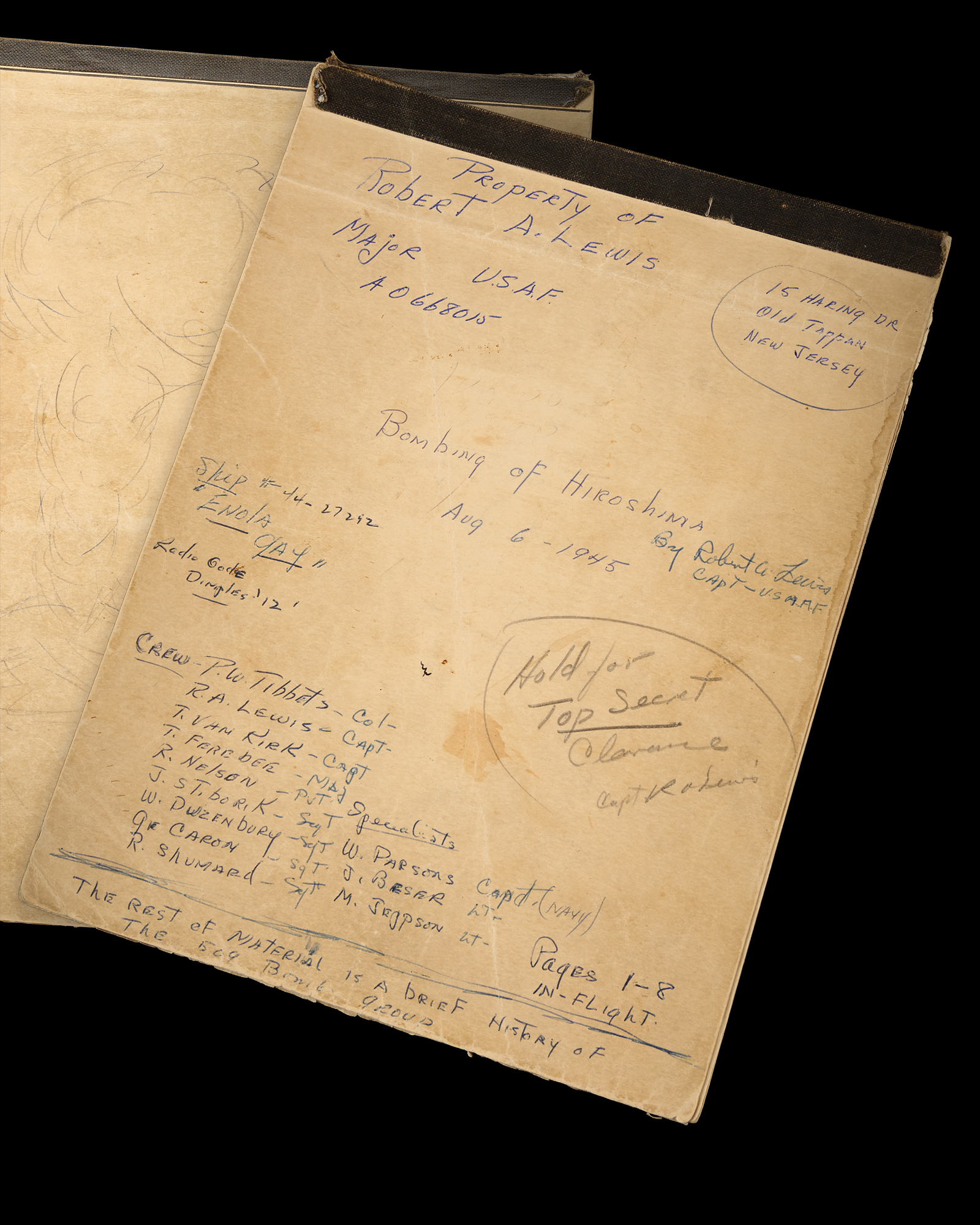
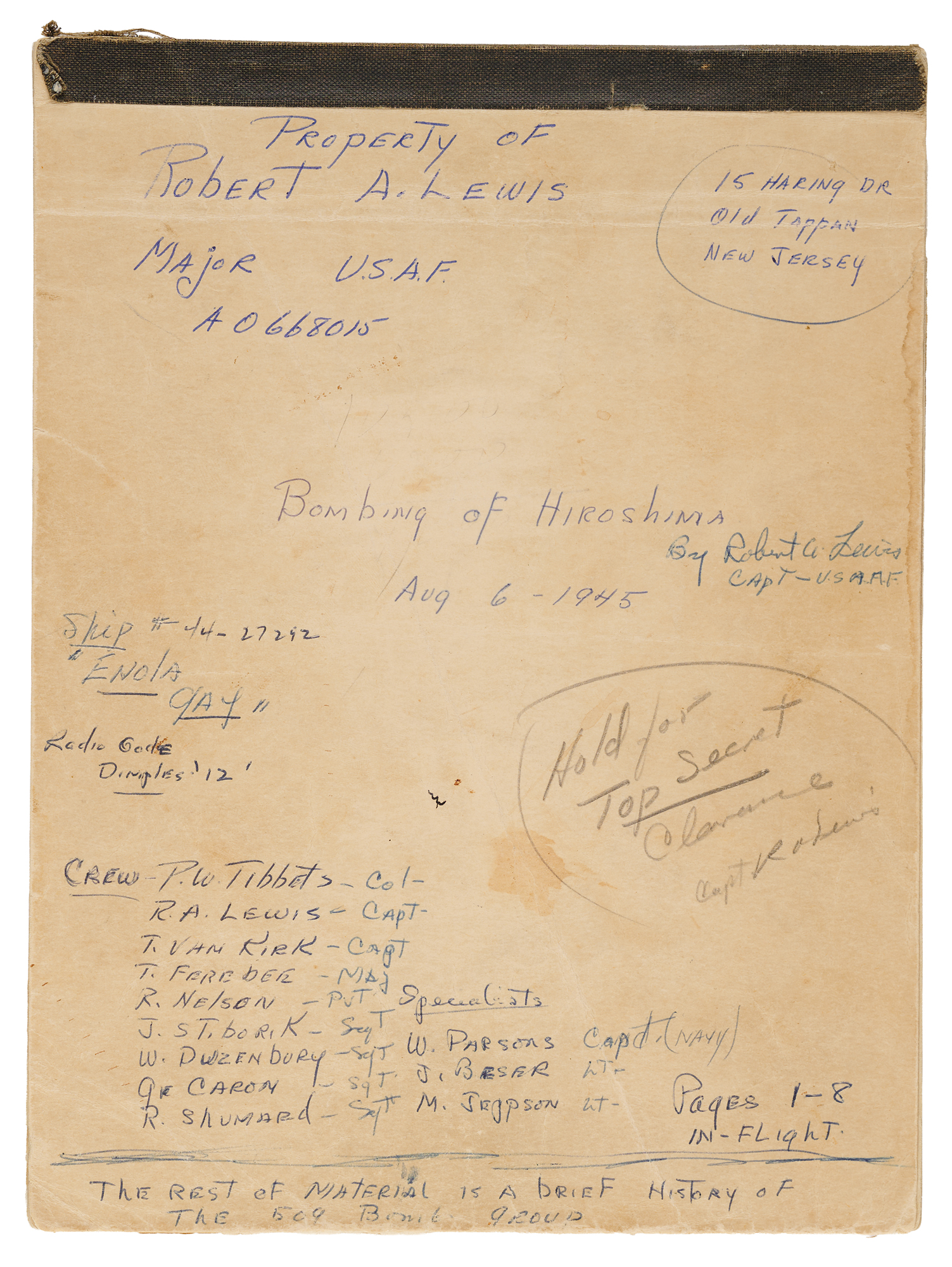
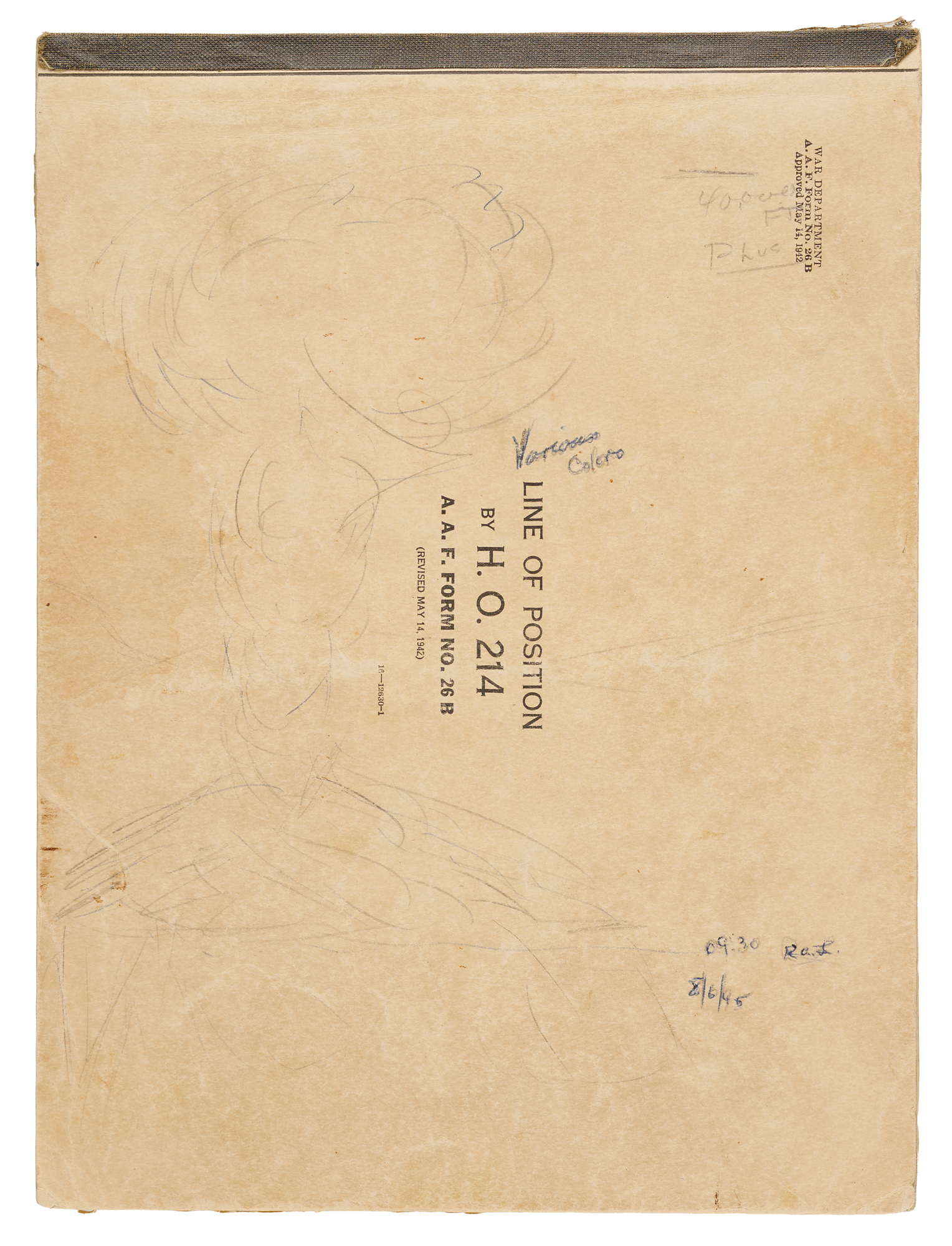
Complementing the written narrative, the back cover contains Lewis's pencil sketch of the Hiroshima mushroom cloud, annotated "Various Colors," "40,000 Ft Plus," and "09:30 8/6/45." The front cover bears his handwritten title, "Bombing of Hiroshima," dated "Aug. 6–1945," and signed "By Robert A. Lewis / Capt-USAAF." He records the aircraft as "Ship #44-27292 'Enola Gay,'" the radio call sign "Dimples '12,'" lists the complete crew, and notes, "Pages 1–8 In-Flight. The rest of material is a brief history of the 509 Bomb Group." Also present are Lewis's signed notation, "Hold for Top Secret Clearance," together with later ownership inscriptions recording his rank as Major, U.S.A.F., service number, and Old Tappan, New Jersey address.
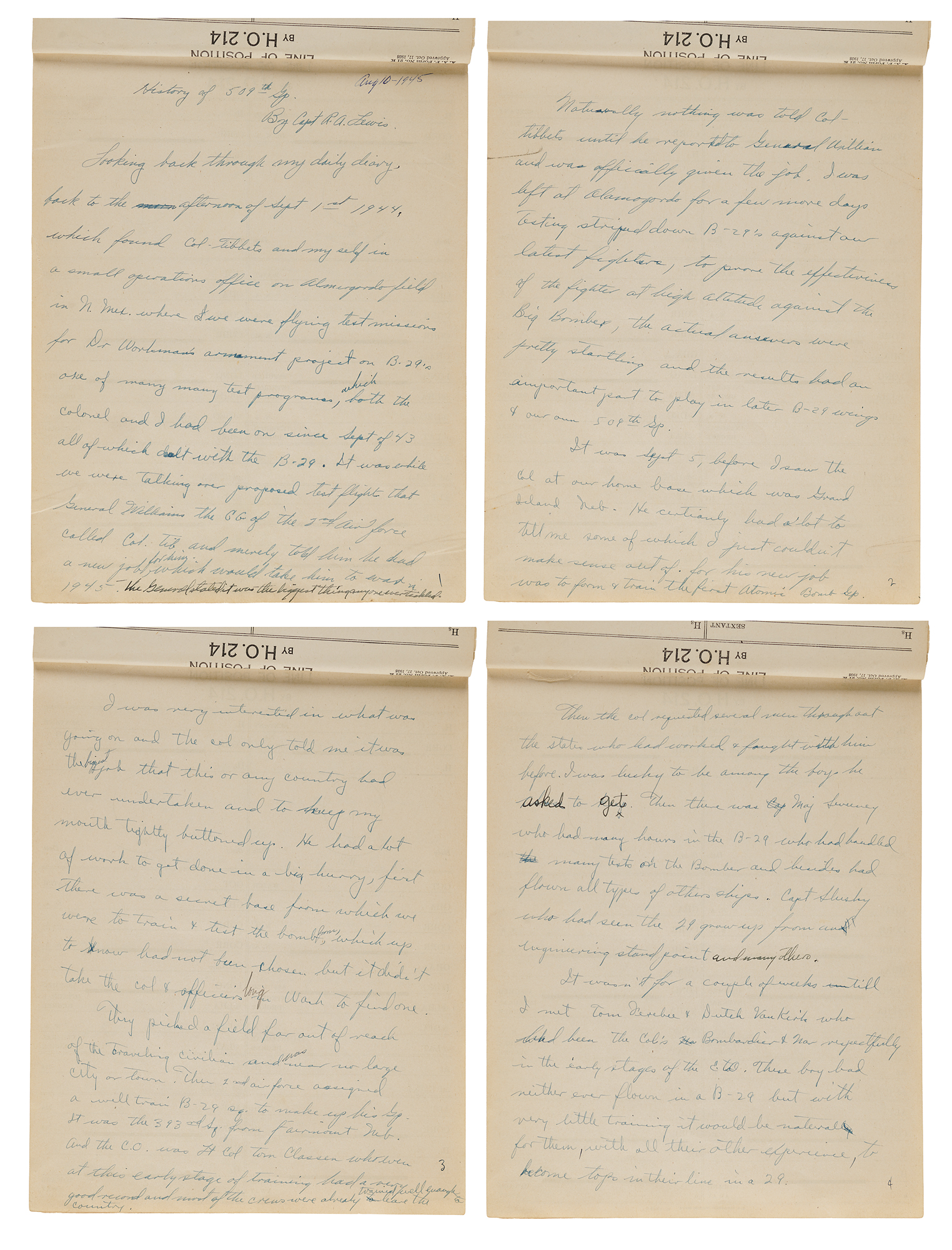
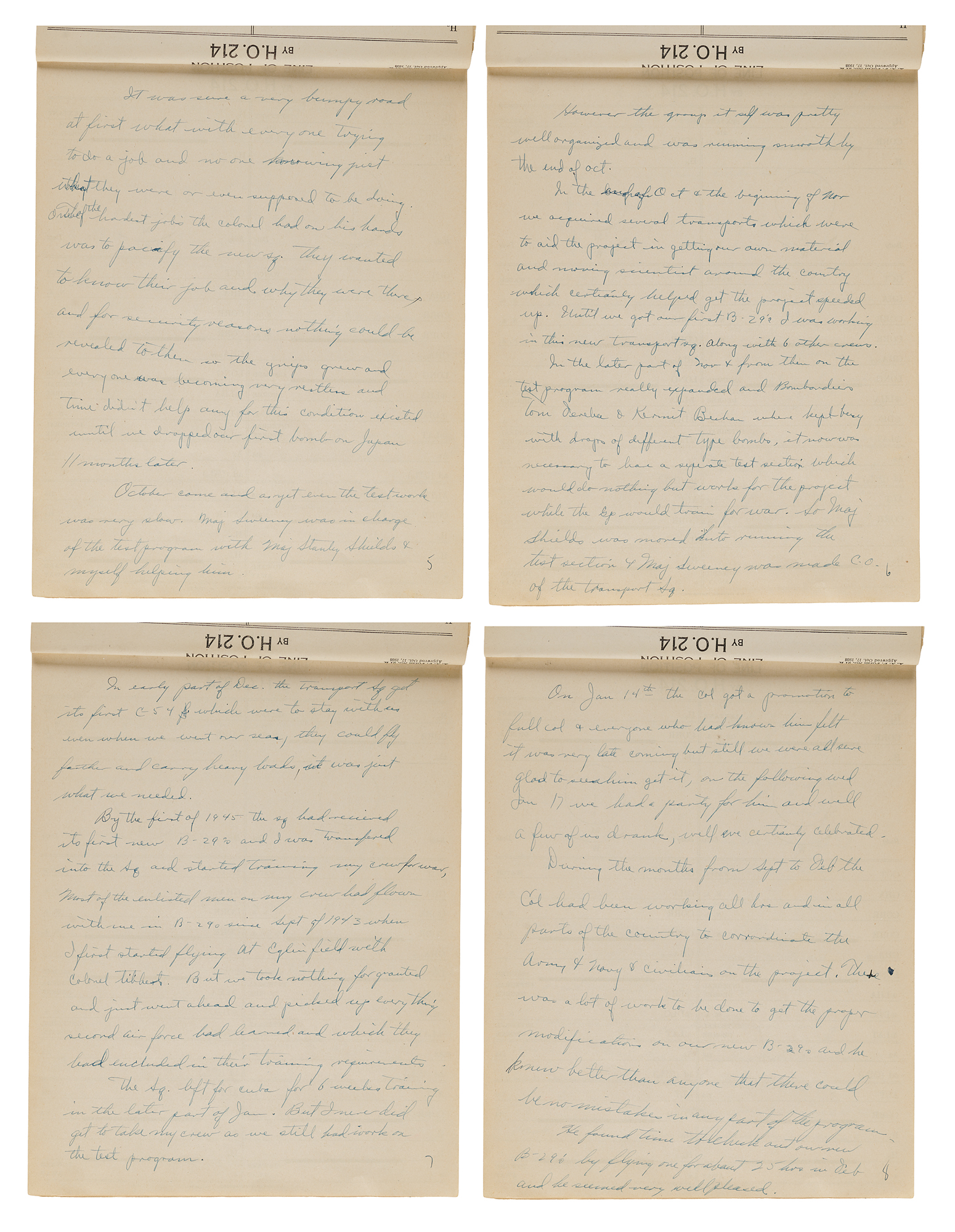
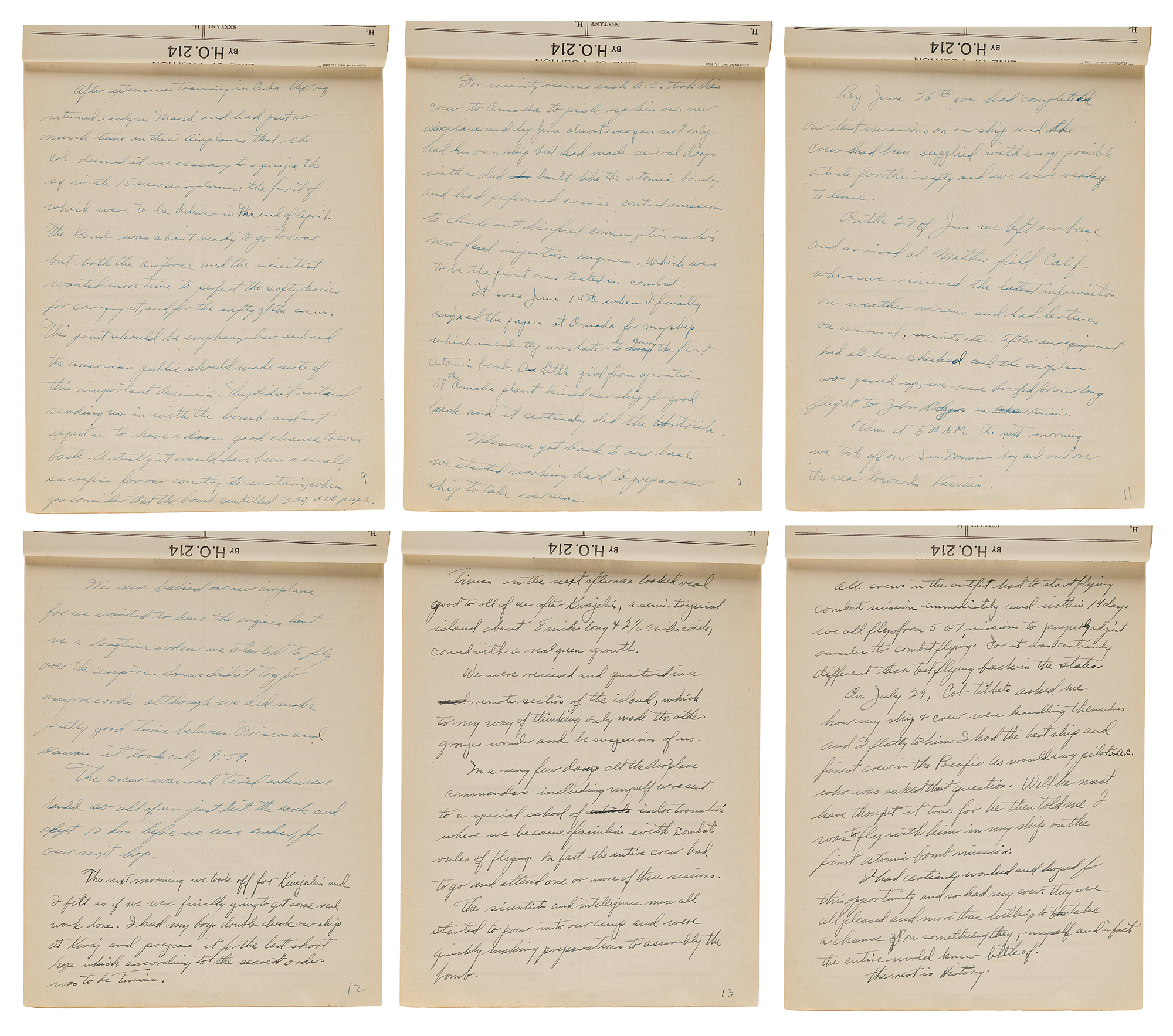
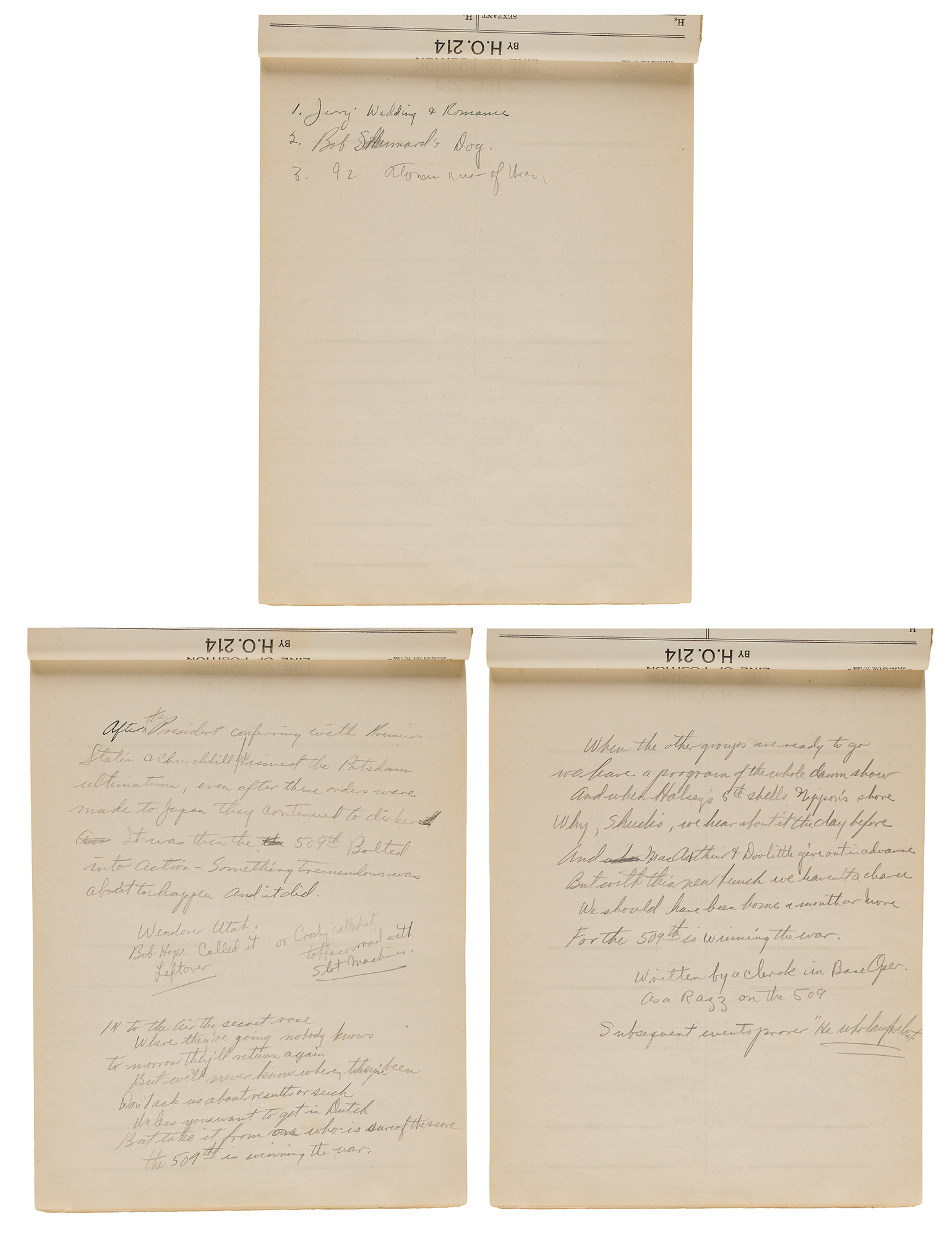
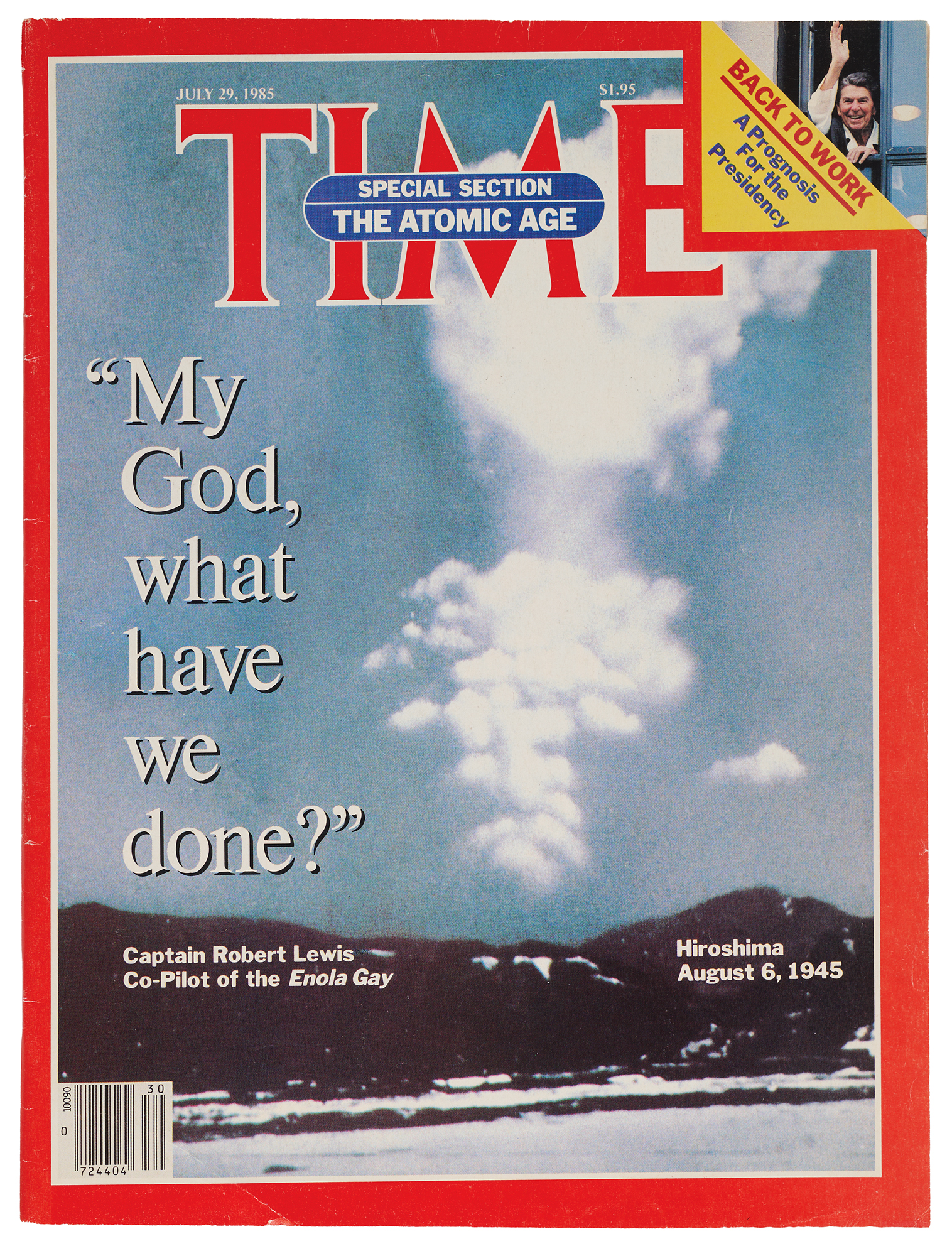
Beginning on August 10, 1945, Lewis continued the notebook with a 14-page manuscript titled "History of 509th Gp.," tracing the origins of the unit from its formation under Colonel Paul W. Tibbets Jr. at Alamogordo through crew selection, training, aircraft preparation, and deployment to Tinian. Recounting the formation and development of the 509th Composite Group only days after the mission, Lewis recalls assuring Tibbets that he had "the best ship and finest crew in the Pacific" before being selected to accompany him on the atomic mission, concluding simply, "The rest is History." The remaining manuscript pages preserve additional notes, including a brief account of the Potsdam ultimatum and a two-page morale song of the 509th Composite Group, copied by Lewis and attributed to "a clerk in Base Oper.," ending with Lewis's observation, "Subsequent events prove 'He who laughs last.'" In fine condition, with light stains and overall wear. Accompanied by a cloth-bound custom clamshell presentation case, and the July 29, 1985, special "The Atomic Age" edition of Time magazine, whose cover prominently features Lewis's famous reflection from the notebook – "My God, what have we done?" – published on the fortieth anniversary of the Hiroshima mission.
Provenance: Robert A. Lewis; Sotheby's, New York, November 24, 1971; Sotheby's, New York, 1978, to Malcolm Forbes; Christie's, New York, March 26, 2002, Lot 172 (Malcolm Forbes Collection); Heritage Auctions, Historical Platinum Session, July 16, 2022, Lot 42029.

This item is Pre-Certified by PSA/DNA
Buy a third-party letter of authenticity for
(inquire for price)
*This item has been pre-certified by a trusted third-party authentication service, and by placing a bid on this item, you agree to accept the opinion of this authentication service. If you wish to have an opinion rendered by a different authenticator of your choosing, you must do so prior to your placing of any bid. RR Auction is not responsible for differing opinions submitted 30 days after the date of the sale.
Third-party authentication service applies only to signatures and handwriting, and does not cover the addition of sketches, artwork, musical quotations, etc.

