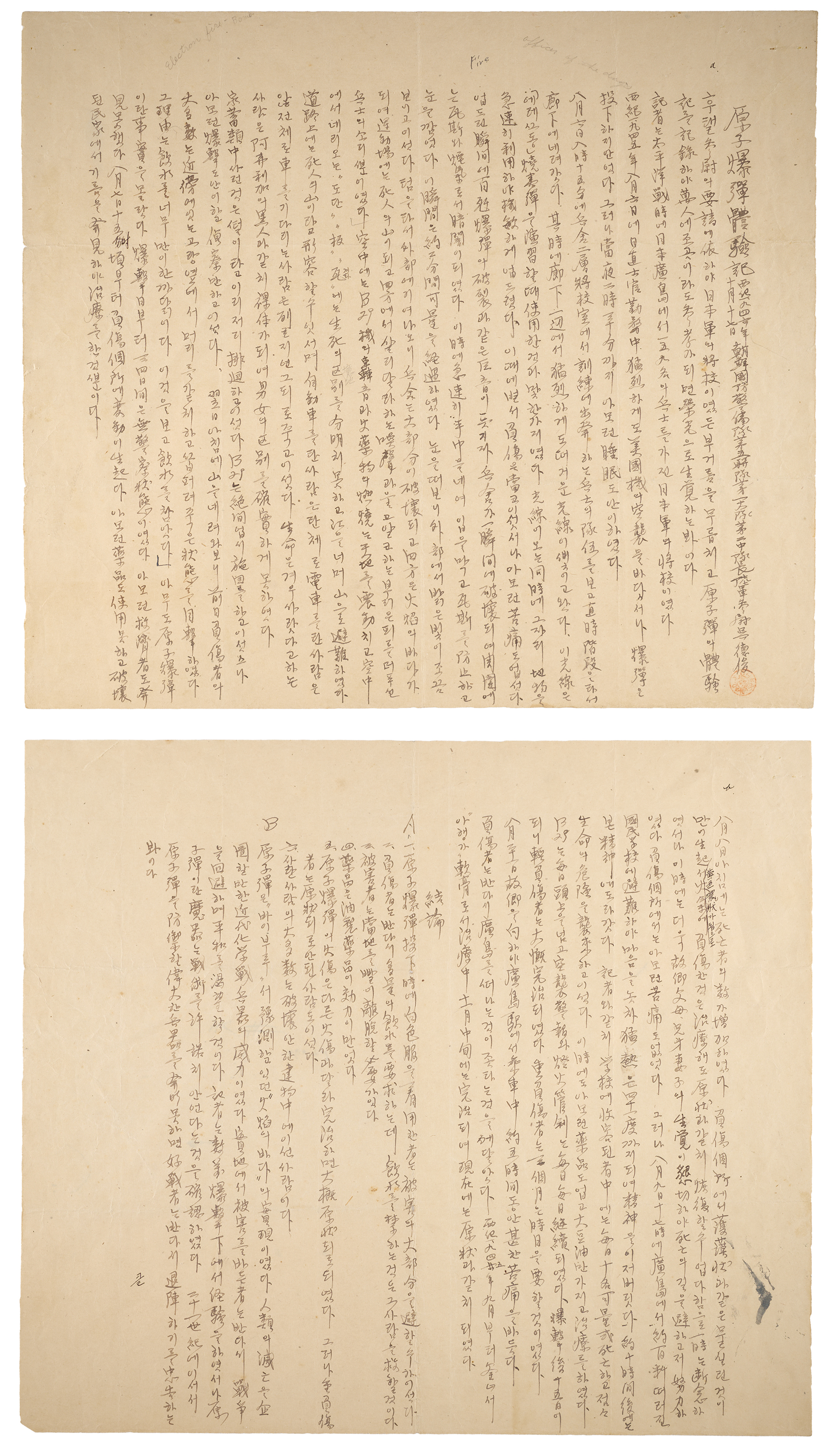
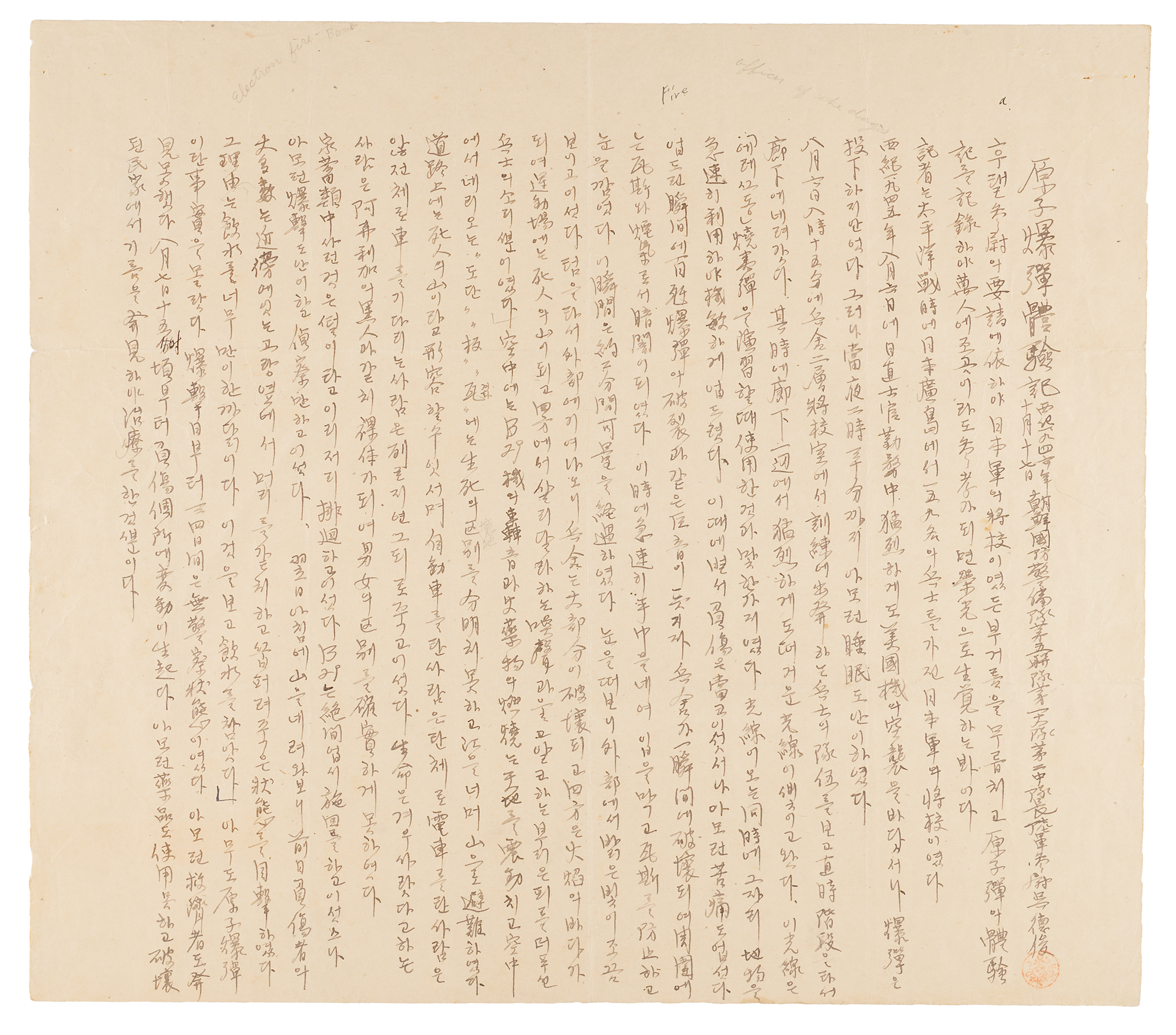
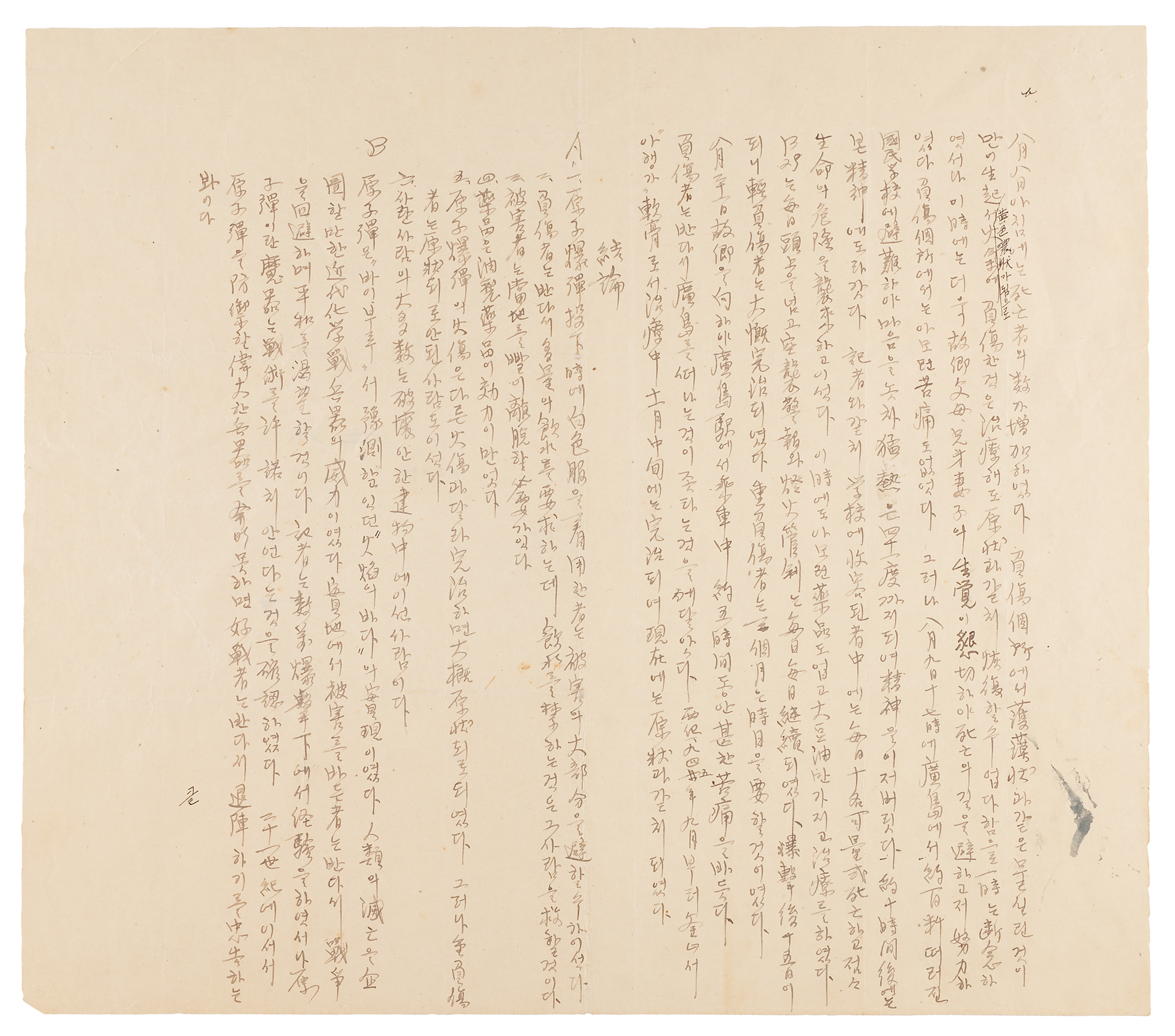
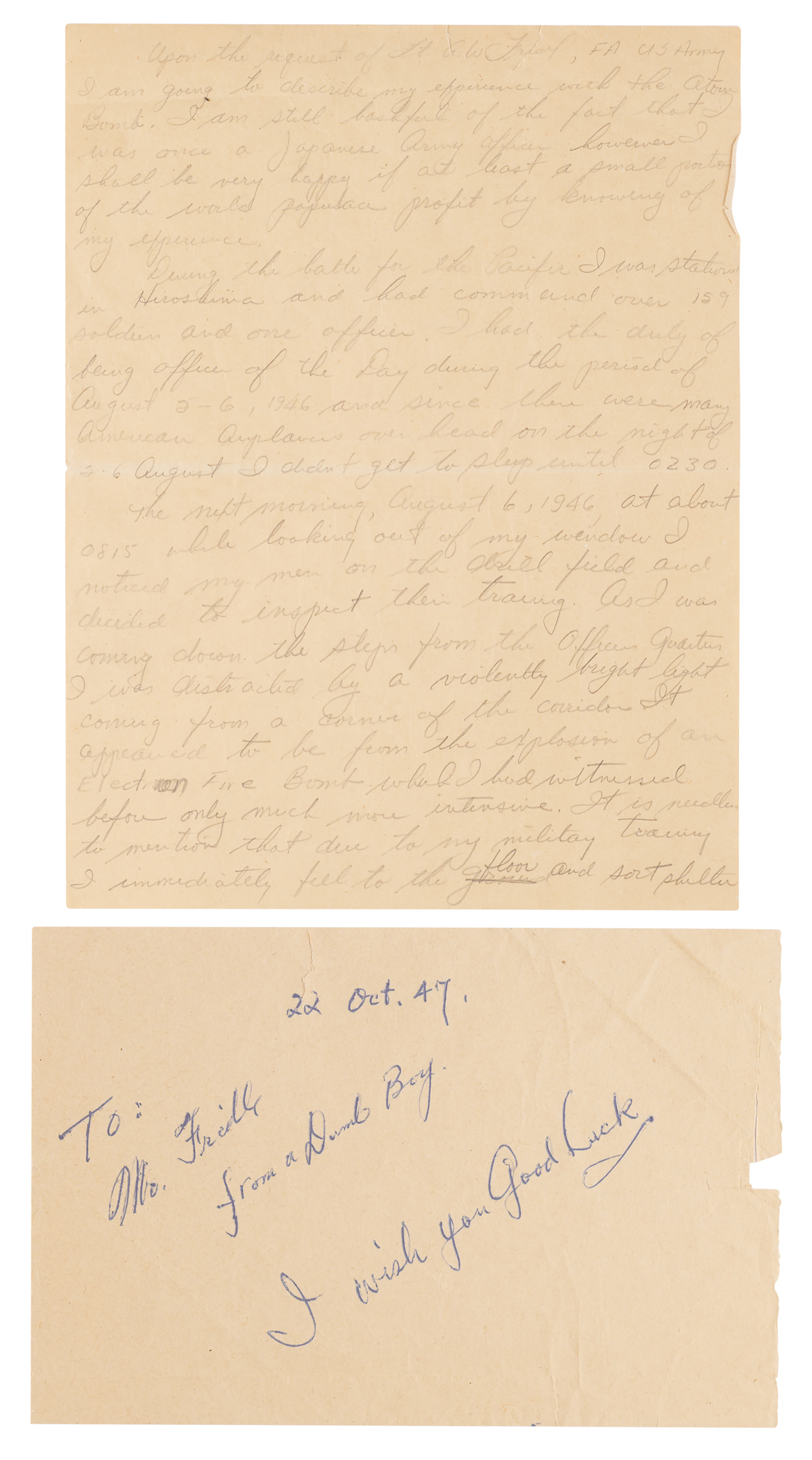
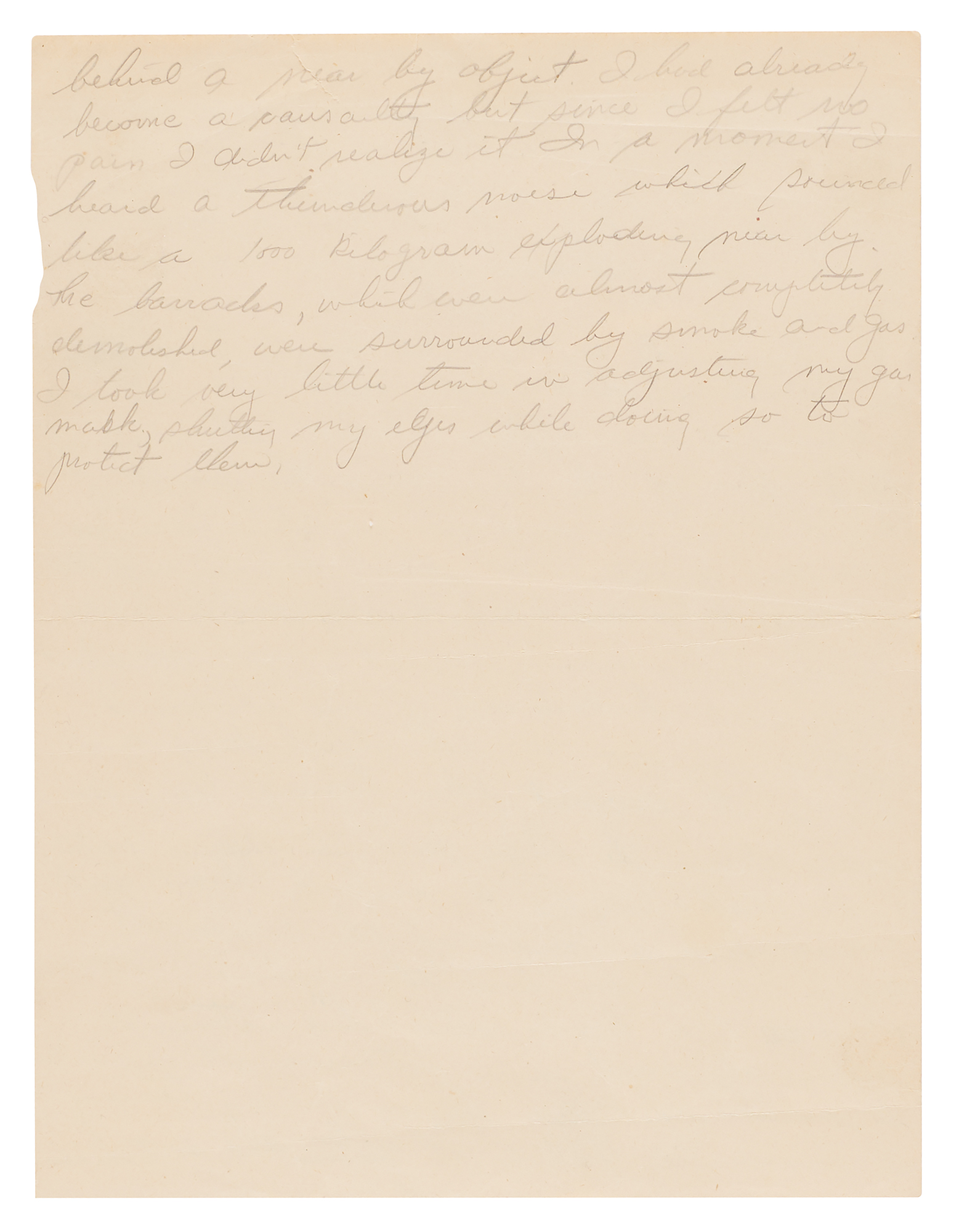
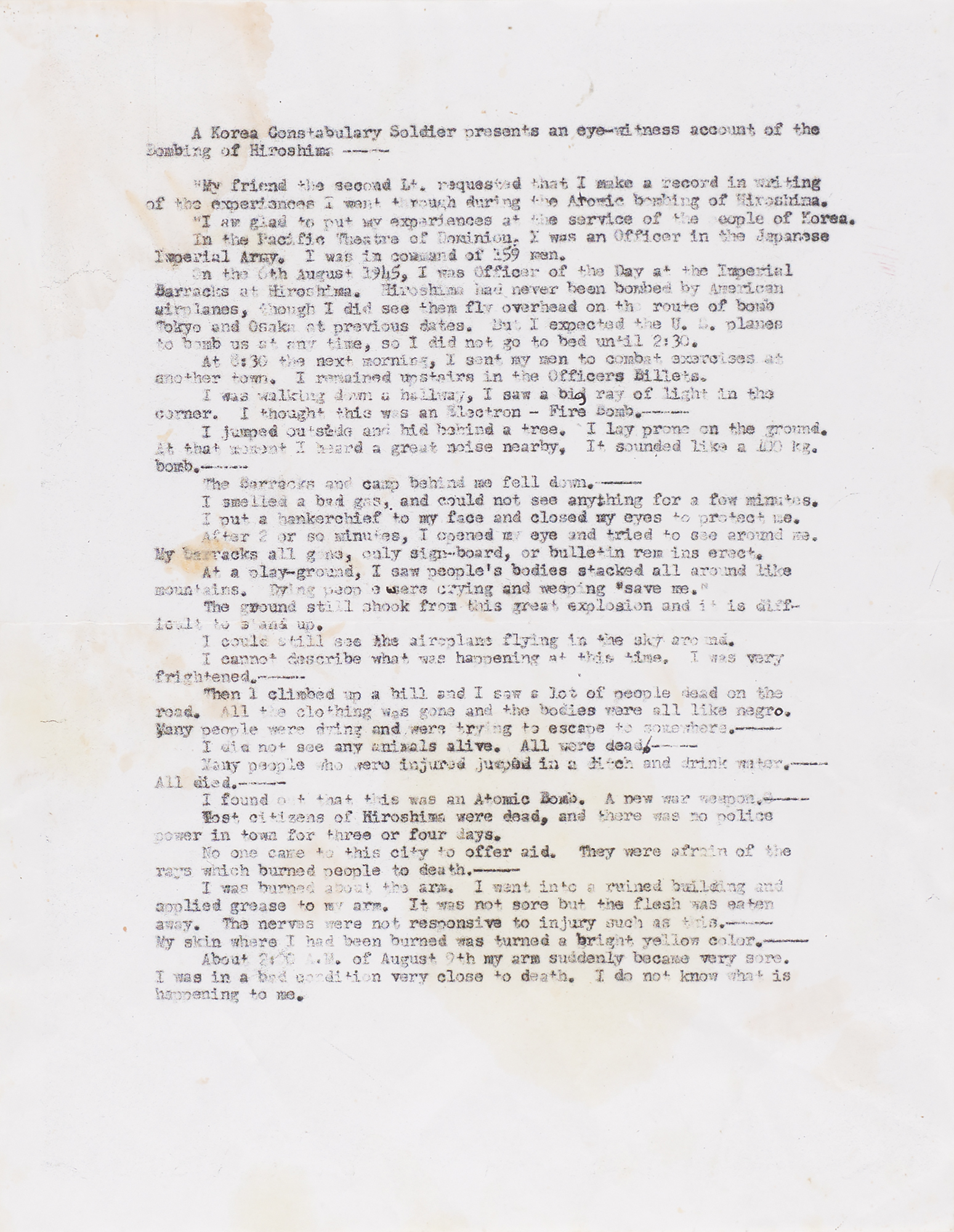
Historic eyewitness manuscript recounting the atomic bombing of Hiroshima, handwritten in Japanese by Korean officer G. T. Hun in 1947 on two large 17.25 x 15.25 sheets of fine rice paper, documenting his firsthand experiences while serving as a Japanese Army officer stationed in Hiroshima on August 6, 1945. Accompanied by Hun's handwritten English presentation note, dated "22 Oct. 47" ("To: Mr. Fridl, from a Dumb Boy. I wish you Good Luck"), a handwritten English draft translating the opening portion of the narrative, and a contemporary typed English translation prepared for U.S. Army Lt. Arthur William Fridl.
As the accompanying handwritten and typed English translations preserve different portions of the narrative, the following excerpts are compiled from both to present the fullest account of Hun's eyewitness testimony.
Written just two years after the bombing, Hun's vivid narrative begins by explaining that he is writing at Fridl's request: "Upon the request of Lt. A. W. Fridl, FA U.S. Army, I am going to describe my experience with the Atomic Bomb…I was stationed in Hiroshima and had command over 159 soldiers and one officer." He then recounts the moment of detonation: "At about 0815…As I was coming down the steps from the officers' quarters, I was distracted by a violently bright light…It appeared to be from the explosion of an Electron Fire Bomb…only much more intensive…I immediately fell to the floor and sought shelter." Moments later came the blast: "I heard a thunderous noise…The barracks…were almost completely demolished."
Emerging into the devastated city, Hun describes one of the manuscript's most haunting scenes: "At a playground, I saw people's bodies stacked all around like mountains. Dying people were crying and weeping 'save me.'…I climbed up a hill and saw a lot of people dead on the road. All the clothing was gone and the bodies were all like negro. Many people were dying…I did not see any animals alive. All were dead." He continues by recounting desperate civilians seeking water, "Many people who were injured jumped in a ditch and drank water. All died,” before realizing, "I found out that this was an Atomic Bomb. A new war weapon…Most citizens of Hiroshima were dead, and there was no police power in town for three or four days. No one came to this city to offer aid. They were afraid of the rays which burned people to death."
Hun goes on to describe his own injuries, writing: "I was burned about the arm…the flesh was eaten away…the nerves were not responsive," before recalling that by August 9th, "my arm suddenly became very sore. I was in a bad condition very close to death." He later recounts his recovery after the war, observations on radiation injuries, including his belief that white clothing reduced burns and that burn victims should not drink water, and concludes with a sobering reflection on the future of warfare: "This weapon is the worst weapon in the world. Maybe the 21st century a most deadly weapon will be found, and maybe it will be even greater than this." In fine condition.
G. T. Hun was a Korean officer serving in the Imperial Japanese Army during Japan's occupation of Korea, commanding 159 soldiers in Hiroshima when the atomic bomb was dropped on August 6, 1945. His account offers the perspective of a Korean colonial subject serving in Japan's military at the end of World War II. Writing in October 1947 for Lt. Arthur William Fridl, a recent West Point graduate serving with the U.S. Army in postwar Korea, Hun recorded his experiences while the events remained painfully fresh. His manuscript records not only the immediate devastation wrought by the atomic bomb but also the uncertainty surrounding an entirely new weapon, describing catastrophic burns, the collapse of civil authority, delayed radiation injuries, and the absence of organized relief.
Original firsthand survivor manuscripts documenting the atomic bombing of Hiroshima are exceedingly uncommon, and accounts written so soon after the event – especially by a Korean serving in the Japanese military – are rarer still, making this an exceptional primary source documenting one of the defining events of the twentieth century.

