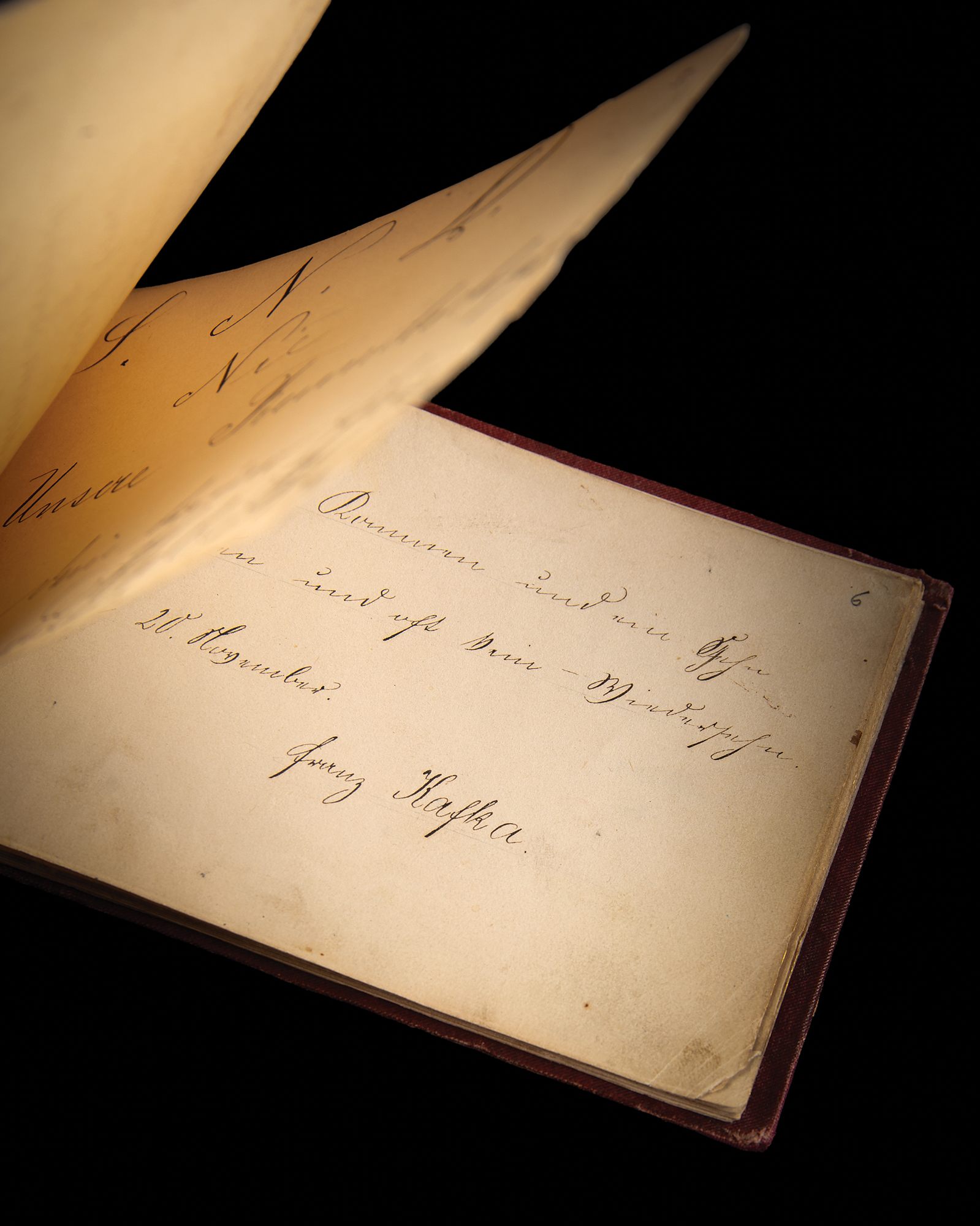
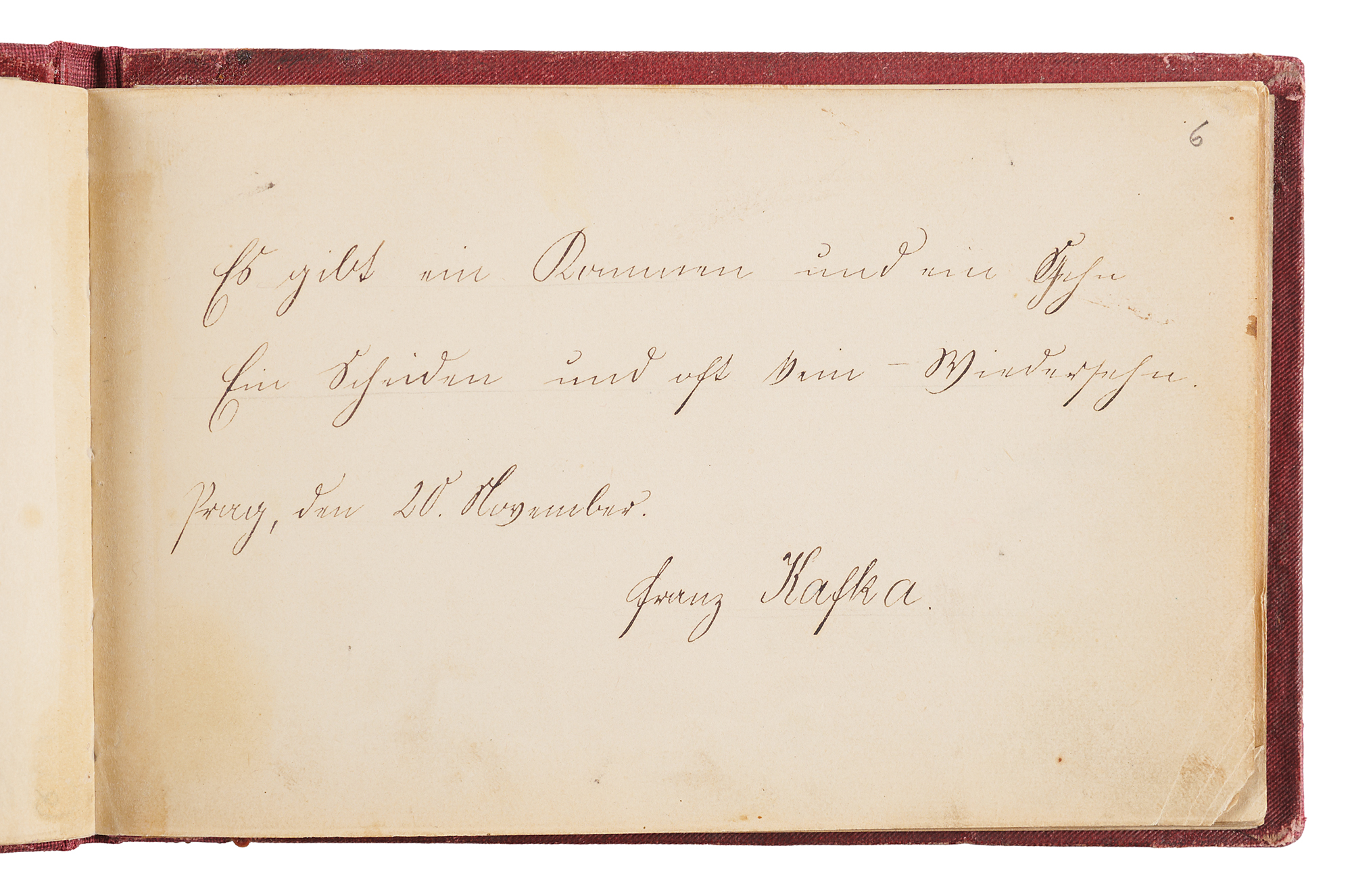
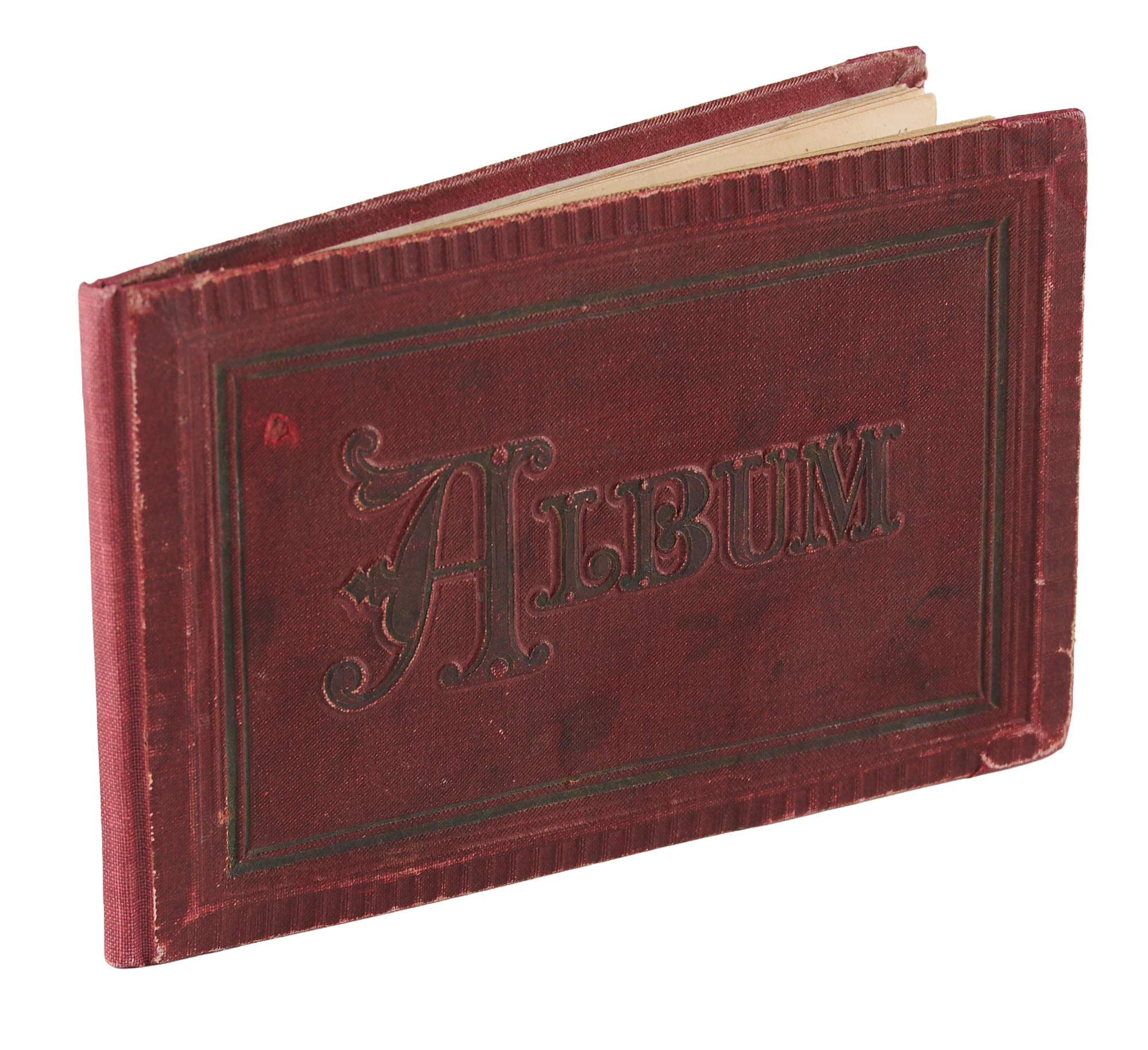
AQS in German by a 14-year-old Franz Kafka, containing what is recognized as his earliest known piece of creative writing, handwritten in fountain pen within a 5.5 x 3.5 autograph album belonging to his school friend, Hugo Bergmann, dated “Prag, den 20. November [1897].” Penned in his early teens, Kafka contributes a brief verse foreshadowing the themes of separation and loss that would later permeate his literary work. In full (translated): “There is a coming and a going / A parting and often no – reunion.” The album’s original owner, Bergmann, was Kafka's closest school friend, who later became the founding director of the Jewish National and University Library in Jerusalem and served as rector of the Hebrew University of Jerusalem. In fine condition.
Penned on November 20, 1897, the inscription predates all of Kafka's known literary manuscripts and offers a remarkable glimpse into the formative imagination of one of the twentieth century's most influential writers. Though composed by an adolescent, its meditation on arrival, departure, and irrevocable separation already possesses the concise, unsettling quality that would become synonymous with Kafka's mature work. Bergmann later recalled that it was in his family home that Kafka first announced his intention to become a writer. Reflecting on this very inscription on his ninetieth birthday, Bergmann wrote: ‘When Kafka wrote these words at Barmitzvah age, did Kafka have in mind the deep meaning that we attach to his words today? – I don't know…we can probably interpret these lines as a warning to his generation.’
Bergmann emigrated to Palestine in 1920, preserving his childhood autograph album in Jerusalem while much of Kafka's surviving personal archive was later lost or destroyed. When Kafka died of tuberculosis in 1924 at the age of forty, he instructed his literary executor, Max Brod, to destroy his unpublished manuscripts, notebooks, and letters. Brod famously refused, preserving and publishing works including The Trial and The Castle, thereby establishing Kafka's posthumous reputation as one of the defining literary voices of the modern age. Against that history, this album inscription assumes extraordinary significance: composed decades before Kafka wrote the works that made his name, it survives not because Kafka preserved it, but because his closest childhood friend carried it safely into a new life. It stands among the most significant surviving artifacts of Kafka's adolescence, capturing the earliest known creative expression of a writer whose vision would profoundly shape modern literature.

This item is Pre-Certified by PSA/DNA
Buy a third-party letter of authenticity for
(inquire for price)
*This item has been pre-certified by a trusted third-party authentication service, and by placing a bid on this item, you agree to accept the opinion of this authentication service. If you wish to have an opinion rendered by a different authenticator of your choosing, you must do so prior to your placing of any bid. RR Auction is not responsible for differing opinions submitted 30 days after the date of the sale.
Third-party authentication service applies only to signatures and handwriting, and does not cover the addition of sketches, artwork, musical quotations, etc.

