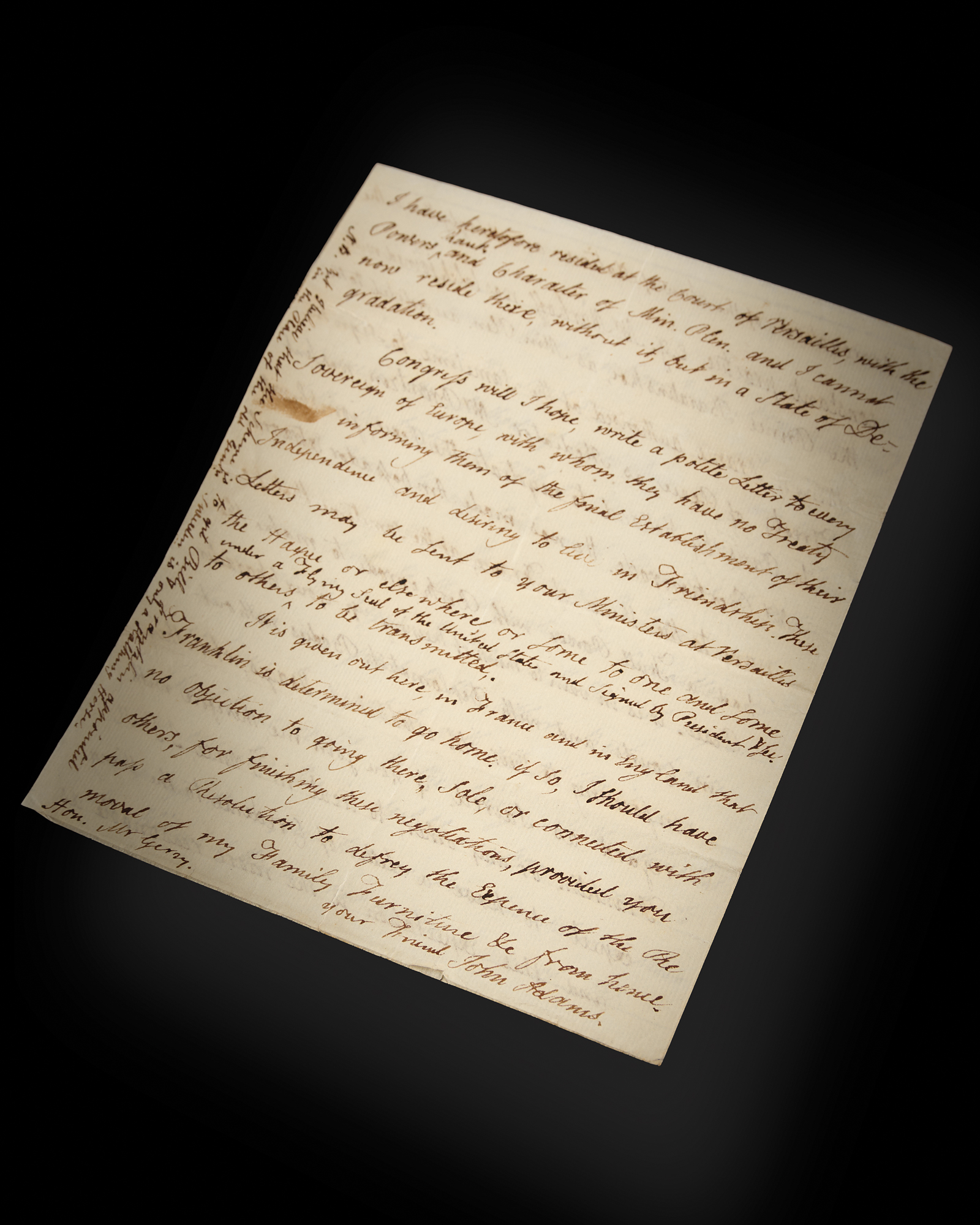
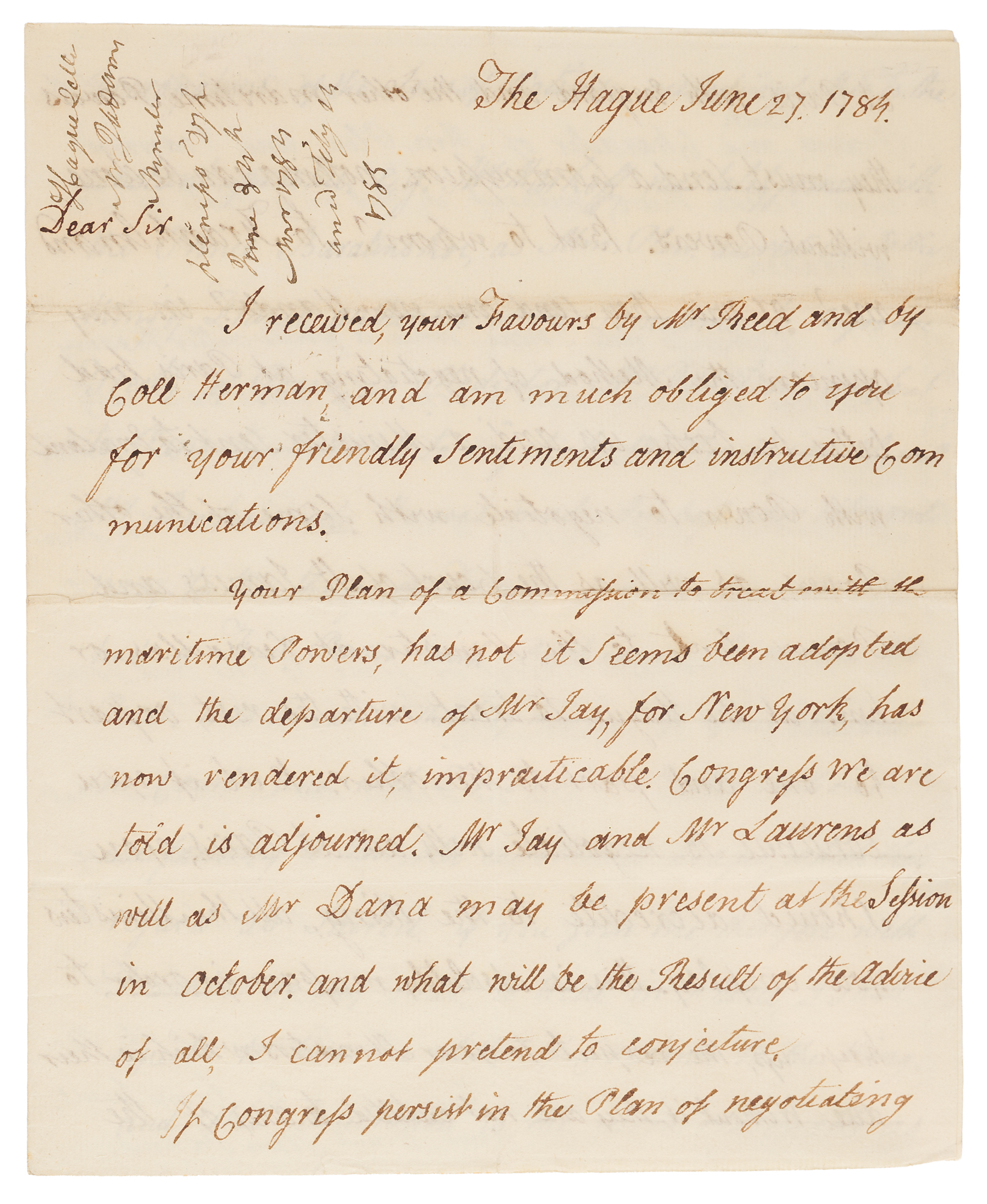
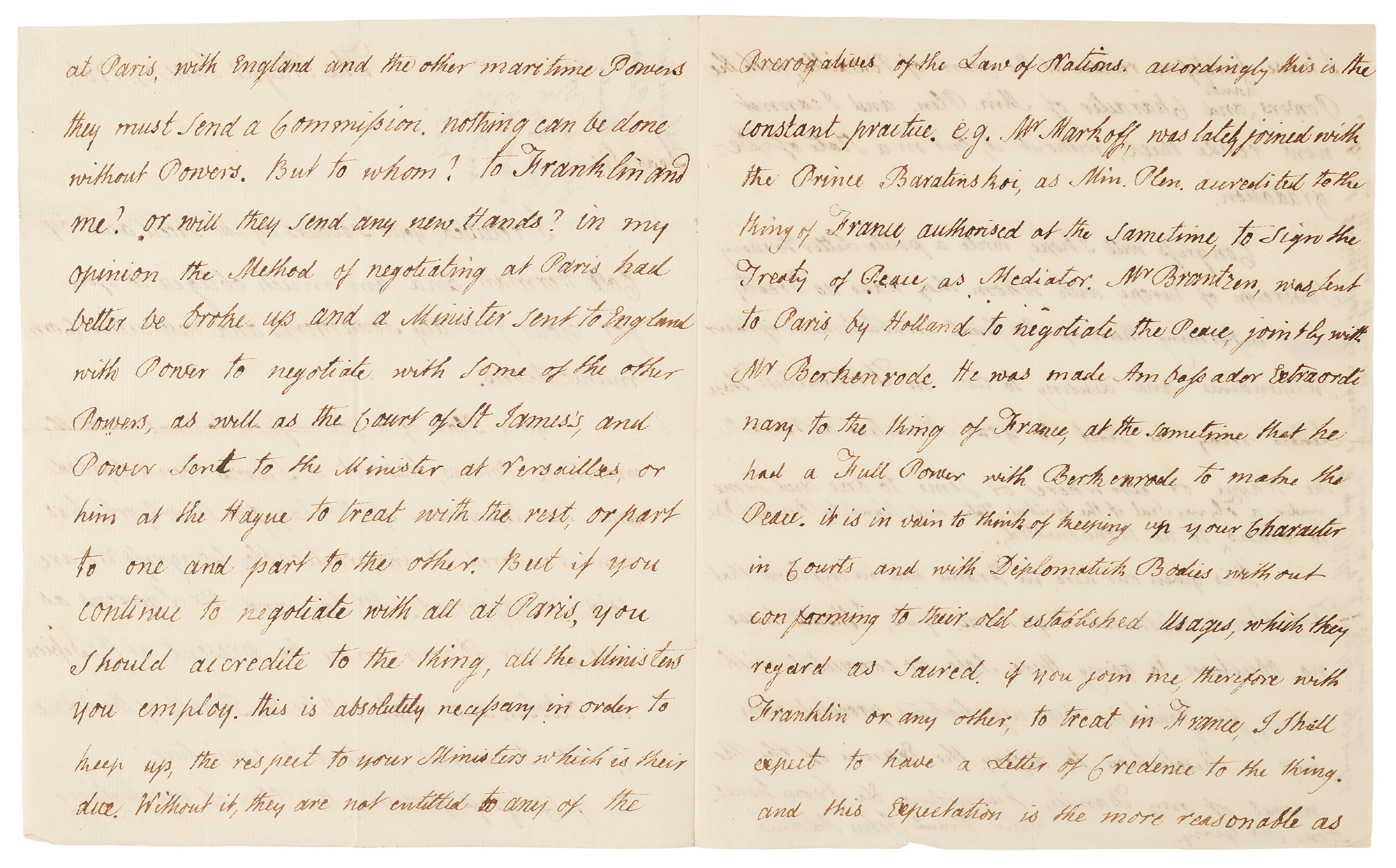
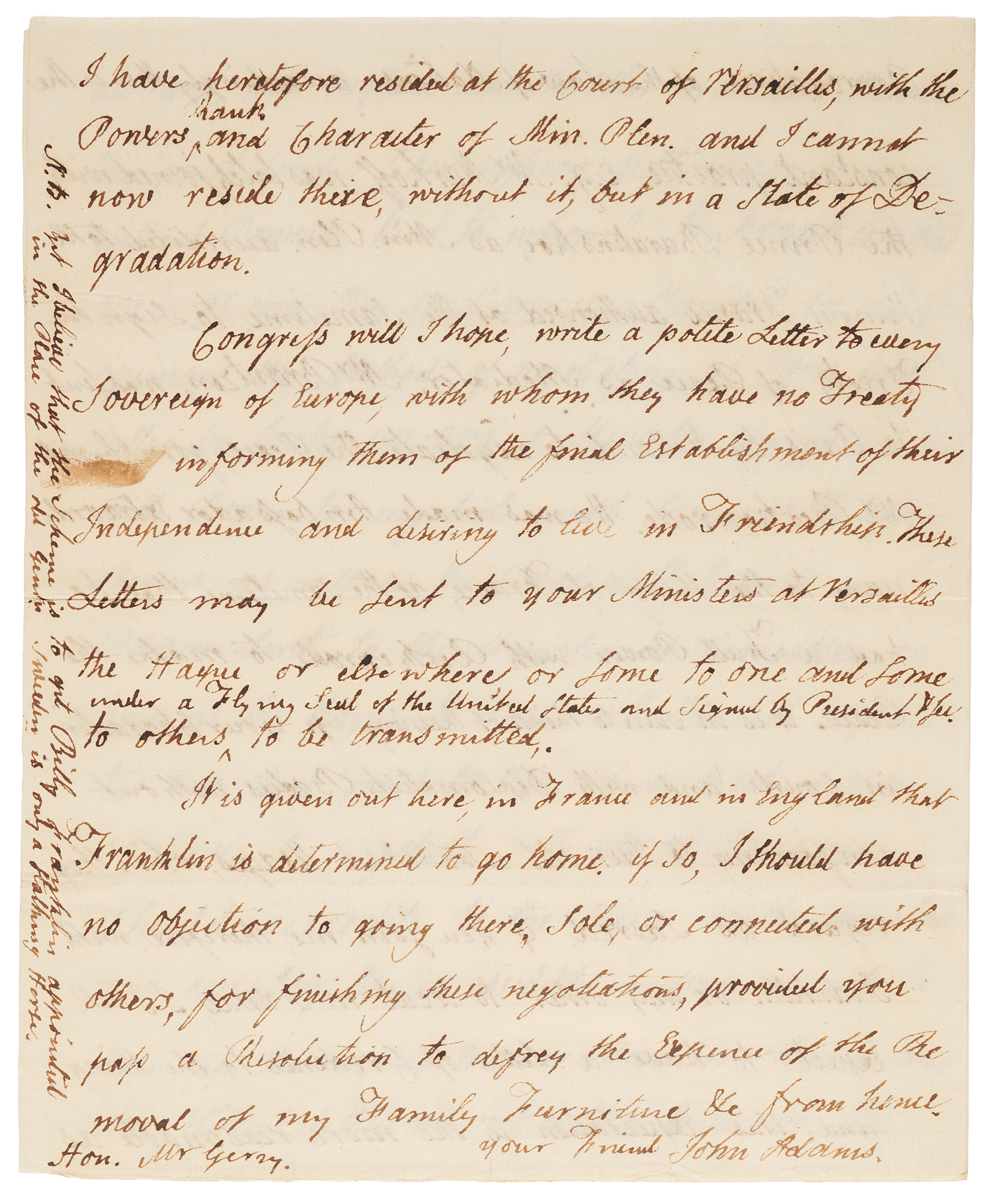
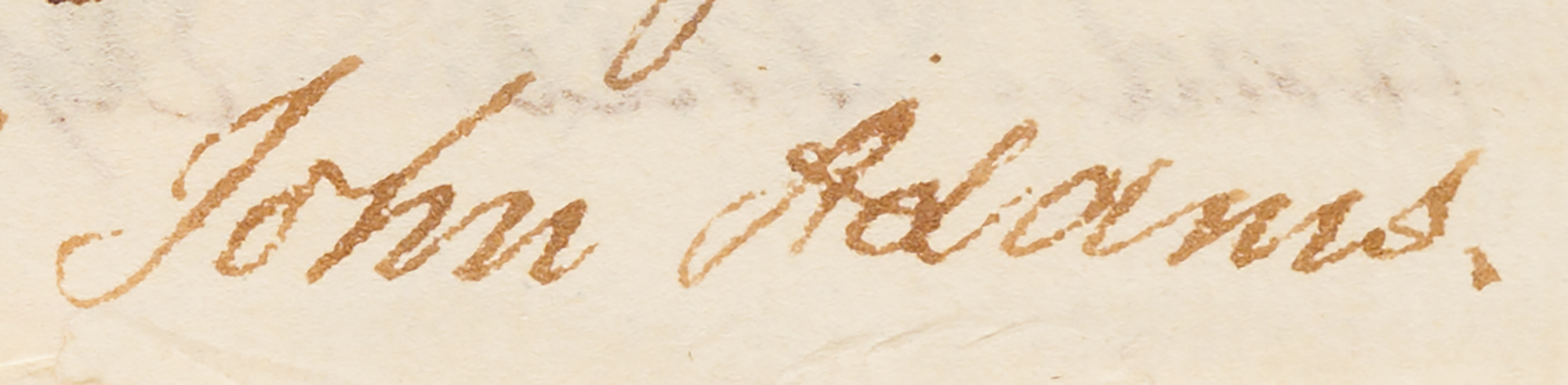
ALS, four pages on two adjoining sheets, 7.25 x 8.75, June 27, 1784. Addressed from “The Hague,” an important diplomatic letter to Elbridge Gerry concerning the organization of American diplomacy in Europe following the Treaty of Paris and the formal recognition of the United States' independence. Adams discusses Congress, John Jay, Henry Laurens, Francis Dana, Benjamin Franklin, negotiations with the European maritime powers, diplomatic accreditation, and the future structure of the American foreign service. In full:
“I received your Favours by Mr. Reed and by Col’l Herman, and am much obliged to you for your friendly sentiments and instructive communications.
Your Plan of a commission to treat with the maritime powers, has not it seems been adopted and the departure of Mr. Jay, for New York, has now rendered it, impracticable. Congress we are told is adjourned. Mr. Jay and Mr. Laurens, as well as Mr. Dana may be present at the Session in October and what will be the Result of the Advice of all, I cannot pretend to conjecture.
If Congress persists in the Plan of negotiating at Paris, with England and the other maritime powers they must send a Commission. Nothing can be done without Powers. But to Whom? To Franklin and me? Or will they send any new Hands? In my opinion the Method of negotiating at Paris had better be broken up and a Minister sent to England with Power to negotiate with some of the other Powers, as well as the Court of St. James’s, and Power sent to the Minister at Versailles, or to him at the Hague to treat with the rest, or part to one and part to the other. But if you continue to negotiate with all at Paris, you should accredite to the King, all the Ministers you employ. This is absolutely necessary in order to keep up, the respect to your Ministers which is their due. Without it, they are not entitled to any of the Prerogatives of the Law of Nations.
Accordingly this is the constant practice. e.g. Mr. Markoff, was lately joined with the Prince Baratinskoi, as Min. Plen. accredited to the King of France, authorized at the Sametime, to Sign the Treaty of Peace, as Mediator. Mr. Brantzen, was sent to Paris, by Holland to negotiate the Peace, jointly with Mr. Berkenrode. He was made Ambassador Extraordinary to the King of France, at the sametime that he had a Full Power with Berkenrode to make the Peace. It is in vain to think of keeping up your Character in Courts and with Diplomatic Bodies without conforming to their old established Usages, which they regard as Sacred. If you join me, therefore with Franklin or any other, to treat in France, I shall expect to have a Letter of Credence to the King. And this Expectation is the more reasonable as I have heretofore resided at the Court of Versailles, with the Powers, Rank and Character of Min. Plen. and I cannot now reside there, without it, but in a State of Degradation.
Congress will, I hope, write a polite Letter to every Sovereign of Europe, with whom they have no Treaty informing them of the final Establishment of their Independence and desiring to live in Friendship. These Letters may be Sent to your Ministers at Versailles the Hague or elsewhere or Some to one and Some to others under a Flying Seal of the United States and Signed by President Lee to be transmitted.
It is given out here, in France and in England that Franklin is determined to go home. If so, I should have no objection to going there, Sole, or connected with others, for finishing these negotiations, provided you pass a Resolution to defrey the Expense of the Removal of my Family Furniture etc. from home.” Adams adds a postscript along the left margin: “N.B. Yet I believe that the Scheme is to get Billy Franklin appointed in the Place of the old gents. Sweden is only a stalking horse.”
Written in the aftermath of the Treaty of Paris, formally ending the Revolutionary War, the letter captures John Adams at the center of the United States' earliest efforts to establish itself within the diplomatic system of Europe. Adams had been posted to The Hague since 1782, when he achieved one of the most significant diplomatic triumphs of the Revolutionary era, securing Dutch recognition of American independence and negotiating crucial loans from Dutch banking houses that helped sustain the Continental war effort. Writing from The Hague in June 1784, Adams addresses the unresolved structure of American foreign policy, ongoing treaty negotiations with the European maritime powers, and Congress's uncertainty regarding the future roles of its leading diplomats abroad. The letter references many of the principal architects of early American diplomacy – John Jay, Henry Laurens, Francis Dana, Benjamin Franklin, and Elbridge Gerry – while reflecting Adams's strong views on diplomatic authority, accreditation, and international protocol.
Particularly significant are Adams's extended remarks on the necessity of formal ministerial credentials and recognition by European courts. Insisting that American representatives conform to the "old established Usages" of European diplomacy, Adams argues that without proper accreditation American ministers would exist "in a State of Degradation." The letter vividly documents the practical challenges faced by the young republic as it attempted to secure equal standing among the established monarchies of Europe following independence. Those challenges were compounded by the structural limitations of the Articles of Confederation, which gave Congress limited authority over foreign policy and no reliable power to enforce treaty obligations or regulate commerce, the same congressional indecision and lack of coherent foreign policy direction that Adams's letter repeatedly reflects. Adams also notes the recent departure of John Jay for New York, where Jay would assume the role of Secretary of Foreign Affairs under the Confederation government, leaving a significant vacancy in the American diplomatic presence in Europe. Within weeks of this letter, Thomas Jefferson would arrive in Paris to join Franklin and Adams as the third American commissioner for commercial treaty negotiations, beginning to fill the diplomatic void Adams describes.
The concluding postscript contains unusually candid political commentary concerning William Temple Franklin, Benjamin Franklin's grandson and longtime diplomatic secretary, whom Adams dismissively calls "Billy Franklin." Adams writes: "I believe that the Scheme is to get Billy Franklin appointed in the Place of the old gents. Sweden is only a stalking horse." The remark appears to reflect Adams's suspicion that proposed diplomatic initiatives involving Sweden were being used indirectly to advance William Temple Franklin's diplomatic prospects following Benjamin Franklin's anticipated retirement from European service. The passage offers a glimpse into the factional rivalries and personal tensions that frequently shaped American diplomacy during the Confederation era. Adams's closing reference to "the Removal of my Family Furniture" carries personal resonance as well, as Abigail Adams and their daughter had sailed from Boston that same month to join him in Europe after a separation of nearly four years, ending one of the most celebrated epistolary partnerships in American history.
Letters of this depth and political candor from Adams’s European diplomatic service are highly desirable, particularly those combining notable content on American foreign policy, Congress, European negotiations, diplomatic protocol, and Franklin family politics during the formative years of the United States government.

This item is Pre-Certified by PSA/DNA
Buy a third-party letter of authenticity for
$150.00
*This item has been pre-certified by a trusted third-party authentication service, and by placing a bid on this item, you agree to accept the opinion of this authentication service. If you wish to have an opinion rendered by a different authenticator of your choosing, you must do so prior to your placing of any bid. RR Auction is not responsible for differing opinions submitted 30 days after the date of the sale.
Third-party authentication service applies only to signatures and handwriting, and does not cover the addition of sketches, artwork, musical quotations, etc.

