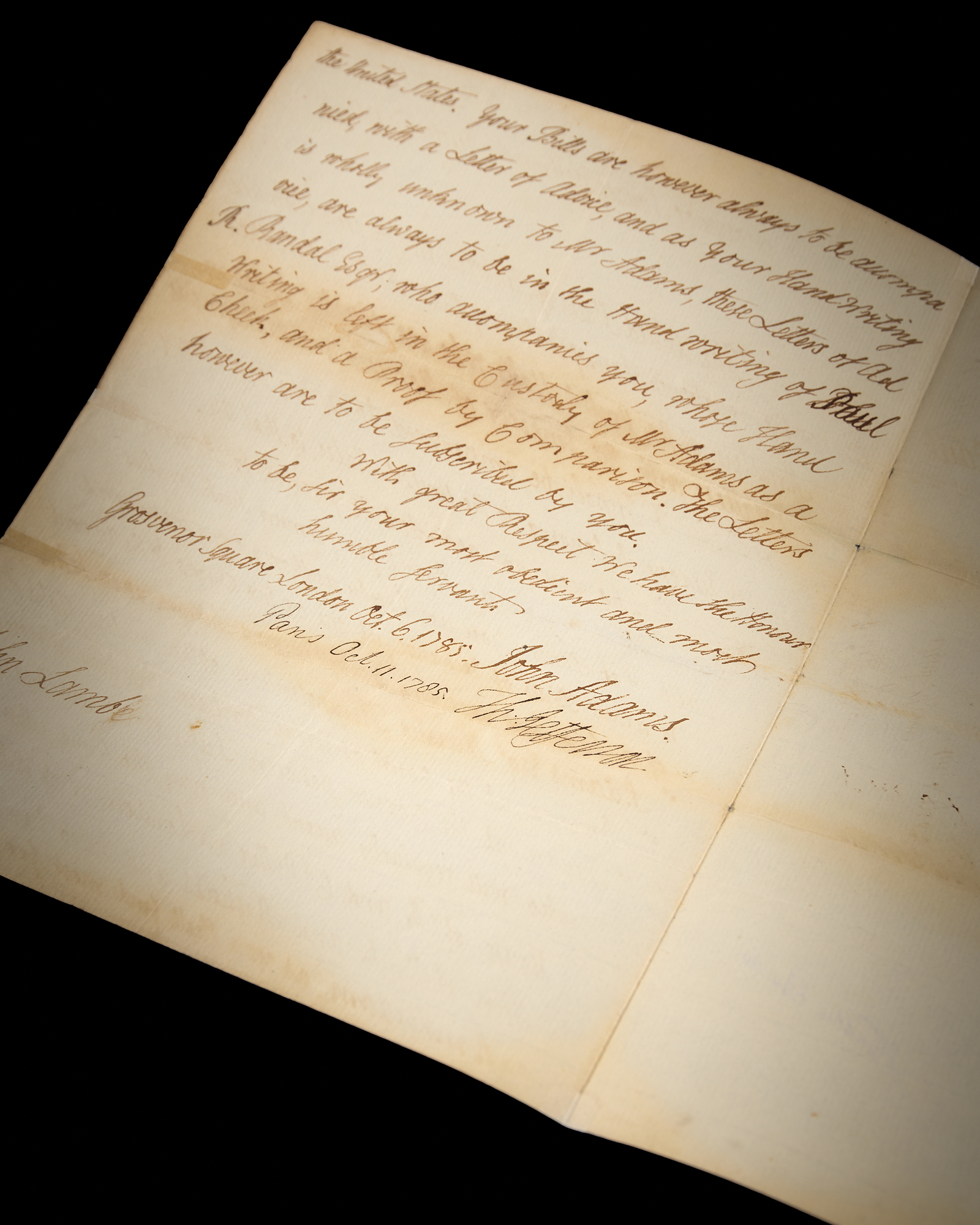
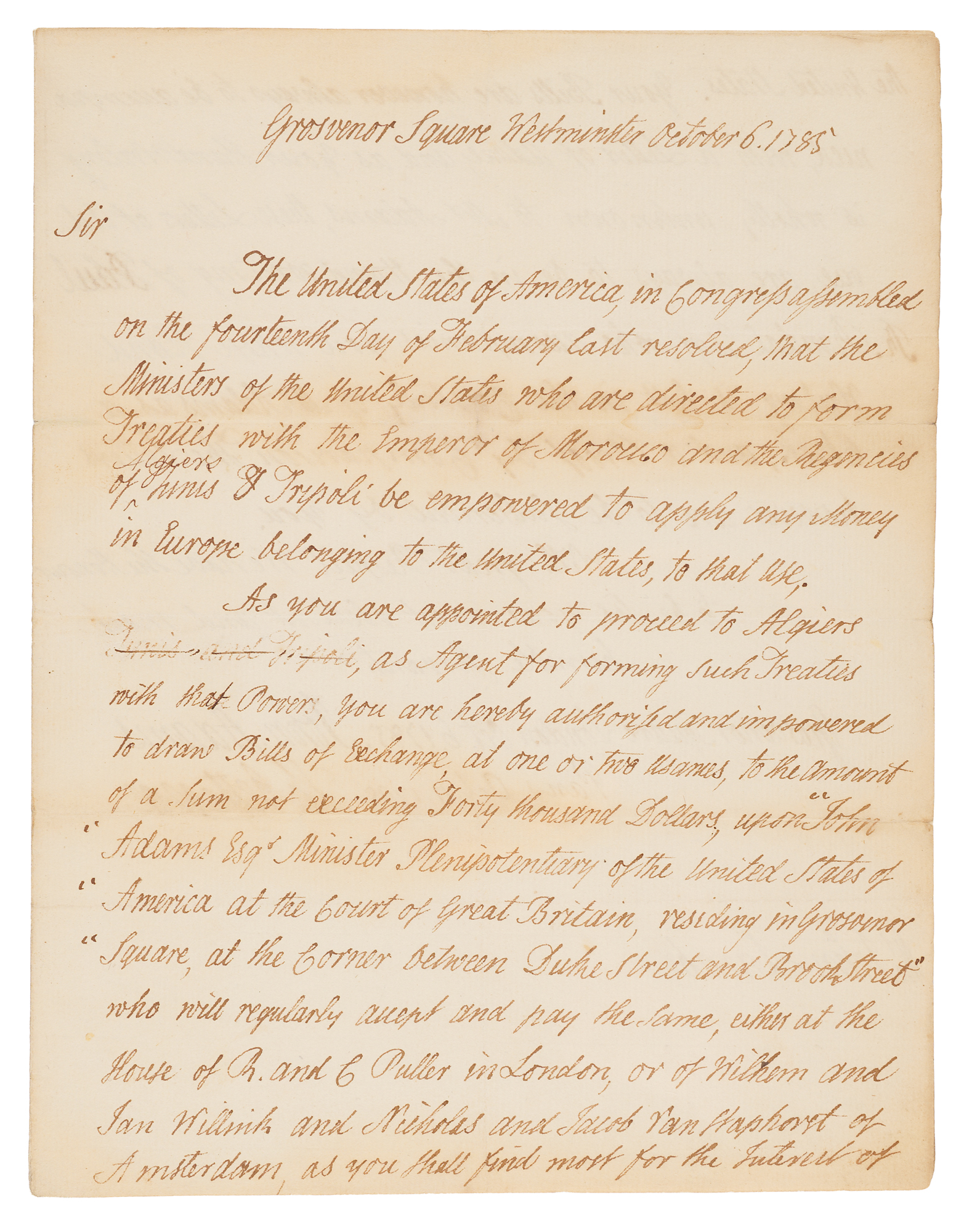
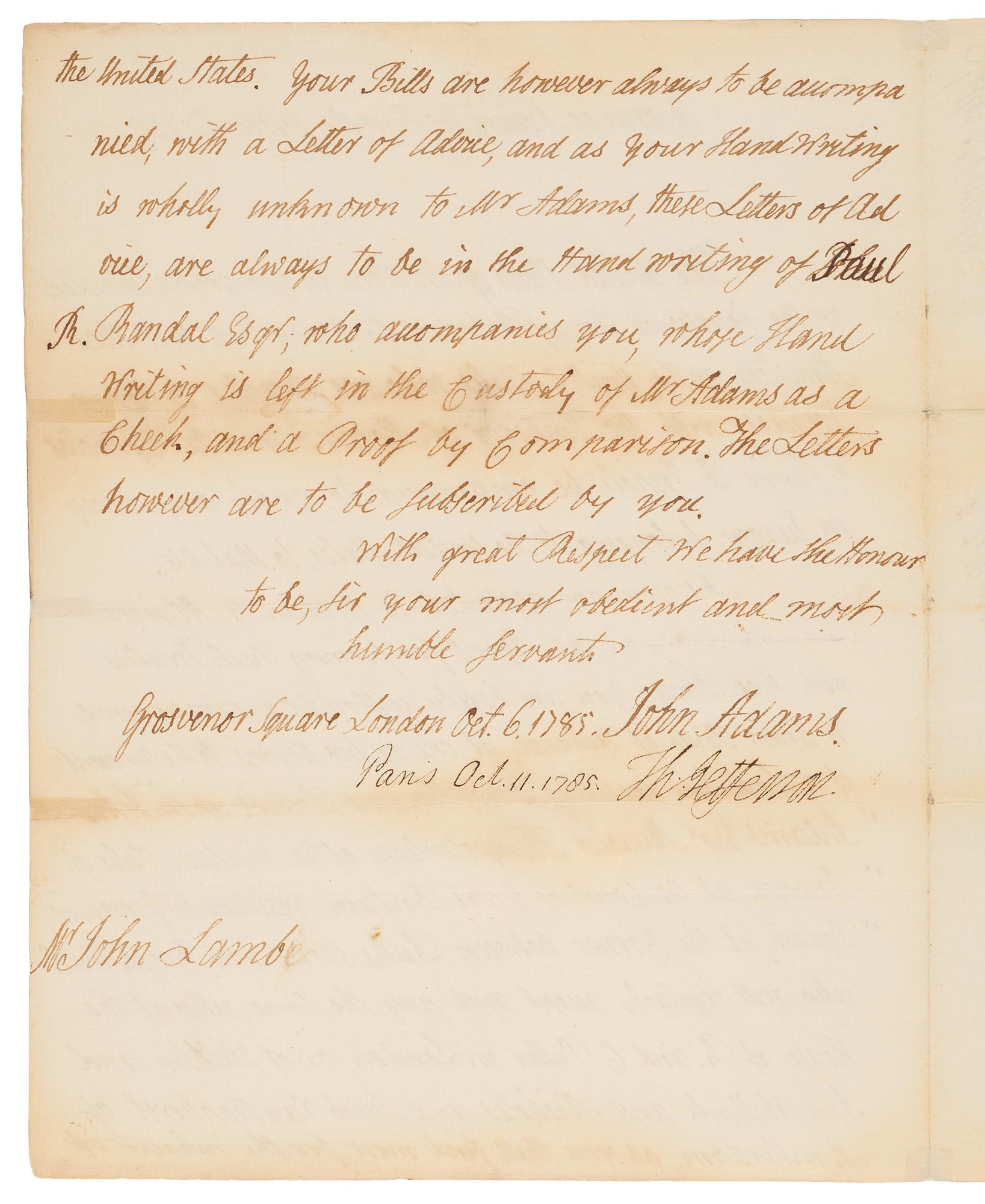
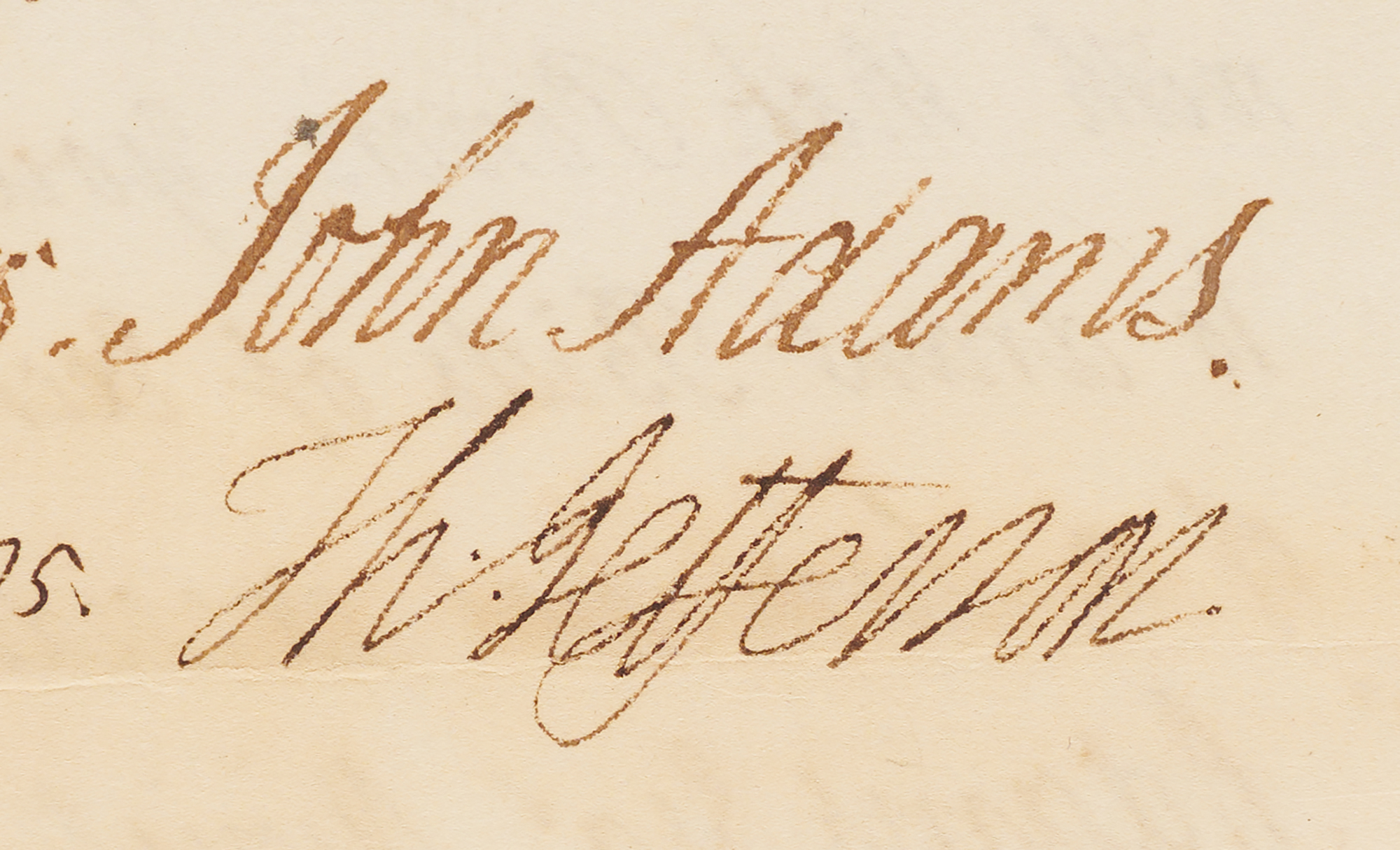
Important Confederation-era ALS signed by John Adams in London on October 6, 1785, and countersigned five days later in Paris by Thomas Jefferson (“Th: Jefferson”) on October 11, 1785, one page both sides, 7.75 x 9.75. Addressed from Grosvenor Square, the letter authorizes Connecticut merchant and sea captain John Lamb to negotiate with the Barbary powers and draw funds for the ransom of American seamen held captive in North Africa. Issued just over two years after the Treaty of Paris formally ended the Revolutionary War, the document reflects one of the earliest diplomatic crises confronting the newly independent United States as American shipping came under threat from Algiers, Tunis, and Tripoli.
In full: "Grosvenor Square London Westminster October 6. 1785. Sir / The United States of America, in Congress Assembled on the 14th day of February last resolved, that the Ministers of the United States who are directed to form Treaties with the Emperor of Morocco and the Regencees of Algiers Tunis & Tripoli be empowered to apply any Money in Europe belonging to the United States to that use: As you are appointed to proceed to Algiers [“Tunis and Tripoli” struck through] as Agent for forming such Treaty with the Emperor you are hereby authorized & empowered to draw Bills of Exchange to the amount of a sum not exceeding twenty thousand Dollars, at one or two usances, upon 'John Adams Esqr Minister Plenipotentiary of the United States of America at the Court of Great Britain, residing in Grosvenor Square, at the corner between Duke Street & Brook Street,' who will regularly accept & pay the same either at the house of R & C Puller in London or of Wilhem & Jan Willink & Nicholas & Jacob Staphorst at Amsterdam. Your Bills are however to be always accompanied with a letter of Advice in your own hand writing to Mr Adams, a duplicate of which you will also send by some other conveyance.” Signed neatly at the conclusion by both Adams and Jefferson. In fine condition, with light toning along the folds.
Issued by the two future presidents at the peak of their European diplomatic partnership – Adams as Minister Plenipotentiary in London and Jefferson as Minister Plenipotentiary in Paris – this document was signed at separate capitals on different days, a practice the diplomatic historian Hunter Miller described as ‘highly unusual’ in eighteenth-century treaty-making. The notable strikethrough of “Tunis and Tripoli” reflects a humanitarian pivot: just weeks before this document was signed, Algerian corsairs had captured the Boston schooner Maria on July 25, 1785, off Cape St. Vincent, followed five days later by the Philadelphia ship Dauphin west of Lisbon. Twenty-one American sailors, including the seventeen-year-old James Leander Cathcart, who would spend the next eleven years as a slave and eventually serve as chief Christian clerk to the Dey of Algiers, were carried into captivity. Adams and Jefferson narrowed Lamb's mission to Algiers because that was where their fellow citizens were enslaved.
Lamb's mission ultimately failed: he arrived in Algiers in March 1786 to find the Dey demanding nearly three times the $20,000 authorized here. The 21 sailors would remain enslaved for a full decade; the final ransom in 1796 cost $642,000 plus annual tribute and a 36-gun frigate. Adams and Jefferson would later split sharply on how to respond to the Barbary crisis, with Jefferson favoring naval force, and Adams favoring tribute, a policy fork that this very document opens, and which culminated in the First Barbary War during Jefferson's presidency. Dual-signed documents by Adams and Jefferson are among the most desirable artifacts in American autograph collecting, and operational orders from their joint commission are particularly uncommon.
A prior catalog description states that this letter was previously known only through a retained copy recorded in Adams’s contemporary letterbook and later resurfaced in a collection assembled in 1902.

This item is Pre-Certified by PSA/DNA
Buy a third-party letter of authenticity for
(inquire for price)
*This item has been pre-certified by a trusted third-party authentication service, and by placing a bid on this item, you agree to accept the opinion of this authentication service. If you wish to have an opinion rendered by a different authenticator of your choosing, you must do so prior to your placing of any bid. RR Auction is not responsible for differing opinions submitted 30 days after the date of the sale.
Third-party authentication service applies only to signatures and handwriting, and does not cover the addition of sketches, artwork, musical quotations, etc.

