Sold For $22,035
*Includes Buyers Premium
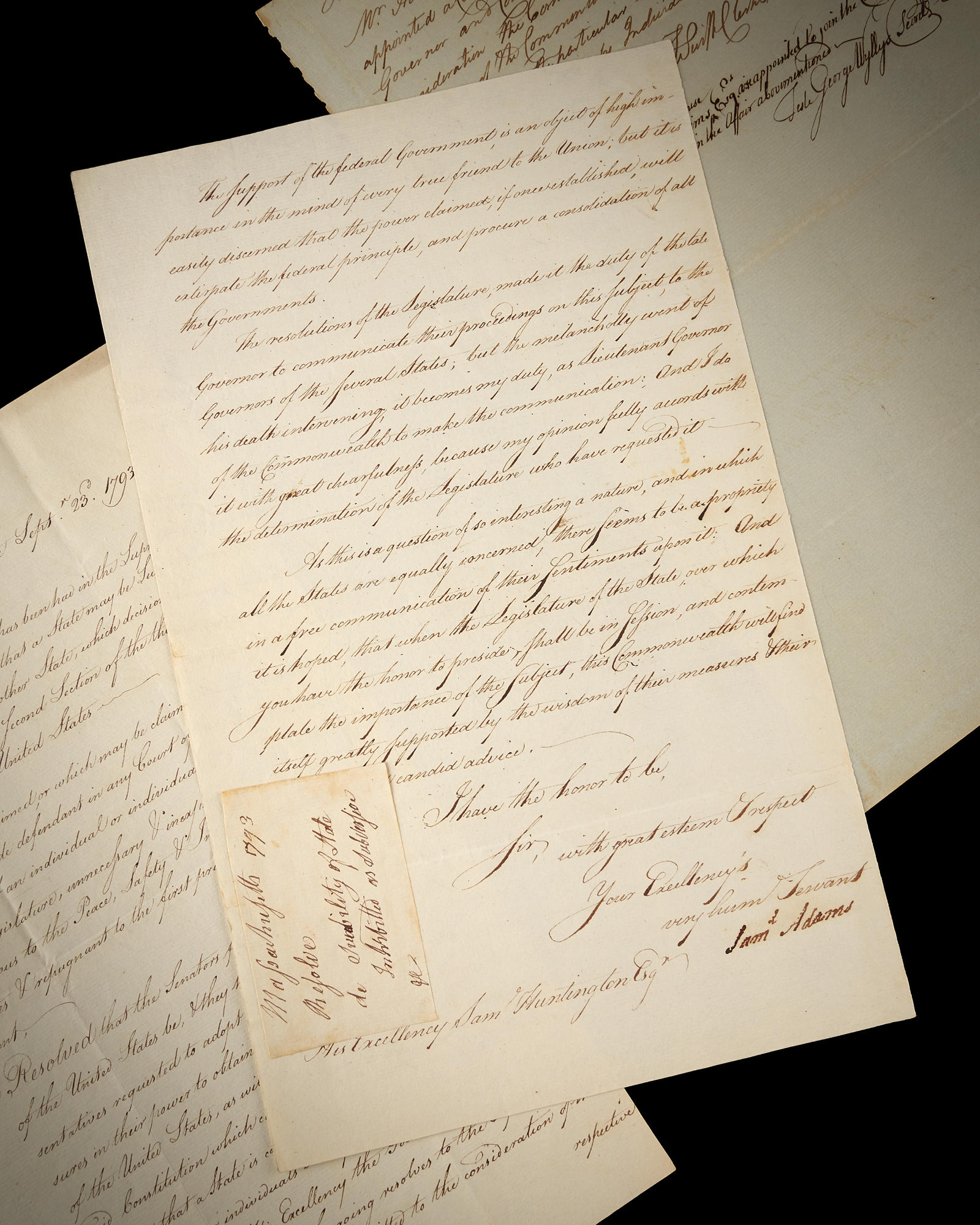
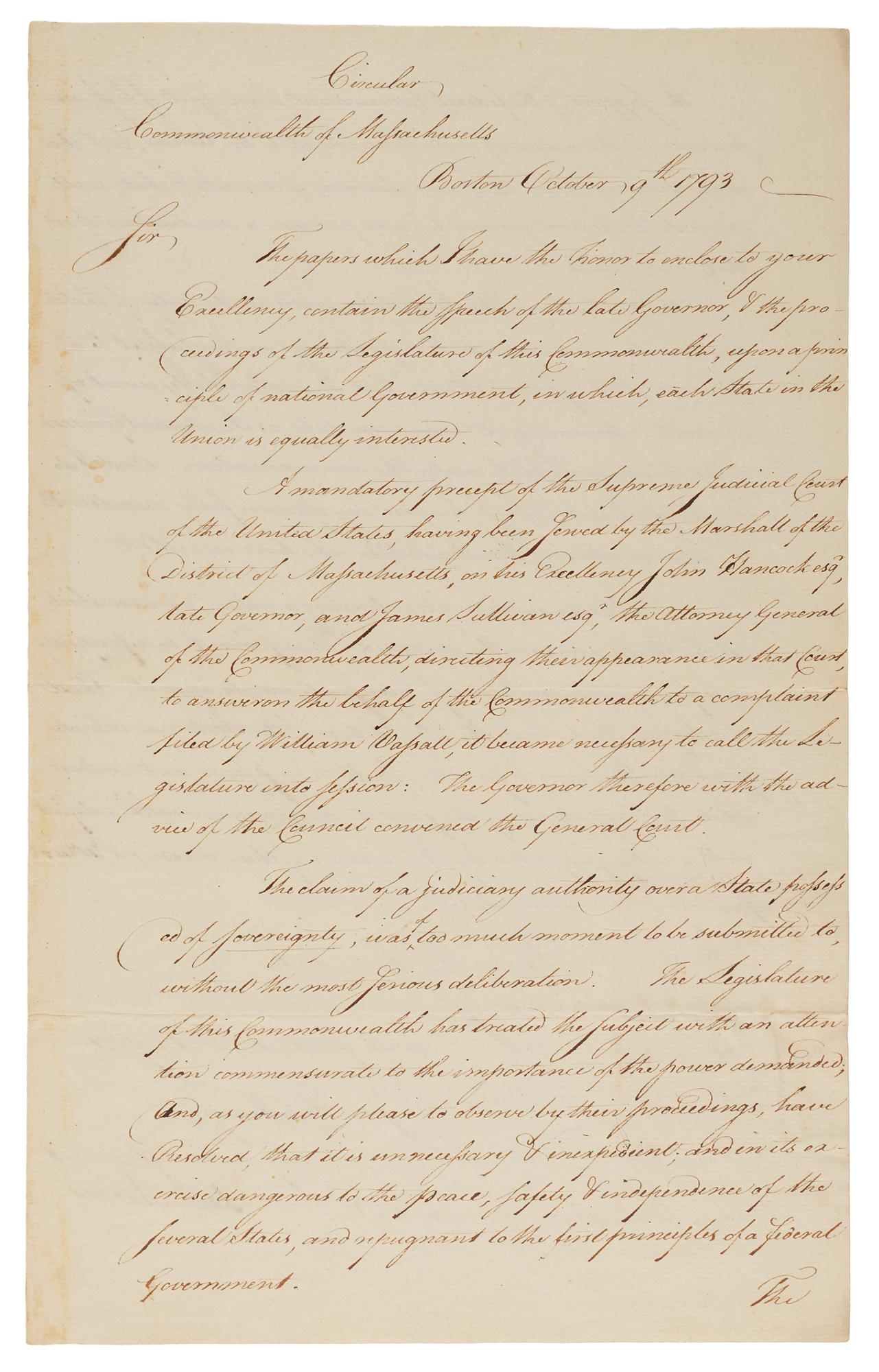
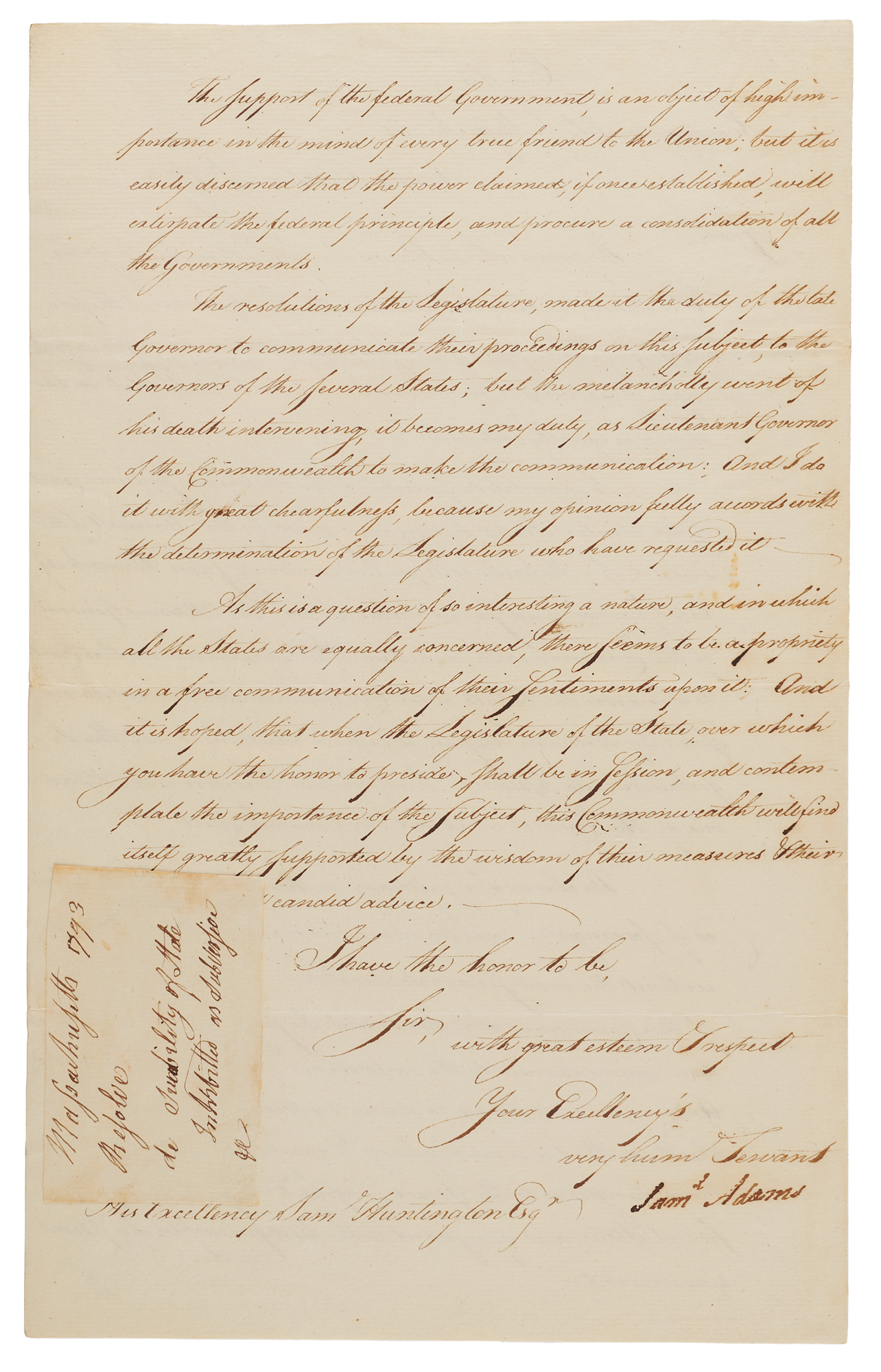
LS signed “Sam'l Adams,” one page both sides, 8 x 12.75, Boston, October 9, 1793. Written on his first day as Acting Governor of Massachusetts, Adams transmits to Samuel Huntington, governor of Connecticut, a powerful circular letter arguing for the “first principles of a federal government” in direct response to Chisholm v. Georgia, the Supreme Court decision that prompted the Eleventh Amendment.
In part: “The claim of a judiciary authority over a State possessed of sovereignty was of too much moment to be submitted to without the most serious deliberation. The Legislature of this Commonwealth has treated the subject with an attention, commensurate to the importance of the power demanded; And, as you will please to observe by their proceedings, have Resolved, that it is unnecessary & inexpedient; and in its exercise dangerous to the peace, safety & independence of the several States, and repugnant to the first principles of a Federal Government…the power claimed, if once established, will extirpate the federal principle, and produce a consolidation of all governments.”
Adams urges coordinated action, noting that the states “are equally concerned” in preserving their sovereignty, laments the loss of John Hancock on the previous day: "The resolutions of the Legislature, made it the duty of the late Governor to communicate their proceedings on this subject, to the Governors of the several States; but the melancholly event of his death intervening, it becomes my duty, as Lieutenant Governor of the Commonwealth to make the communication." In fine condition.
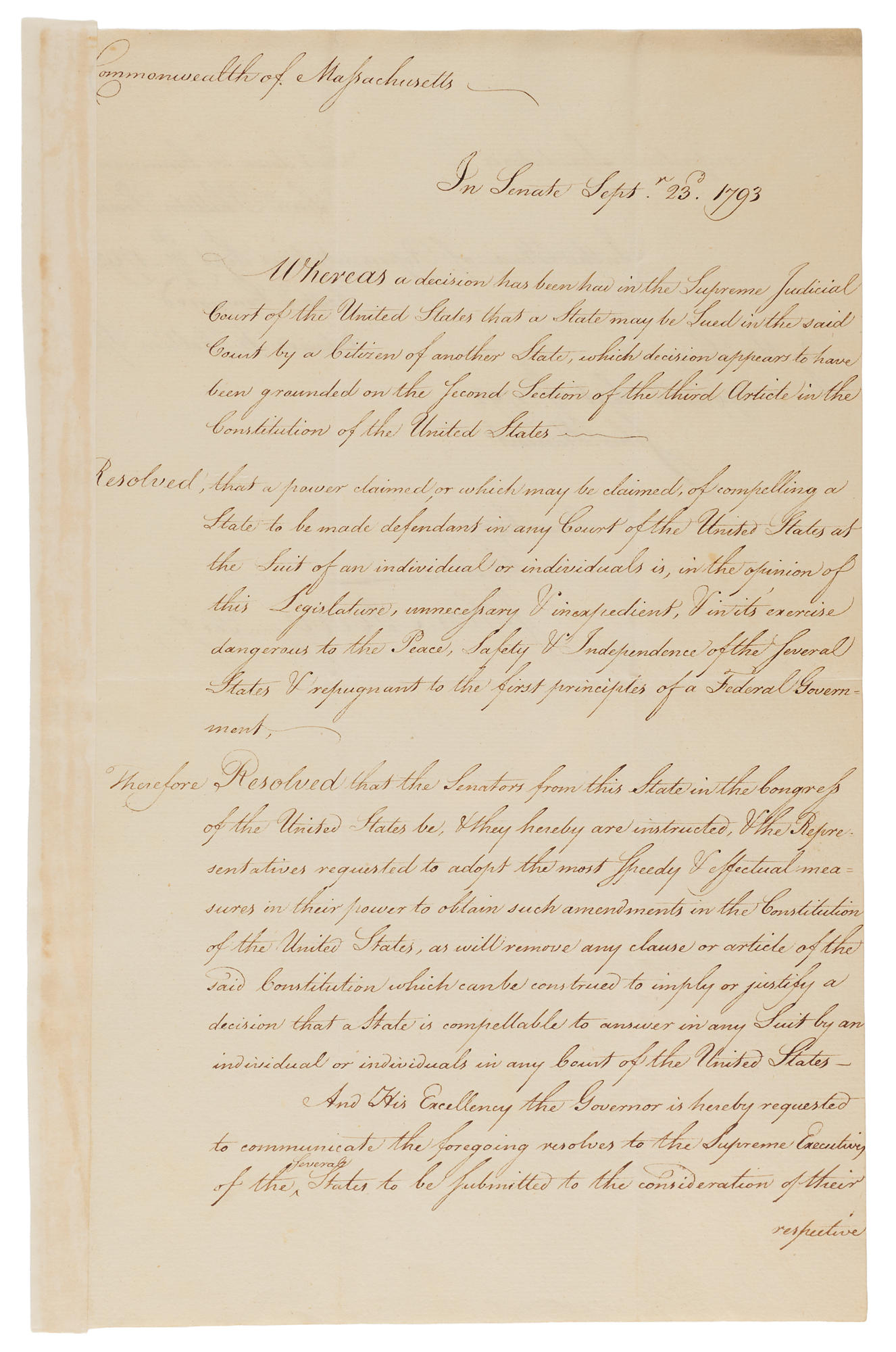
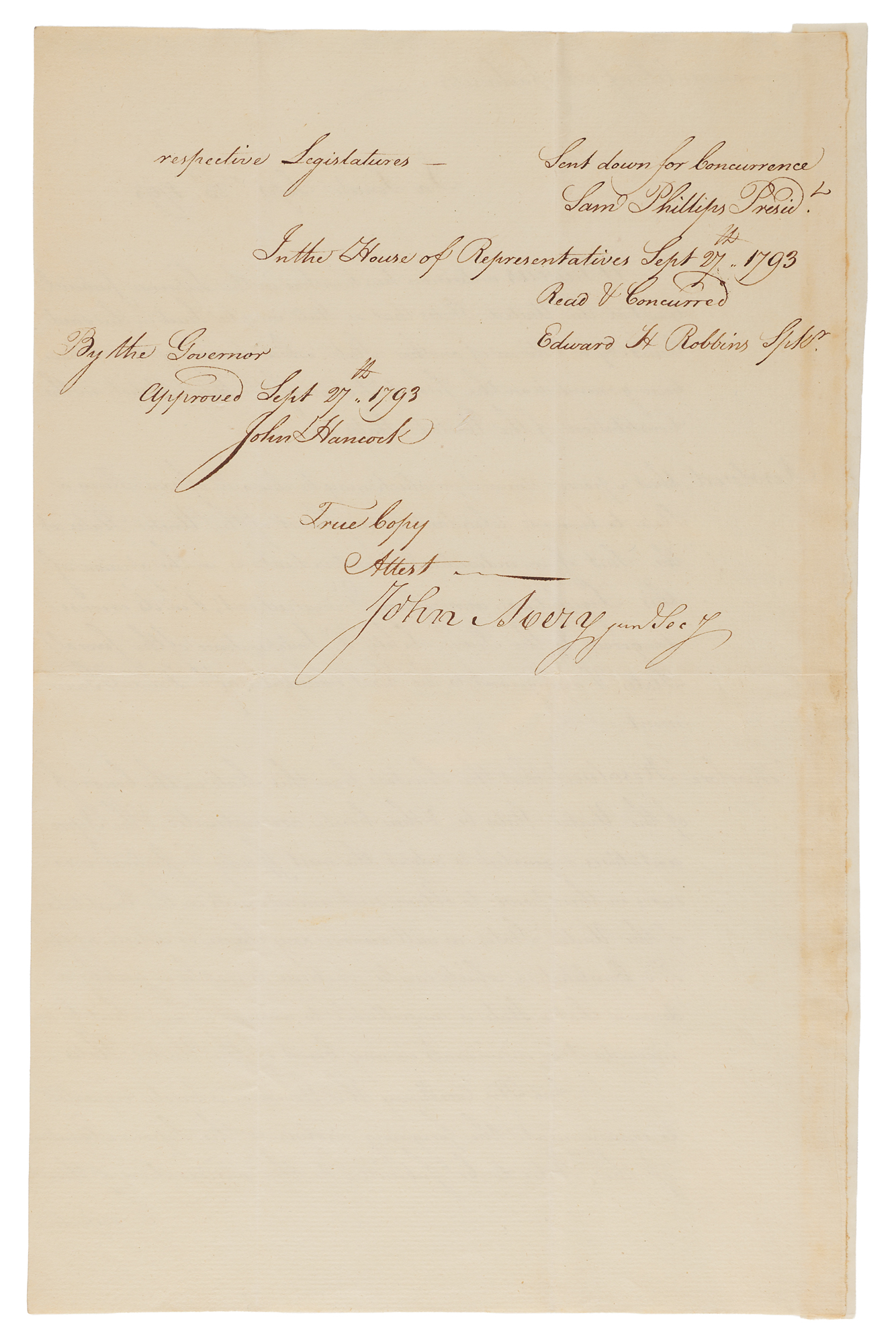
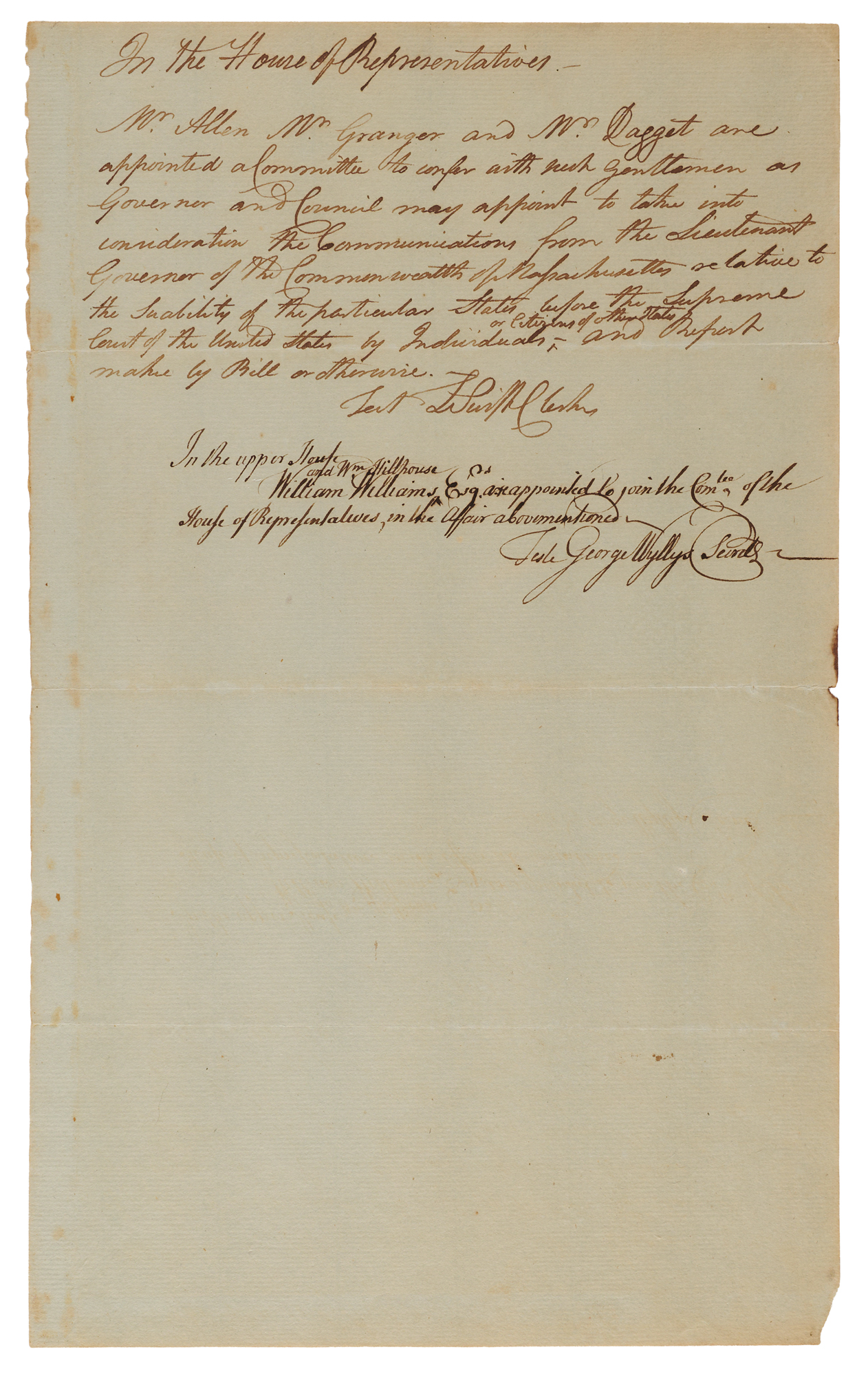
The letter is accompanied by a contemporary manuscript “true copy” of the Commonwealth's resolution passed September 23, 1793, signed by John Avery (with secretarial signature of then-governor John Hancock), and a manuscript document from the Connecticut House of Representatives, signed by George Wyllys, appointing William Williams to a committee to "take into consideration the Communications from the Lieutenant Governor of the Commonwealth of Massachusetts."
The Commonwealth's resolution, in part: "Resolved that a power claimed or which may be claimed of compelling a State to be made defendant in any court of the United States at the suit of an individual or individuals is, in the opinion of this Legislature, unnecessary & inexpedient, & in it's exercise dangerous to the Peace, Safety & Independence of the several States & repugnant to the first principles of a Federal Government, Therefore, Resolved, that the Senators from this State in the Congress of the United States be, & they hereby are, instructed, & the Representatives requested to adopt the most speedy and effectual measures in their power to obtain such amendments in the Constitution of the United States, as will remove any clause or article of the said Constitution which can be construed to imply or justify a decision that a State is compellable to answer in any Suit by an individual or individuals in any Court of the United States."
Emerging from the Revolution as one of the foremost champions of colonial rights and republican self-government, Samuel Adams remained deeply suspicious of any authority that threatened to consolidate power at the expense of the states. His alarm in this letter reflects one of the earliest constitutional crises of the new federal republic: the Supreme Court’s 1793 decision in Chisholm v. Georgia, which held that a state could be sued in federal court by a citizen of another state. To Adams and the Massachusetts legislature, this ruling struck at the very structure of federalism, reducing sovereign states to ordinary defendants before a national judiciary and opening the door to what Adams called a “consolidation of all governments.”
The moment was made still more dramatic by the death of Governor John Hancock the previous day, leaving Adams, on his first day as Acting Governor, to carry forward Massachusetts’s protest and urge coordinated resistance among the states. The controversy quickly produced a rare and decisive constitutional response: Congress proposed the Eleventh Amendment in 1794, and it was ratified in 1795, establishing that the judicial power of the United States does not extend to suits against a state by citizens of another state or by citizens or subjects of a foreign state.

This item is Pre-Certified by PSA/DNA
Buy a third-party letter of authenticity for
$250.00
*This item has been pre-certified by a trusted third-party authentication service, and by placing a bid on this item, you agree to accept the opinion of this authentication service. If you wish to have an opinion rendered by a different authenticator of your choosing, you must do so prior to your placing of any bid. RR Auction is not responsible for differing opinions submitted 30 days after the date of the sale.
Third-party authentication service applies only to signatures and handwriting, and does not cover the addition of sketches, artwork, musical quotations, etc.

