Sold For $5,375
*Includes Buyers Premium
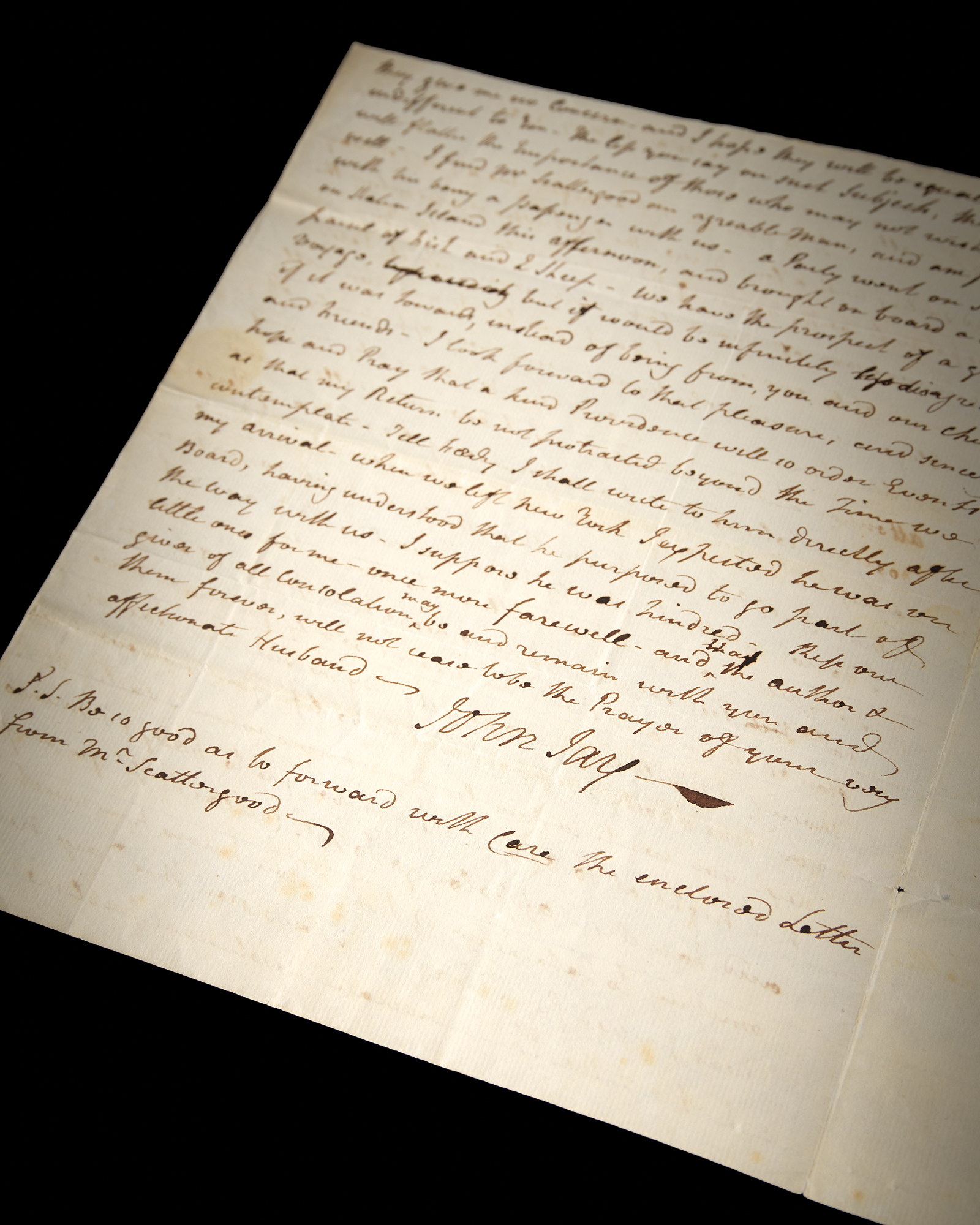
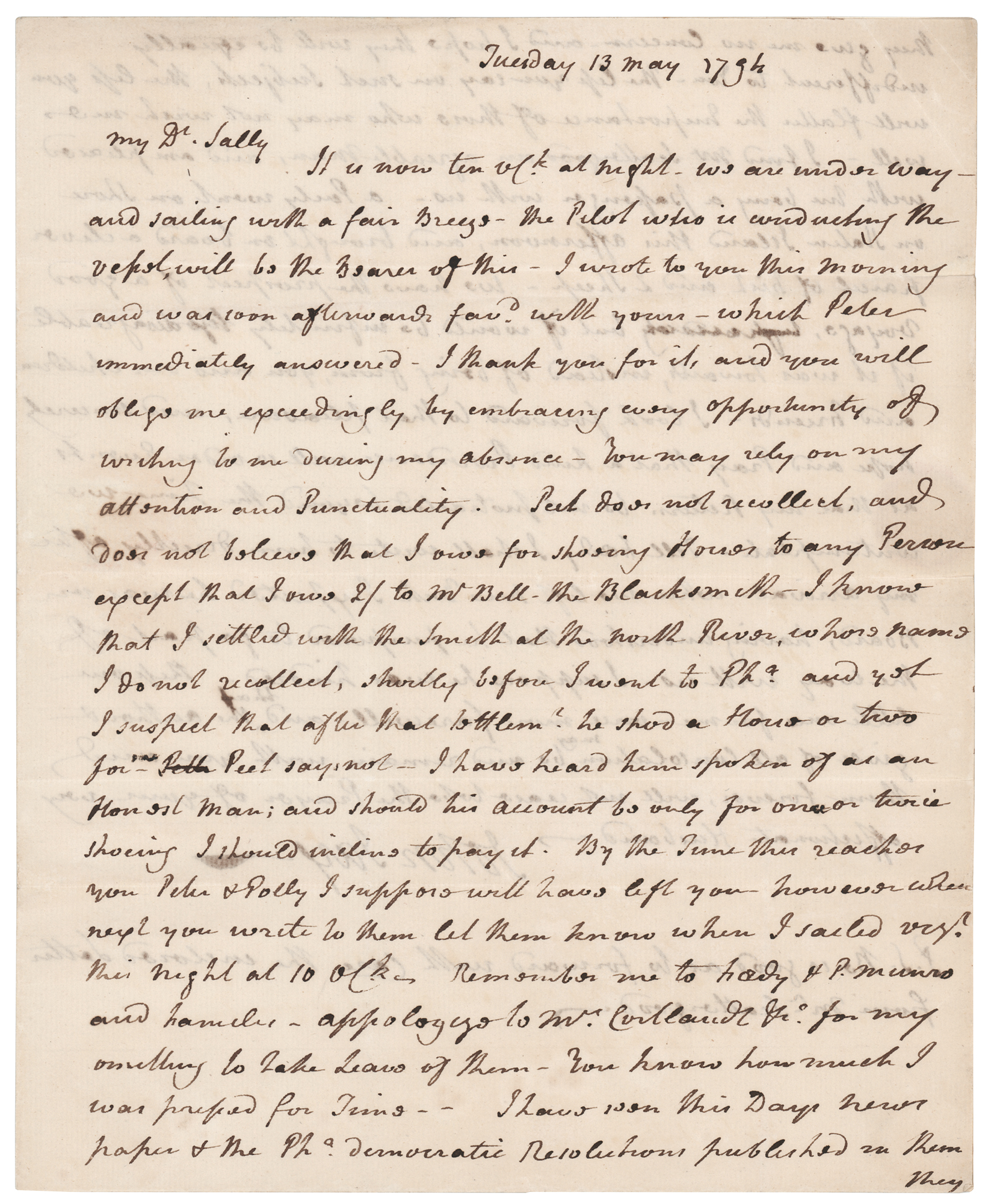
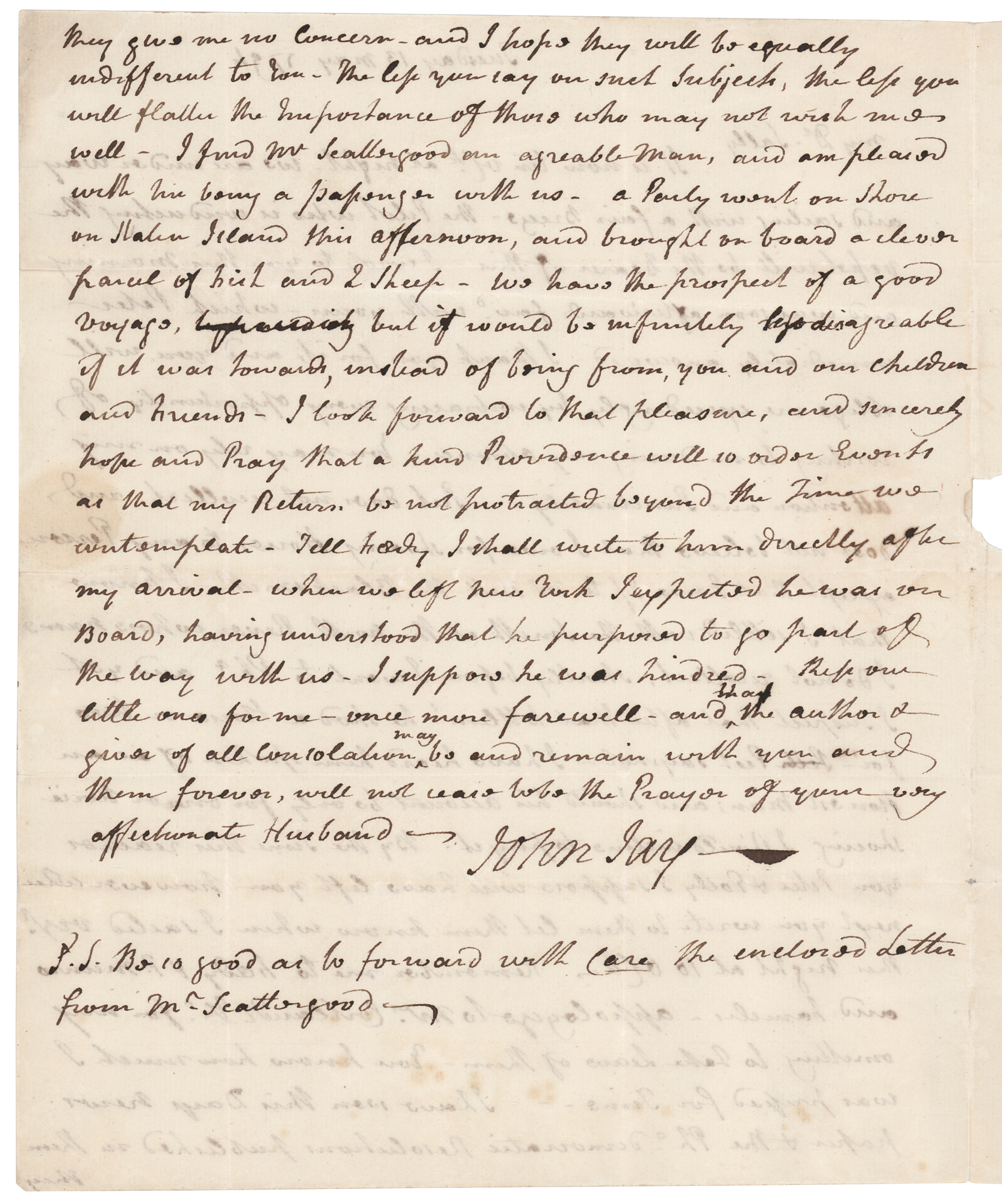
ALS, one page both sides, 8 x 10, May 13, 1794. Handwritten letter from Boston to his wife, Sarah Livingston Jay, whom he affectionately calls “My Dear Sally.” Jay writes from on board the ship Ohio, at the start of his journey to London, where he would negotiate what became known as the Jay Treaty.
In full: "It is now ten oC'k at night. We are under way—and sailing with a fair Breeze. The Pilot who is conducting the vessel, will be the Bearer of this. I wrote to you this morning and was soon afterwards facd. with yours—which Peter immediately answered. I thank you for it, and you will oblige me exceedingly, by embracing every opportunity of writing to me during my absence. You may rely on my attention and Punctuality. Peel does not recollect, and does not believe that I owe for shoeing Horses to any Person except that I owe 2/ to Mr. Bell—the Blacksmith—I know that I settled with the smith at the north River, whose name I do not recollect, shortly before I went to Ph[iladelphi]a and yet I suspect that after that—he shod a Horse or two for me. Peel says not—I have heard him spoken of as an Honest man; and should his account be only for once or twice shoeing I should incline to pay it. By the Time this reaches you Peter & Polly I suppose will have left you—however when next you write to them let them know when I sailed—this night at 10 oC'k—Remember me to Fordy & P. Munro and Families. Appologize to Mr. Cortlandt &c for my omitting to take Leave of them. You know how much I was pressed for Time—
I have seen this Days news paper & the Ph[iladelphi]a Democratic Resolutions published in them. They give me no concern—and I hope they will be equally indifferent to You. The less you say on such Subjects, the less you will flatter the Importance of those who may not wish me well. I find Mr. Scattergood an agreable man, and am pleased with his being a passenger with us—a Party went on shore on Staten Island this afternoon and brought on board a clever parcel of Fish and 2 Sheep. We have the prospect of a good voyage, but it would be infinitely less disagreable if it was towards, instead of being from, you and our children and Friends. I look forward to that pleasure, and sincerely hope and Pray that a kind Providence will so order Events as that my Return be not protracted beyond the Time we contemplate. Tell Fordy I shall write to him directly after my arrival. When we left New York I expected he was on Board, having understood that he purposed to go part of the way with us. I suppose he was hindred. Kiss our little ones for me—once more farewell—and that the author & giver of all consolation may be and remain with you and them forever, will not cease to be the Prayer of your very affectionate Husband." In a postscript Jay adds, "Be so good as to forward with Care the enclosed Letter from Mr. Scattergood." In fine condition, with a small area of seal-related paper loss to the integral address leaf.
In 1794 the United States faced its most important foreign crisis since the Revolution, and as Chief Justice, John Jay was selected by George Washington to negotiate a settlement with Great Britain concerning that country's continued occupation of posts in the northwest, pending private debts to English creditors, and the British plunder of neutral American shipping during their hostilities with France. The importance to the young America of maintaining peace and financial stability was enormous, and Jay spent the summer of 1794 in London negotiating with Lord Grenville to reach an agreement.
The result of his work, the Jay Treaty, which was signed on November 19, 1794, created a system to settle financial claims between the two nations, provided for the removal of British troops from the Northwest Territory, established commissions to settle boundary disputes on the northern frontier, and extended free trade and navigation guarantees to the English on the Mississippi River. It was submitted to the United States Senate for its advice and consent on June 8, 1795, and ratified by a two-thirds majority on June 24, 1795.
The Treaty, however, aroused a storm of protest in the United States among the Jeffersonian Republicans, who denounced it as a sellout by pro-British Federalists. Mobs burned Jay in effigy, and opponents denounced him as a traitor. Before the negotiations, Jay at one time had been considered a leading candidate to succeed Washington, but the unpopular treaty ruined whatever chances he had for the presidency. New York Federalists, however, elected him governor after his return from England.
This item is Pre-Certified by PSA/DNA
Buy a third-party letter of authenticity for
$100.00
*This item has been pre-certified by a trusted third-party authentication service, and by placing a bid on this item, you agree to accept the opinion of this authentication service. If you wish to have an opinion rendered by a different authenticator of your choosing, you must do so prior to your placing of any bid. RR Auction is not responsible for differing opinions submitted 30 days after the date of the sale.
Third-party authentication service applies only to signatures and handwriting, and does not cover the addition of sketches, artwork, musical quotations, etc.

