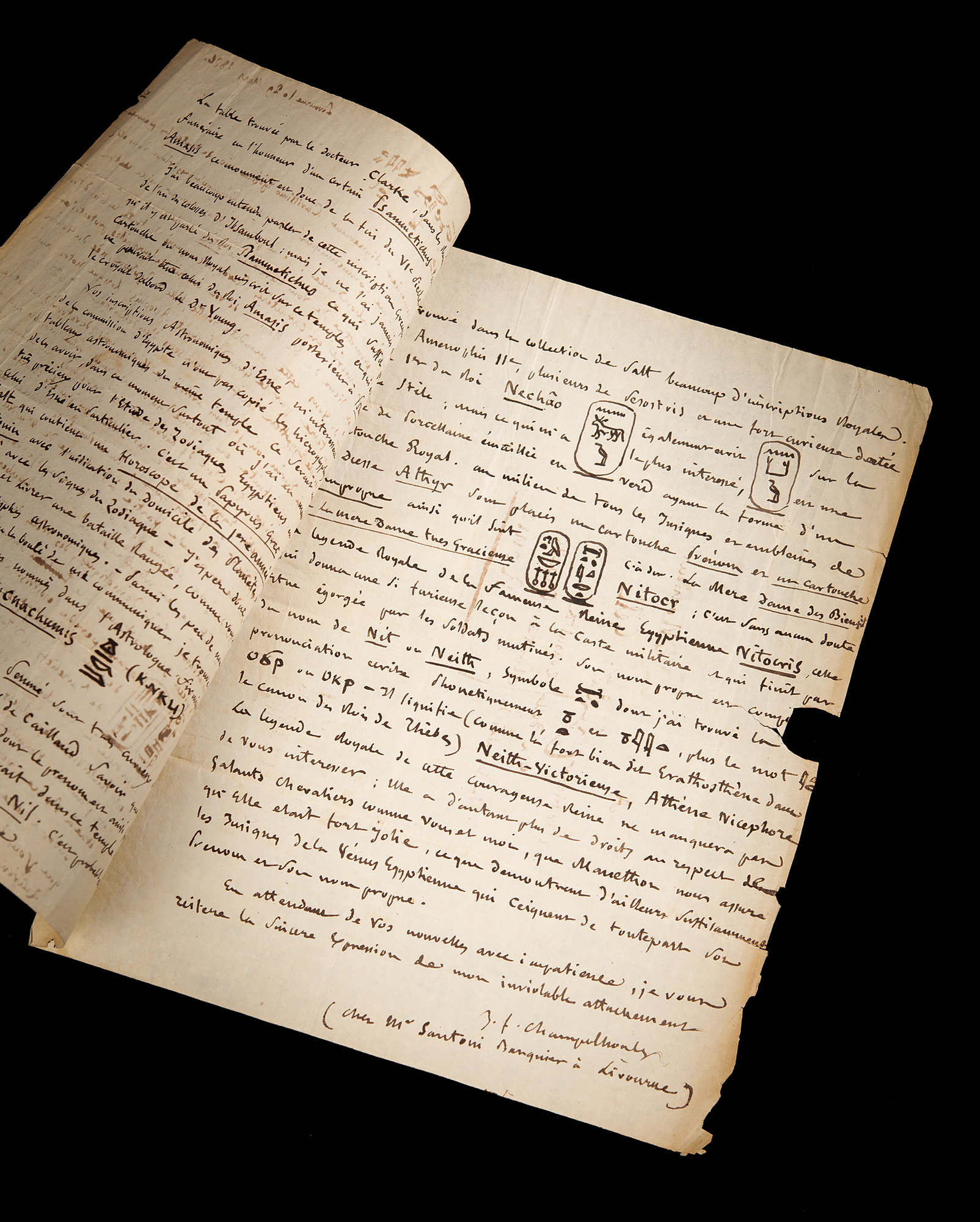
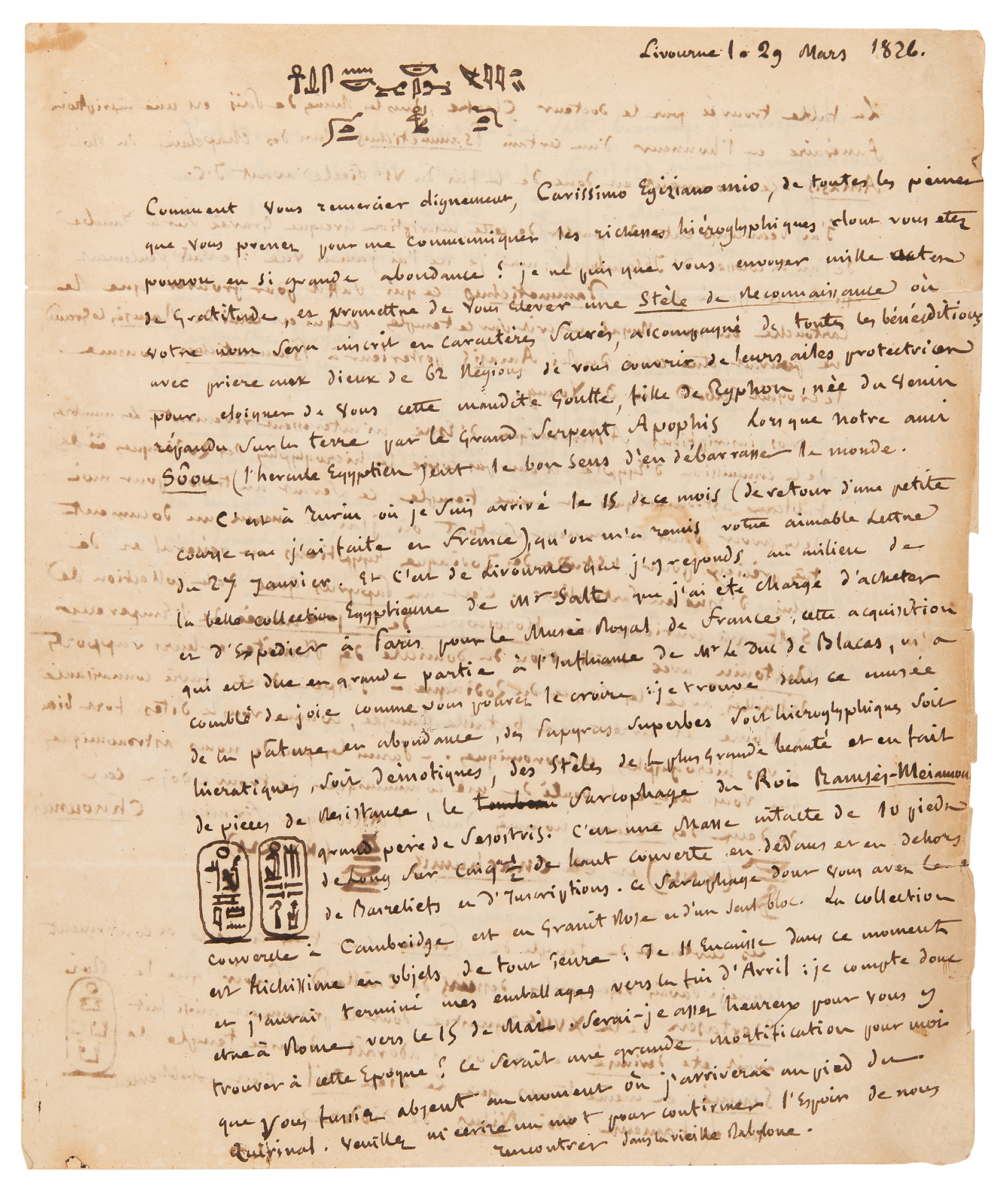
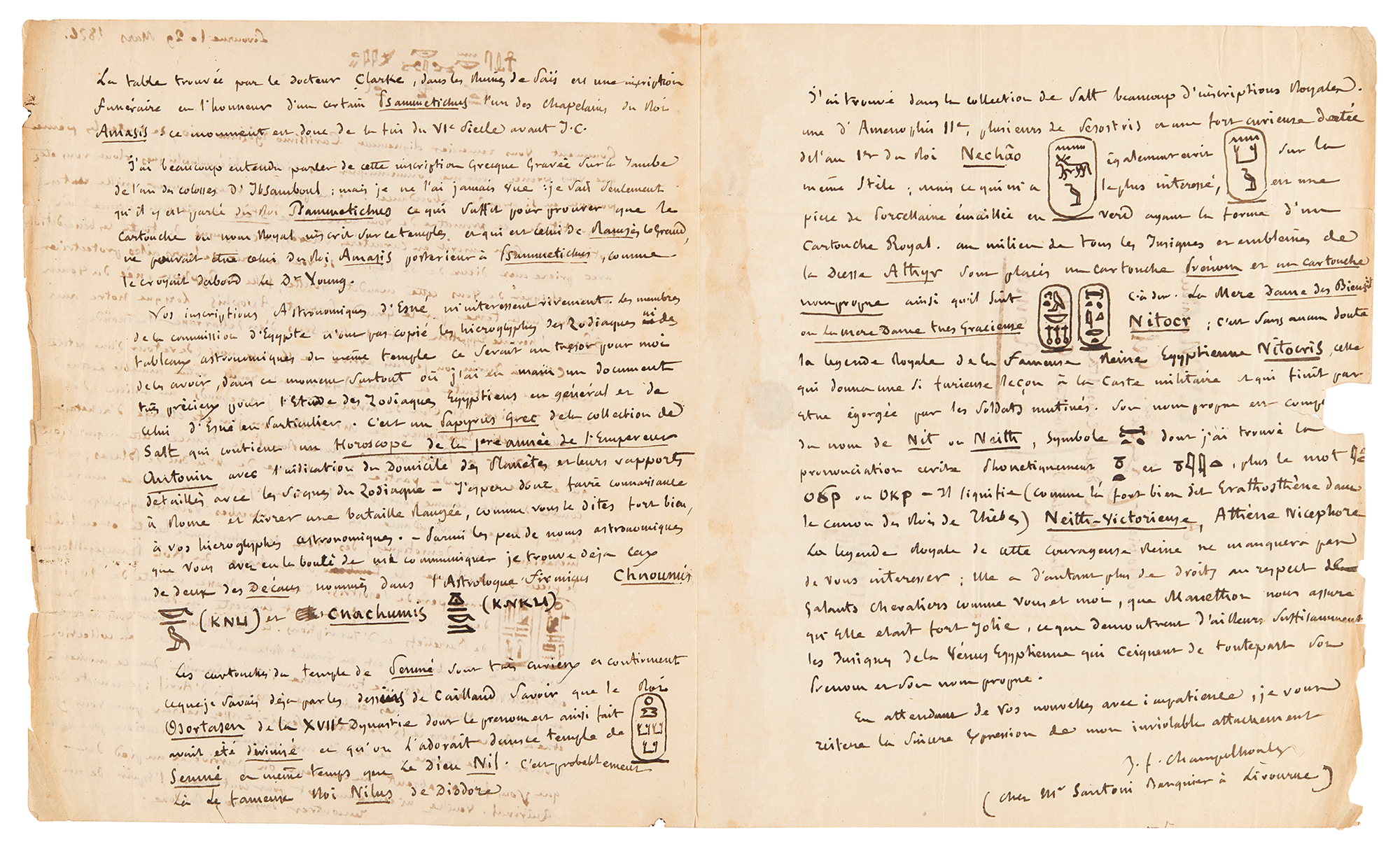

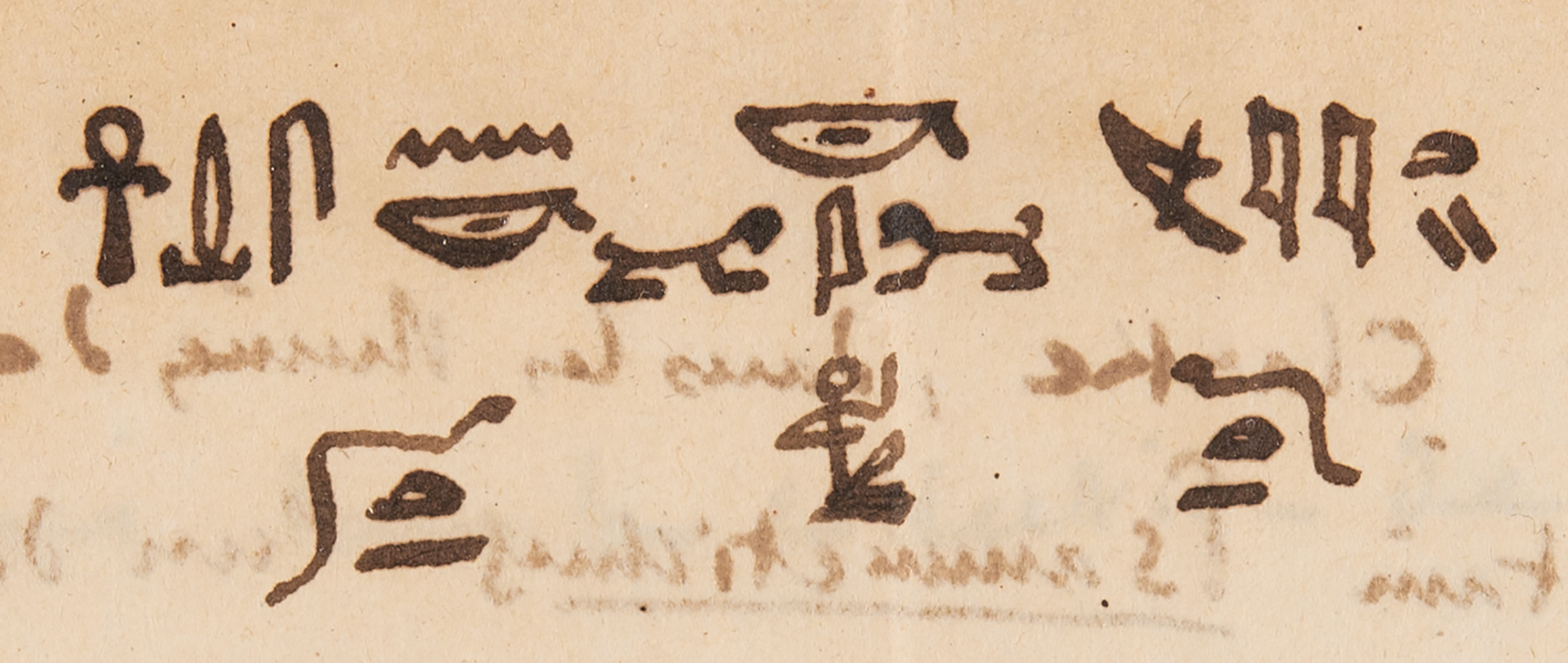
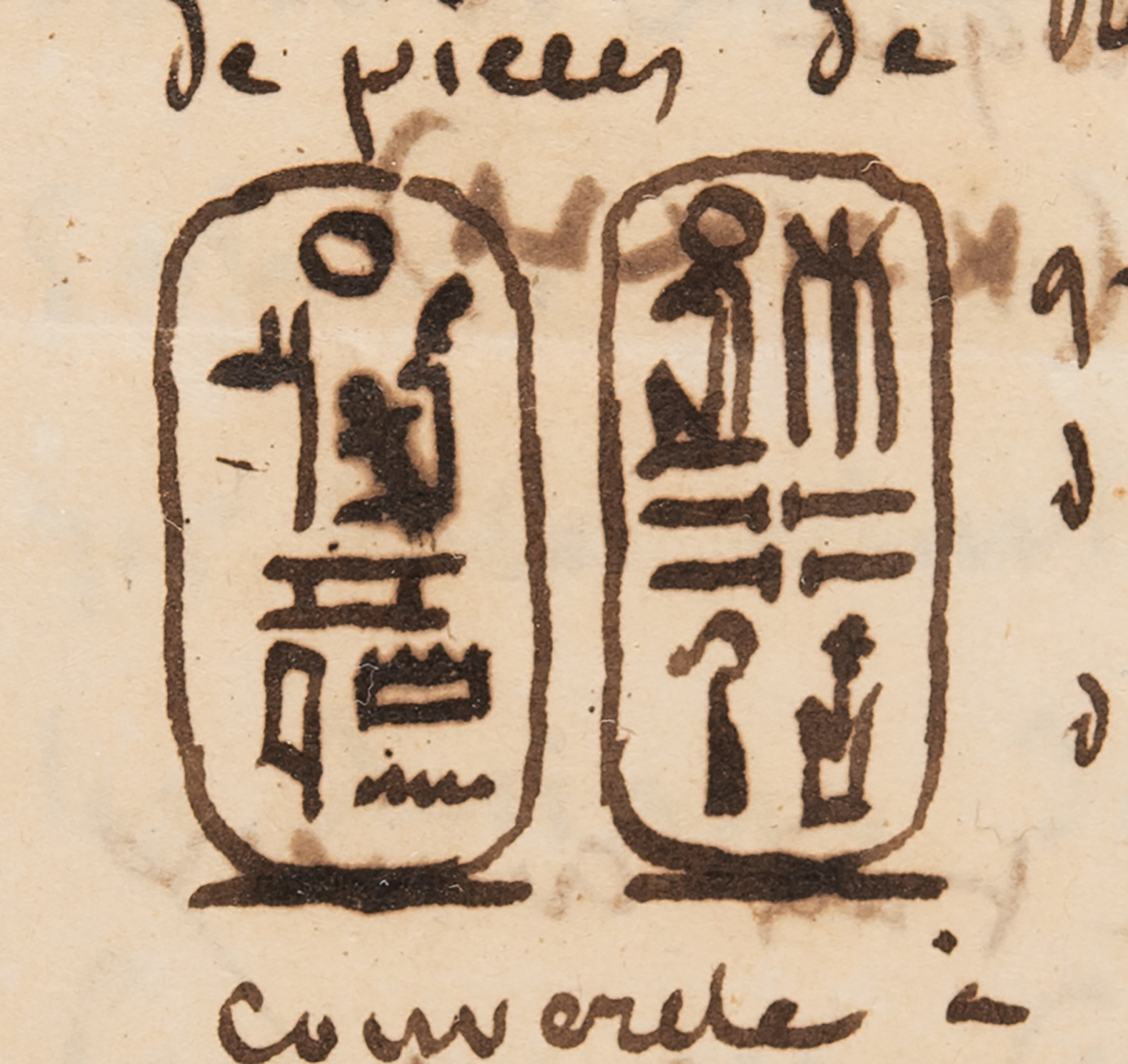
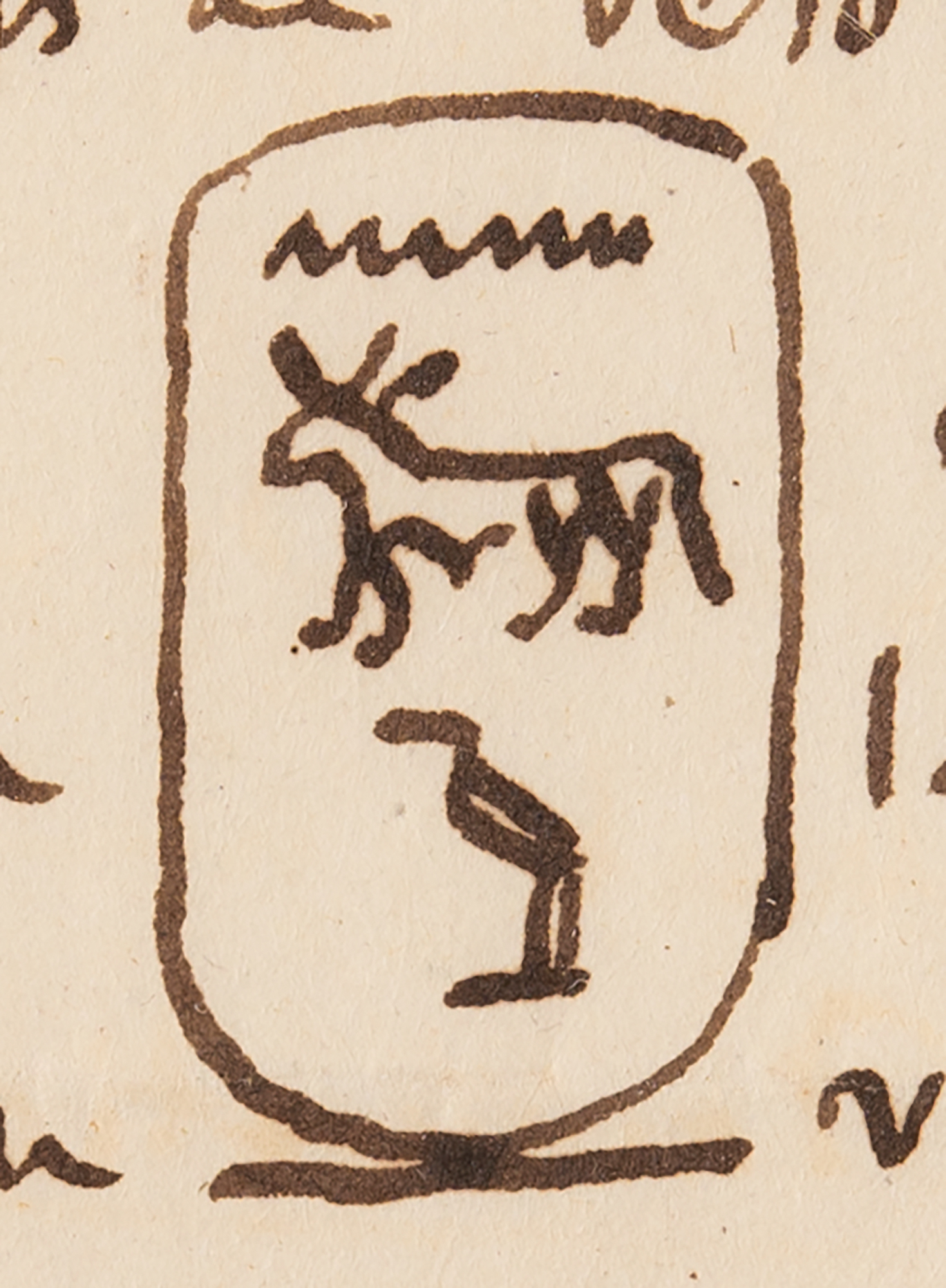
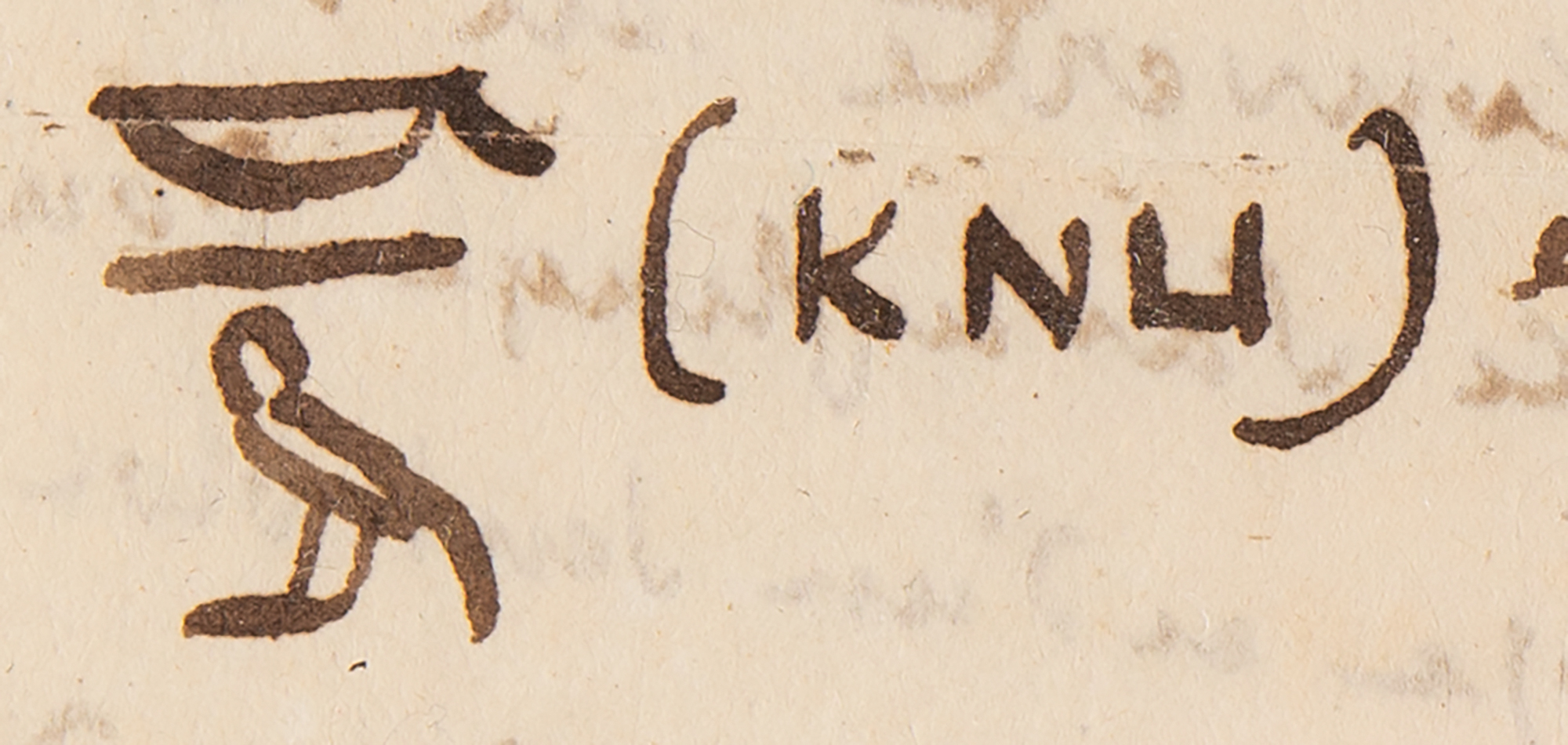
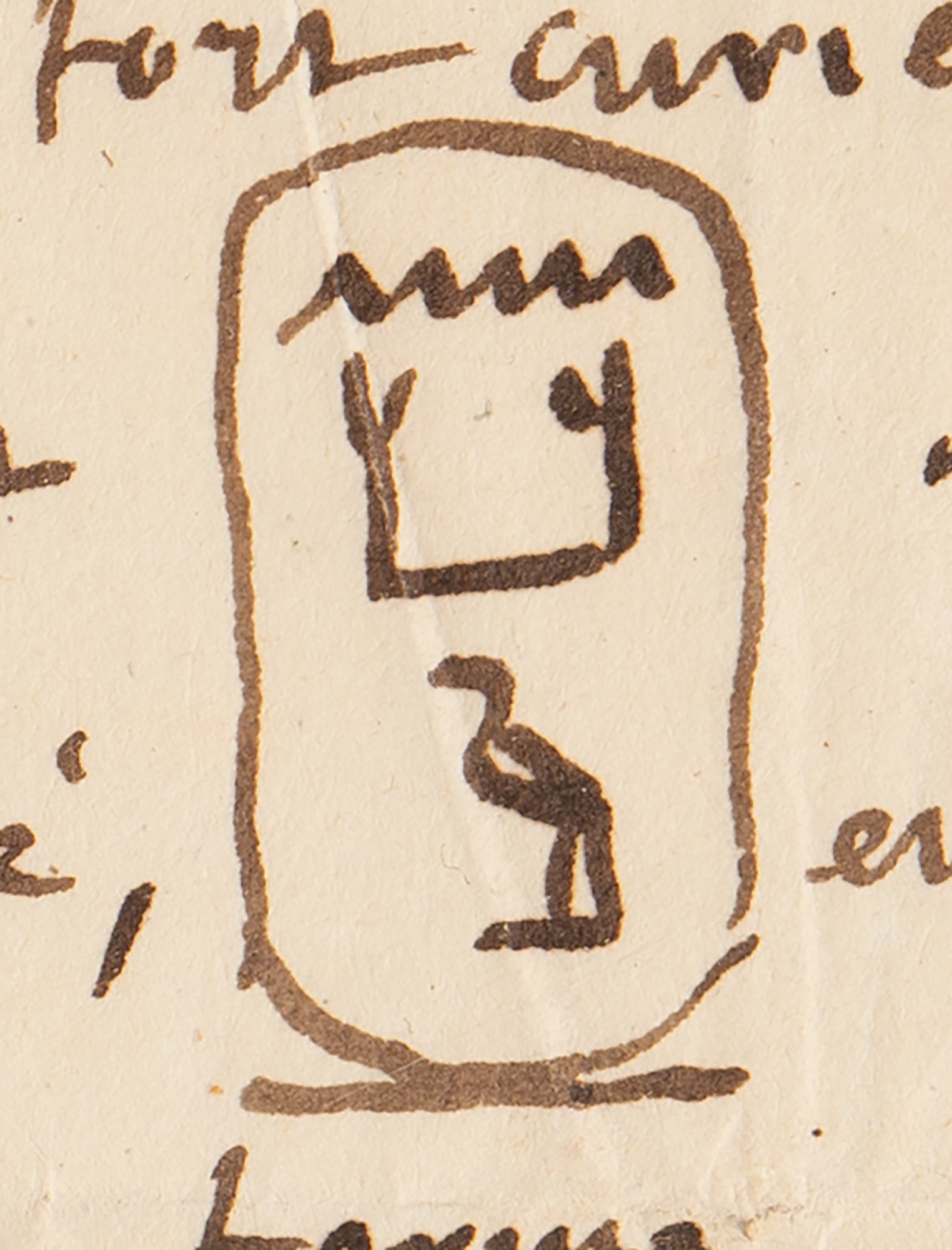
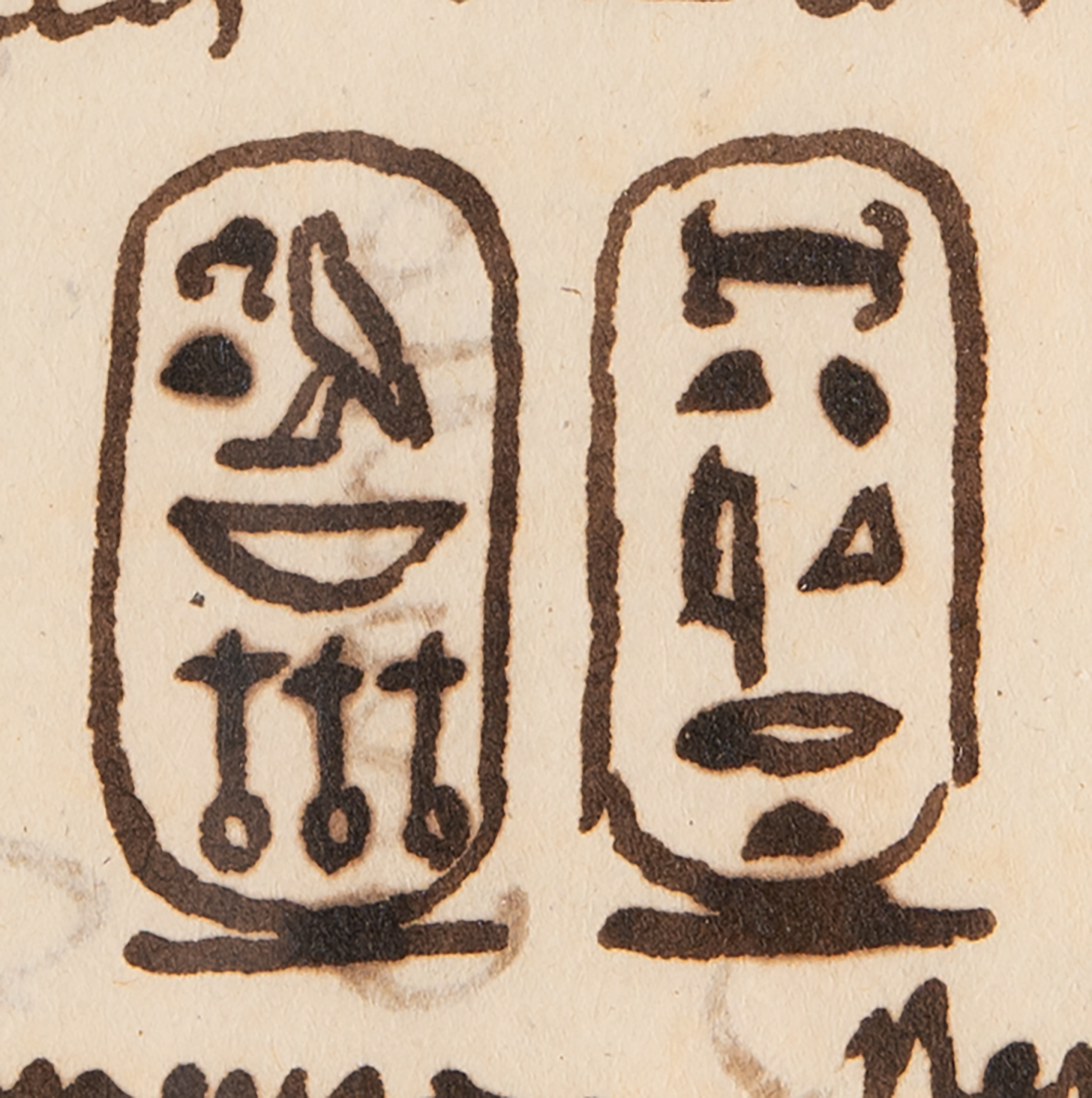
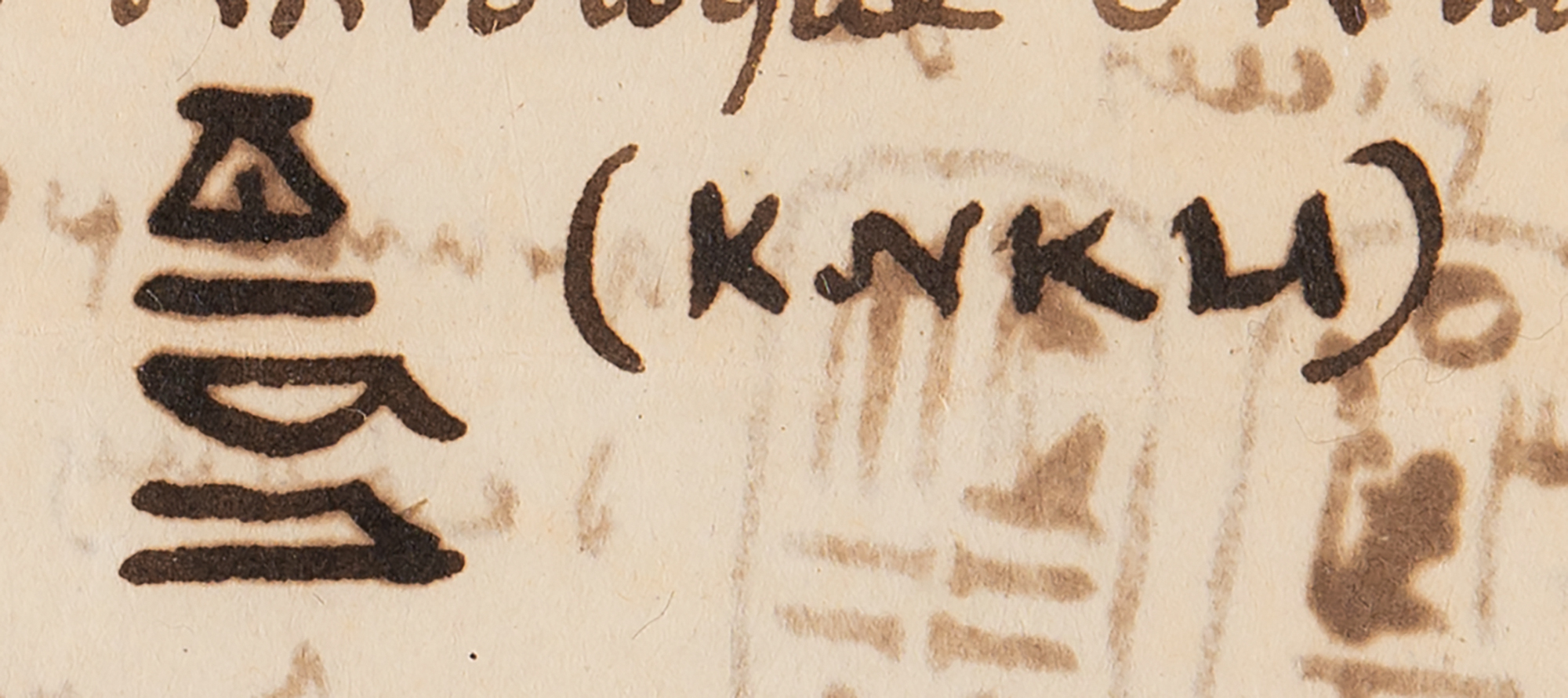
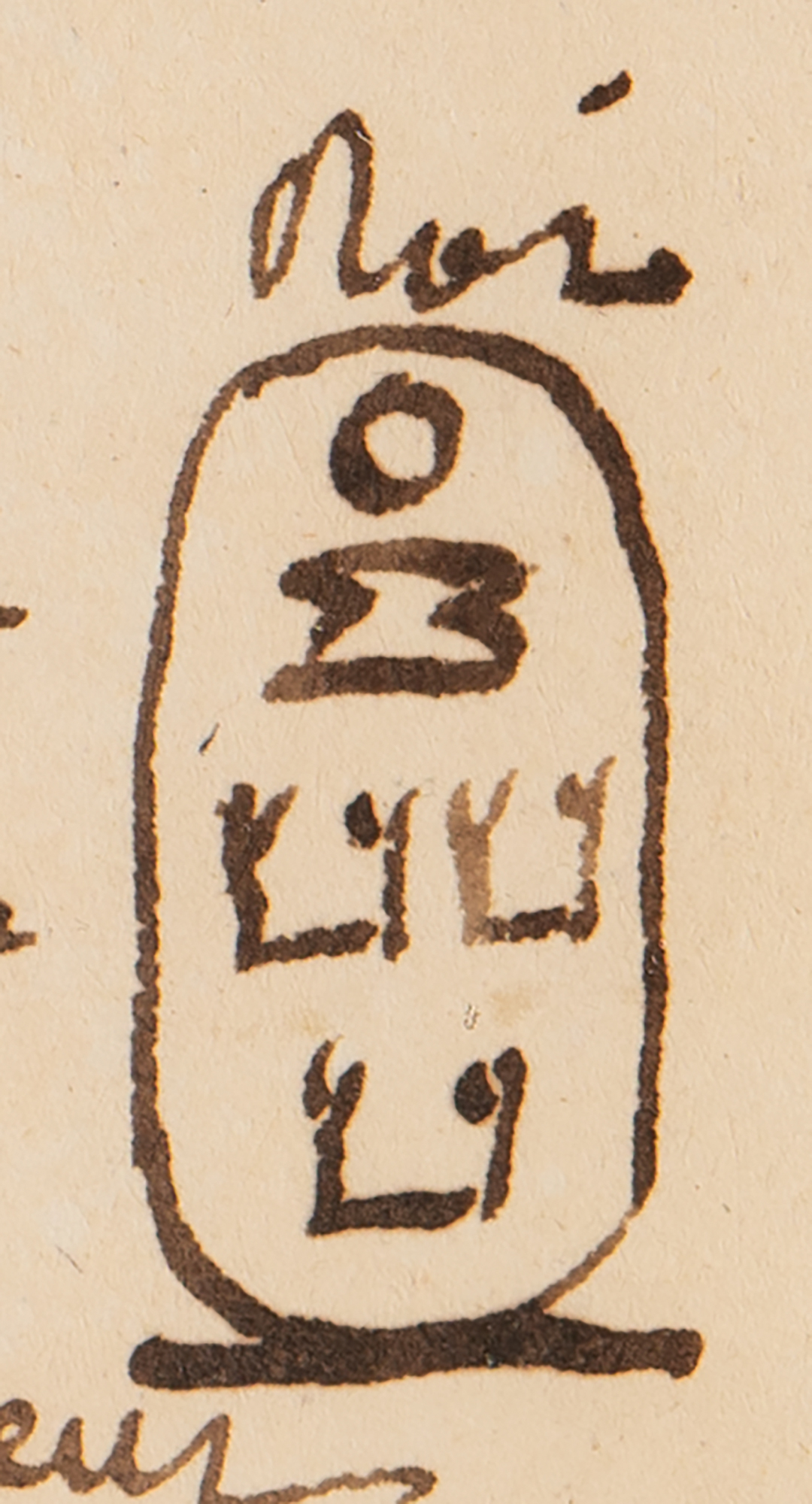
French scholar and founding figure in the field of Egyptology (1790–1832) who published the first translation of the Rosetta Stone hieroglyphs in 1822. ALS in French, signed "J. F. Champollion," three pages on two adjoining sheets, 8.25 x 10, March 29, 1826. Handwritten letter to the archaeologist William Gell, discussing his acquisition of Henry Salt's collection of Egyptian antiquities for the Louvre; remarkably, he fills the letter with about fifteen hieroglyphic inscriptions. In full (translated): "How can I thank you properly, dear Egyptian, for all the trouble you take to share with me the hieroglyphic riches with which you are so abundantly endowed! I can only send you a thousand acts of gratitude, and promise to erect for you a stele of gratitude on which your name will be inscribed in sacred characters, accompanied by all the blessings, with a prayer to the gods of 62 regions, to cover you with their protective wings to ward off this cursed drop, daughter of Typhon, born from the venom spread across the earth by the great serpent Apophis when our friend Soou (the Egyptian Hercules) had the good sense to rid the world of it.
It was in Turin, where I arrived on the 15th of this month (returning from a short trip I made to France), that I received your kind letter of January 27th. And it is from Livorno that I answer it in the middle of the beautiful Egyptian collection of Mr. Salt that I was charged with purchasing and sending to Paris for the Royal Museum of France; this acquisition, which is due in large part to the influence of Mr. Le Duc de Blacas, has filled me with joy as you can imagine: I find in this museum treasures in abundance, superb papyri, whether hieroglyphic, hieratic, or demotic, steles of the greatest beauty and, in fact, the centerpiece, the sarcophagus of King Ramses-Meiamoun [Hieroglyphs] grandfather of Sesostris. It is an intact mass 10 feet long by 5 1/2 high, covered inside and out with bas-reliefs and inscriptions. This sarcophagus, the lid of which you have in Cambridge, is made of pink granite and of a single block. The collection is extremely rich in objects of all kinds. I am cashing it in right now and will have finished packing it by the end of April. I therefore expect to be in Rome around the 15th of May. Will I be lucky enough to find you there at that time? It would be a great mortification for me if you were absent when I arrive at the foot of the Quirinal. Please write me a line to confirm the hope of meeting you in old Babylon.
The tablet found by Dr. Clarke in the ruins of Sais is a funerary inscription in honor of a certain Psammetichus, one of the chaplains of King Amasis. This monument therefore dates from the end of the 6th century BC.
I have heard a lot about this Greek inscription engraved on the tomb of one of the colossi of Ibsamboul, but I have never seen it. I only know that it refers to King Psammetichus, which is sufficient to prove that the cartouche or royal name inscribed on this temple, which is that of Ramesses the Great, could not have been that of King Amasis, who was later than Psammetichus, as Dr. Young initially believed.
Your astronomical inscriptions from Esne interest me greatly. The members of the Egyptian commission did not copy the hieroglyphs of the zodiacs or the astronomical tables from the same temple. It would be a treasure for me to have them, especially at this time when I have in my hands a very valuable document for the study of Egyptian zodiacs in general and that of Esne in particular. It's a Greek papyrus from the Salt collection that contains a horoscope for the first year of Emperor Antoninus Pius, indicating the domicile of the planets and their detailed relationships with the signs of the zodiac. I therefore hope to make acquaintance in Rome and wage a pitched battle, as you so aptly put it, against your astronomical hieroglyphs. Among the few astronomical names you have been kind enough to communicate to me, I already find those of two of the decans named in the Astrologer Firmicus: Chnoumis [H] and Cnachumis [H].
The cartouches of the temple of Semne are very curious and confirm what I already knew from Cailliaud's drawings. Namely, that King Osortasen of the 17th Dynasty, whose first name is thus [H], had been deified and was worshipped in this temple of Semne at the same time as the god Nile. This is probably the famous King Nilus of Diodorus.
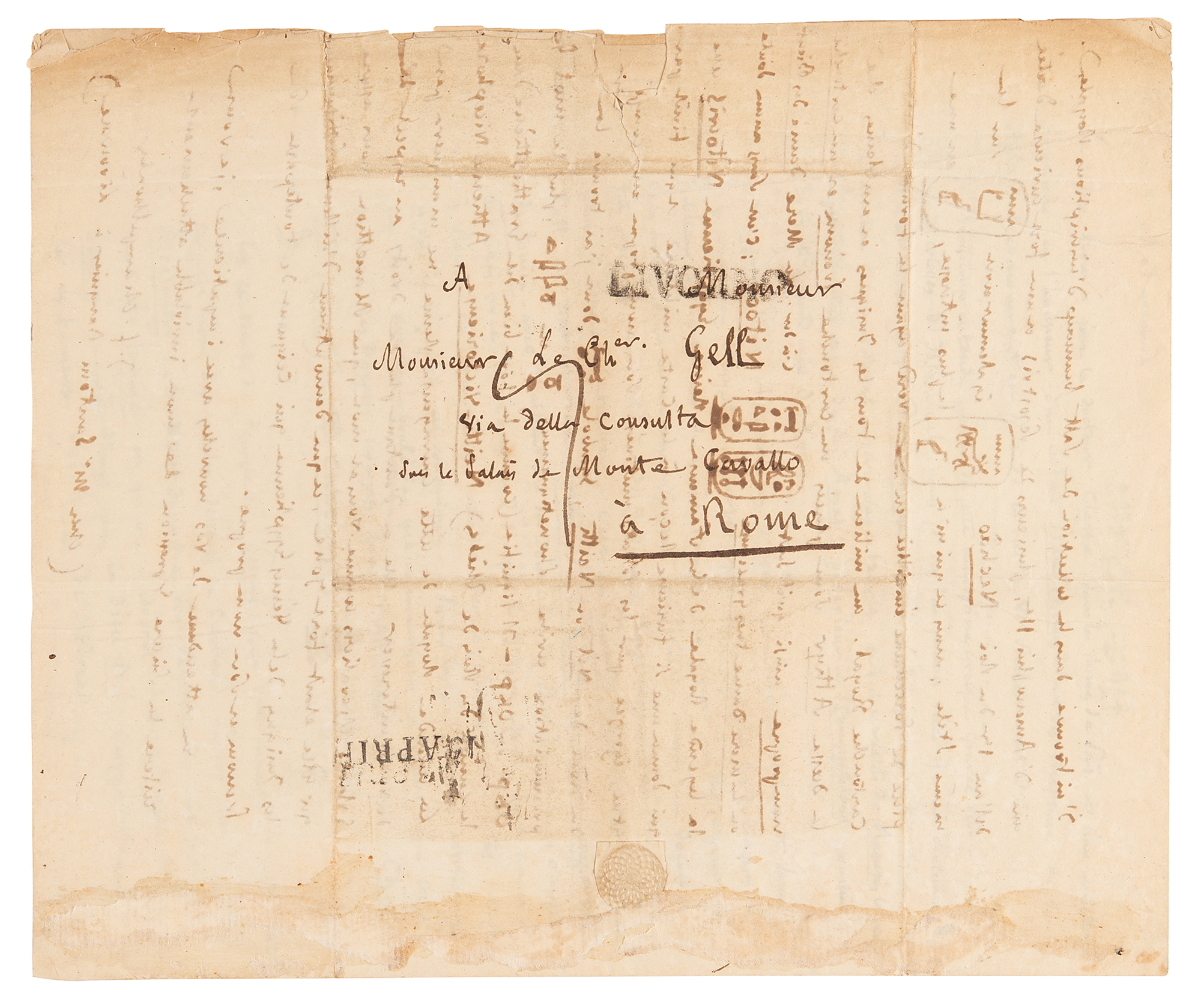
I found in the Salt collection many royal inscriptions. One of Amenhotep II, several of Sesostris and a very curious one dated the first year of King Nechao [H] also written [H] on the same stele; but what interested me most was a porcelain stone enameled in verd [sic] in the form of a Royal cartouche. In the middle of all the insignia and emblems of the goddess Athyr are placed a first name cartouche and a proper name cartouche as follows [H] That is to say the mother lady of Benefits or the very gracious mother lady Nitocr: this is without a doubt the royal legend of the famous Egyptian Queen Nitocris, the one who gave such a furious lesson to the military caste and who ended up being slaughtered by the mutinous soldiers. His proper name is composed of the name of Nit or Neith, symbol [H] whose pronunciation I found written phonetically [H] and [H] plus the word [H] [H]." Addressed on the integral leaf in Champollion's hand. In very good to fine condition, with a small area of seal-related paper loss (and associated tear) to last page, affecting a couple of words of text.
The collection of Henry Salt (1780–1827), British consul in Egypt, held an exceptional variety of pieces: sarcophagi, cartonnage, statues, steles, chests, furniture, vases, oushebtis, papyrus, seals, sandals, basketwork, funerary masks, jewelry, and amulets in wood, sandstone, bronze, enameled earth, limestone, earthenware, alabaster, gold, and ivory.
Captivated by the richness of the collection, Champollion ardently hoped that France would acquire it and work towards the creation of an Egyptian museum. He feared that this set of treasures would escape the country as was the case for the first Drovetti collection and strived to convince King Charles X of the merits of the investment. The king is not convinced and the Egyptologist despairs: 'It is a lost affair forever, and the word economy makes a very good impression in the mouths of people who throw millions away when it comes to doing something stupid, or to satisfy a ridiculous vanity.'
Finally convinced by the report of the Duke of Blacas, Charles X ratified, on February 23, 1826, the purchase of the Salt collection at the asking price of 250,000 francs. Champollion was then commissioned to return to Livorno in order to draw up a descriptive inventory of the 4,014 objects and then organize their transport to Paris.
Exhilarated by so much beauty, he was hard at work in March: 'The collection is extremely rich in objects of all kinds: I'm cashing it in at this time and I will have finished my packaging towards the end of April,' he confides to Gell.
On May 15, extraordinary news reached Champollion: he learned that an order from King Charles X had just created the Egyptian antiquities division of the Louvre Museum, and he was named its first curator.
The Salt collection would reach Paris. The Durance, a ship responsible for transporting crates of antiquities to France, entered the port of Livorno on June 24. Loading can finally begin, and, on July 8, the loading of the pieces is completed: "The entire collection is on board the Durance. It's full of it." The precious antiquities then continued their journey to Paris where Champollion received them at the end of November 1826.
________________________________
It was in Rome, in 1824, through the Duke of Blacas d'Aulps, that Champollion met the British archaeologist William Gell (1777–1836). The latter, friend of the English Egyptologist Thomas Young, Walter Scott and Lord Byron, was passionate about Egyptian hieroglyphs and communicated precious inscriptions noted and copied at Karnak by his compatriots Wilkinson and Cooper who had traveled Egypt from 1821.
In this letter Champollion analyzes and clarifies hieroglyphic inscriptions submitted by William Gell in his letter of January 27. Furthermore, aware of the celestial links of the Egyptian inscriptions, Champollion expresses to his friend his desire to further clarify his astronomical knowledge: 'Your astronomical inscriptions from Esné interest me greatly. The members of the Egyptian commission have not copied the hieroglyphs of the zodiacs nor the astronomical tables of the same temple. It would be a treasure for me to have them, especially at this moment when I have in hand a very precious document for the study of the Egyptian zodiacs in general and that of Esné in particular.'
In a letter dated April 20th, Gell replied to Champollion: 'My dear Champollion, I will certainly be at Rome, alive or dead, when you arrive in May, and shall be highly delighted to see you. I imagine I shall be able to show you many astronomical inscriptions and, good or bad, every thing on the zodiac at Esne.'

This item is Pre-Certified by PSA/DNA
Buy a third-party letter of authenticity for
(inquire for price)
*This item has been pre-certified by a trusted third-party authentication service, and by placing a bid on this item, you agree to accept the opinion of this authentication service. If you wish to have an opinion rendered by a different authenticator of your choosing, you must do so prior to your placing of any bid. RR Auction is not responsible for differing opinions submitted 30 days after the date of the sale.

