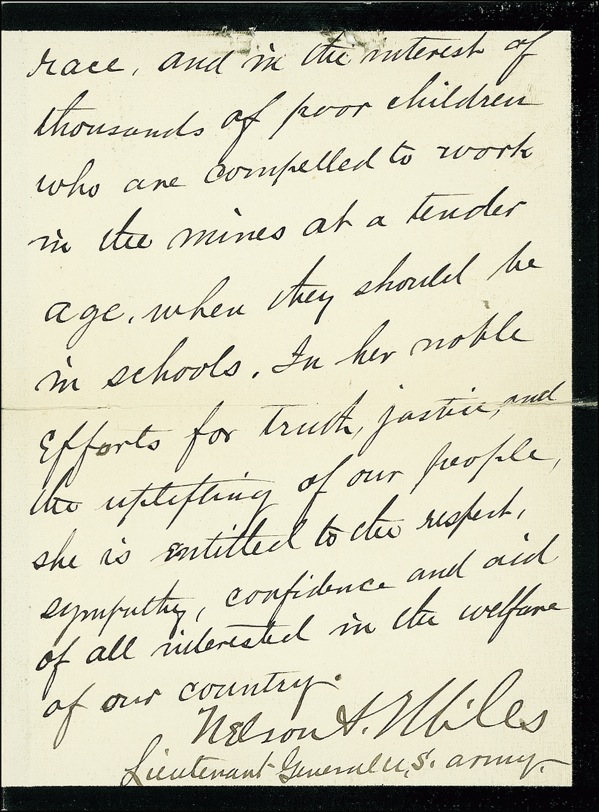
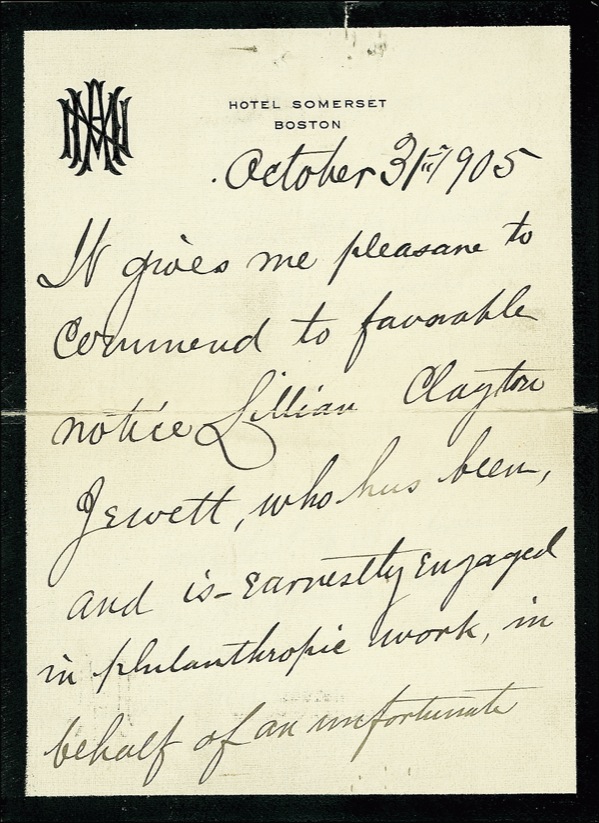
American soldier (1839–1925) who earned a niche in military history as the only man to serve as an officer in the Civil War, Indian Wars, and Spanish-American War. Though the nearly eighty-year-old Miles volunteered to serve during World War I, his offer was declined by Woodrow Wilson. ALS signed “Nelson A. Miles, Lieutenant General U.S. Army,” two pages on two adjoining sheets, 4.75 x 6.5, black-bordered Hotel Somerset letterhead, October 31, 1905. Letter to Miss Lillian Clayton Jewett of Boston reads in full, “It gives me great pleasure to commend to favorable notice Lillian Clayton Jewett, who has been, and is-earnestly engaged in philanthropic work, in behalf of an unfortunate race, and in the interest of thousands of poor children who are compelled to work in the mines at a tender age, when they should be in schools. In her noble efforts for truth, justice, and the uplifting of our people, she is entitled to the respect, sympathy, confidence and aid of all interested in the welfare of our country.” Accompanied by the original mailing envelope. Jewett gained national attention when she set out to help the family of Frazier Baker, an African- American postmaster in the town of Lake City, South Carolina who was killed along with his daughter after a mob attacked his home and post-office. African-American anti-lynching advocates considered asking the family to leave Charleston where they lived awaiting the outcome of the trial. Jewett came to their rescue after learning the family was in dire straits. Against the wishes of many of the city’s black elite, Jewett secretly boarded a train heading south. In Charleston she convinced the Bakers of her good intentions, and the family agreed to accompany her. Jewett’s African-American supporters in the North likened her to Harriet Beecher Stowe. Jewett appeared with the Bakers before large gatherings in Rhode Island, Massachusetts, and Maine. Holding up the family’s suffering as an object lesson against lynching, she strongly denounced President McKinley for his failure to take a public stand against mob rule in the South. R&R COA.

