The 30 Minute Rule begins December 9 at 7:00 PM EST. An Initial Bid Must Be Placed By December 9 at 6:00 PM EST To Participate After 6:00 PM EST
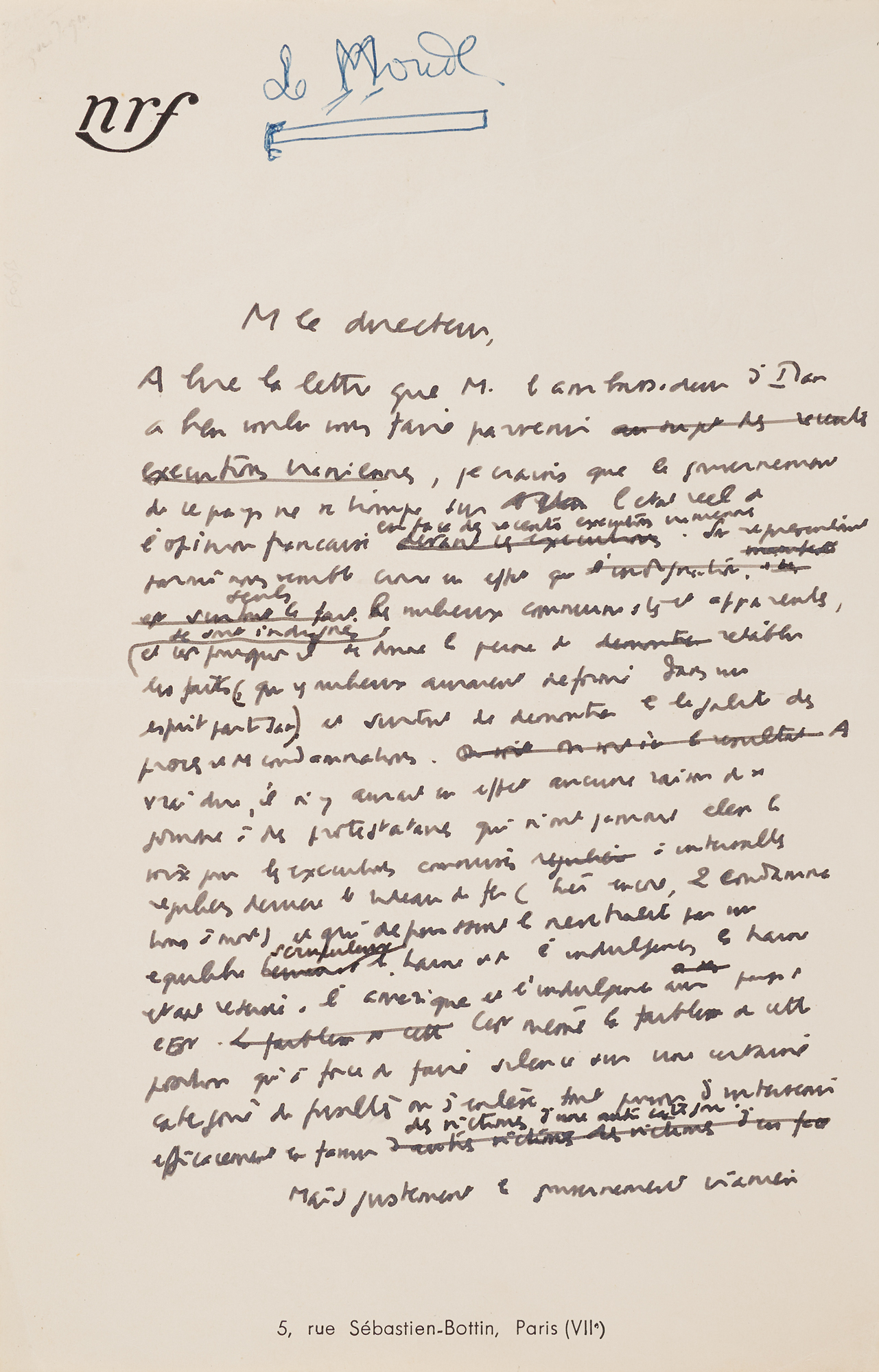
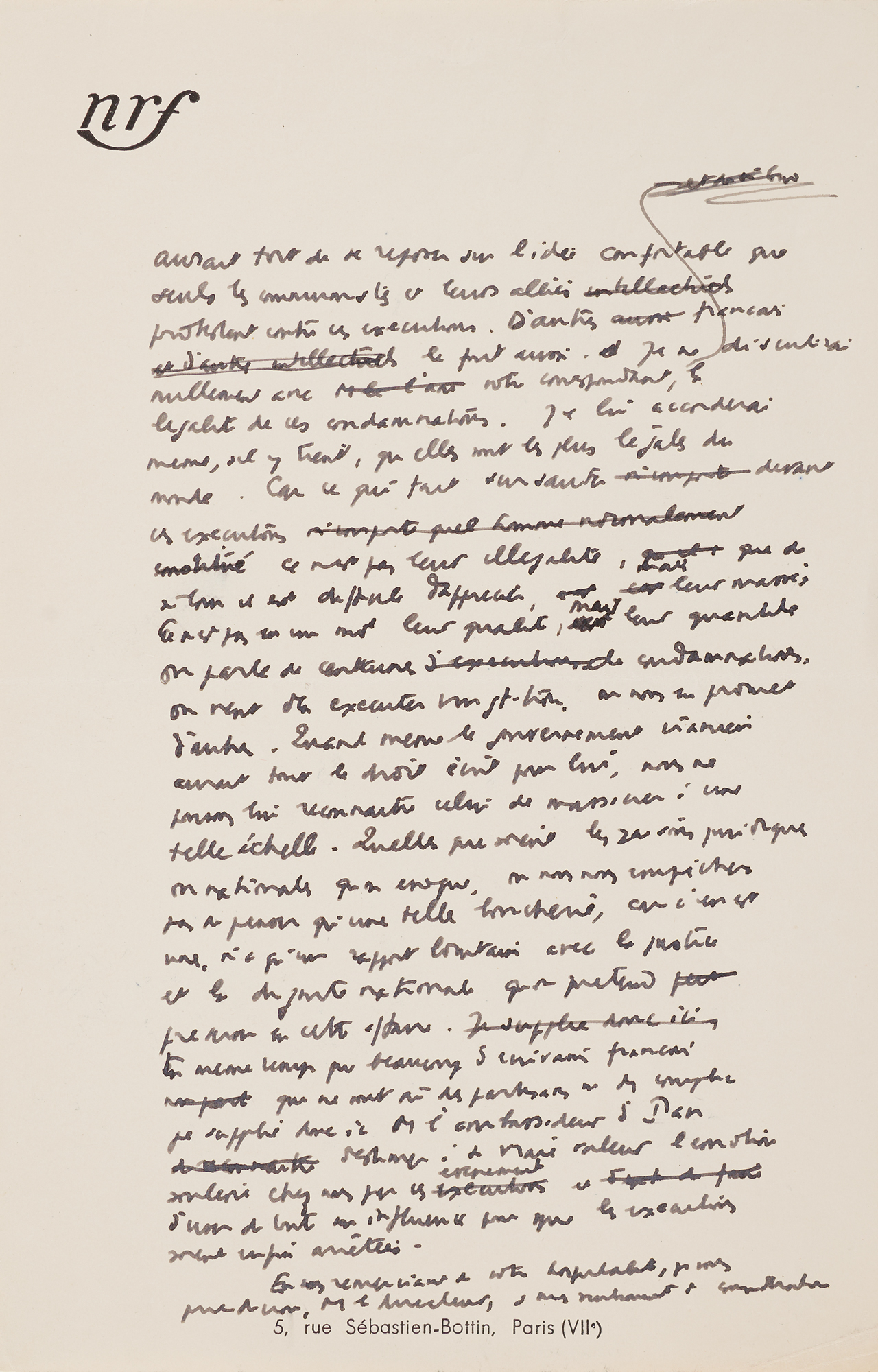
French philosopher, author, and journalist (1913–1960) who won the Nobel Prize in Literature in 1957; his best-known works include The Stranger and The Plague. Autograph manuscript in French by Albert Camus, unsigned, two pages, 5.25 x 8.25, Nouvelle Revue Française letterhead, no date. Heavily corrected draft of a letter to the editor of the French newspaper Le Monde, replying to a letter from the Iranian ambassador defending his government’s recent executions.
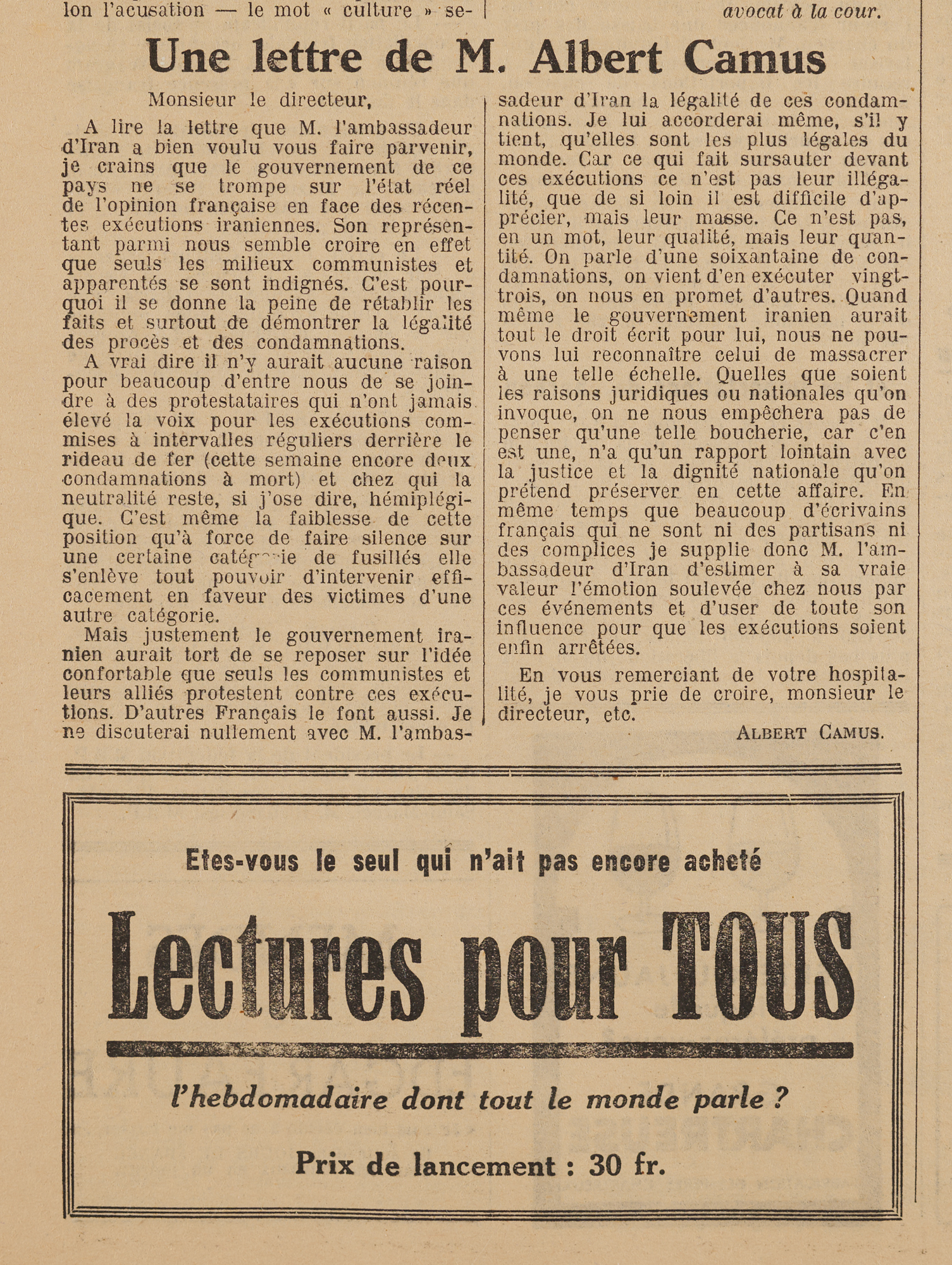
In full (translated): "Mr. Director, Having read the letter that the Iranian Ambassador was kind enough to send you, I fear that the government of that country may have a mistaken understanding of the true state of French public opinion in response to the recent executions in Iran. Its representative here appears to believe that only communist circles and those associated with them have expressed indignation. This is why he takes the trouble to set the record straight (which, he suggests, these circles have distorted out of partisan motives) and, above all, to prove the legality of the trials and sentences.
To be sure, there would indeed be no reason to join in the protests of those who have never raised their voices against the executions carried out at regular intervals behind the Iron Curtain (two more death sentences were handed down only yesterday), and whose stance goes beyond neutrality, striking a scrupulous balance between hatred and indulgence: hatred being reserved for America, and indulgence for the countries of the Eastern Bloc.
Indeed, this is precisely the weakness of this position: by remaining silent about one particular category of those executed by firing squad, it deprives itself of any ability to intervene effectively on behalf of the victims of another category.
But the Iranian government would be mistaken to take comfort in the assumption that only the Communists and their allies are protesting against these executions. Other French people are doing so as well.
I shall not argue with your correspondent about the legality of these sentences. I will even grant him, if he so wishes, that they are the most lawful in the world.
For what makes these executions so shocking is not their illegality, which is difficult to assess from so far away, but their sheer scale. In a word, it is not their nature, but their number.
We hear of hundreds of sentences; twenty-three people have just been executed, and we are promised more. Even if the Iranian government had every written law on its side, we could not acknowledge its right to carry out massacres on such a scale. Whatever legal or national justifications may be invoked, nothing will prevent us from believing that such a bloodbath—for that is what it is—has little to do with justice or with the national dignity that is supposedly being upheld in this affair.
Along with many French writers who are neither partisans nor accomplices, I therefore earnestly appeal to the Iranian Ambassador to recognize the true significance of the emotion aroused in our country by these events, and to use all his influence to ensure that the executions are finally brought to an end."
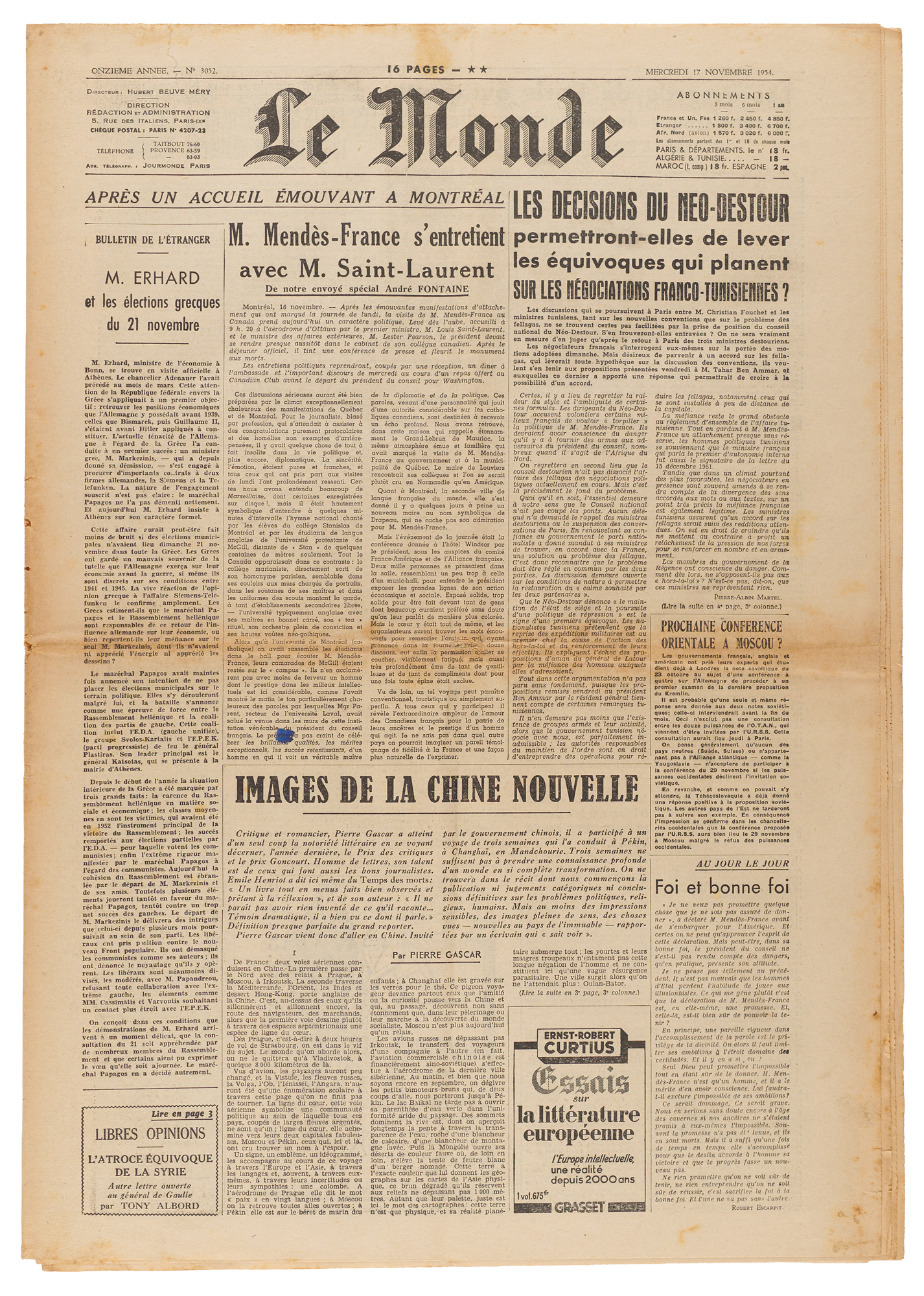
"Le Monde" is written in blue ink in the upper margin of the first page. Includes an original copy of Le Monde from November 17, 1954, in which the letter appears on page 5 under the heading "Les exécutions en Iran," below a letter from defense lawyer Joë Nordmann. In overall fine condition, with light toning; the newspaper has a central fold, toning, and edgewear.
The Iranian ambassador’s defense of the military tribunals in Tehran appeared in the newspaper Le Monde on November 9, 1954. The proceedings followed the discovery of a clandestine network of officers tied to the communist Tudeh Party. Camus’s published response cited approximately 60 death sentences and 23 executions already carried out. Printed on the same newspaper page, a letter from defense lawyer Joë Nordmann reported that more than 800 people faced prosecution and that the accused had been stripped of their most basic rights.

This item is Pre-Certified by PSA/DNA
Buy a third-party letter of authenticity for
$150.00
*This item has been pre-certified by a trusted third-party authentication service, and by placing a bid on this item, you agree to accept the opinion of this authentication service. If you wish to have an opinion rendered by a different authenticator of your choosing, you must do so prior to your placing of any bid. RR Auction is not responsible for differing opinions submitted 30 days after the date of the sale.
Third-party authentication service applies only to signatures and handwriting, and does not cover the addition of sketches, artwork, musical quotations, etc.

