The 30 Minute Rule begins December 9 at 7:00 PM EST. An Initial Bid Must Be Placed By December 9 at 6:00 PM EST To Participate After 6:00 PM EST
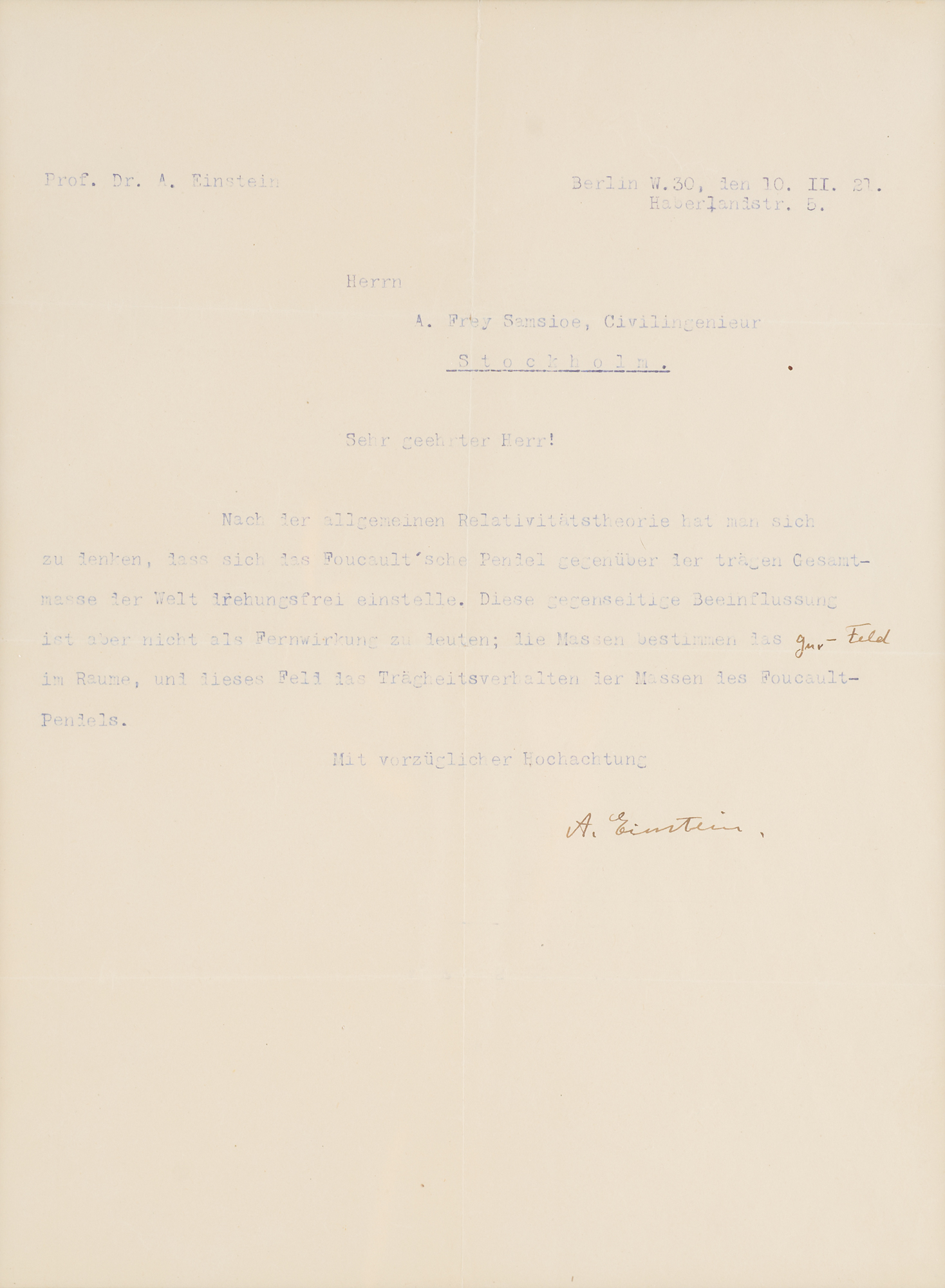
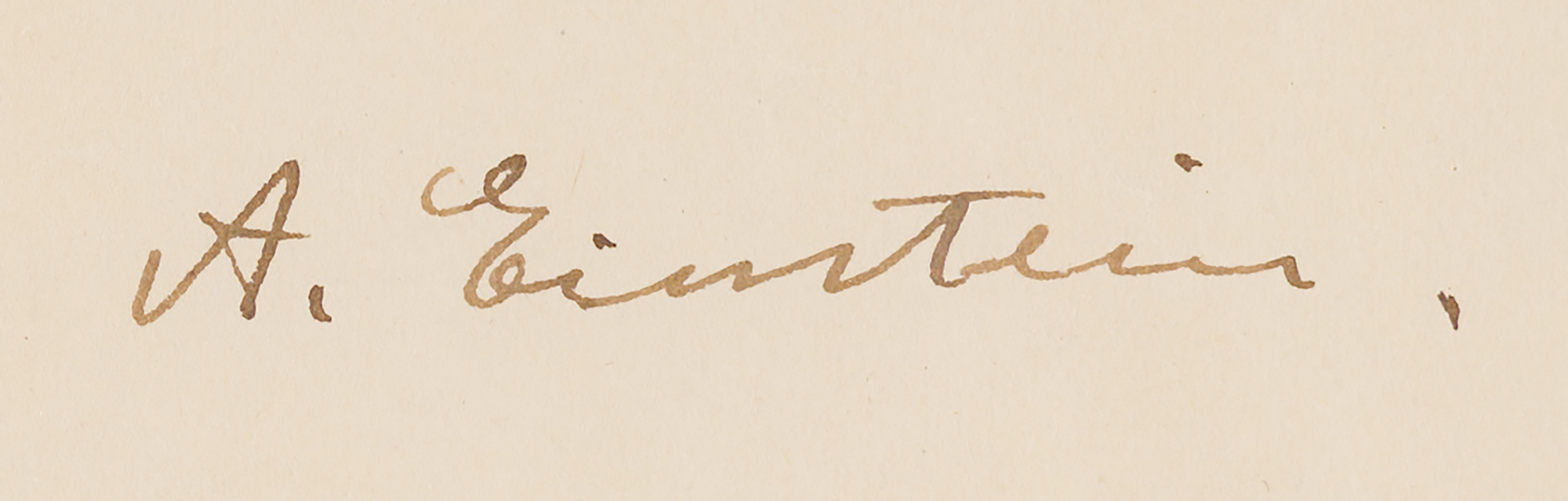
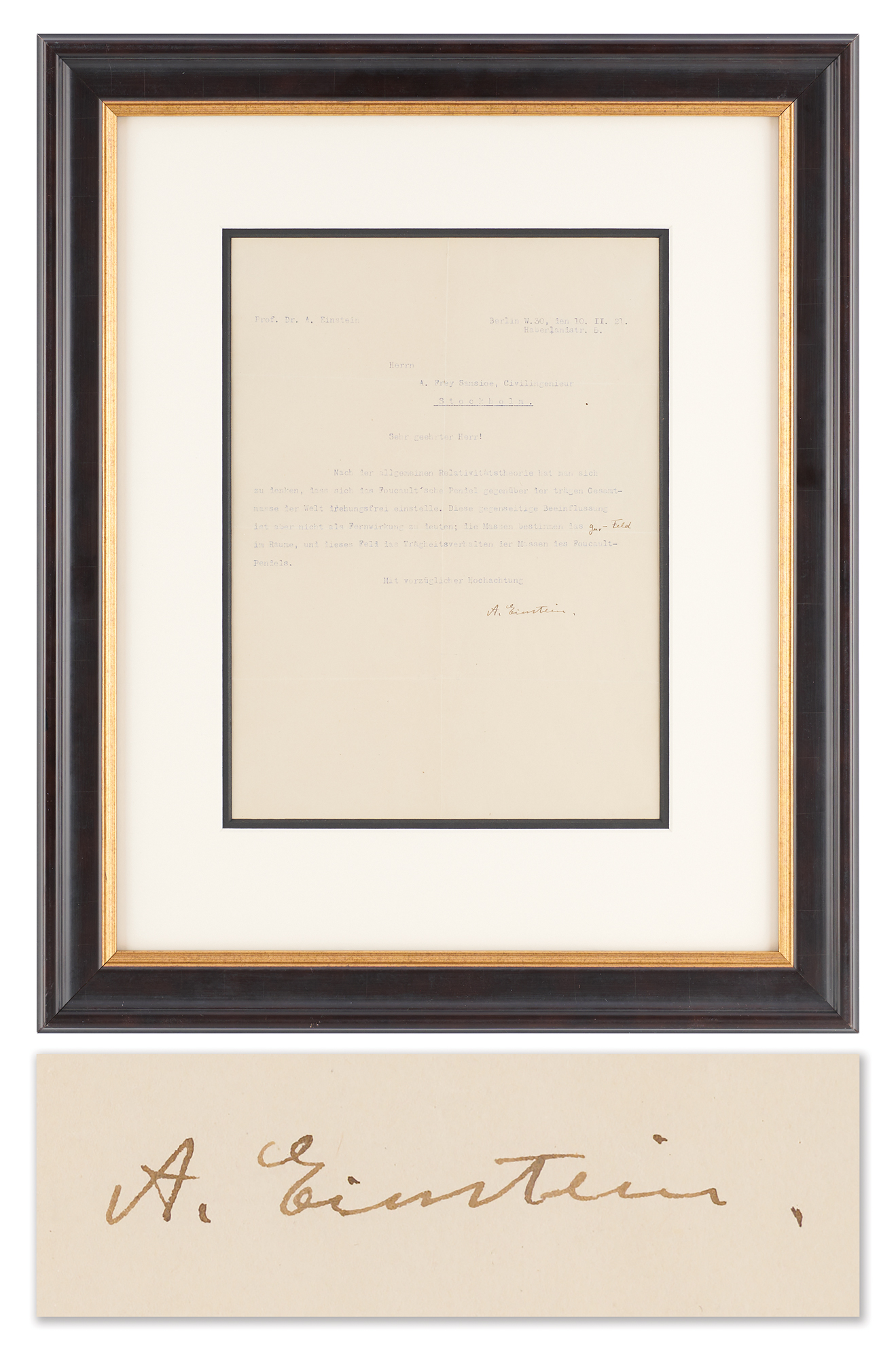
TLS in German, signed “A. Einstein,” with handwritten annotation, "gµν-Feld," one page, 8.5 x 11, February 10, 1921. Letter to Swedish civil engineer Axel Frey Samsoie, in full (translated): "According to the general theory of relativity, one must consider that the Foucault pendulum adjusts itself to be rotation-free with respect to the total mass of the universe. This mutual influence should however not be interpreted as action at a distance: the [total] masses define the gμν-Feld [i.e., the gravitational metric field] in space, and this field defines the inertial behaviour of the mass of the Foucault pendulum." Handsomely double-matted and framed to an overall size of 16.5 x 19.5. In fine condition, with intersecting folds.
Written just five years after the publication of his groundbreaking general theory of relativity, this remarkable letter finds Einstein addressing one of the fundamental questions of modern physics: what determines whether an object is rotating? In 1851, French physicist Léon Foucault famously demonstrated the Earth's rotation with a pendulum suspended from the dome of the Panthéon in Paris. Seventy years later, Swedish engineer Axel Frey Samsoie asked Einstein whether the pendulum measured the Earth's rotation relative to the Sun, the stars, or some other frame of reference.
Einstein's succinct response invokes Mach's principle, the idea that inertia is intimately connected to the distribution of matter throughout the universe. Rather than attributing the pendulum's behavior to an invisible force acting across vast distances, Einstein explains that the universe's mass determines the gravitational field of spacetime, which in turn governs the pendulum's inertial motion. His explanation offers a fascinating glimpse into the philosophical and scientific foundations of general relativity, touching on the relationship between matter, gravity, and motion that occupied Einstein throughout his career. An exceptional letter of profound scientific content, dating to 1921—the year for which Einstein received the Nobel Prize in Physics.

This item is Pre-Certified by PSA/DNA
Buy a third-party letter of authenticity for
$150.00
*This item has been pre-certified by a trusted third-party authentication service, and by placing a bid on this item, you agree to accept the opinion of this authentication service. If you wish to have an opinion rendered by a different authenticator of your choosing, you must do so prior to your placing of any bid. RR Auction is not responsible for differing opinions submitted 30 days after the date of the sale.
Third-party authentication service applies only to signatures and handwriting, and does not cover the addition of sketches, artwork, musical quotations, etc.

