The 30 Minute Rule begins November 19 at 7:00 PM EST. An Initial Bid Must Be Placed By November 19 at 6:00 PM EST To Participate After 6:00 PM EST
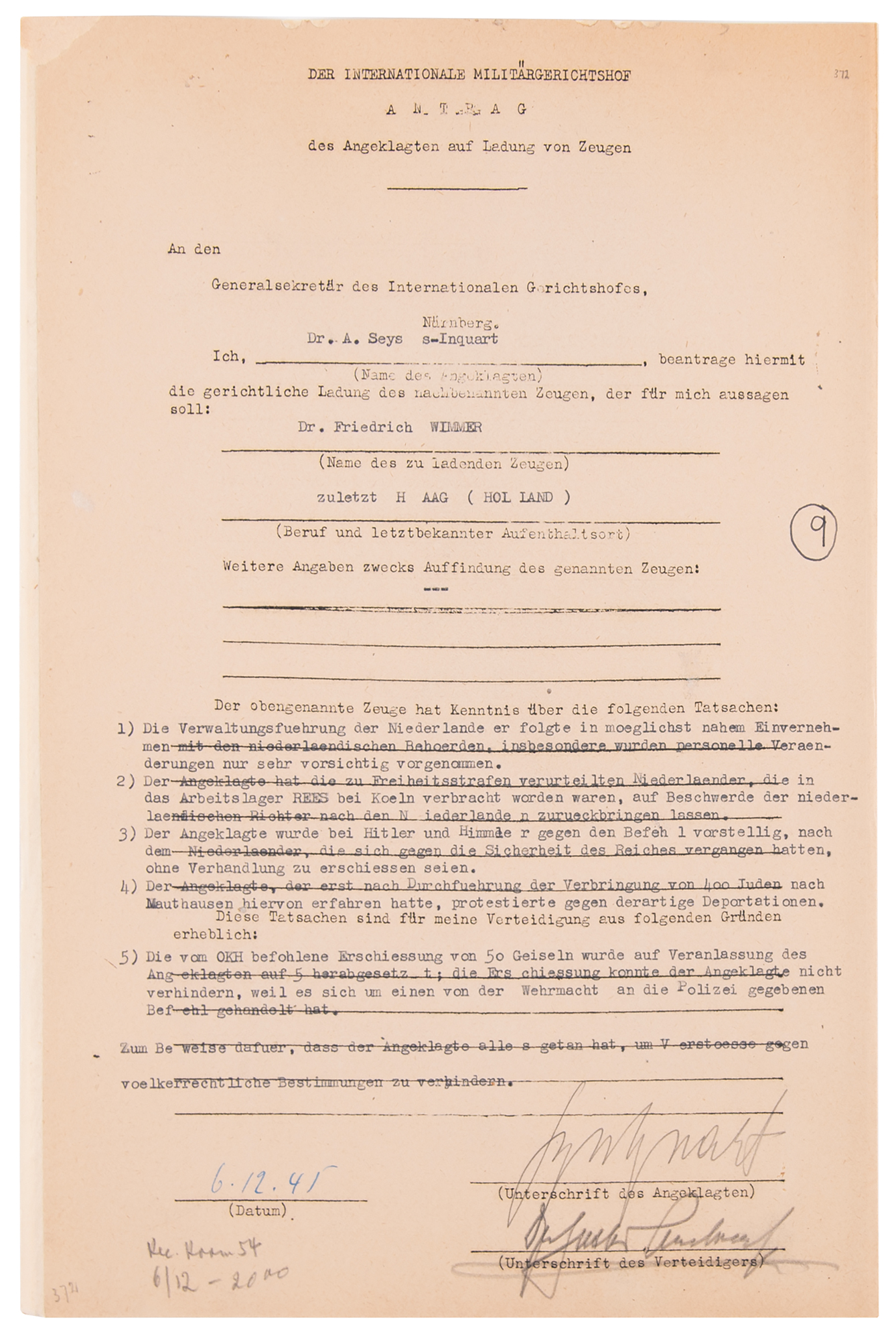
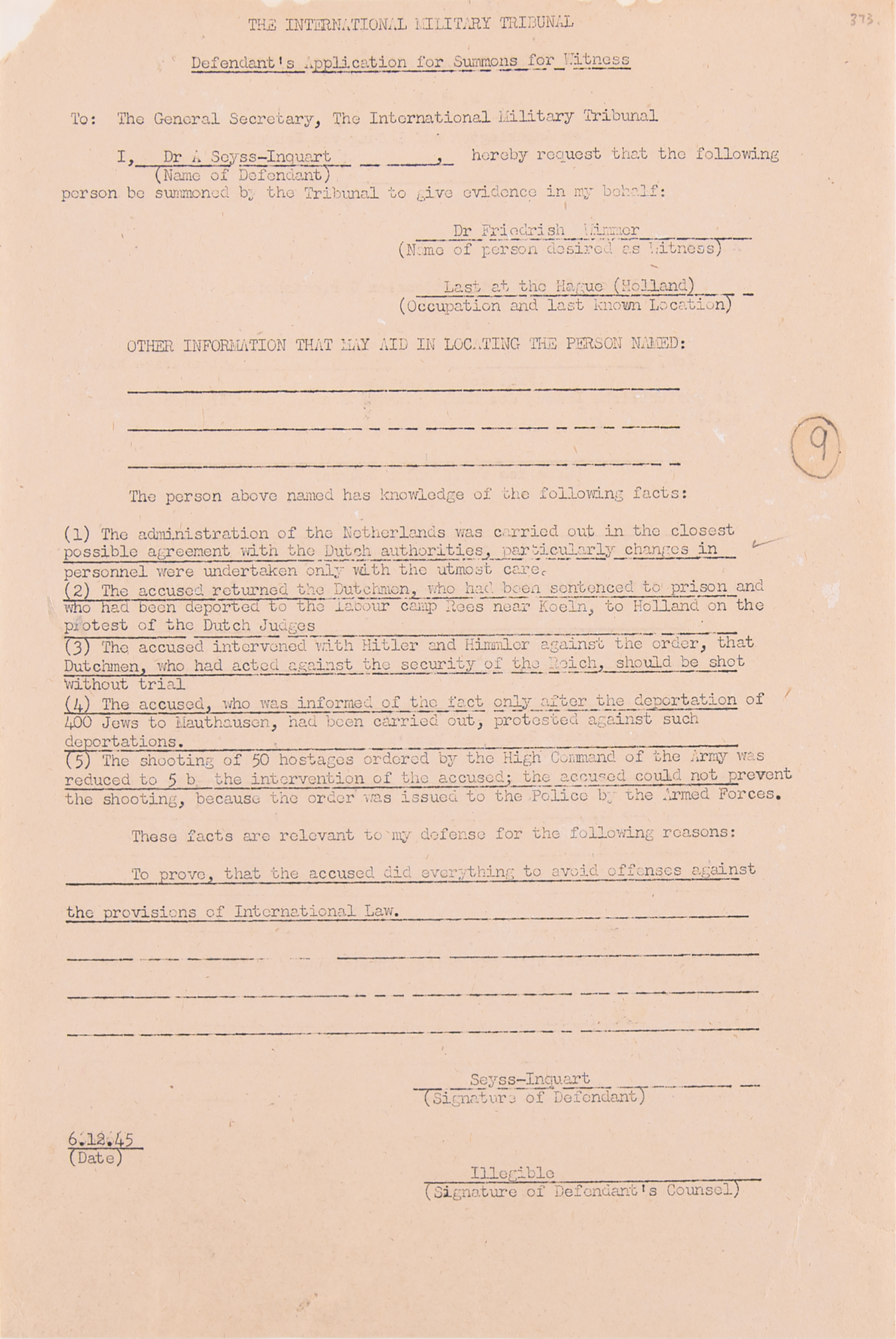
Partly-printed DS, in German, signed “Seyss-Inquart,” one page, 8 x 12.25, December 6, 1945. Document headed (translated), "The International Military Tribunal, Defendant's Application for Summons for Witness," made while preparing his defense for the Nuremberg trials. Seyss-Inquart and his defense lawyer request testimony from "Dr. Friedrich Wimmer," citing his knowledge of these facts: "(1) The administration of the Netherlands was carried out in the closest possible agreement with the Dutch authorities, particularly changes in personnel were undertaken only with the utmost care. (2) The accused returned the Dutchmen, who had been sentenced to prison and who had been deported to the labour camp Rees near Koeln, to Holland on the protest of the Dutch Judges. (3) The accused intervened with Hitler and Himmler against the order, that Dutchmen, who had acted against the security of the Reich, should be shot without trial. (4) The accused, who was informed of the fact only after the deportation of 400 Jews to Mauthausen, had been carried out, protested against such deportations. (5) The shooting of 50 hostages ordered by the High Command of the Army was reduced to 5 by the intervention of the accused; the accused could not prevent the shooting, because the order was issued to the Police by the Armed Forces."
Seyss-Inquart argues that these facts prove "that the accused did everything to avoid offenses against the provisions of International Law." Signed at the conclusion in pencil by Seyss-Inquart, and countersigned by his defense counsel. Backed by lightweight cardstock and in fine condition. Accompanied by a contemporary English translation.
Friedrich Wimmer was a particularly important witness for Seyss-Inquart’s defense: from July 1940 until the end of the war, he served as General Commissioner for Administration and Justice in the occupied Netherlands, working directly beneath Seyss-Inquart and participating in the regime’s senior administrative conferences. When called before the IMT in June 1946, Wimmer supported the same central argument advanced in this application—that Seyss-Inquart had attempted to restrain the harsher measures demanded by Berlin, preserve elements of the existing Dutch administration, and intervene against executions and other abuses.
The defense sought to portray such interventions as evidence that Seyss-Inquart had governed within the limits of international law, but they could not overcome the broader record of his occupation regime, including the systematic persecution and deportation of Dutch Jews, forced labor, hostage-taking, and political repression. The Tribunal ultimately convicted Seyss-Inquart of war crimes and crimes against humanity and sentenced him to death.
This item is Pre-Certified by PSA/DNA
Buy a third-party letter of authenticity for
(inquire for price)
*This item has been pre-certified by a trusted third-party authentication service, and by placing a bid on this item, you agree to accept the opinion of this authentication service. If you wish to have an opinion rendered by a different authenticator of your choosing, you must do so prior to your placing of any bid. RR Auction is not responsible for differing opinions submitted 30 days after the date of the sale.
Third-party authentication service applies only to signatures and handwriting, and does not cover the addition of sketches, artwork, musical quotations, etc.

