The 30 Minute Rule begins November 11 at 7:00 PM EST. An Initial Bid Must Be Placed By November 11 at 6:00 PM EST To Participate After 6:00 PM EST
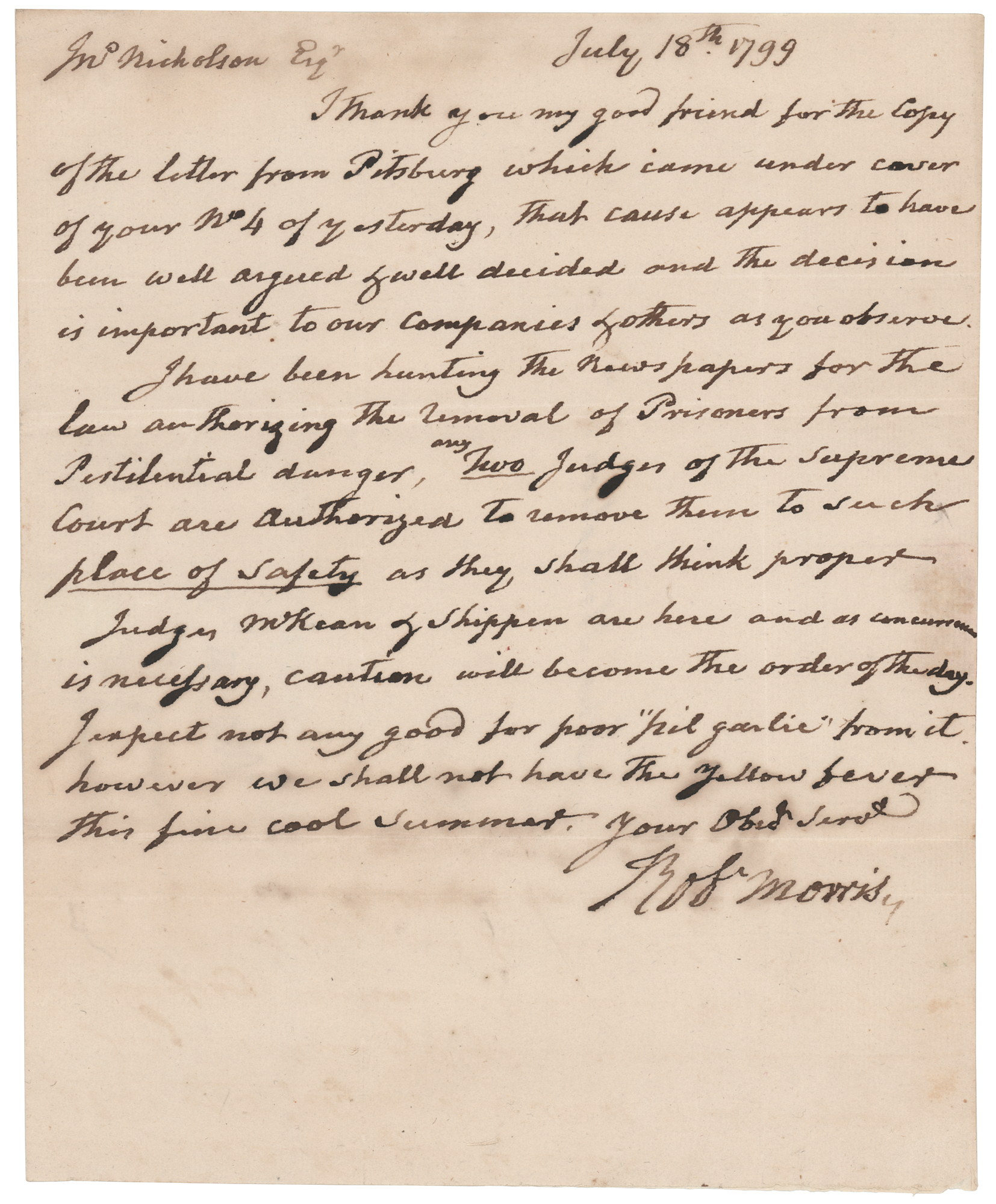
Important financier (1734-1806) who signed the Declaration of Independence, Articles of Confederation, and Constitution. ALS signed “Rob't Morris,” one page, 7.5 x 9, July 18, 1799. Handwritten letter from debtors’ prison to his longtime business partner John Nicholson, the former comptroller general of Pennsylvania, in part: “Thank you my good friend for the Copy of the letter from Pitsburg which came under cover of your No. 4 of yesterday, that cause appears to have been well argued & well decided and the decision is important to our Companies & others as you observe. I have been hunting the newspapers for the law authorizing the Removal of Prisoners from Pestilential danger, and Two Judges of the Supreme Court are authorized to remove them to such place of safety as they shall think proper. Judges McKean & Shippen are here and as concurrence is necessary, caution will become the order of the day. I expect not any good for poor ‘… garlic’ from it, however we shall not have the yellow fever this fine cool summer.” In fine condition.
At the time he wrote this letter, Robert Morris was himself a prisoner, confined for debt in Philadelphia’s Prune Street Prison after the collapse of his vast land-speculation ventures. His search for “the law authorizing the Removal of Prisoners from Pestilential danger” was therefore intensely personal: Philadelphia had suffered devastating yellow fever epidemics in the preceding years, and Morris was attempting to determine whether prisoners could be removed to safety should the disease again threaten the city. According to Morris, two judges of the Pennsylvania Supreme Court could authorize such a removal, prompting his observation that Judges Thomas McKean and Edward Shippen were present and that “concurrence is necessary.” His closing hope that “we shall not have the yellow fever this fine cool summer” reflects a danger with which he was already intimately familiar; other surviving letters written during his imprisonment likewise discuss yellow fever and mortality in Philadelphia.
The recipient, John Nicholson, was Morris’s longtime business partner and shared many of the speculative ventures that contributed to his financial ruin, including the North American Land Company. Morris’s reference to a legal decision being important to “our Companies” thus concerns enterprises at the center of the financial collapse that had already placed him behind bars. Nicholson soon met the same fate: early in the winter of 1799–1800, he too was imprisoned for debt, and he died in prison on December 5, 1800.

This item is Pre-Certified by PSA/DNA
Buy a third-party letter of authenticity for
$150.00
*This item has been pre-certified by a trusted third-party authentication service, and by placing a bid on this item, you agree to accept the opinion of this authentication service. If you wish to have an opinion rendered by a different authenticator of your choosing, you must do so prior to your placing of any bid. RR Auction is not responsible for differing opinions submitted 30 days after the date of the sale.
Third-party authentication service applies only to signatures and handwriting, and does not cover the addition of sketches, artwork, musical quotations, etc.

