The 30 Minute Rule begins November 11 at 7:00 PM EST. An Initial Bid Must Be Placed By November 11 at 6:00 PM EST To Participate After 6:00 PM EST
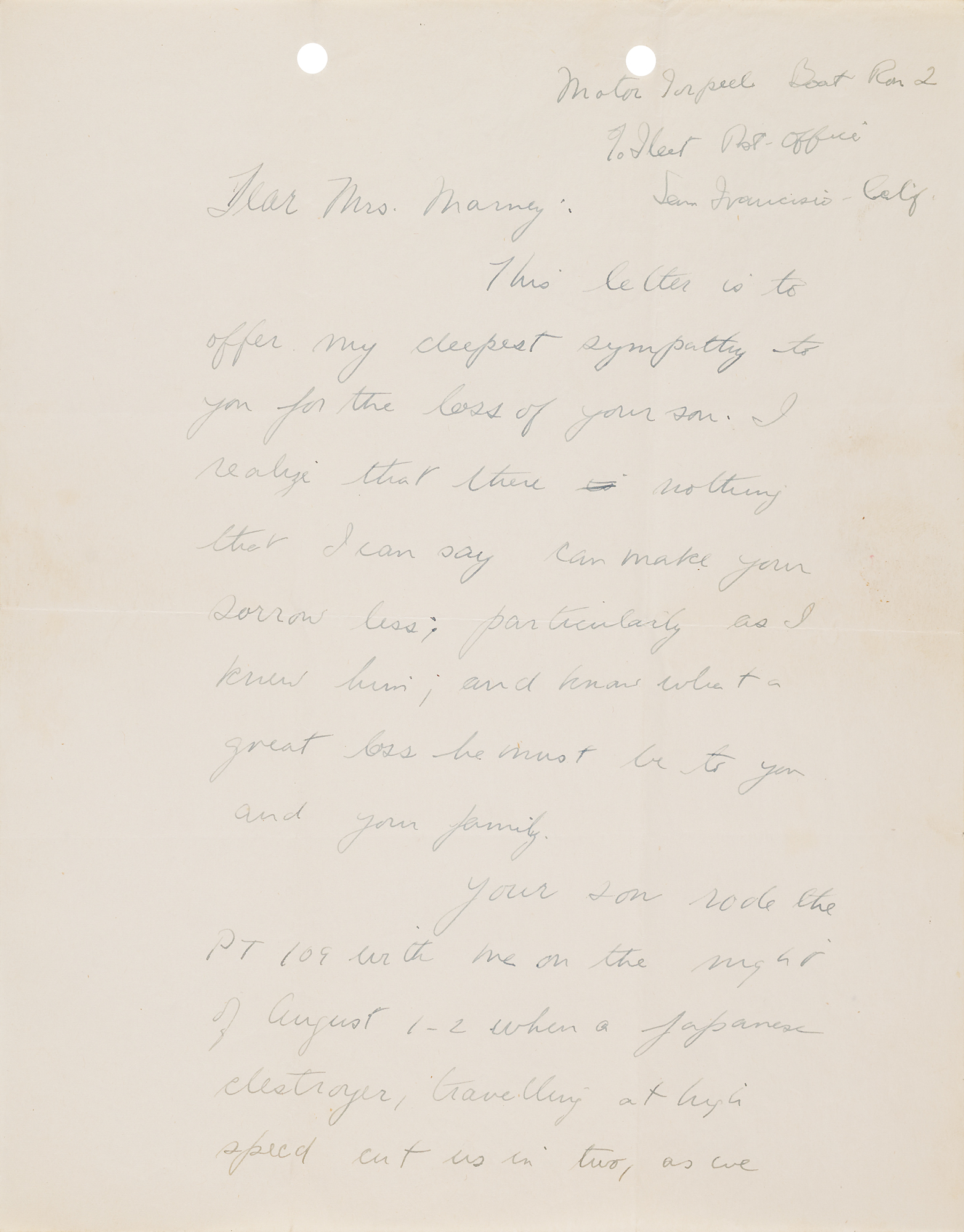
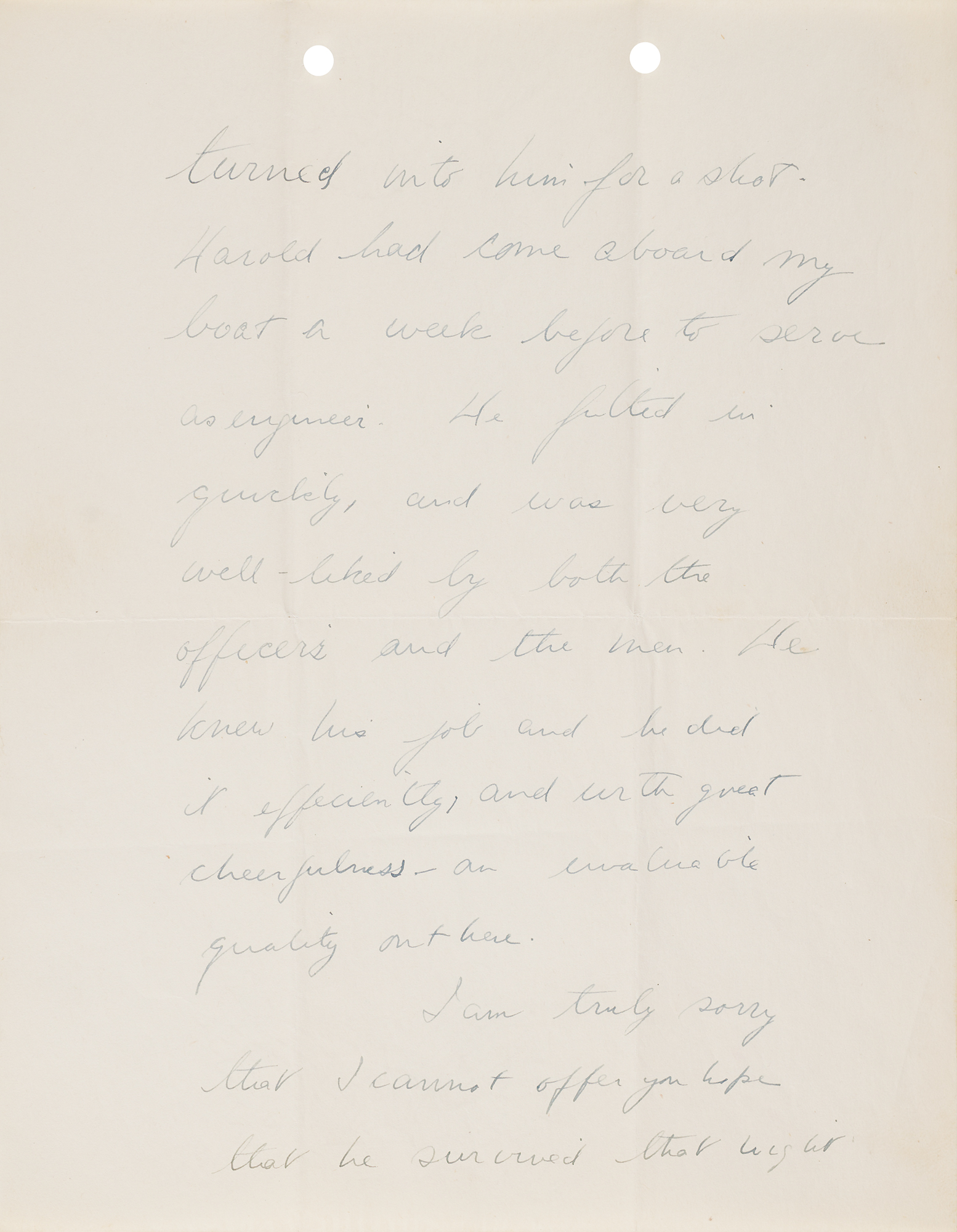
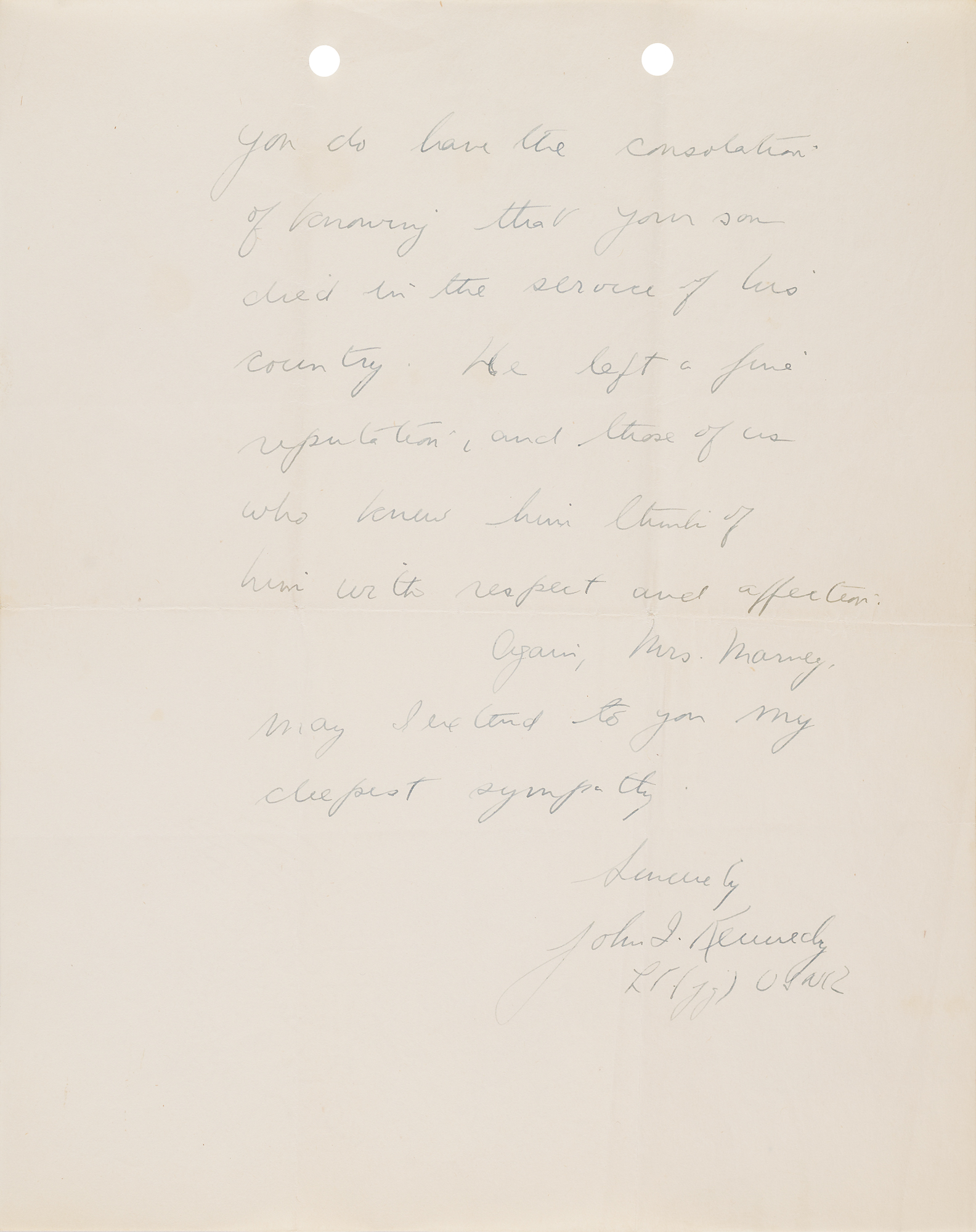
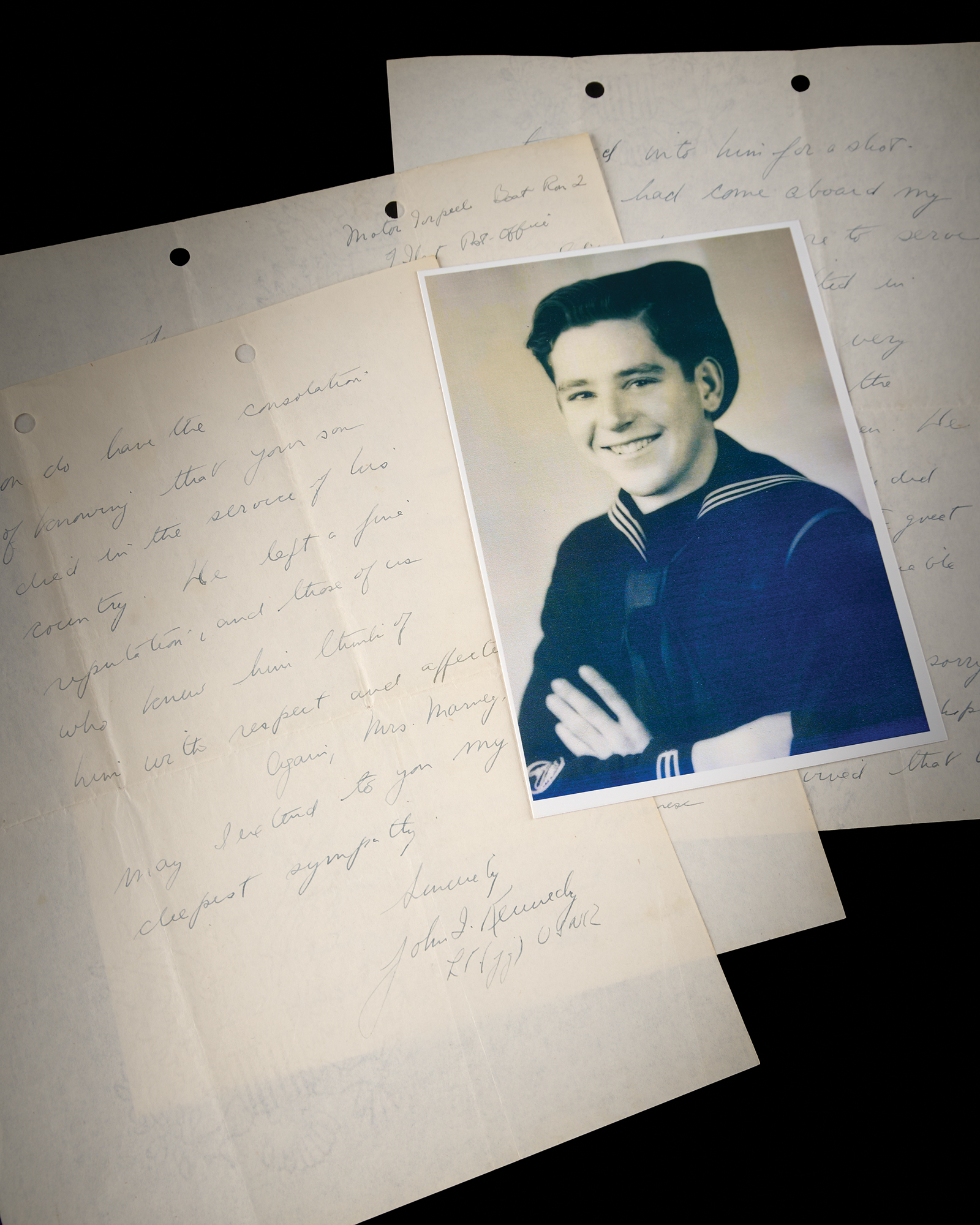
World War II-dated ALS signed "John F. Kennedy, Lt. (jg) USNR," three pages, 8 x 10.5, circa August–September 1943. Handwritten letter of condolence to “Mrs. Marney,” Jennie Marney, the mother of Harold W. Marney, one of two crew members killed when PT-109, commanded by Lt. John F. Kennedy, was rammed and sunk by the Japanese destroyer Amagiri near the Solomon Islands on August 2, 1943. In full: “This letter is to offer my deepest sympathy to you for the loss of your son. I realize that there is nothing that I can say [that] can make your sorrow less; particularly as I knew him, and I know what a great loss he must be to you and your family.
Your son rode the PT 109 with me on the night of August 1-2 when a Japanese destroyer, travelling at a high speed cut us in two, as we turned into him for a shot. Harold had come aboard my boat a week before to serve as engineer. He fitted in quickly, and was very well-liked by both the officers and the men. He knew his job and he did it efficiently, and with great cheerfulness – an invaluable quality out here. I am truly sorry that I cannot offer you hope that he survived that night. You do have the consolation of knowing that your son died in the service of his country. He left a fine reputation, and those of us who knew him think of him with respect and affection. Again, Mrs. Marney, may I extend to you my deepest sympathy."
Kennedy likely wrote this letter in August or September 1943 while serving with Motor Torpedo Boat Squadron Two in the Solomon Islands, with the surrounding evidence suggesting a September date. After the loss of PT-109 on August 2 and his rescue six days later, Kennedy returned to duty and assumed command of PT-59 on September 1. The dating is further supported by Kennedy’s signature as lieutenant junior grade; he was promoted to lieutenant on October 1, 1943. His reference to Marney’s cheerfulness as “an invaluable quality out here” likewise indicates that Kennedy was still writing from the Pacific theater. In the upper right corner, Kennedy adds his naval mailing address, “Motor Torpedo Boat Ron 2 / c/o Fleet Post-Office / San Francisco - Calif.”; the Fleet Post Office address served to route correspondence to Kennedy’s overseas unit and does not indicate that he was physically in San Francisco when the letter was written.
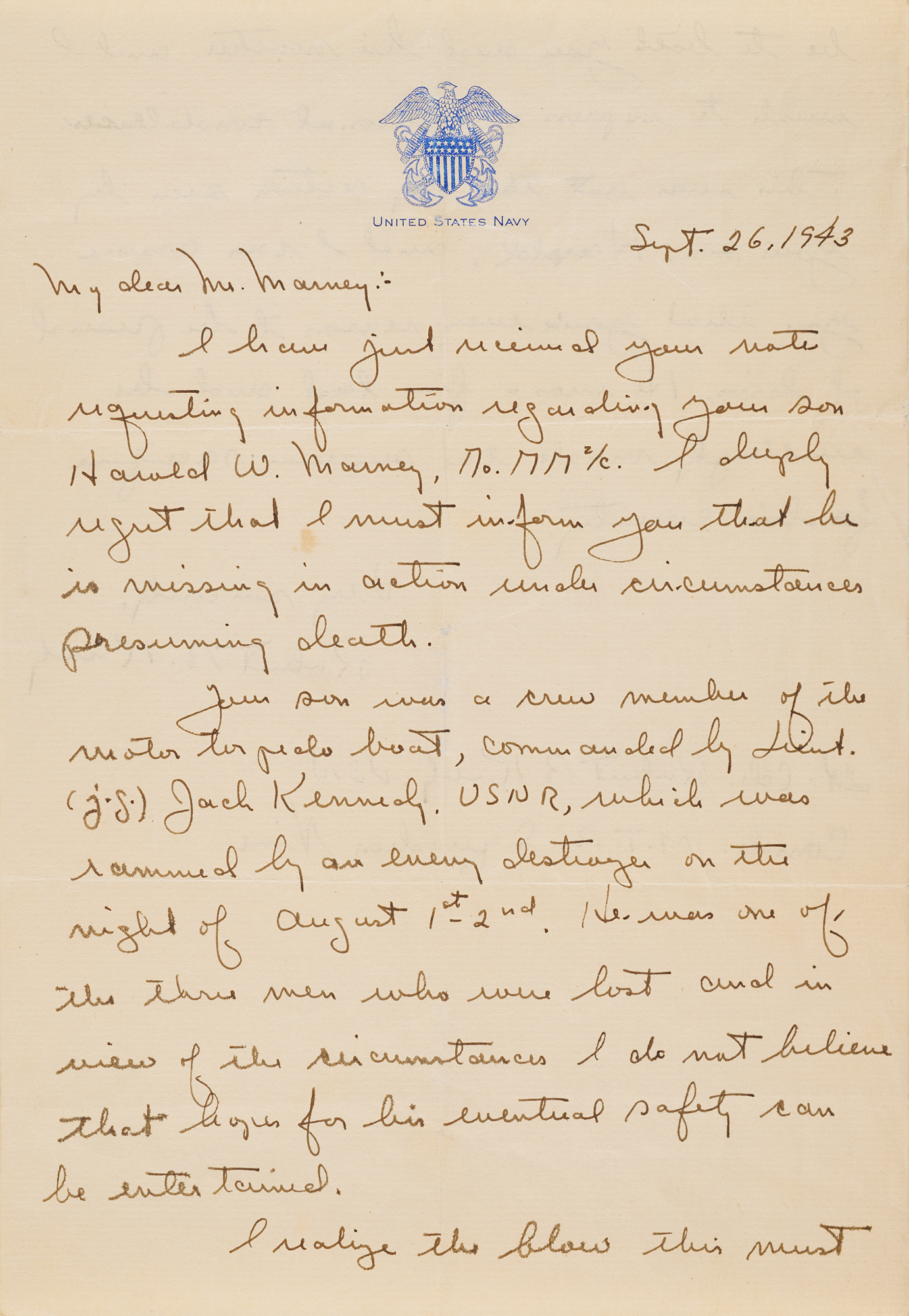
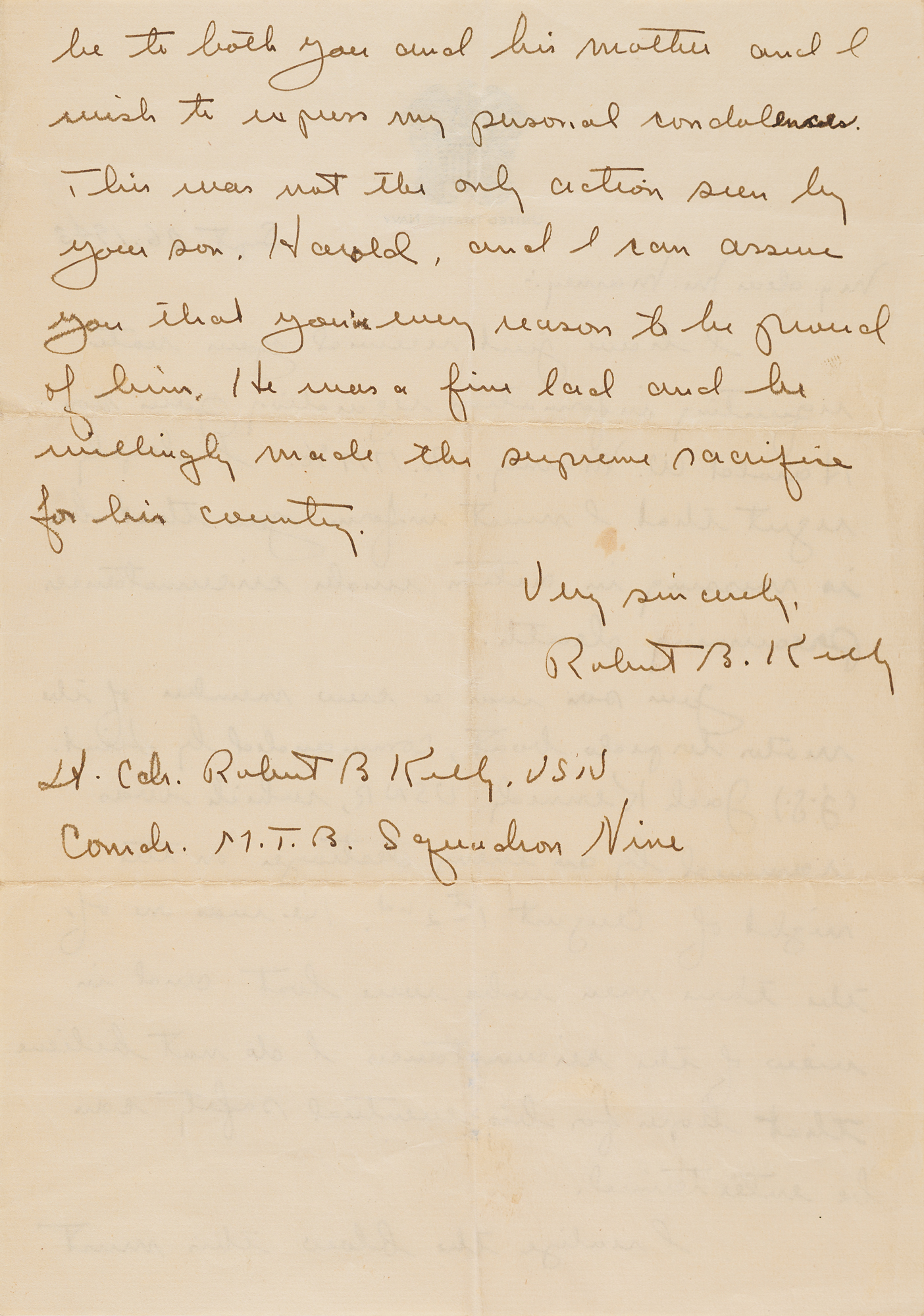
Included is a two-page ALS from Lt. Cdr. Robert B. Kelly, a senior officer in the Navy’s Motor Torpedo Boat operations, dated September 26, 1943, which reads: “I have just received your note requesting information regarding your son Harold W. Marney, Mo.M.M 2/c. I deeply regret that I must inform you that he is missing in action under circumstances presuming death. Your son was a crew member of the motor torpedo boat, commanded by Lieut. (j.g.) Jack Kennedy, USNR, which was rammed by an enemy destroyer on the night of August 1st-2nd. He was one of the three men who were lost and in view of the circumstances I do not believe that hope for his eventual safety can be entertained. I realize the blow this must be to both you and his mother and I wish to express my personal condolences. This was not the only action seen by your son, Harold, and I can assure you that you've every reason to be proud of him. He was a fine lad and he willingly made the supreme sacrifice for his country.” Kelly’s contemporary account refers to three men lost in the collision; subsequent accounts identify Marney and Andrew Jackson Kirksey as the two PT-109 crewmen who did not survive. The September 26 date of Kelly’s letter further supports dating Kennedy’s condolence letter to this period, although no direct connection between the two letters has been established.
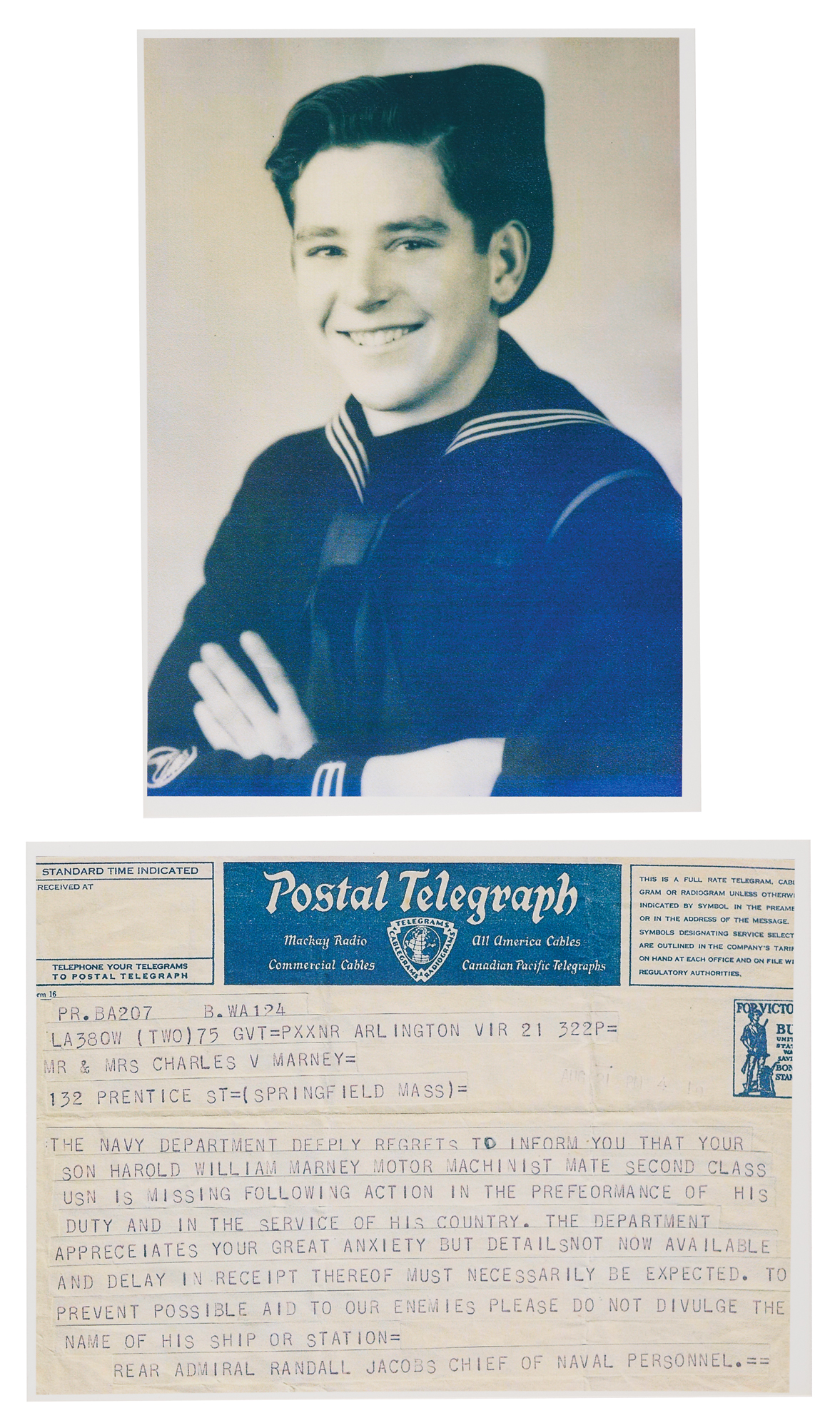
In fine condition. Accompanied by a copy of the Navy Department Telegraph sent to Mr. and Mrs. Marney reporting on his disappearance and a copy of a photograph of Harold Marney.
Harold Marney, 19, of Massachusetts, joined the crew of PT-109 in July 1943 as a motor machinist’s mate. One of the boat’s four motor machinist’s mates, or 'motormacs,' he worked primarily with its three Packard engines. According to William Doyle’s book, PT 109: An American Epic of War, Survival and the Destiny of John F. Kennedy, Marney was stationed in the starboard gun turret at the time of the collision, directly in the path of Amagiri’s bow, and was the first crewman to shout a warning as the destroyer bore down on PT-109. No trace of Marney was ever found. For hours after the collision, Kennedy and the survivors called for Marney and Andrew Jackson Kirksey, the other missing crewman, without response.
In the early morning of August 2, 1943, Lieutenant Kennedy’s PT-109 was struck and sunk by the Japanese destroyer Amagiri in the Blackett Strait of the Solomon Islands. Following a 3.5-mile swim to shore, Kennedy and his ten surviving crew members were rescued from Olasana Island six days later. Kennedy’s actions during the ordeal became an important part of his public biography after John Hersey chronicled the story in The New Yorker and Reader’s Digest, and resurfaced prominently during his 1960 presidential campaign, when his wartime service was emphasized in response to concerns about his youth and experience. The PT boat became a recognizable campaign symbol, appearing on tie bars, pins, clasps, charms, and other campaign pieces.

This item is Pre-Certified by PSA/DNA
Buy a third-party letter of authenticity for
$200.00
*This item has been pre-certified by a trusted third-party authentication service, and by placing a bid on this item, you agree to accept the opinion of this authentication service. If you wish to have an opinion rendered by a different authenticator of your choosing, you must do so prior to your placing of any bid. RR Auction is not responsible for differing opinions submitted 30 days after the date of the sale.
Third-party authentication service applies only to signatures and handwriting, and does not cover the addition of sketches, artwork, musical quotations, etc.

