Sold For $484,151
*Includes Buyers Premium
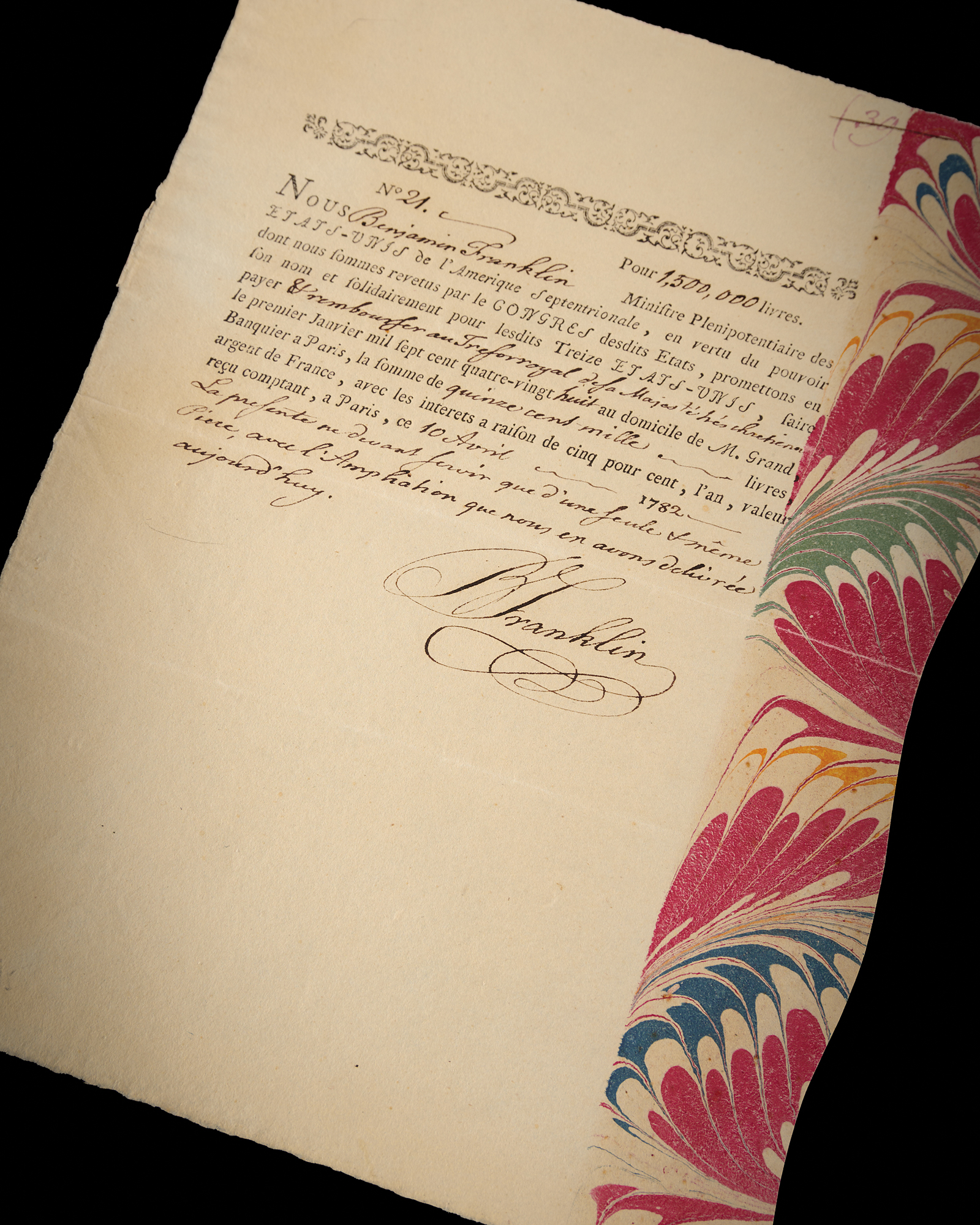
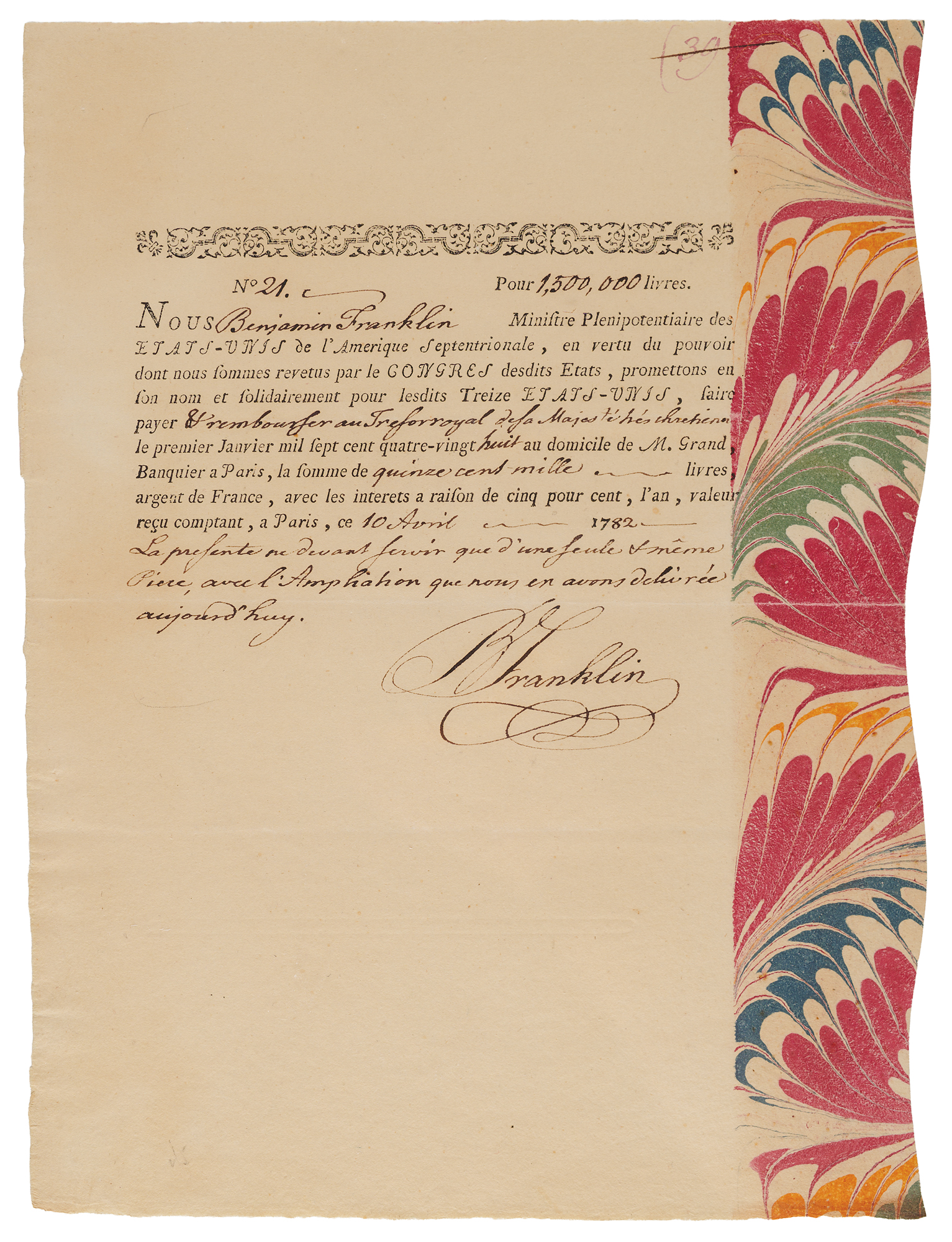
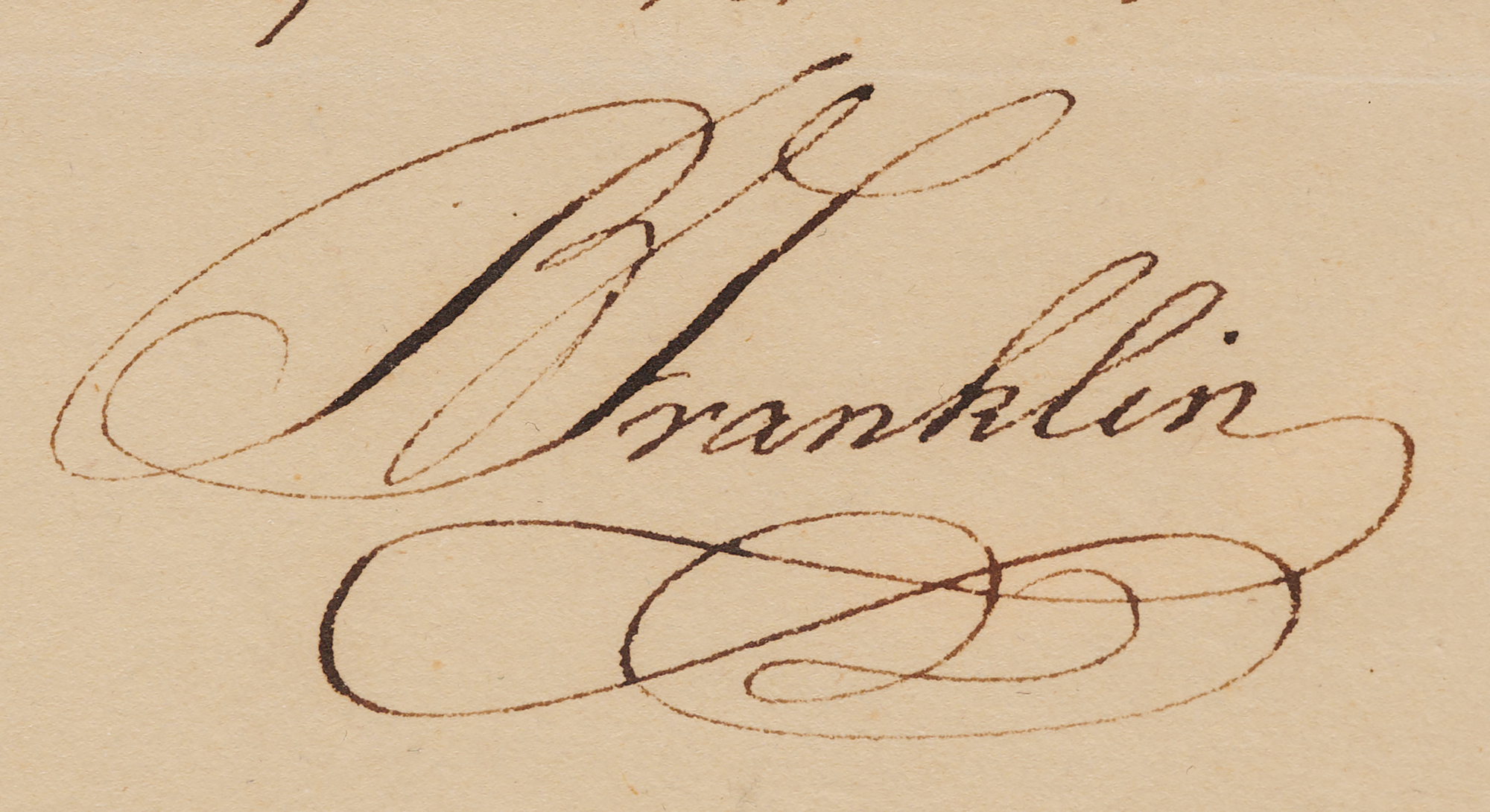
Revolutionary War-dated twice-signed partly-printed DS in French, filled out neatly in the hand of Benjamin Franklin, who signs the document at the conclusion, "B. Franklin," and at the onset in the third-person, "Benjamin Franklin," one page, 7.5 x 9.75, April 10, 1782. Extraordinary promissory note produced at Franklin's celebrated Passy press outside Paris, accomplished entirely in his hand as Minister Plenipotentiary of the United States, binding the young republic to repay the Royal Treasury of King Louis XVI the sum of 1,500,000 silver livres with annual interest at five percent. Printed on fine paper with an elaborate marbled strip along the right scalloped margin and an upper decorative border surmounted by fleur-de-lis ornaments, the document reads, in part (translated): "I, Benjamin Franklin, Minister Plenipotentiary of the United States of North America, in virtue of power vested in me by the Congress of the said States, promise in its name…to make payment and reimburse the Royal Treasury of His Most Christian Majesty." Franklin additionally appends a three-line handwritten rider beneath the text in his neat, formal hand. In very fine condition.
Not listed by Luther S. Livingston in Franklin and his Press at Passy (Grolier Club, 1914), though the identical typographical ornaments appear in Livingston no. 20, this extraordinarily rare financial instrument, numbered "21" at the top, is one of only four comparable Franklin-issued Revolutionary War loan documents dated between February 15, 1781, and April 10, 1782, sold from the celebrated Perc S. Brown collection at Parke Bernet in 1966, with the present example representing the largest sum among them. A remarkable artifact documenting the French loans that sustained the American cause during the Revolution, it stands as one of the clearest surviving records of Franklin's diplomatic success in securing vital foreign support for the United States.
France's entry into the American Revolution was the product of careful diplomacy and strategic calculation on both sides. Even before the formal alliance, French foreign minister Charles Gravier, comte de Vergennes, had covertly supplied aid to the Continental Army through the fictitious trading firm Rodrigue Hortalez et Cie, organized by Pierre-Augustin Caron de Beaumarchais. The American victory at Saratoga in October 1777 proved decisive: convinced that the United States could survive as a viable military and political ally, France formally recognized the new nation with the Treaty of Amity and Commerce and the Treaty of Alliance signed on February 6, 1778.
Franklin, who arrived in Paris in December 1776 as part of a three-man diplomatic commission, became Minister Plenipotentiary in 1778 and emerged as the leading American architect of the Franco-American alliance. Beyond securing French recognition and military support, he negotiated the loans that kept the Continental Army financially solvent during the war, executing promissory notes on behalf of Congress that bound the United States to repayment with interest. Dated April 10, 1782, and committing the United States to repay 1,500,000 silver livres to the Royal Treasury of Louis XVI, the present document corresponds to the first of three 1782 receipts later enumerated in the July 16, 1782, contract between France and the United States, together forming the final 6,000,000-livre French loan of the Revolution.
By April 1782, the military outcome of the Revolution was effectively decided: Cornwallis had surrendered at Yorktown six months earlier, and preliminary peace negotiations were already underway in Paris. The offered document was therefore not simply a wartime expedient, but part of the financial bridge by which Franklin helped carry the United States from military victory to recognized nationhood. It stands among the most tangible surviving records of Franklin's diplomatic and financial achievement during the Revolution.

This item is Pre-Certified by PSA/DNA
Buy a third-party letter of authenticity for
$200.00
*This item has been pre-certified by a trusted third-party authentication service, and by placing a bid on this item, you agree to accept the opinion of this authentication service. If you wish to have an opinion rendered by a different authenticator of your choosing, you must do so prior to your placing of any bid. RR Auction is not responsible for differing opinions submitted 30 days after the date of the sale.
Third-party authentication service applies only to signatures and handwriting, and does not cover the addition of sketches, artwork, musical quotations, etc.

