Sold For $2,440
*Includes Buyers Premium
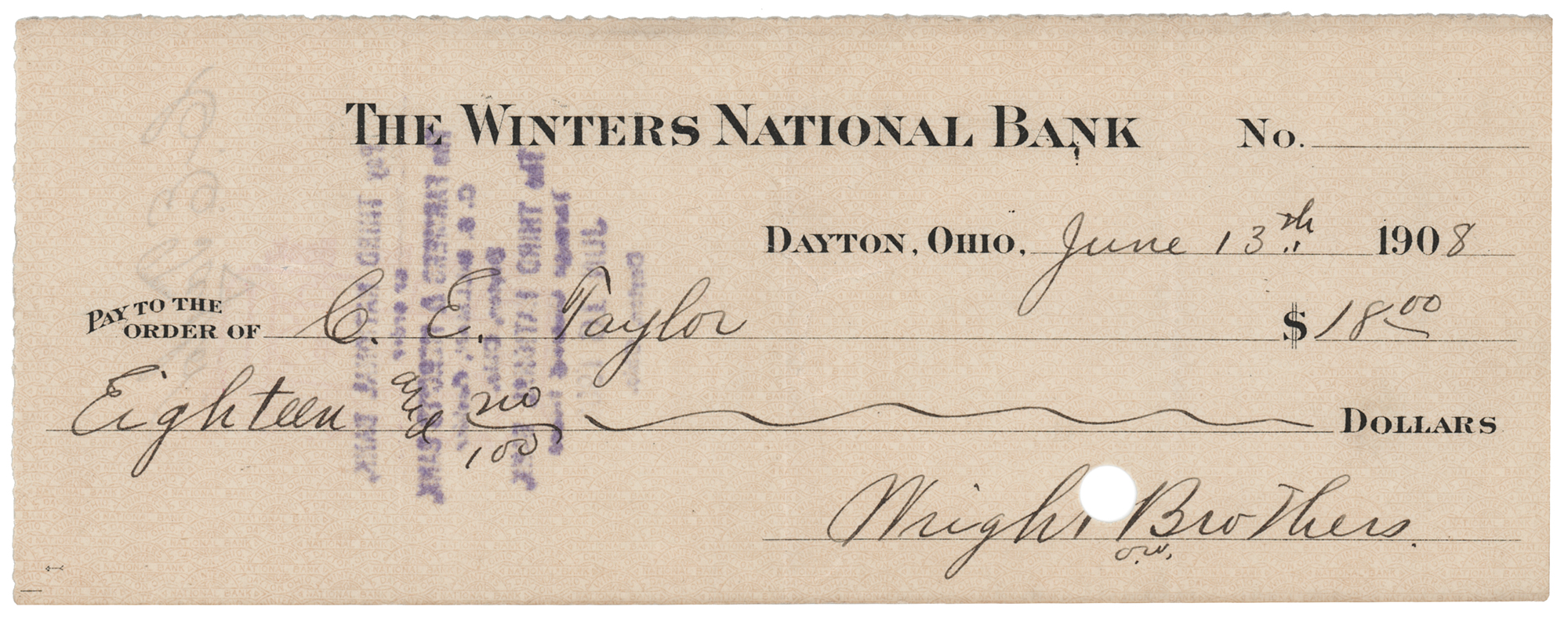
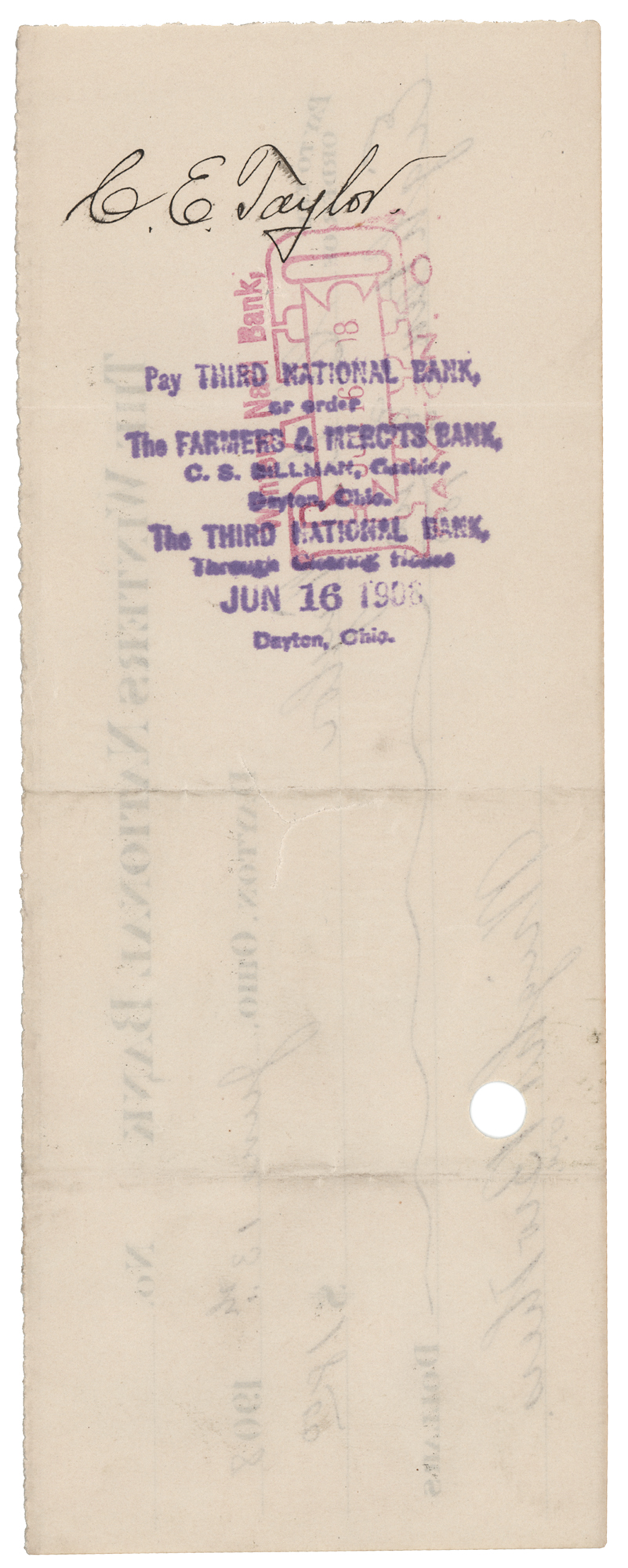
The Winters National Bank check, 8.25 x 3.25, filled out in the hand of Orville Wright, who signs on behalf of both himself and his brother, "Wright Brothers," and adds his initials below, “O.W.,” payable to mechanic C. E. Taylor for $18, June 13, 1908. Also endorsed on the reverse by Charlie Taylor. In fine condition, with a cancellation hole in the signature area.
Charles Edward Taylor (1868–1956) was the gifted machinist and mechanic whose engineering skill proved indispensable to the Wright brothers’ pioneering aviation achievements. Born in Illinois and later settling in Dayton, Ohio, Taylor worked as a machinist for the Stoddard Manufacturing Company before joining Wilbur and Orville Wright’s bicycle business in 1901. Initially hired to repair bicycles, he gradually assumed responsibility for much of the shop’s daily operation as the brothers devoted themselves to aeronautical experimentation. By 1902, the Wrights trusted Taylor enough to manage the business during their extended glider trials at Kitty Hawk.
His most important contribution came in 1903, when the Wright brothers were unable to locate a lightweight engine capable of powering their experimental aircraft. Working from rough sketches and performance requirements supplied by the brothers, Taylor designed and built a custom four-cylinder, water-cooled aluminum aircraft engine in only six weeks. Producing approximately 12 horsepower, well above the Wrights’ minimum requirement, the engine powered the Wright Flyer during its historic first controlled, sustained powered flight at Kitty Hawk on December 17, 1903, securing Taylor’s place as one of the essential technical figures in aviation history.
Taylor remained at the center of the Wright brothers’ aviation efforts for years afterward, serving as their chief mechanic during public demonstrations, exhibition flights, and military trials. In 1908, he accompanied Orville Wright to Fort Myer, Virginia, where the “military Flyer” crashed during Army demonstrations after a propeller failure, killing Lieutenant Thomas Selfridge and seriously injuring Orville; Taylor was among the first to reach the wreckage and assist the injured aviator. The following year, he traveled with Wilbur Wright to New York for the celebrated Hudson-Fulton flights over the Hudson River, carefully maintaining the aircraft and helping prepare it for dangerous over-water demonstrations before millions of spectators.
As aviation rapidly developed, Taylor became one of America’s leading aircraft mechanics, later assisting pioneering aviator Calbraith Perry Rodgers during his 1911 transcontinental flight across the United States. Though often overshadowed by the Wright brothers themselves, Taylor’s mechanical brilliance and tireless maintenance work became foundational to early powered flight and to the broader field of aviation mechanics. His legacy survives today through the FAA’s prestigious Charles Taylor Master Mechanic Award, the Embry-Riddle Charles Taylor Aviation Maintenance Science program, and Aviation Maintenance Technician Day, observed annually on his birthday.

This item is Pre-Certified by PSA/DNA
Buy a third-party letter of authenticity for
$75.00
*This item has been pre-certified by a trusted third-party authentication service, and by placing a bid on this item, you agree to accept the opinion of this authentication service. If you wish to have an opinion rendered by a different authenticator of your choosing, you must do so prior to your placing of any bid. RR Auction is not responsible for differing opinions submitted 30 days after the date of the sale.
Third-party authentication service applies only to signatures and handwriting, and does not cover the addition of sketches, artwork, musical quotations, etc.

