The 30 Minute Rule begins July 15 at 7:00 PM EDT. An Initial Bid Must Be Placed By July 15 at 6:00 PM EDT To Participate After 6:00 PM EDT
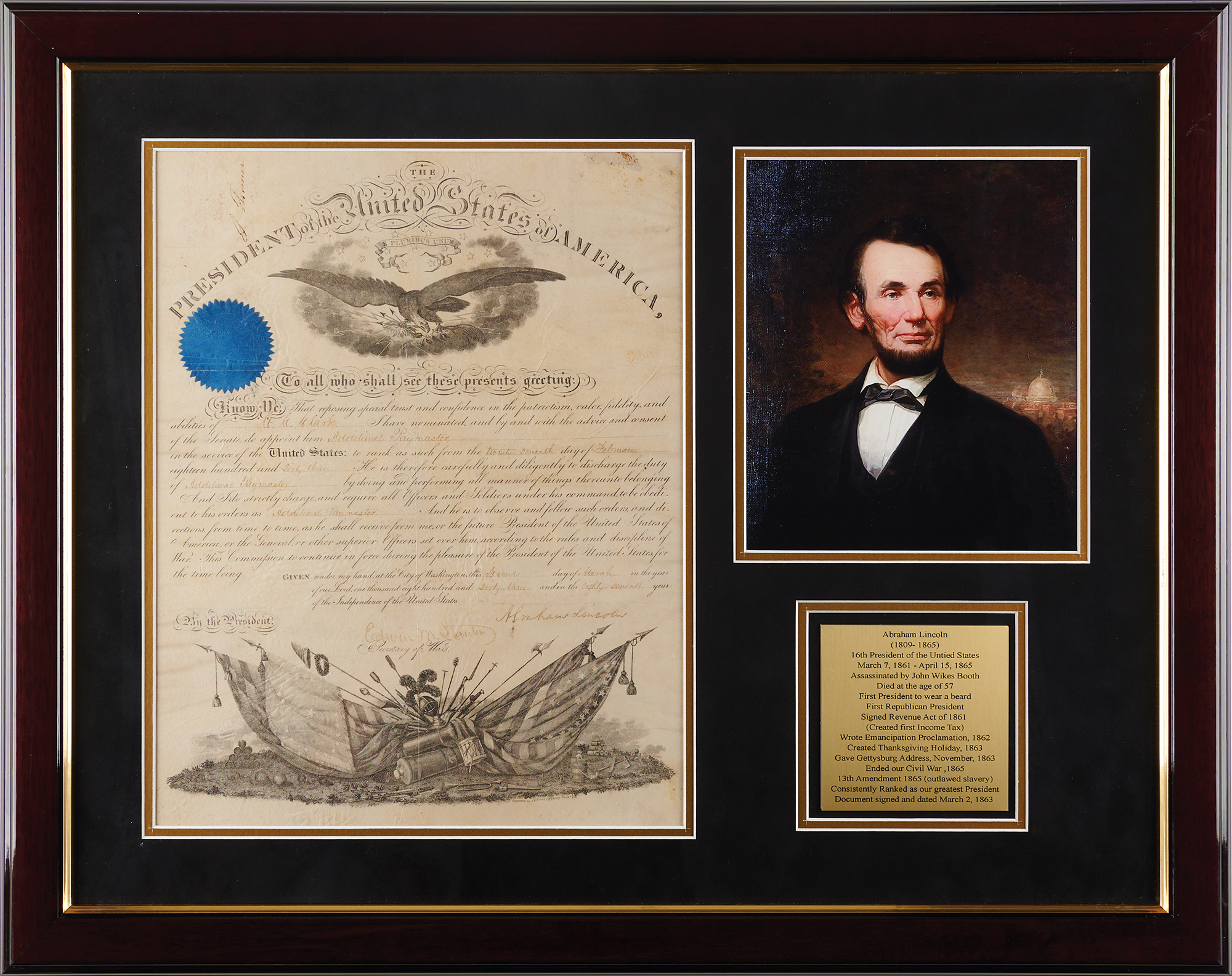
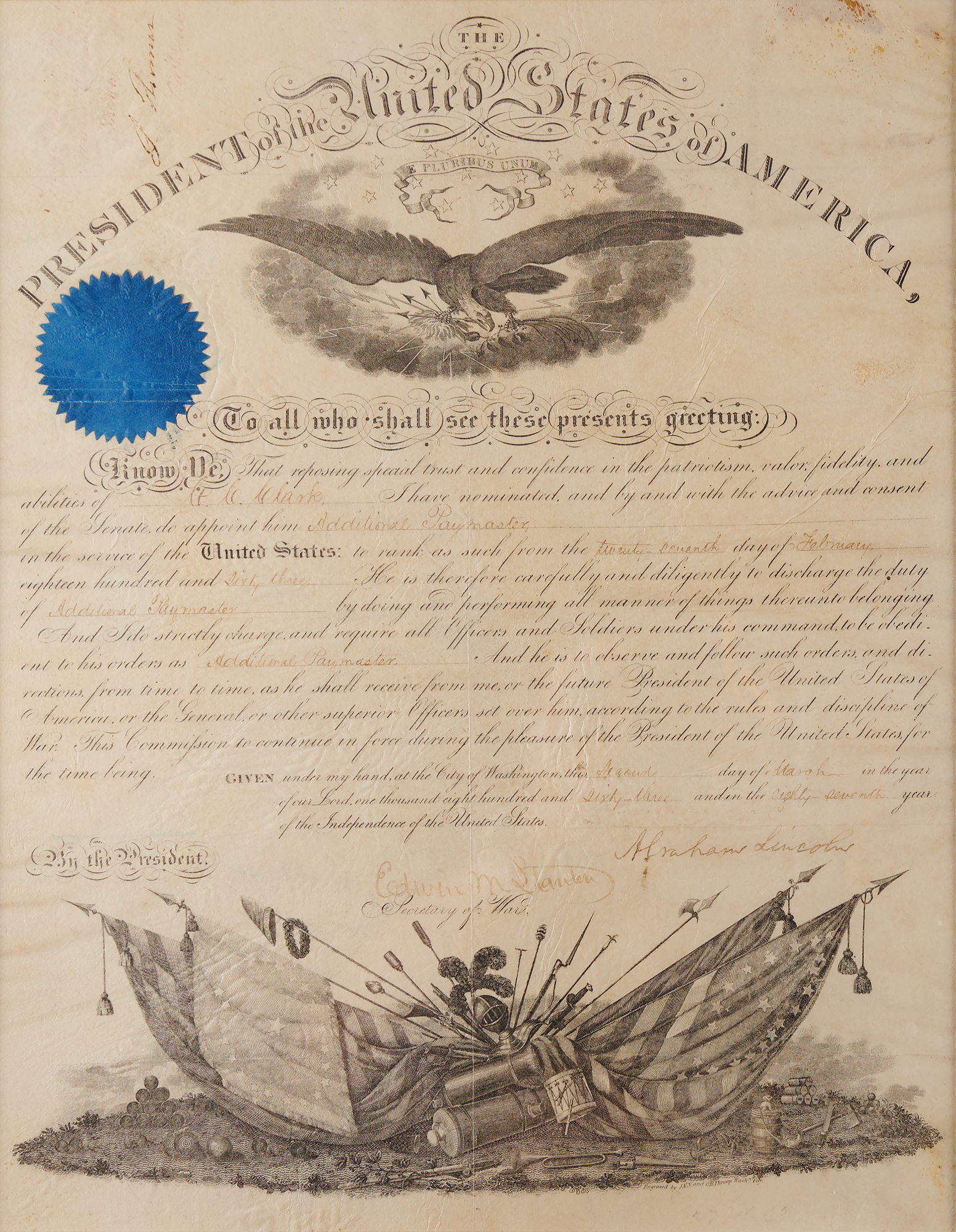
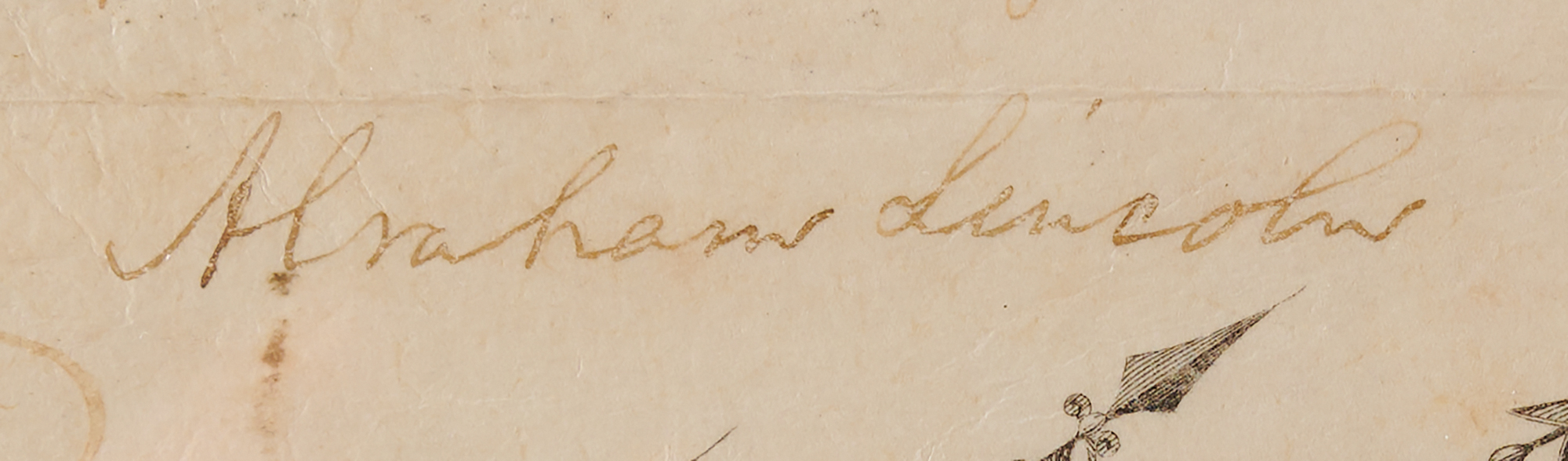
Civil War-dated partly-printed DS as president, one page, 12.75 x 16.25, March 2, 1863. President Lincoln appoints C. C. Clark to be an “Additional Paymaster in the service of the United States.” Signed at the conclusion in ink by Abraham Lincoln, and countersigned by Secretary of War Edward M. Stanton. The original blue War Department seal remains affixed to the upper left. Impressively double-matted and framed with a color portrait and engraved plaque to an overall size of 29.75 x 23.5. Professionally cleaned and restored to near fine condition, with slight fading to all handwritten portions.
Signed one day before President Lincoln approved the controversial Enrollment Act of 1863, the first genuine national conscription law in American history, this appointment dates to a pivotal moment in the expansion of the Union war effort. Passed by Congress to provide fresh manpower for the Union Army, the act required the enrollment of every male citizen and immigrants who had filed for citizenship between the ages of 20 and 45, unless specifically exempted. The War Department did provide a legal means of avoiding service: a drafted man could hire a substitute to serve in his place, typically by paying a bounty of approximately $300 to a volunteer replacement. Even President Lincoln himself hired a substitute, John Summerfield Staples of Pennsylvania, as a public gesture of support for the measure.
The law proved enormously controversial and, following the Battle of Gettysburg, helped spark the infamous New York City Draft Riots of July 1863, a week-long uprising that resulted in the deaths of more than 100 civilians and over one million dollars in property damage. The violence remains widely regarded as the largest civil insurrection in American history apart from the Civil War itself.
Dr. Cyrus Curtis Clark (1830-1923) served throughout much of the Civil War in both combat and administrative roles, beginning his military career in May 1861 as a captain in Company H of the Connecticut Heavy Artillery. After more than a year of service, he received a promotion to major in August 1862 and transferred to the 14th Connecticut Infantry. During his wartime service, he was wounded multiple times, reportedly suffering injuries at Fredericksburg in 1862, at Spotsylvania Court House in 1864, and again near Farmville in April 1865 during the closing days of the war.
In February 1863, Clark was appointed a major and additional paymaster in the United States Volunteers Paymaster’s Department, a position formally confirmed later that year under the Lincoln administration. In that capacity, he was responsible for distributing government funds to Union troops until being mustered out in November 1865. Two years after he was appointed paymaster, Clark became involved in a widely litigated controversy after reporting that nearly $16,000 in government funds had been stolen from his safe in Texas; although federal investigators and later congressional committees accepted that the robbery occurred without negligence on his part, the case continued through the courts for years afterward.

This item is Pre-Certified by PSA/DNA
Buy a third-party letter of authenticity for
$500.00
*This item has been pre-certified by a trusted third-party authentication service, and by placing a bid on this item, you agree to accept the opinion of this authentication service. If you wish to have an opinion rendered by a different authenticator of your choosing, you must do so prior to your placing of any bid. RR Auction is not responsible for differing opinions submitted 30 days after the date of the sale.
Third-party authentication service applies only to signatures and handwriting, and does not cover the addition of sketches, artwork, musical quotations, etc.

