
The 30 Minute Rule begins June 10 at 7:00 PM EDT. An Initial Bid Must Be Placed By June 10 at 6:00 PM EDT To Participate After 6:00 PM EDT
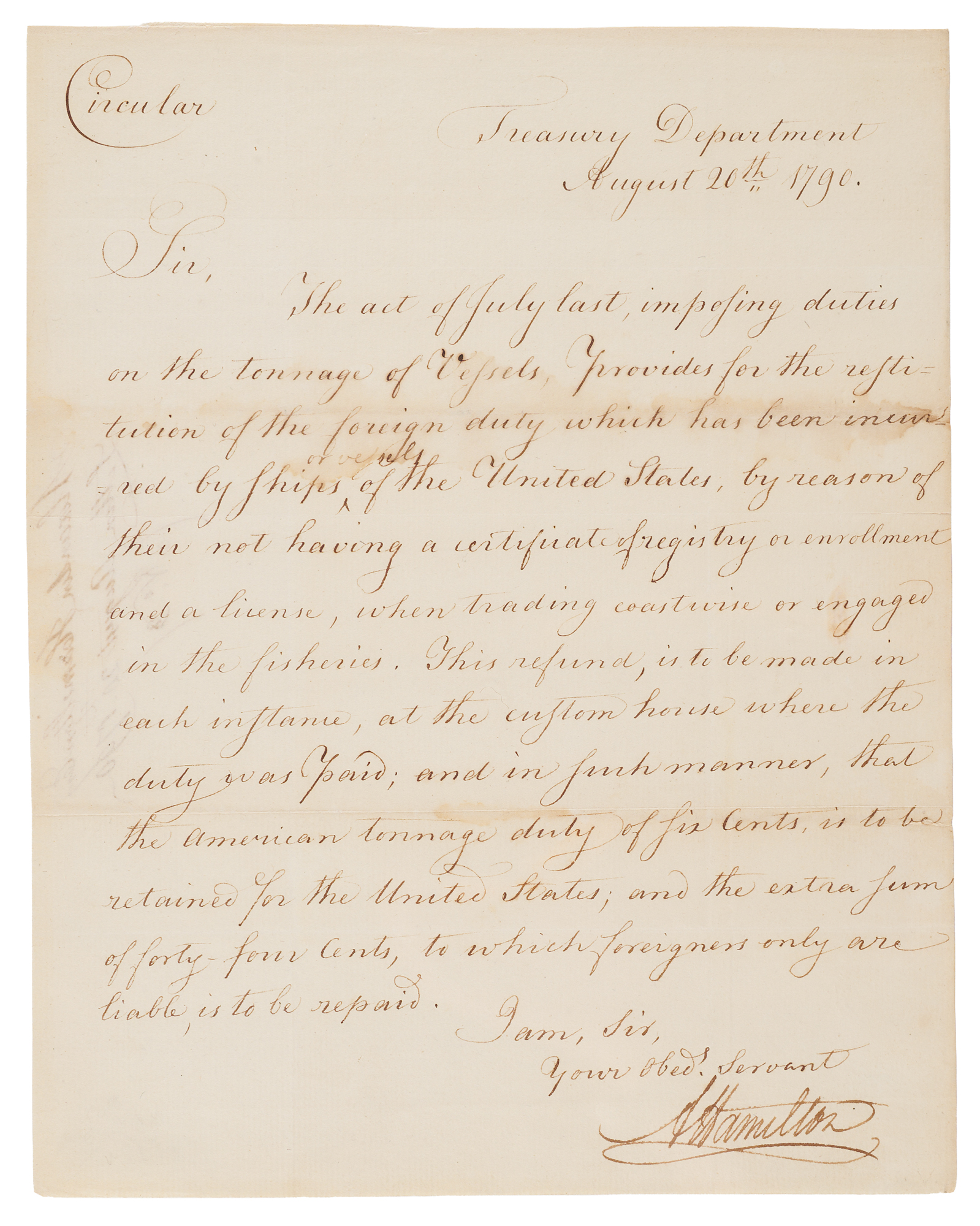
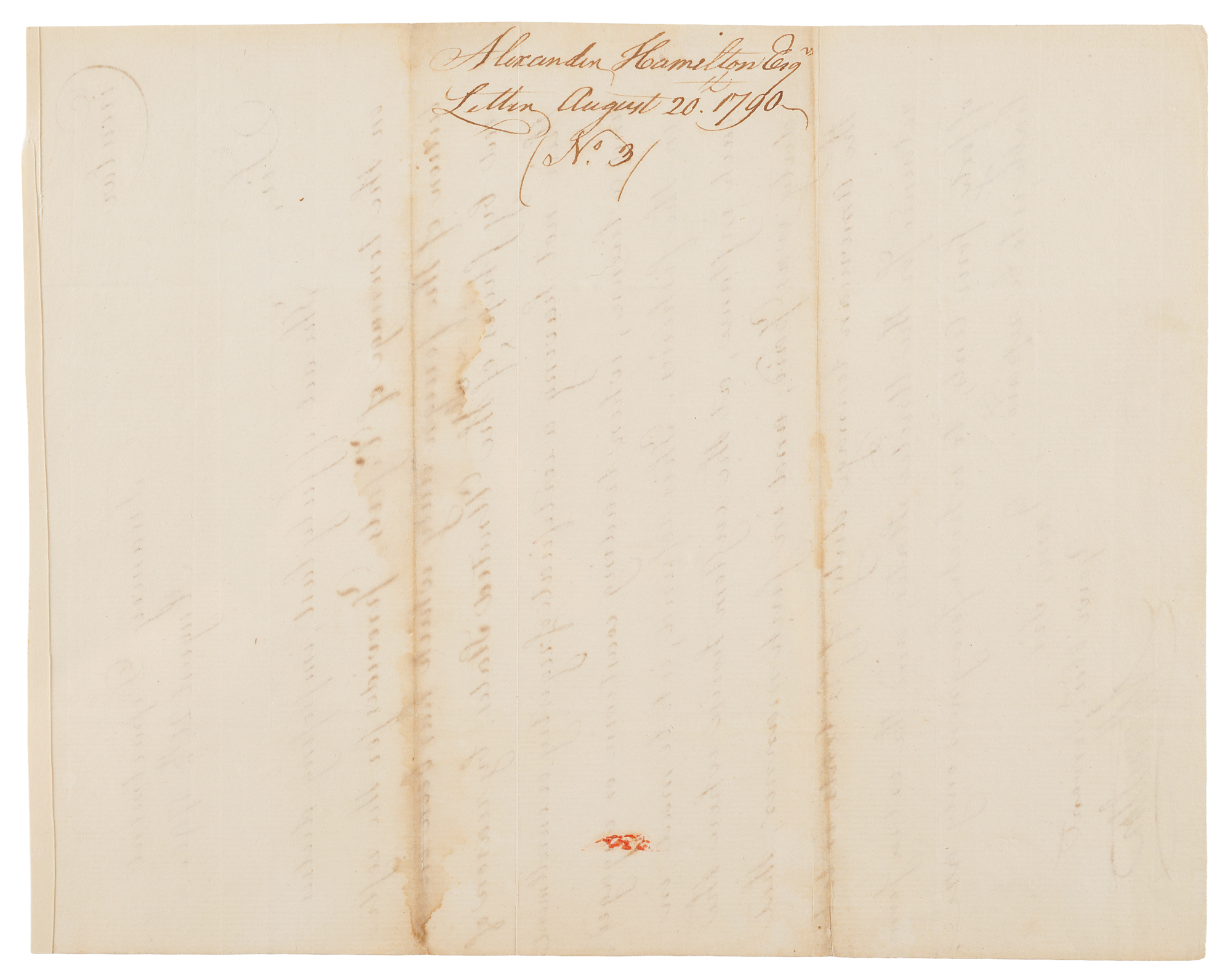
LS as Secretary of the Treasury, signed “A. Hamilton,” one page, 8 x 10, August 20, 1790. Issued from the “Treasury Department,” a circular letter communicating an important detail of the recently instituted duties on maritime imports, which constituted the primary revenue-producing aspect of Hamilton's financial plan for the new nation: "The Act of July last imposing duties on the Tonnage of Vessels, provides for the restitution of the foreign duty which has been incurred by Ships or Vessels of the United States by reason of their not having a Certificate of Registry or Enrollment and a License, when trading Coastwise or engaged in the fisheries. This refund is to be made in each instance, at the custom house where the duty was paid and in such manner that the American Tonnage duty of Six Cents is to be retained for the United States and the extra sum of forty four cents, to which foreigners only are liable, is to be repaid." Includes a custom presentation folder. An excellent example of Hamilton's unflagging willingness to arrange and manage even the most minute administrative details of the new revenue system. In fine condition, with some faint staining.
Crafted to avoid any perception of ‘taxation without representation,’ the Articles of Confederation rendered the federal government essentially powerless to collect revenue; only states could levy taxes, and the national government relied upon disbursements from its states for funding. The result was a weak and underfunded central government. The United States Constitution, backed by Federalists like Alexander Hamilton and James Madison, sought to correct these problems by allowing the central government to regulate commerce and collect taxes.
The primary source for these funds became duties collected at the nation’s customs houses, situated at America’s ports of entry. Collectors of customs were nominated by President George Washington, who often chose to reward loyal and distinguished service in the Revolutionary War with these sought-after appointments. These officials formed the backbone of the earliest federal administrative system, operating under the direction of the Treasury Department.
Earlier that month, on July 4, 1790, Congress had passed the Tonnage Act, complementing the earlier Tariff Act of 1789, and forming a central pillar of Hamilton’s revenue program. Designed to favor American carriers, the law levied a 50¢ per ton duty on foreign vessels, while American-owned ships were charged just 6¢ per ton. In this letter, Secretary of the Treasury Hamilton clarifies a crucial point in its enforcement, directing that American vessels improperly charged the higher foreign rate due to a lack of documentation be refunded the excess. Issued as a circular to customs officials, the letter reflects the practical implementation of the nation’s first federal revenue system and Hamilton’s close oversight of its operation. An important piece of early American financial history.

This item is Pre-Certified by PSA/DNA
Buy a third-party letter of authenticity for
$200.00
*This item has been pre-certified by a trusted third-party authentication service, and by placing a bid on this item, you agree to accept the opinion of this authentication service. If you wish to have an opinion rendered by a different authenticator of your choosing, you must do so prior to your placing of any bid. RR Auction is not responsible for differing opinions submitted 30 days after the date of the sale.
Third-party authentication service applies only to signatures and handwriting, and does not cover the addition of sketches, artwork, musical quotations, etc.

