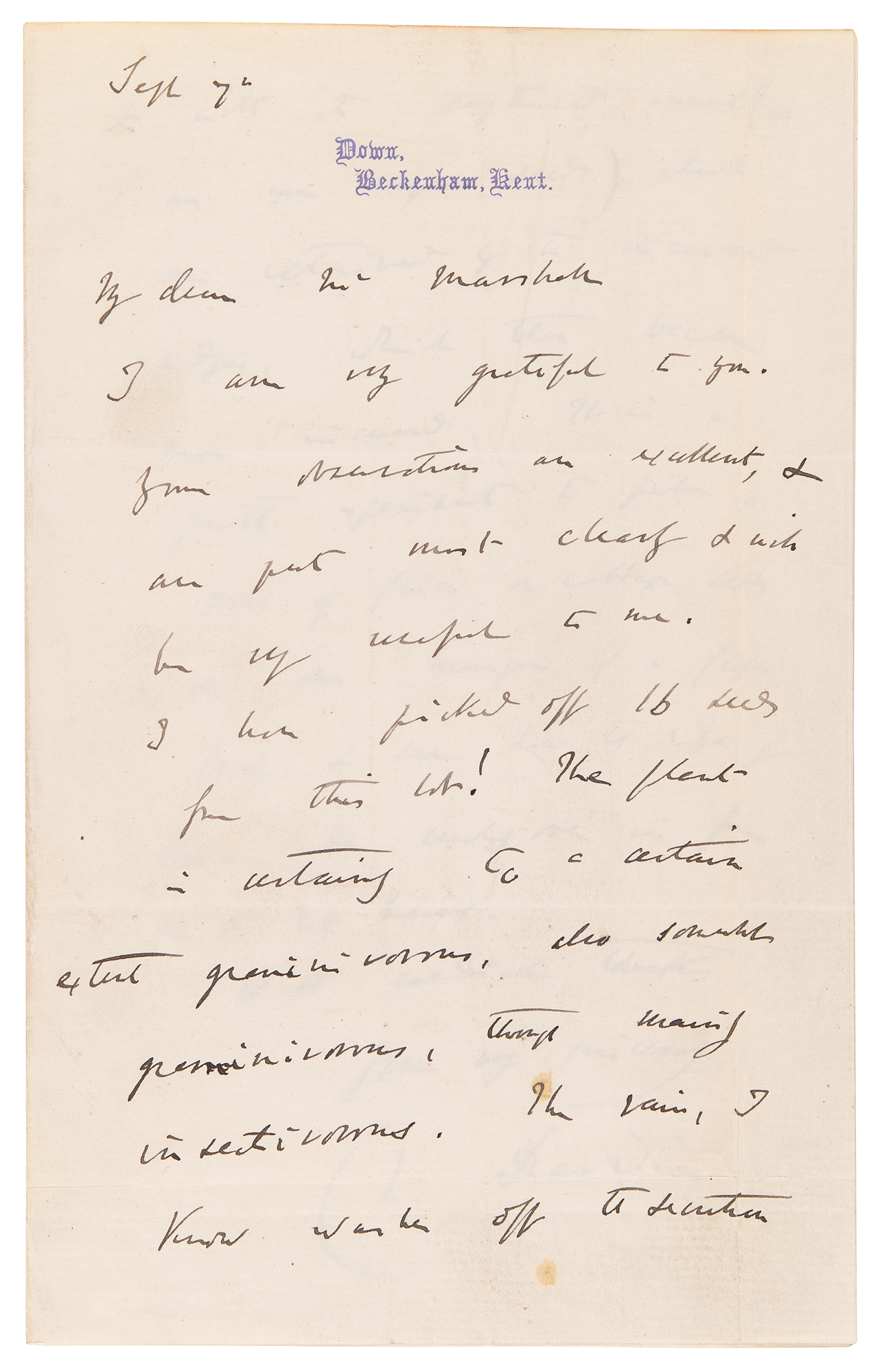
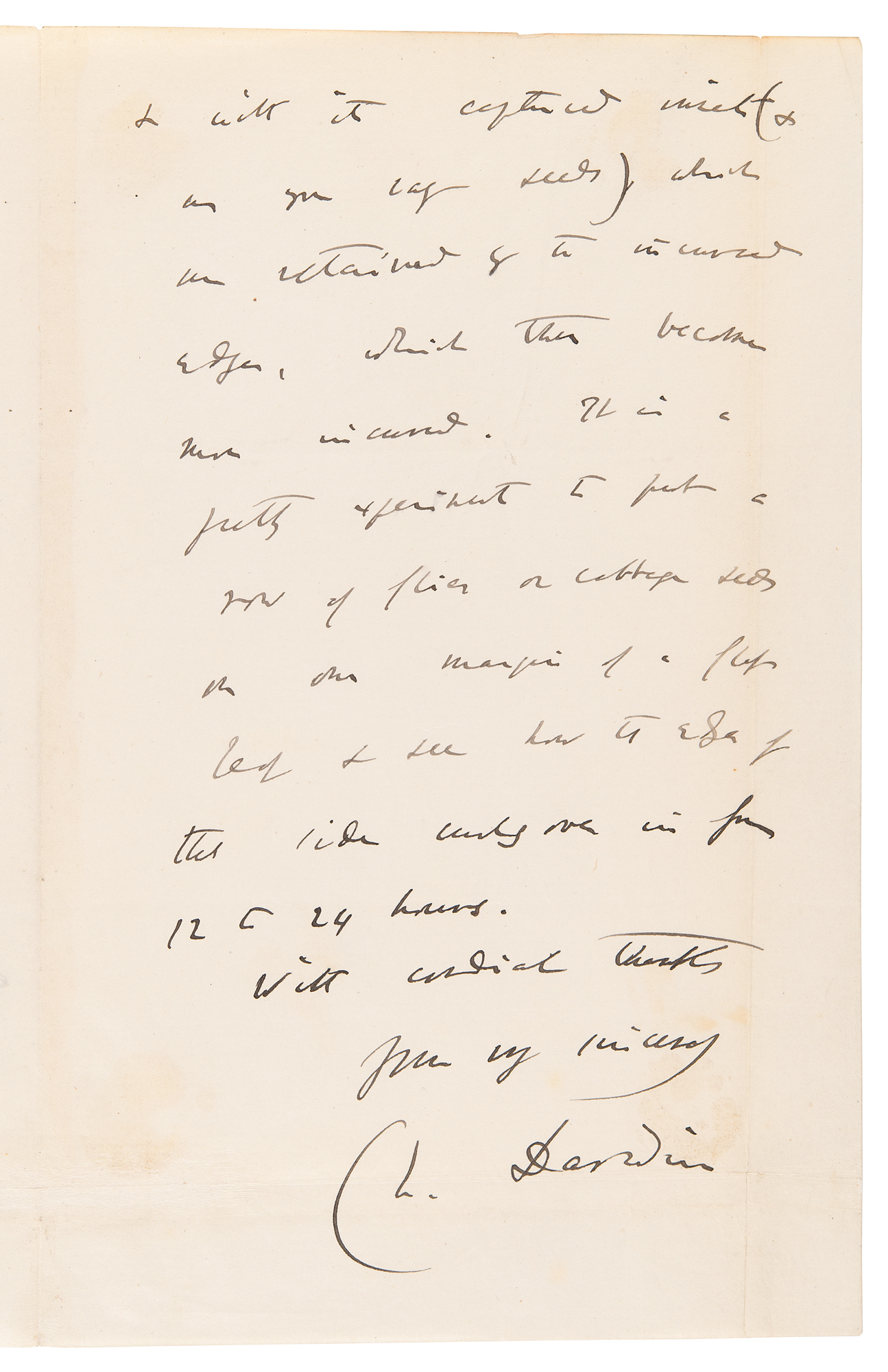
ALS signed “Ch. Darwin,” two pages on two adjoining sheets, 5 x 7.75, Down, Beckenham, Kent letterhead, September 7, [1874]. Handwritten letter to British architect William Cecil Marshall, regarding his observations on Pinguicula, commonly known as butterwort, a genus of carnivorous flowering plants. In full: "I am very grateful to you. Your observations are excellent, & are put most clearly & will be very useful to me. I have picked off 16 seeds from this lot! The plant is certainly to a certain extent graninivorous also somewhat graminivorous, though mainly insectivorous. The rain, I know washes off the secretion & with it captured insects (& as you say seeds), which are retained by the incurved edges, which then become more incurved. It is a pretty experiment to put a row of flies or cabbage seeds on one margin of a flat leaf & see how the edge of the side curls over in from 12 to 24 hours." In fine condition.
Recorded by the Darwin Correspondence Project as Letter no. 9627F.
Darwin's fascination with carnivorous plants culminated in Insectivorous Plants (1875), a landmark work in which he applied the principles of natural selection to explain the remarkable adaptations of flesh-eating flora. Drawing on years of meticulous experimentation, Darwin documented in precise detail how various species capture and digest prey—whether through ingenious snap-trap mechanisms or adhesive secretions—and probed the physiological triggers behind their responses. In characteristic fashion, he subjected specimens to an array of stimuli, including meat, glass, and hair, ultimately demonstrating that only the movement of living animal prey reliably elicited a reaction—a compelling testament to nature's efficiency and the conserving logic of evolution.
The volume was illustrated with the collaborative efforts of Darwin and his sons George and Francis, underscoring the familial nature of his scientific enterprise. First issued in a print run of 3,000 copies, Insectivorous Plants was translated into multiple languages and enjoyed wide circulation, later appearing in a posthumous second edition in 1888, carefully edited and annotated by Francis Darwin. The work stands as a cornerstone of Darwin's broader mission to illuminate the transformative power of natural selection across the full spectrum of the living world.

This item is Pre-Certified by PSA/DNA
Buy a third-party letter of authenticity for
$250.00
*This item has been pre-certified by a trusted third-party authentication service, and by placing a bid on this item, you agree to accept the opinion of this authentication service. If you wish to have an opinion rendered by a different authenticator of your choosing, you must do so prior to your placing of any bid. RR Auction is not responsible for differing opinions submitted 30 days after the date of the sale.
Third-party authentication service applies only to signatures and handwriting, and does not cover the addition of sketches, artwork, musical quotations, etc.

