Sold For $36,978
*Includes Buyers Premium
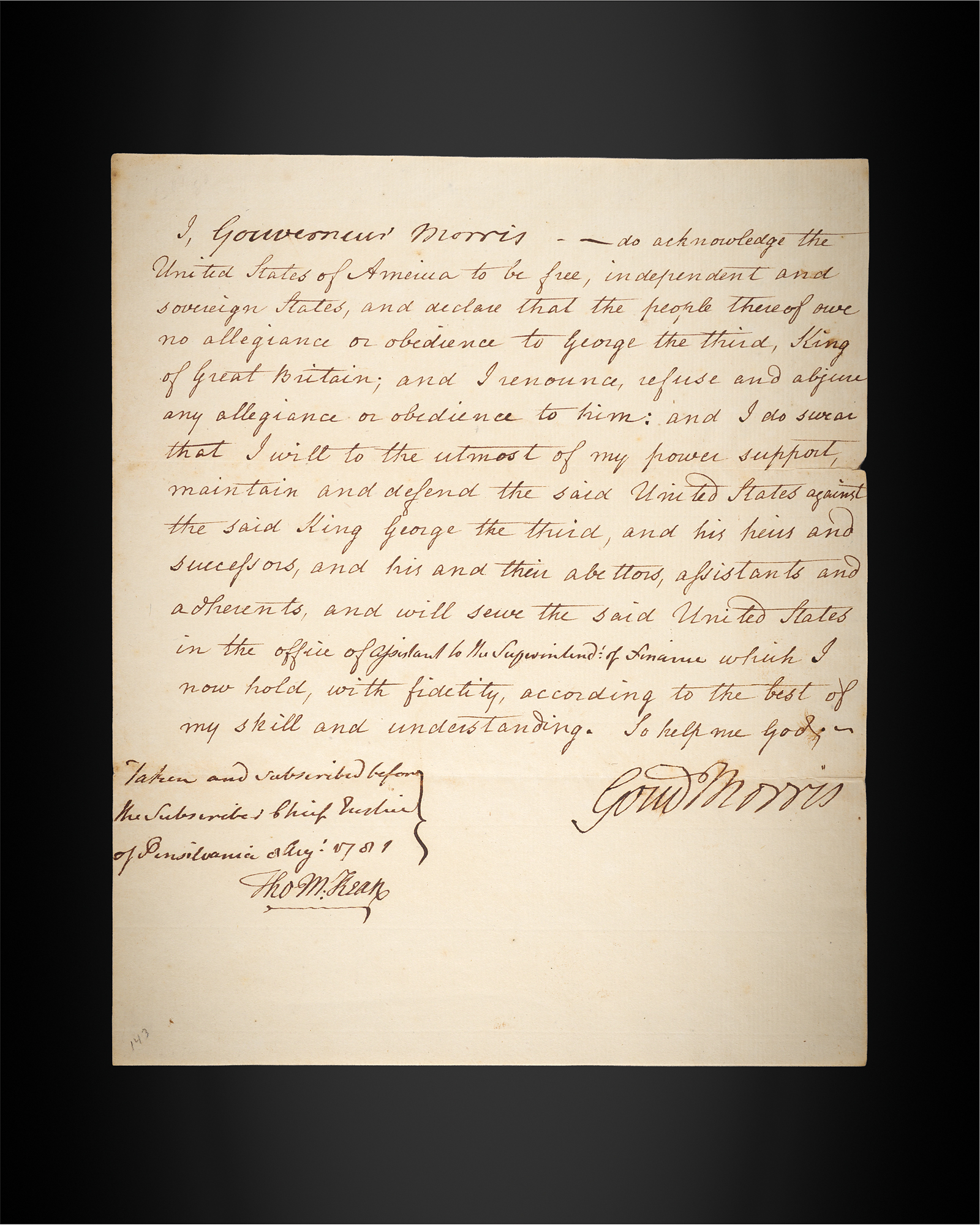
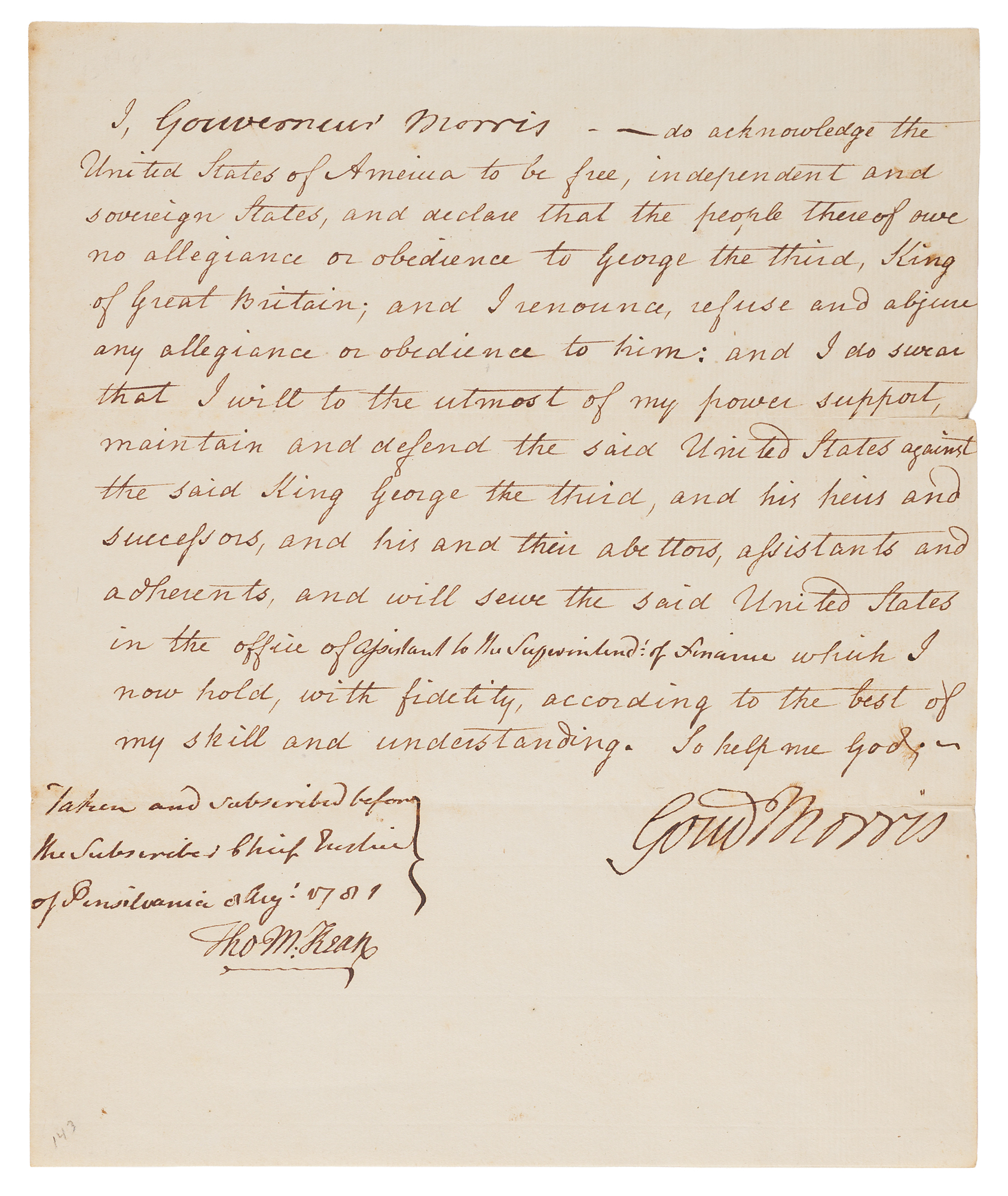
Revolutionary War-dated manuscript DS, signed twice by Gouverneur Morris and countersigned by Thomas McKean, one page, 7.5 x 9, August 8, 1781. Oath of allegiance subscribed by Gouverneur Morris, acknowledging the independence and sovereignty of the United States and renouncing allegiance to King George III. The oath reads in full: “I, Gouverneur Morris – do acknowledge the United States of America to be free, independent and sovereign States, and declare that the people thereof owe no allegiance or obedience to George the third, King of Great Britain; and I renounce, refuse and abjure any allegiance or obedience to him: and I do swear that I will to the utmost of my power support, maintain and defend the said United States against the said King George the third, and his heirs and successors, and his and their abettors, assistants and adherents, and will serve the said United States in the office of Assistant to the Superintendent of Finance which I now hold, with fidelity, according to the best of my skill and understanding. So help me God.” Morris has signed prominently at the conclusion (“Gouv. Morris”), incorporated his signature at the start of the oath, “Gouverneur Morris,” and added his title to the main body of the text, “Assistant to the Superintendent of Finance.” The document is countersigned by McKean ("Tho. M:Kean”), who at the time was serving as Chief Justice of Pennsylvania. In fine condition.
A leading statesman of the Revolutionary and Early National periods, Gouverneur Morris served in the Continental Congress and later helped organize the nation's wartime finances under Superintendent of Finance Robert Morris. At the time this oath was signed, Morris had moved from New York to Pennsylvania to accept appointment as Assistant to the Superintendent of Finance, helping administer efforts to stabilize the finances of the struggling Confederation government during the acute financial crisis of 1781.
By the summer of that year, the Continental dollar had effectively collapsed, Congress lacked independent taxing authority, and the army faced mounting unrest over unpaid wages. Robert Morris' appointment as Superintendent of Finance in May 1781 represented Congress's urgent attempt to rescue the American war effort from fiscal collapse, with Gouverneur Morris joining him almost immediately in that effort. Signed only weeks before the Yorktown campaign, the oath dates to the very moment American officials were struggling to sustain the Continental cause financially during the decisive final phase of the war. Morris would later become one of the principal architects of the United States Constitution, drafting much of its final language, including the celebrated preamble beginning ‘We the People.’
The document also bears the signature of Thomas McKean, signer of the Declaration of Independence, then simultaneously serving as President of Congress and Chief Justice of Pennsylvania. McKean’s dual service in both offices at the same time reflected the institutional fluidity and overlapping governmental responsibilities characteristic of the Revolutionary period. Oaths of allegiance of this nature were required of many officials serving the Revolutionary cause, but surviving examples signed by major founders are uncommon, particularly those explicitly renouncing allegiance to George III while affirming service to the newly independent United States.
This item is Pre-Certified by PSA/DNA
Buy a third-party letter of authenticity for
(inquire for price)
*This item has been pre-certified by a trusted third-party authentication service, and by placing a bid on this item, you agree to accept the opinion of this authentication service. If you wish to have an opinion rendered by a different authenticator of your choosing, you must do so prior to your placing of any bid. RR Auction is not responsible for differing opinions submitted 30 days after the date of the sale.
Third-party authentication service applies only to signatures and handwriting, and does not cover the addition of sketches, artwork, musical quotations, etc.

