The 30 Minute Rule begins July 8 at 7:00 PM EDT. An Initial Bid Must Be Placed By July 8 at 6:00 PM EDT To Participate After 6:00 PM EDT
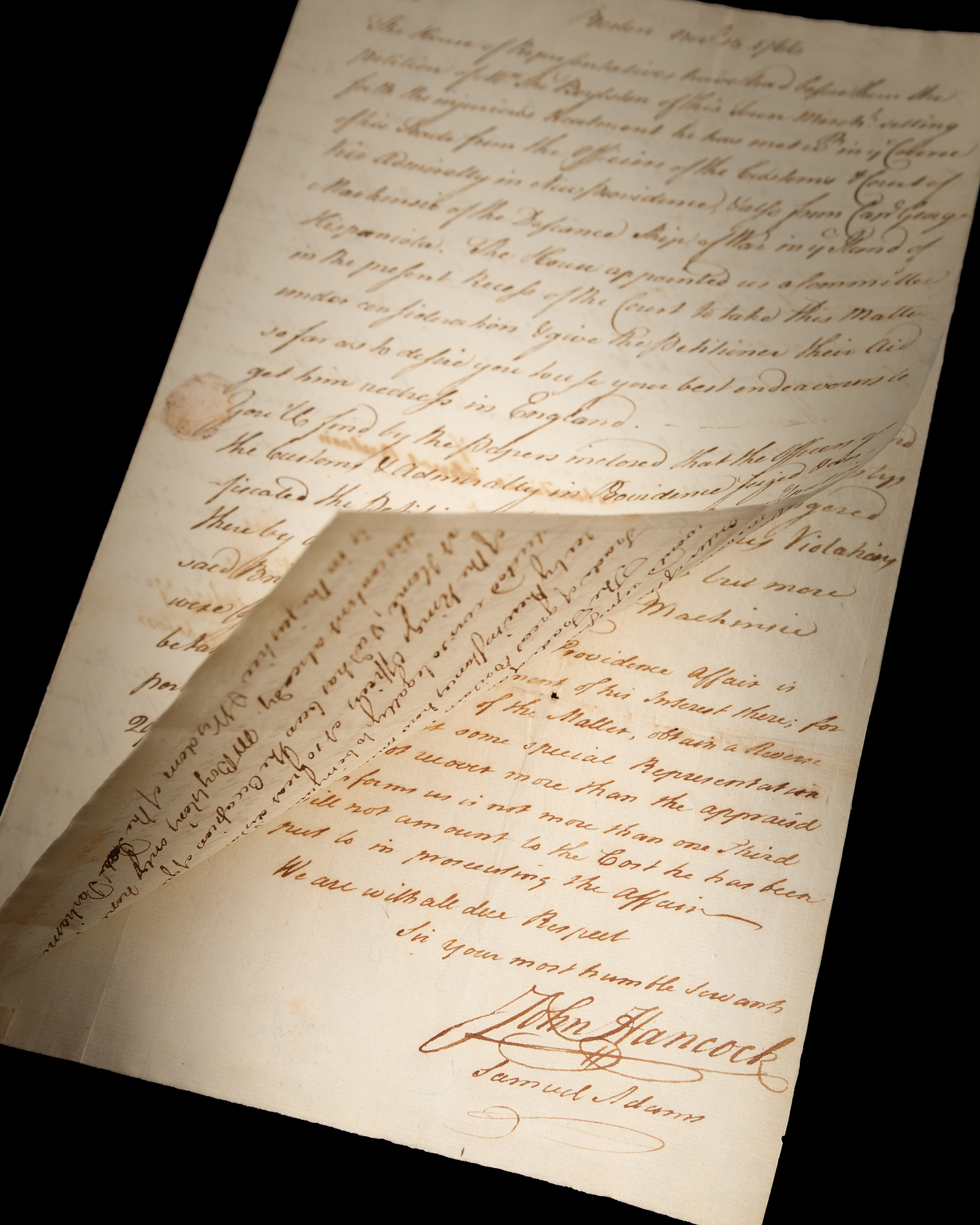
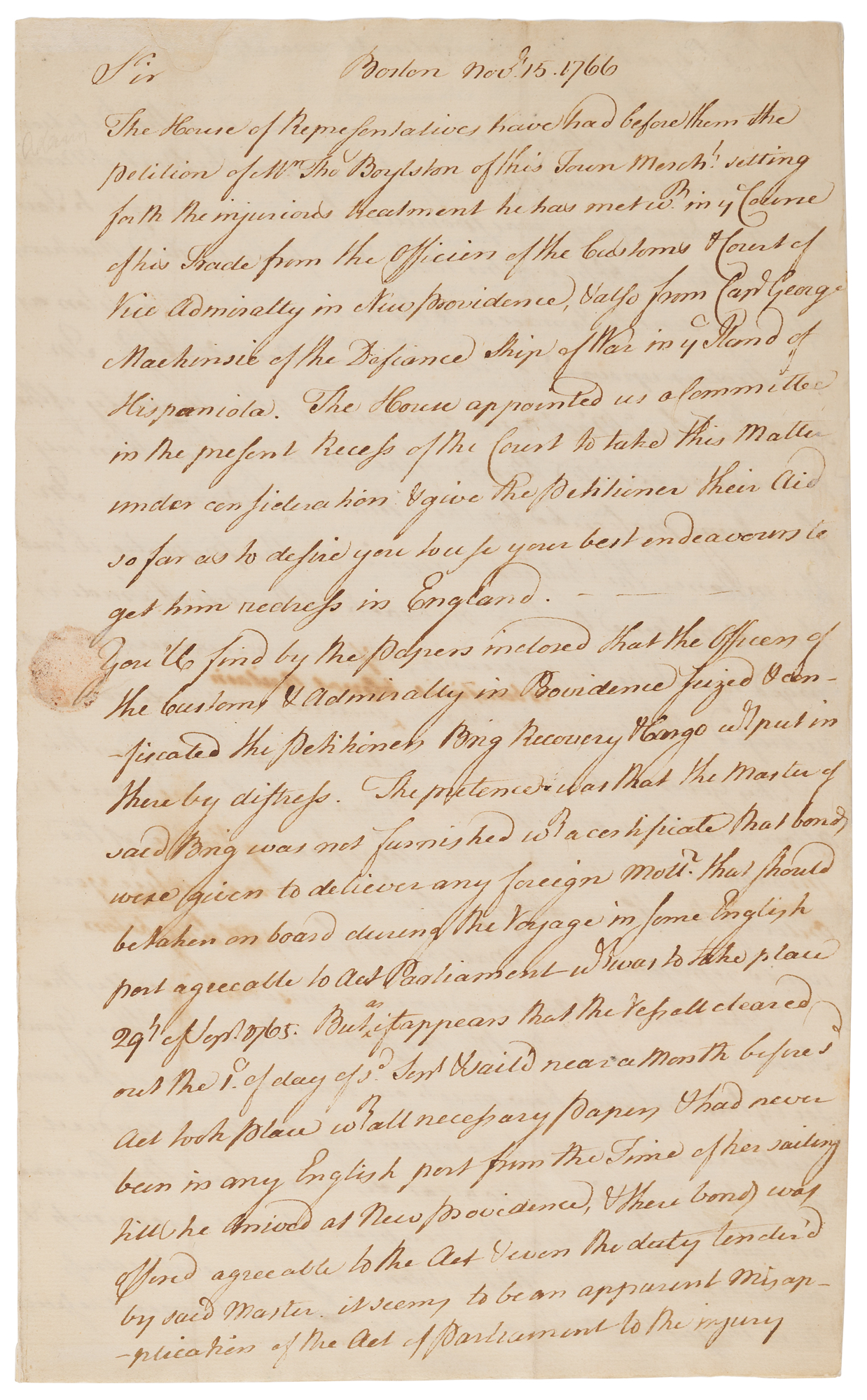
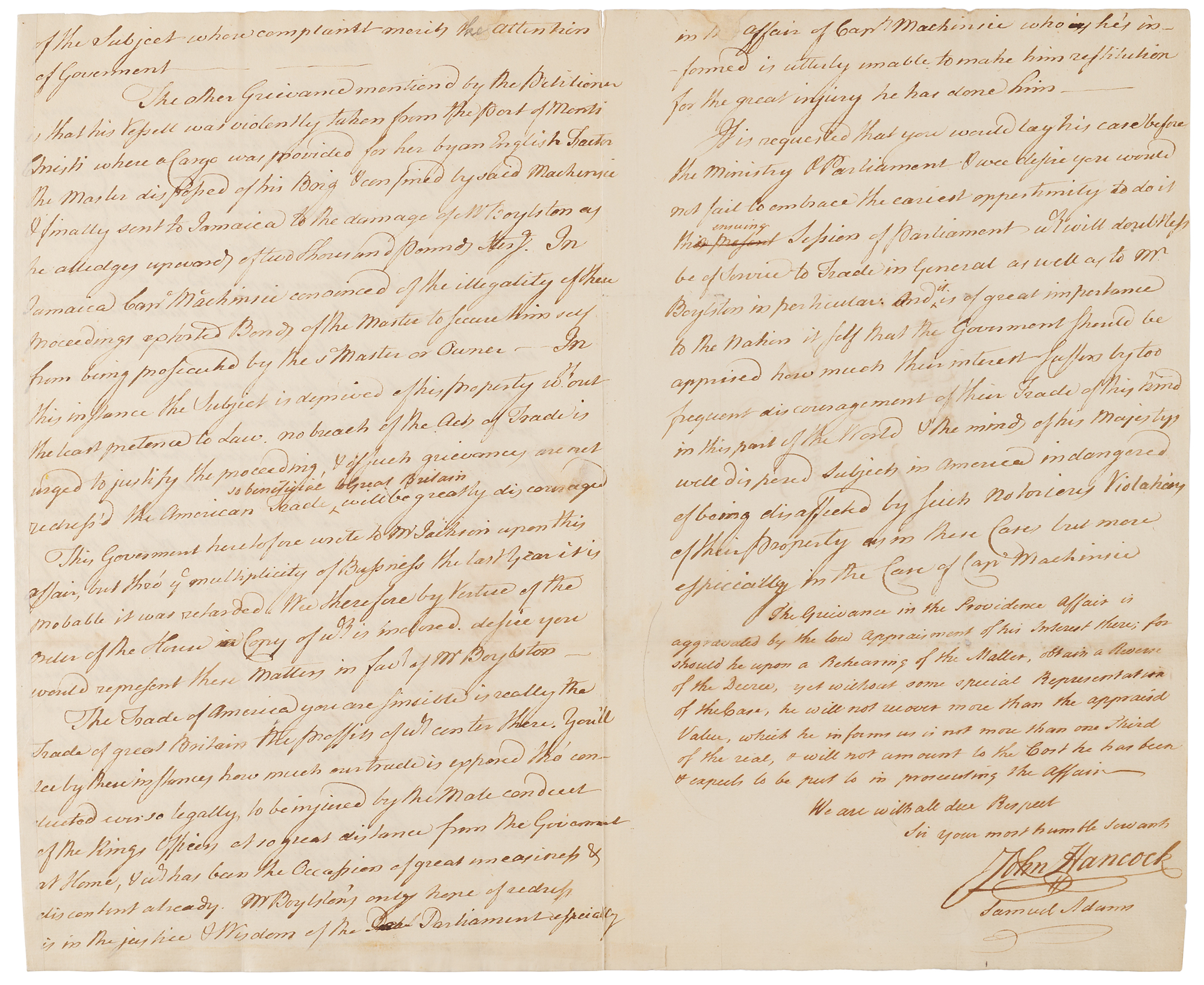
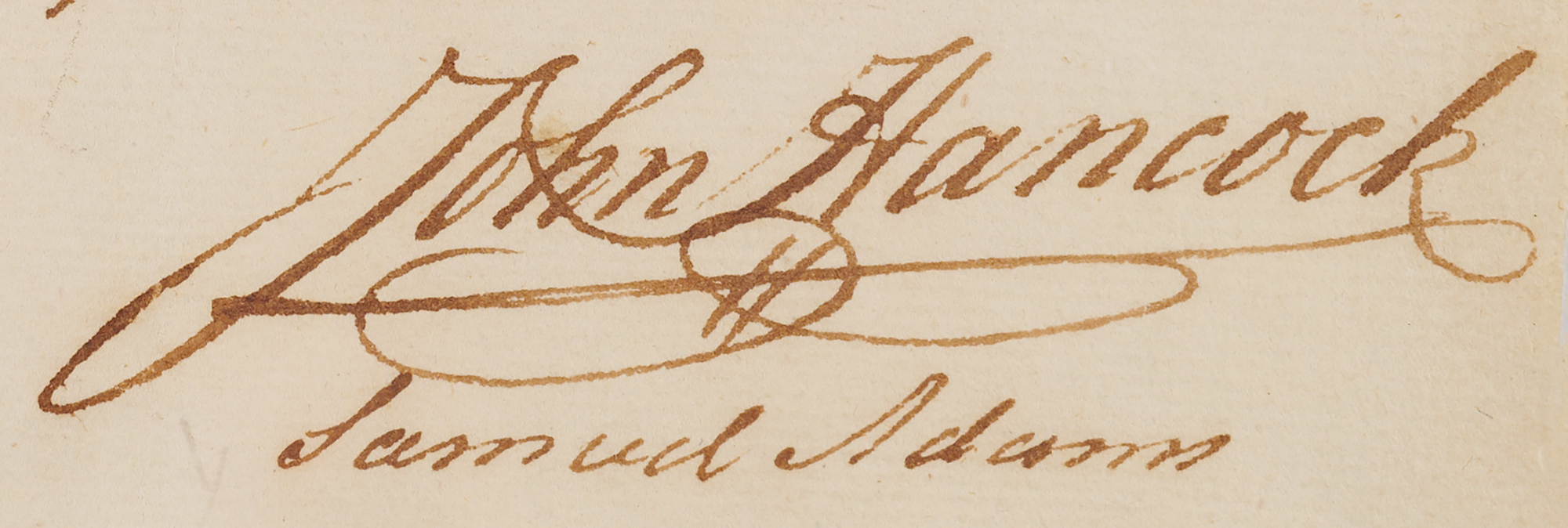
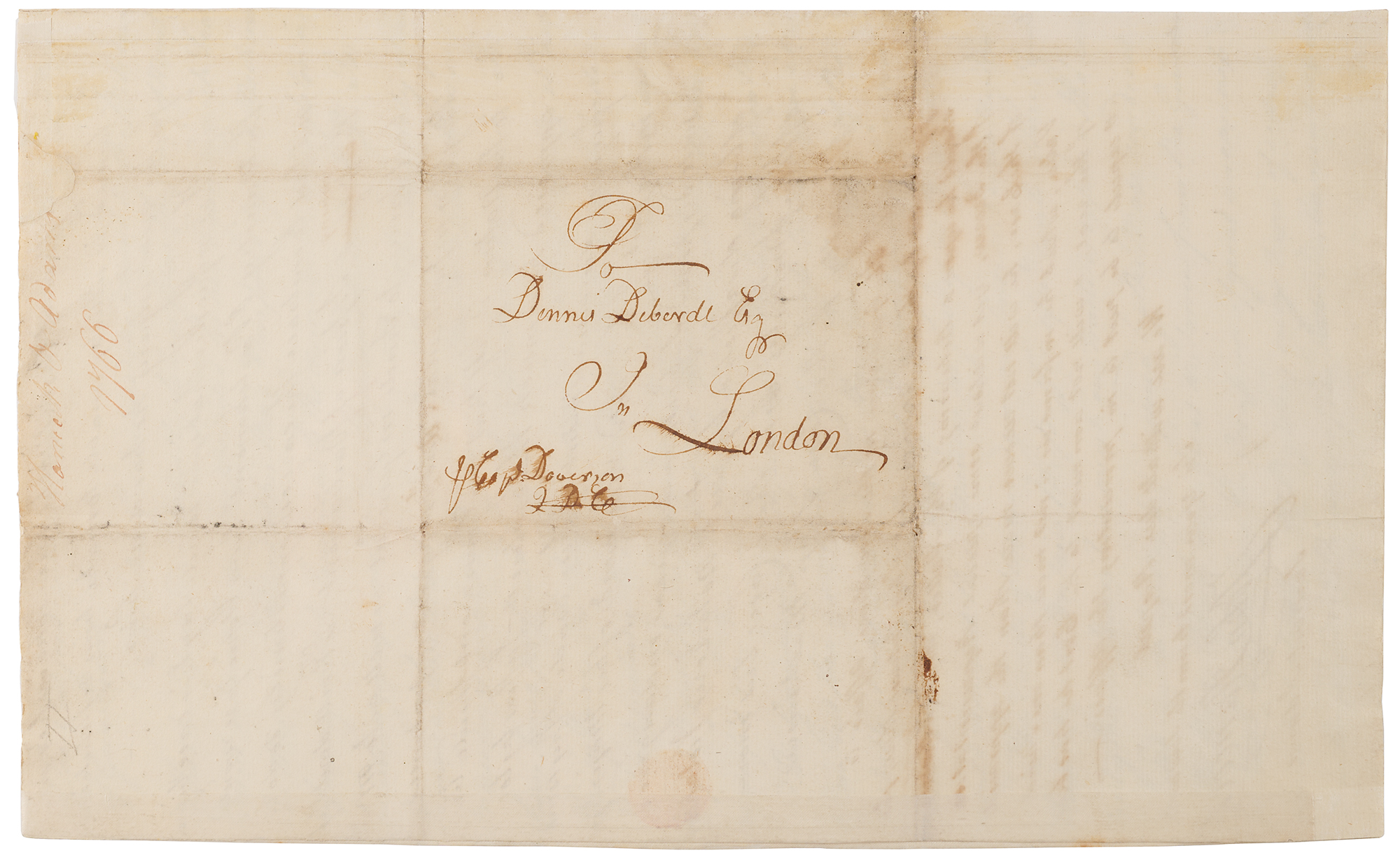
Remarkable LS signed "John Hancock" and "Samuel Adams,” three pages on two adjoining sheets, 7.5 x 12.5, November 15, 1766. Letter to Dennis Diberdi, a London agent, petitioning on behalf of Boston merchant Thomas Boylston, whose brig Recovery had been unjustly seized by customs officers and commandeered to Jamaica by a Captain Mackenzie despite violating no law.
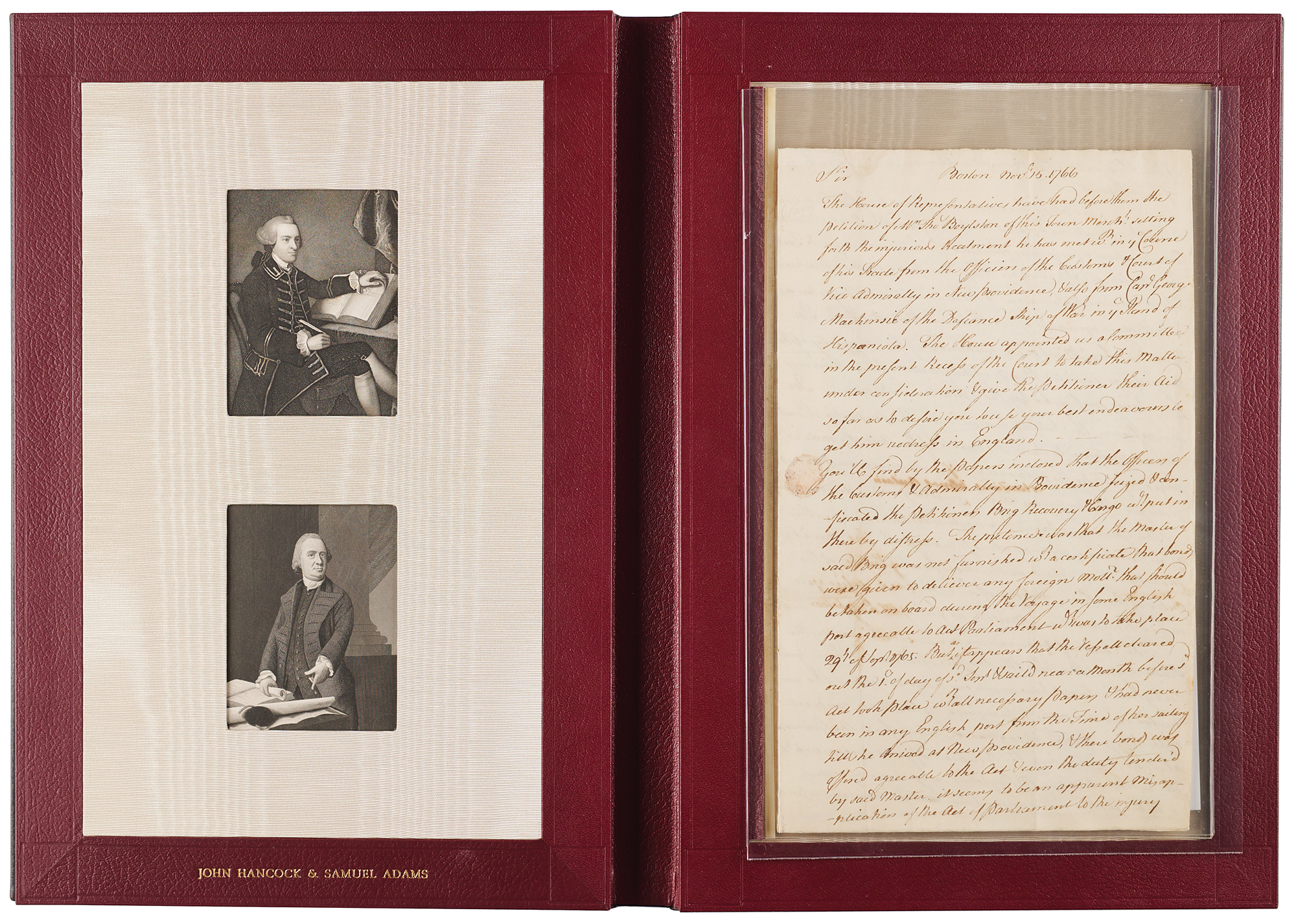
In full: "The House of Representatives have had before them the petition of Mr. Tho. Boylston of this Town, Mercht., setting forth the injurious treatment he has met with in ye Course of his Trade from the Officers of the Customs & Court of Vice Admiralty in New Providence, & also from Capt. George Mackinsie of the Defiance, Ship of War, in ye Island of Hispaniola. The House appointed us a Committee, in the present Recess of the Court, to take this Matter under consideration & give the Petitioner their Aid so far as to desire you to use your best endeavours to get him redress in England.
You’ll find by the Papers inclosed that the Officers of the Customs & Admiralty in Providence seized & confiscated the Petitioner’s Brig Recovery & Cargo, which put in there by distress. The pretence was that the Master of said Brig was not furnished with a certificate that bonds were given to deliver any foreign matter that should be taken on board during the Voyage in some English port, agreeable to Act of Parliament, which was to take place 29th of Sept. 1765. But as it appears that the Vessel cleared out the 1st day of said Sept. & sail’d near a month before said Act took place, with all necessary Papers, & had never been in any English port from the Time of her sailing till she arrived at New Providence, & there bond was offered agreeable to the Act, & even the duty tender’d by said Master, it seems to be an apparent misapplication of the Act of Parliament to the injury of the Subject, where complaint merits the attention of Government.
The other Grievance mention’d by the Petitioner is that his Vessel was violently taken from the Port of Monti Christi, where a Cargo was provided for her by an English Factor, the Master dispossessed of his Brig & confined by said Mackinsie, & finally sent to Jamaica, to the damage of Mr. Boylston, as he alleges, upwards of two thousand pounds Sterg. In Jamaica, Capt. Mackinsie, convinced of the illegality of these proceedings, exploited Bonds of the Master to secure himself from being prosecuted by the said Master or Owner. In this instance the Subject is deprived of his property without the least pretence to Law. No breach of the Act of Trade is urged to justify the proceeding, & if such grievances are not redress’d, the American Trade so beneficial to Great Britain will be greatly discouraged.
This Government heretofore wrote to Mr. Jackson upon this affair, but through ye multiplicity of Business the last year it is probable it was retarded. We therefore, by Virtue of the order of the House, Copy of which is inclosed, desire you would represent these matters in favour of Mr. Boylston.
The Trade of America, you are sensible, is really the Trade of Great Britain, the profits of which center there. You’ll see by these instances how much our trade is exposed, though conducted ever so legally, to be injured by the misconduct of the King’s Officers at so great distance from the Government at Home, & which has been the Occasion of great uneasiness & discontent already. Mr. Boylston’s only hope of redress is in the justice & Wisdom of the Parliament, especially in the affair of Capt. Mackinsie, who he’s informed is utterly unable to make him restitution for the great injury he has done him.
It is requested that you would lay his case before the Ministry & Parliament, & we desire you would not fail to embrace the earliest opportunity to do it the ensuing Sessions of Parliament, which will doubtless be of Service to Trade in General as well as to Mr. Boylston in particular. And it is of great importance to the Nation itself that the Government should be apprised how much their interest suffers by too frequent discouragement of their Trade of this kind in this part of the World, & the minds of his Majesty’s well-disposed subjects in America endangered of being disaffected by such notorious Violations of their Property as in these Cases, but more especially in the Case of Capt. Mackinsie."
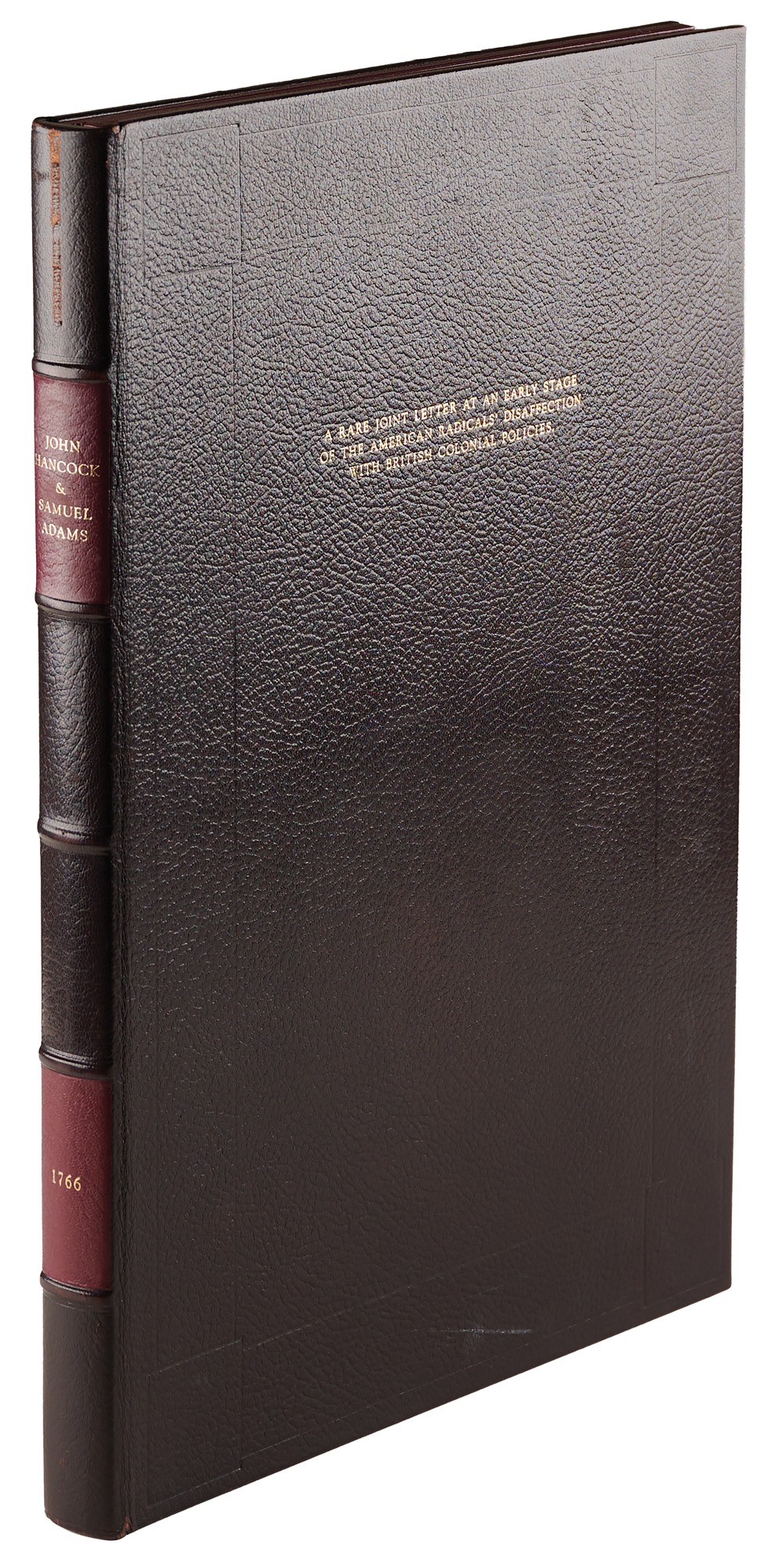
Adams adds eight lines at the conclusion in his own hand: "The Grievance in the Providence Affair is aggravated by the low appraisement of his Interest there; for should he, upon a Rehearing of the matter, obtain a Reverse of the Decree, yet without some special Representation of the Case, he will not receive more than the appraised Value, which he informs is not more than one Third of the real, & will not amount to the Cost he has been & expects to be put to in prosecuting the Affair." In fine condition. Accompanied by an impressive custom-made full morocco clamshell case with gilt-lettered spine and front board.
Written in the uneasy aftermath of the Stamp Act crisis, this 1766 letter captures the transition from colonial protest over taxation to a broader constitutional grievance over arbitrary imperial power. John Hancock and Samuel Adams were then rising figures in Massachusetts politics, and their appeal on behalf of Thomas Boylston framed a commercial dispute as evidence of a larger danger: that royal officers and customs courts could deprive Americans of property without lawful process. The language anticipates the ideological core of the Revolution, linking trade, property rights, and loyalty to the Crown while warning that repeated abuses would alienate “his Majesty’s well-disposed subjects in America.” Coming a decade before independence, the document shows Hancock and Adams not yet calling for separation, but already articulating the colonial argument that British authority, when exercised through distant and unaccountable officials, threatened the rights of Englishmen in America.

This item is Pre-Certified by PSA/DNA
Buy a third-party letter of authenticity for
(inquire for price)
*This item has been pre-certified by a trusted third-party authentication service, and by placing a bid on this item, you agree to accept the opinion of this authentication service. If you wish to have an opinion rendered by a different authenticator of your choosing, you must do so prior to your placing of any bid. RR Auction is not responsible for differing opinions submitted 30 days after the date of the sale.
Third-party authentication service applies only to signatures and handwriting, and does not cover the addition of sketches, artwork, musical quotations, etc.

