Sold For $29,283
*Includes Buyers Premium
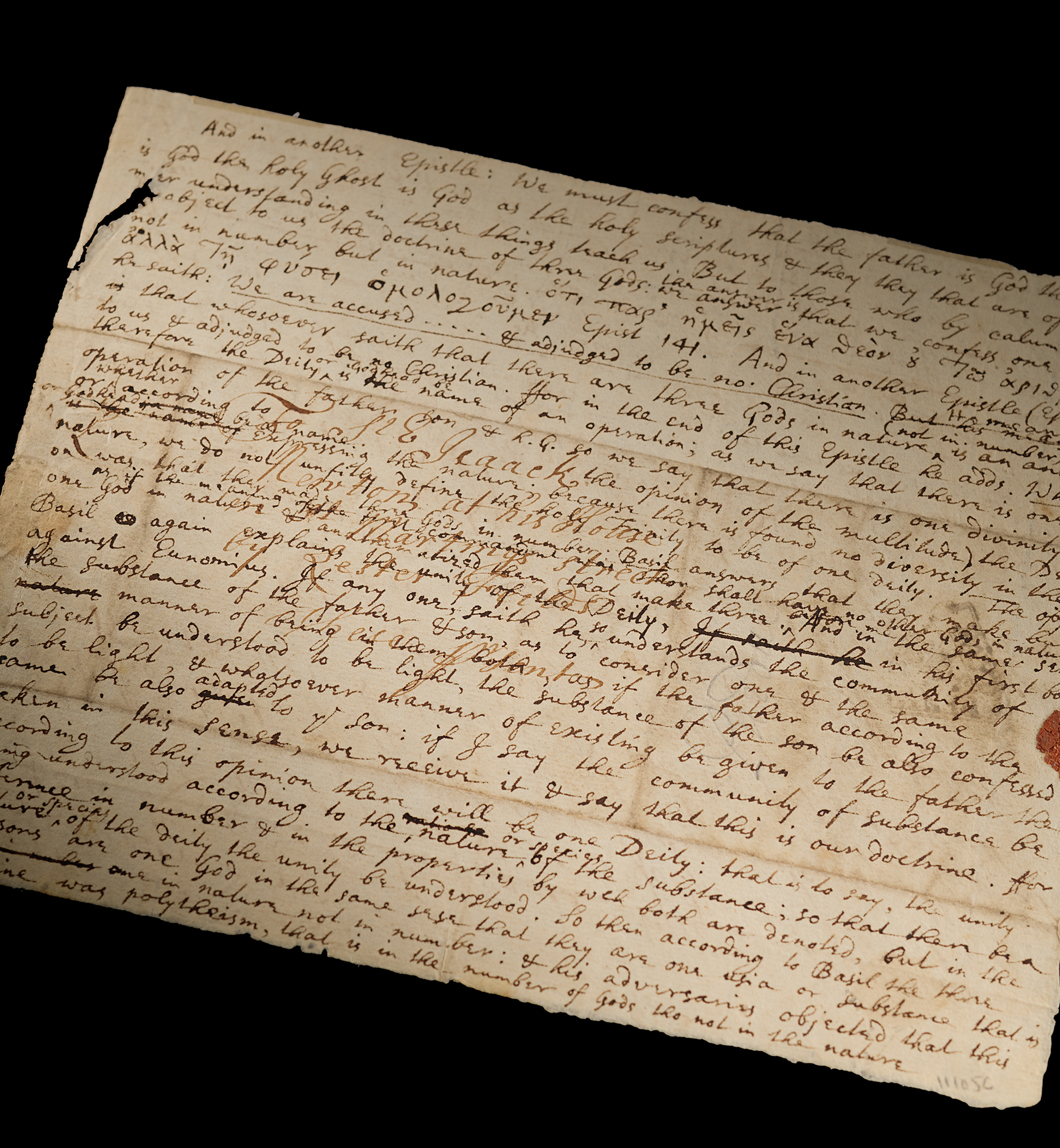
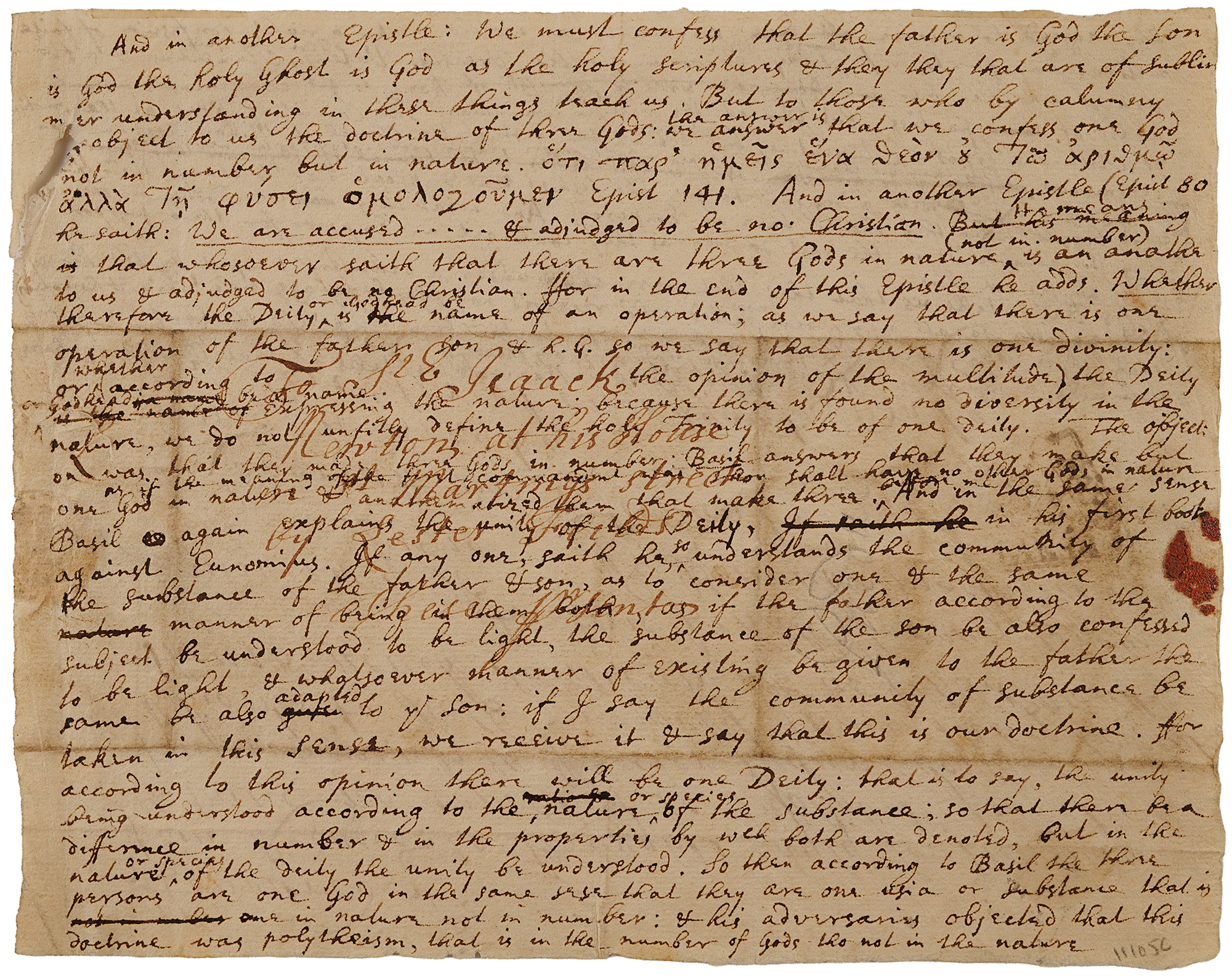
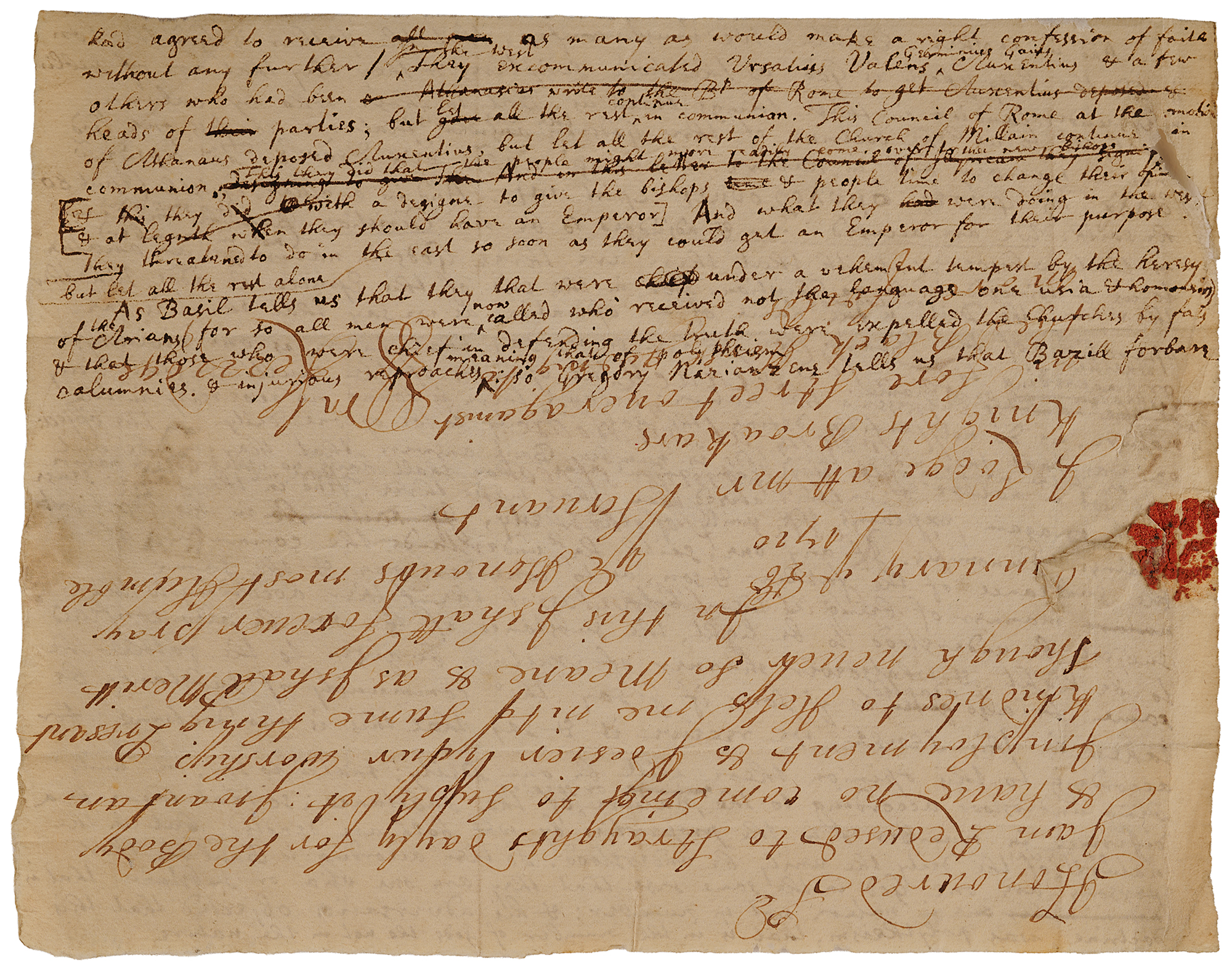
Significant handwritten religious manuscript by Isaac Newton, one page both sides, 7.75 x 6, no date but circa 1720s. Newton writes concerning the Arian Heresy, quoting Basil's opinion on the matter. In the fourth century, Arius, a priest of Alexandria, argued that Christ, being the Son of God, must have been a creature rather than a divinity, otherwise Christians would have to admit that they were worshipping two gods. A serious schism arose, and accordingly the Emperor Constantine summoned all the bishops in Christendom to Nicea to settle the question—the first general council in the history of the Church.
Newton writes, in part: "And in another Epistle: We must confess that the father is God the Son is God the holy Ghost is God as the holy scriptures & they that are of sublimer understanding in these things teach us. But to those who by calumny object to us the doctrine of three Gods: the answer is/we answer that we confess one God not in number, but in nature. [12 words in Greek] Epistle 141. And in another Epistle (Epist 80) he saith: 'We are accused….& adjudged to be no Christian'…He means that whosoever saith that there are three Gods in nature (not in number) is an anathe to us & adjudged to be no Christian. For in the end of this Epistle he adds: Whether therefore the Deity or Godhead &c. is the name of an operation; as we say that there is one operation of the father son & h.G. so we say that there is one divinity: or whether (according to the opinion of the multitude) the Deity Godhead by a name expressing the nature; because there is found no diversity in the nature, we do not unfitly define the holy Trinity to be of one deity. The objection was that they made three Gods in number: Basil answers that they make but one God in nature, as if the meaning of the first commandment was Thou shall have no other Gods in nature and from them that make three. And in the same sense Basil again explains the unity of the Deity, in his first book against Eunomius. If any one, sith he, so understands the community of the substance of the father & son, as to consider one & the same manner of being in them both, as if the father according to the subject be understood to be light, the substance of the son be also confessed to be light, & whatsoever manner of existing be given to the father the same be also adapted to ye Son: if I say the community of substance be taken in this sense, we receive it & say that this is our doctrine. For according to this opinion there will be one Deity: that is to say, the unity being understood according to the nature or species of the substance; so that there be a difference in number & in the properties by wch. both are denoted, but in the nature or species of the deity the unity be understood. So then according to Basil the three persons are one God…that is one in nature not in number: & his adversaries objected that this doctrine was polytheism."
Interestingly, Newton writes over the address panel of a desperate plea addressed to him—"Isaack Newton, at his House on Martin's Street by Lester Fields"—the opposite side reading, in part: "I am reduced to strayghts dayly for the body & have no comeing to supply it: I want an imployment & I desier your worship." Newton continues his religious writings in the blank lower margin. In fine condition, with two small edge tears.
Newton’s theology had correlations with his physics—Newton essentially viewed God the Father as the cause of gravity and Christ the Son as the ruling principle of the natural world. For Newton, Christ was different in substance from God and subject to God’s dominion. The 4th-century Church Council of Nicea, which Newton studied, ruled that Christ and God were one in substance—a ruling that ran counter to Newton’s own 'heretical' anti-trinitarian religious beliefs—and Newton repeatedly returned to the topic and re-examined it anew. The present manuscript may pertain to Newton’s long planned, but unpublished, work on The History of the Church.
Scholars now increasingly recognize the importance of Newton’s theological views for an understanding of the whole man and his science. Newton himself kept his heretical religious views secret, and his heirs suppressed his manuscripts on theology for 200 years after his death—and they are only now beginning to see the light of day. A rare and revelatory witness to Newton’s most private intellectual struggle—where the father of modern science wrestles with the foundations of Christian doctrine itself.
This item is Pre-Certified by PSA/DNA
Buy a third-party letter of authenticity for
$250.00
*This item has been pre-certified by a trusted third-party authentication service, and by placing a bid on this item, you agree to accept the opinion of this authentication service. If you wish to have an opinion rendered by a different authenticator of your choosing, you must do so prior to your placing of any bid. RR Auction is not responsible for differing opinions submitted 30 days after the date of the sale.
Third-party authentication service applies only to signatures and handwriting, and does not cover the addition of sketches, artwork, musical quotations, etc.

