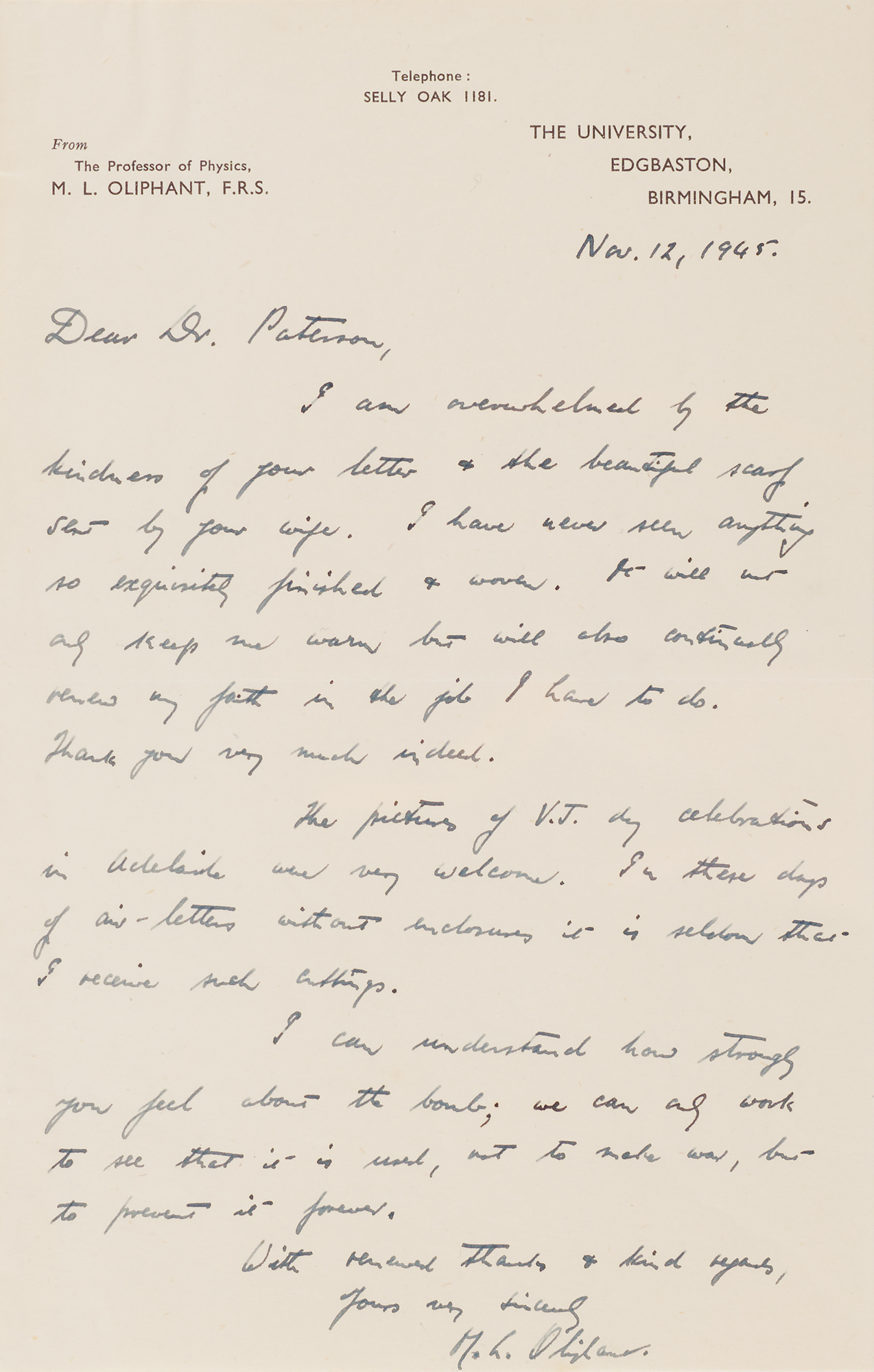
Australian physicist and humanitarian (1901-2000) who played an important role in the first experimental demonstration of nuclear fusion and in the development of nuclear weapons. ALS signed “M. L. Oliphant,” one page, 5 x 8, personal University of Birmingham letterhead, November 12, 1945. Handwritten letter to an Australian scientific colleague named Dr. Paterson, roughly three months after the atomic bombings of Hiroshima and Nagasaki, in full: “I am overwhelmed by the kindness of your letter & the beautiful scarf sent by your wife. I have never seen anything so exquisitely finished & woven. It will not only keep me warm but will also continually renew my faith in the job I have to do. Thank you very much indeed. The pictures of V.J. day celebrations in Adelaide were very welcome. In these days of air-letters without enclosures it is seldom that I receive such cuttings. I can understand how strongly you feel about the bomb; we can only work to see that it is used, not to make war, but to prevent it forever.” In fine condition.
Mark Oliphant was a central figure in the early push toward the atomic bomb, emerging from the Birmingham team behind the 1940 Frisch–Peierls memorandum, which first demonstrated the practical feasibility of a uranium weapon. As a member of the MAUD Committee, he helped confirm that such a bomb could be built within a few years. Frustrated by the lack of urgency in the United States, Oliphant traveled there in 1941 and personally pressed the case, forcefully convincing key figures, including Ernest Lawrence and Robert Oppenheimer, of the need to act. By placing the memorandum directly in their hands at Berkeley and urging immediate attention, he helped set in motion the American effort that became the Manhattan Project.
He later joined the British Mission to the Manhattan Project, working closely with Lawrence at Berkeley while remaining in contact with Oppenheimer, who, as director of Los Alamos, attempted to recruit him. Oliphant chose instead to lead efforts in electromagnetic uranium separation at the Radiation Laboratory, a less visible but essential component of the bomb’s development. While his collaboration with Oppenheimer reflected the interplay between theoretical insight and experimental development at the heart of the project, Oliphant grew increasingly uneasy as it became clear that the United States intended to retain exclusive control over nuclear technology after the war.
Oliphant, who was on holiday in Wales with his family when he first heard of the atomic bombing of Hiroshima and Nagasaki, later remarked that he felt ‘sort of proud that the bomb had worked, and absolutely appalled at what it had done to human beings.’

This item is Pre-Certified by PSA/DNA
Buy a third-party letter of authenticity for
(inquire for price)
*This item has been pre-certified by a trusted third-party authentication service, and by placing a bid on this item, you agree to accept the opinion of this authentication service. If you wish to have an opinion rendered by a different authenticator of your choosing, you must do so prior to your placing of any bid. RR Auction is not responsible for differing opinions submitted 30 days after the date of the sale.
Third-party authentication service applies only to signatures and handwriting, and does not cover the addition of sketches, artwork, musical quotations, etc.

