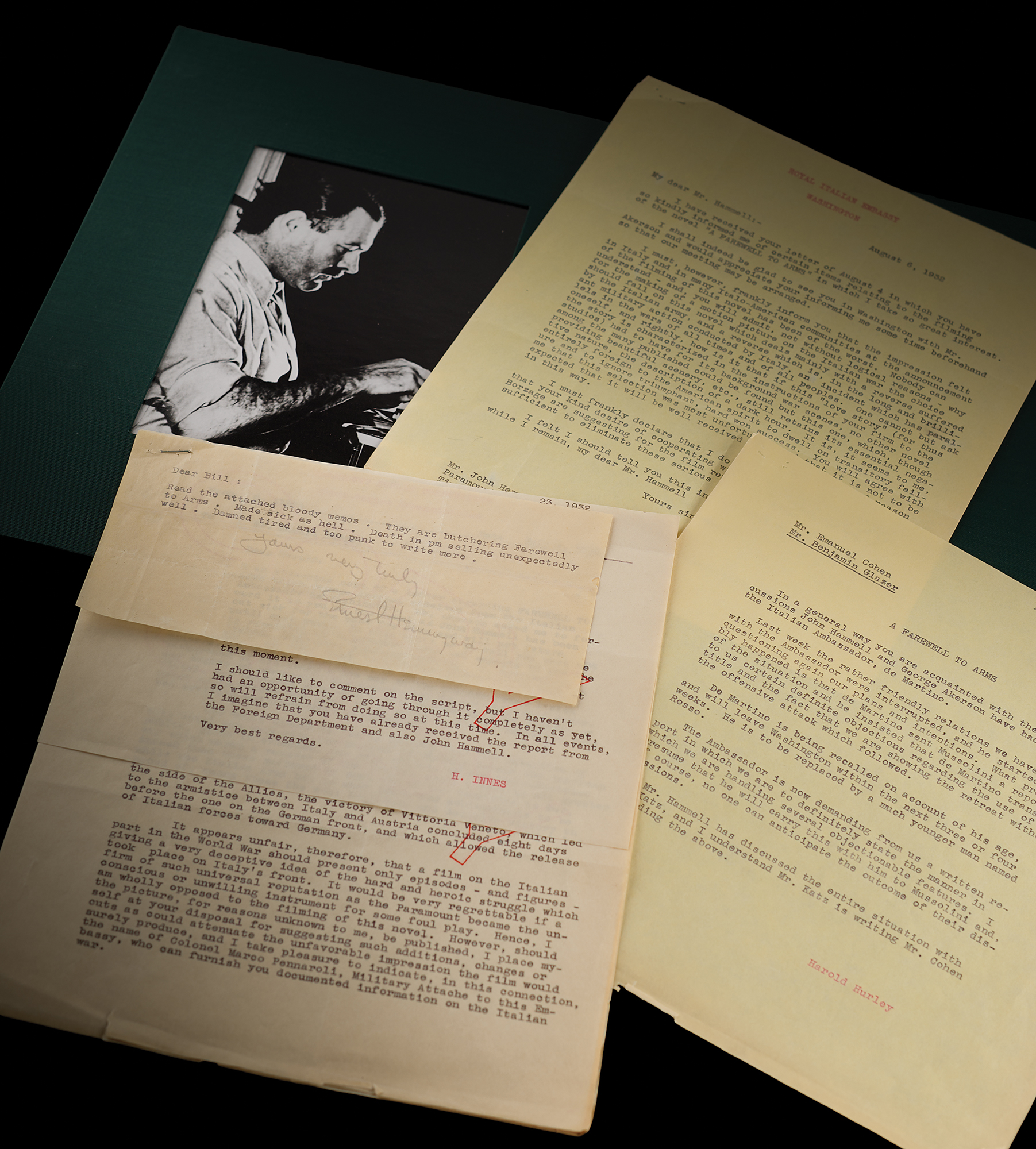
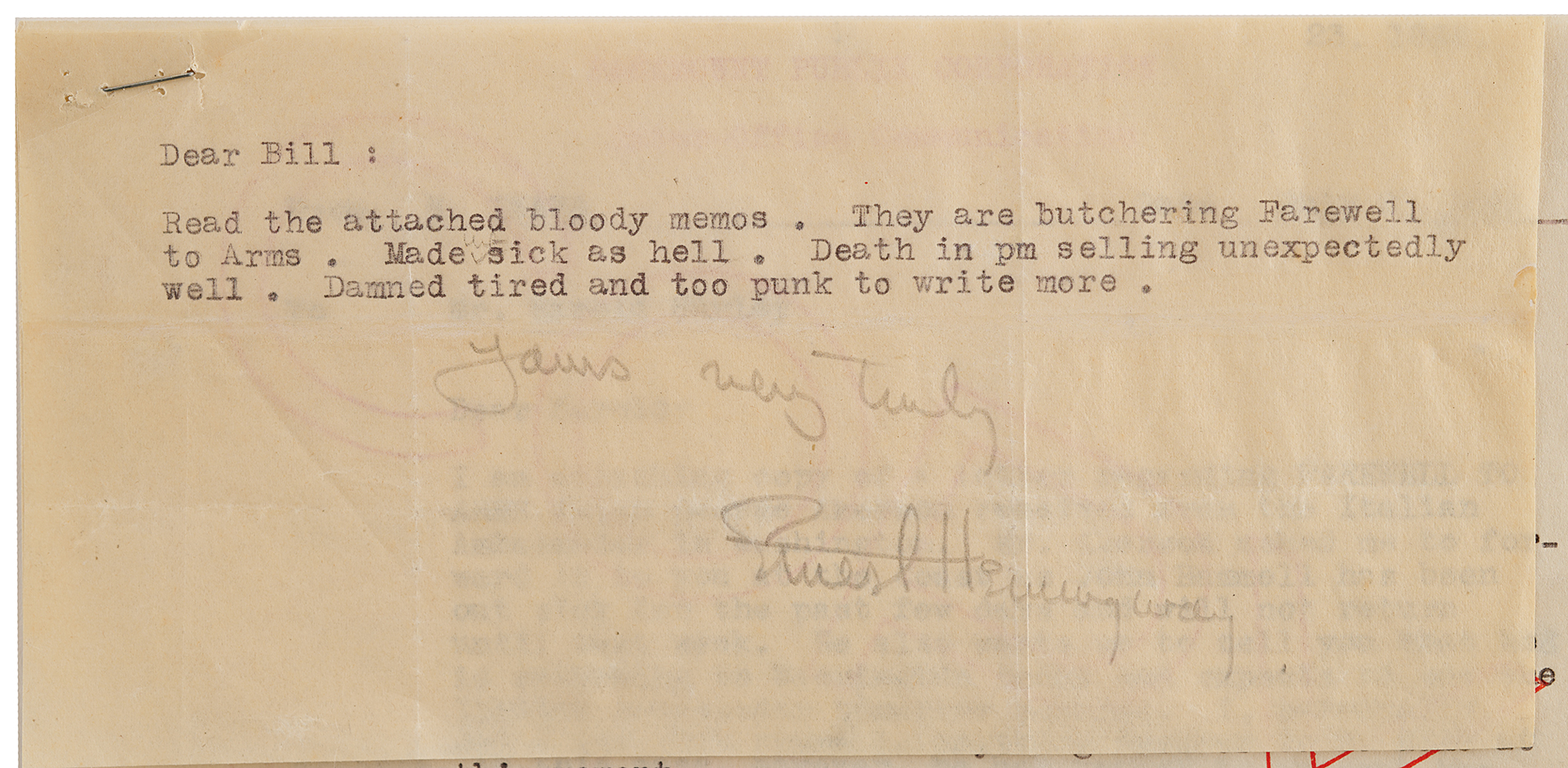
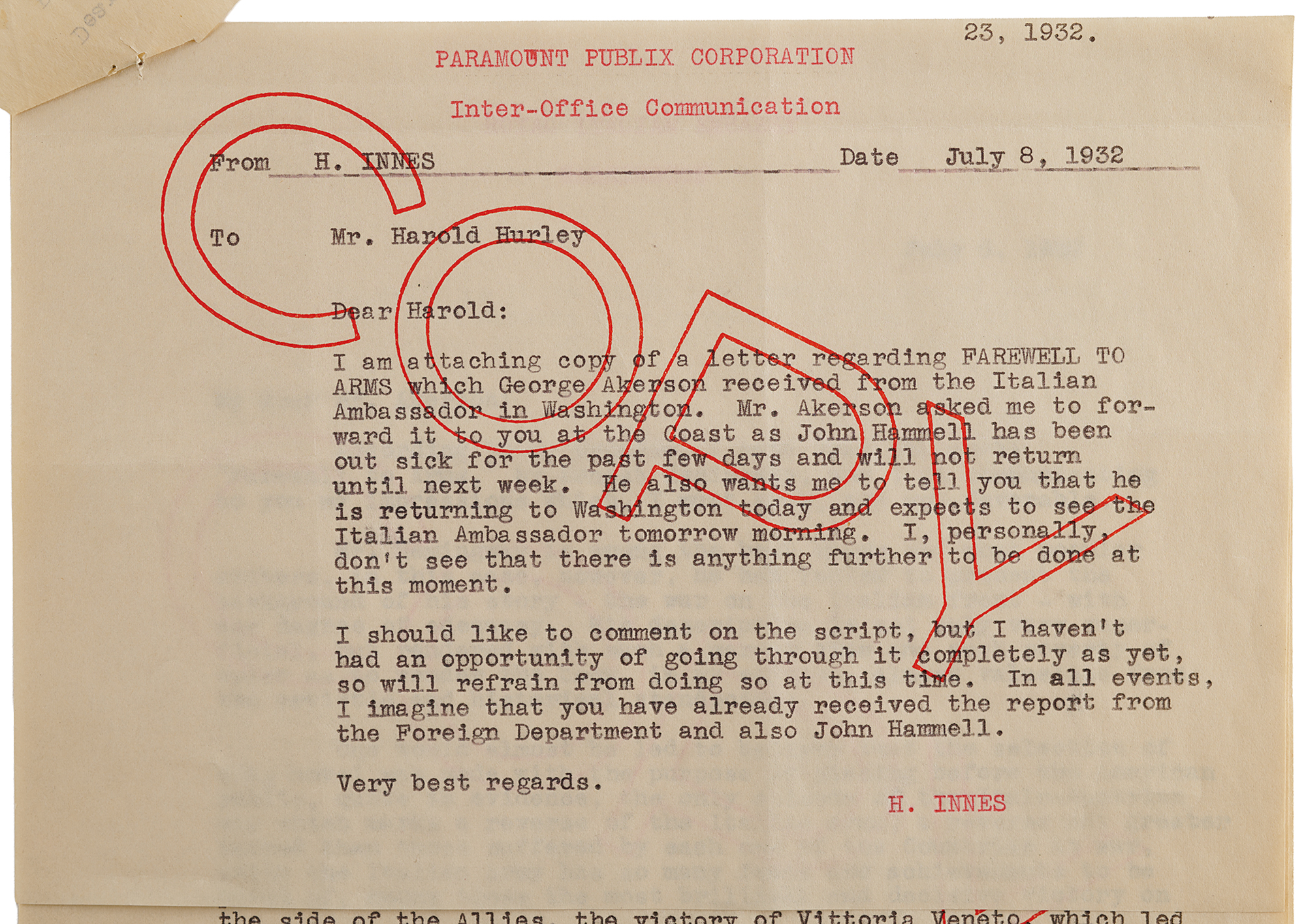
TLS signed “Yours very truly, Ernest Hemingway,” one page, 7.5 x 3.5, no date but circa 1932. Note to "Bill," in full: "Read the attached bloody memos. They are butchering Farewell to Arms. Made sick as hell. Death in pm selling unexpectedly well. Damned tired and too punk to write more." Hemingway's note is stapled to six pages of copied correspondence from Paramount-Publix Corporation and the Royal Italian Embassy, dated from July 6–August 12, 1932.
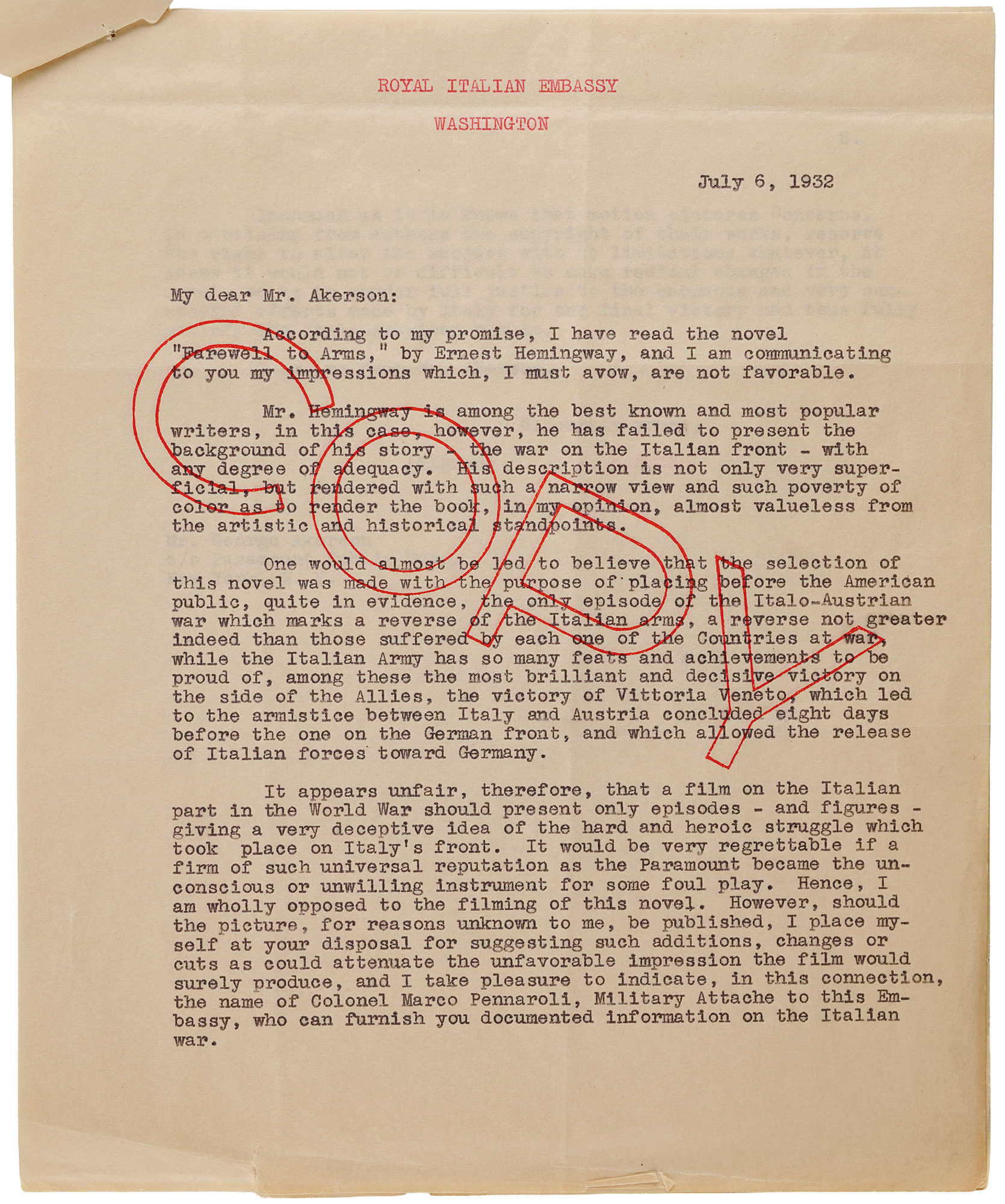
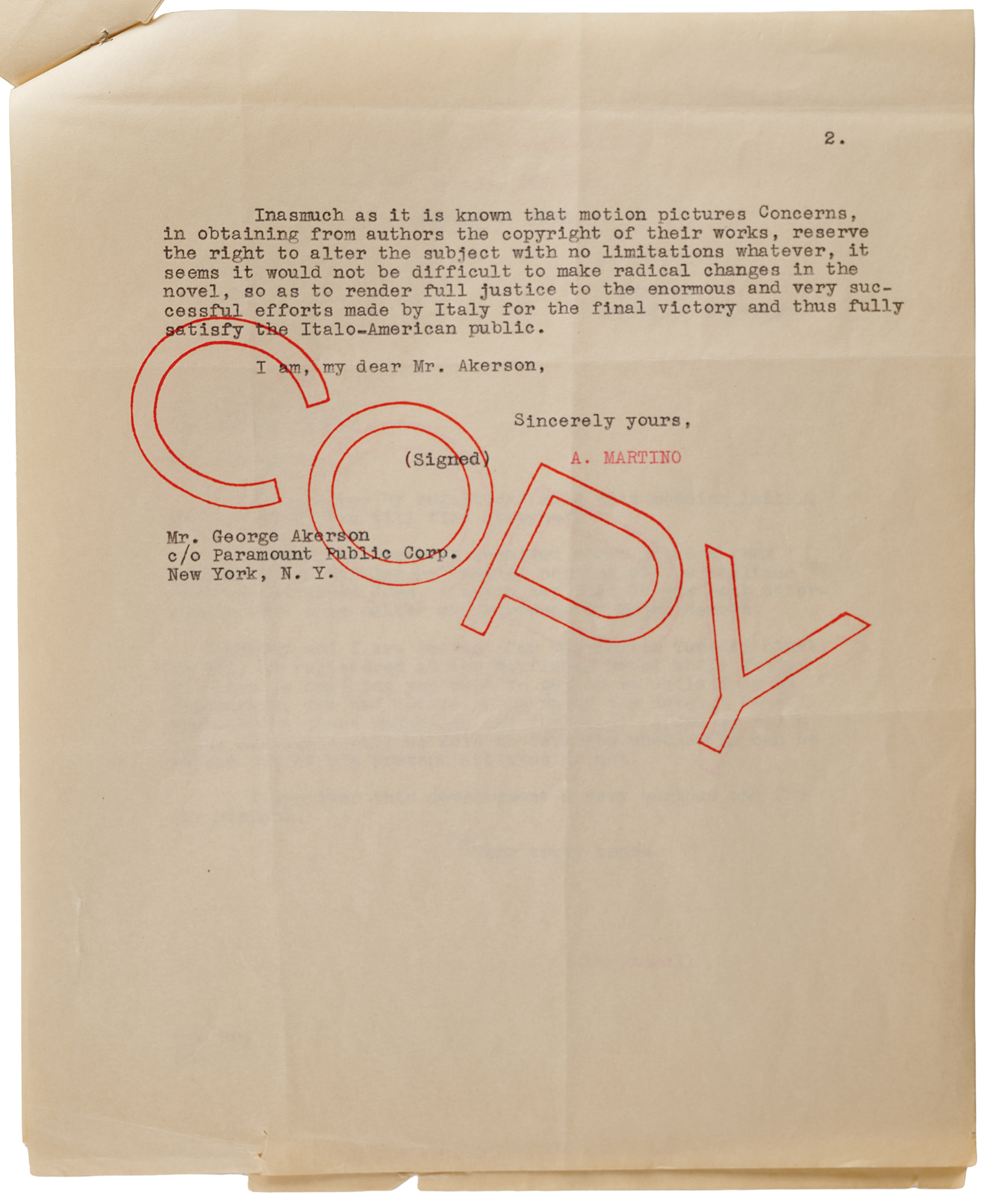
The correspondence begins with a letter from Italian Ambassador Giacomo de Martino to Paramount's George Akerson, in part: "I have read the novel 'Farewell to Arms,' by Ernest Hemingway,' and I am communicating to you my impressions which, I must avow, are not favorable. Mr. Hemingway is among the best known and most popular writers, in this case, however, he has failed to present the background of his story—the war on the Italian front—with any degree of adequacy. His description is not only very superficial, but rendered with such a narrow view and such poverty of color as to render the book, in my opinion, almost valueless from the artistic and historical standpoints. One would almost be led to believe that the selection of this novel was made with the purpose of placing before the American public, quite in evidence, the only episode of the Italo-Austrian war which marks a reverse of the Italian arms, a reverse not greater indeed than those suffered by each one of the Countries at war, while the Italian Army has so many feats and achievements to be proud of…
It appears unfair, therefore, that a film on the Italian part in the World War should present only episodes—and figures—giving a very deceptive idea of the hard and heroic struggle which took place on Italy's front. It would be very regrettable if a firm of such universal reputation as the Paramount became the unconscious or unwilling instrument for some foul play. Hence, I am wholly opposed to the filming of this novel…It seems it would not be difficult to make radical changes in the novel, so as to render full justice to the enormous and very successful efforts made by Italy for the final victory and thus fully satisfy the Italo-American public."
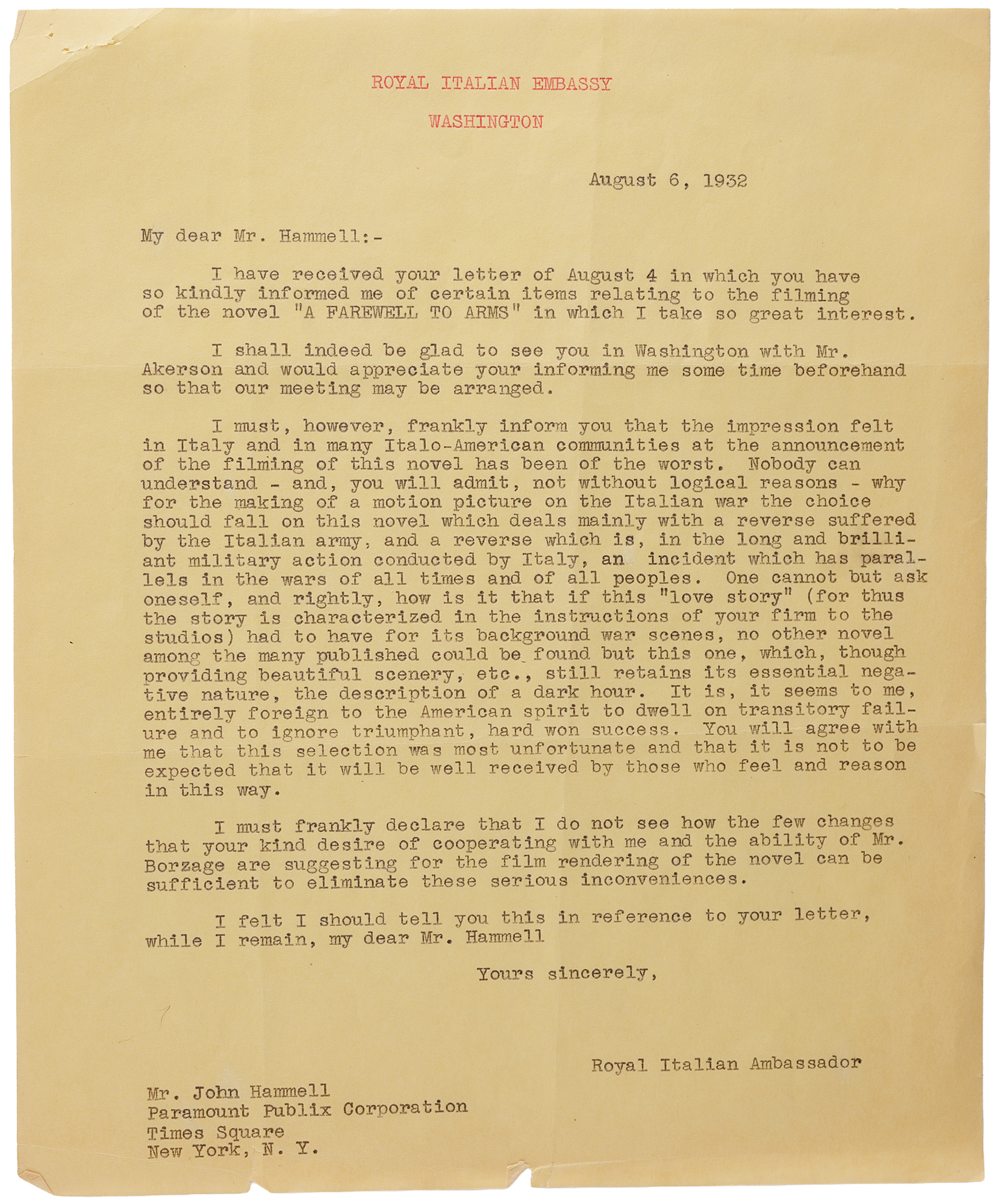
On August 6th, having received word that the project would proceed, the ambassador writes again: "I must…frankly inform you that the impression felt in Italy and in many Italo-American communities at the announcement of the filming of this novel has been of the worst. Nobody can understand—and, you will admit, not without logical reasons—why for the making of a motion picture on the Italian war the choice should fall on this novel which deals many with a reverse suffered by the Italian army, and a reverse which is, in the long and brilliant military action conducted by Italy, an incident which has parallels in the wars of all times and of all peoples. One cannot but ask oneself, and rightly, how is it that if this 'love story' (for thus the story is characterized in the instructions of your firm to the studios) had to have for its background war scenes, no other novel among the many published could be found but this one, which, though providing beautiful scenery, etc., still retains its essential negative nature, the description of a dark hour. It is, it seems to me, entirely foreign to the American spirit to dwell on transitory failure and to ignore triumphant, hard won success. You will agree with me that this selection was most unfortunate and that it is not to be expected that it will be well received by those who feel and reason in this way…I do not see how the few changes that your kind desire of cooperating with me and the ability of Mr. Borzage are suggesting for the film rendering of the novel can be sufficient to eliminate these serious inconveniences."
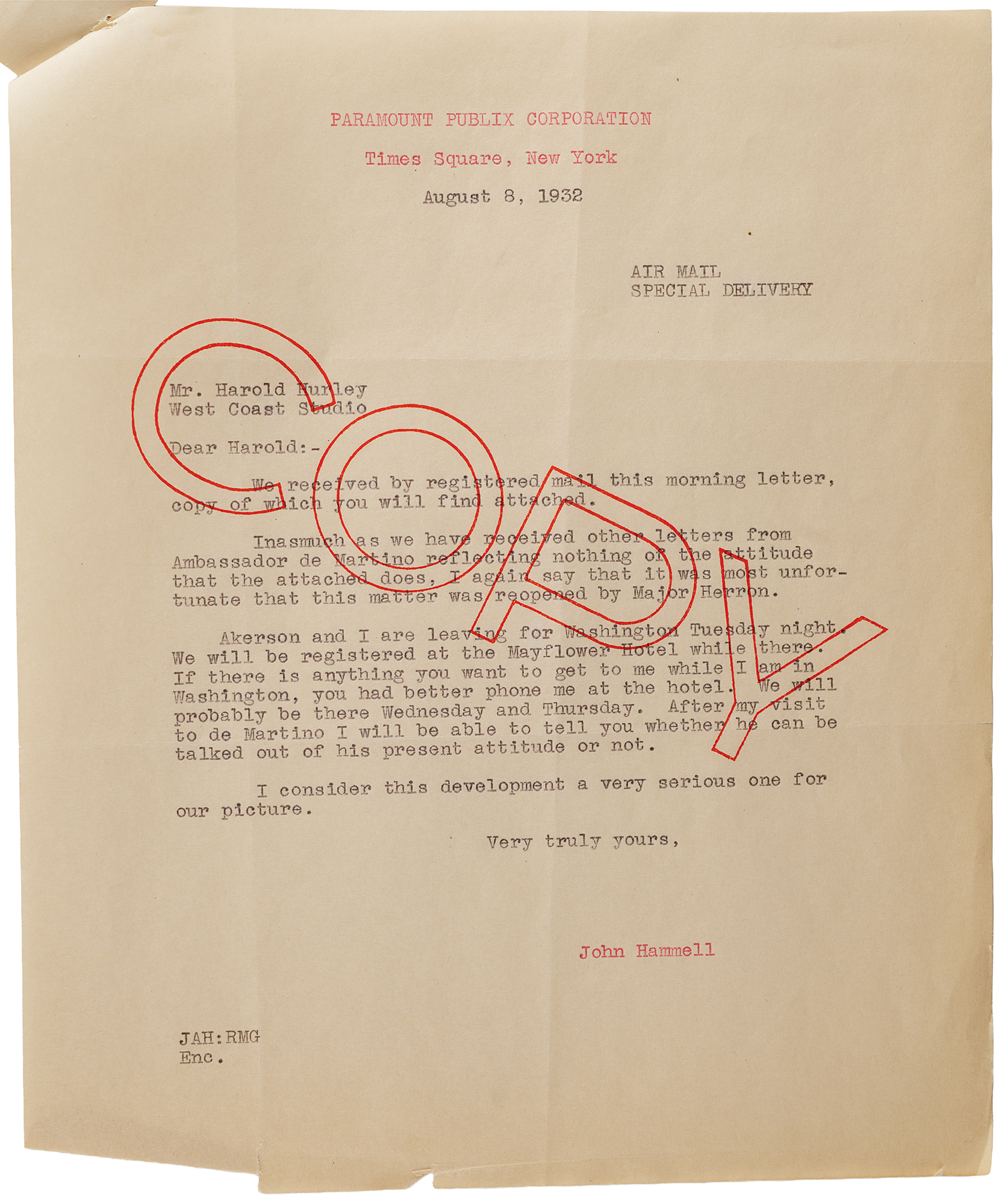
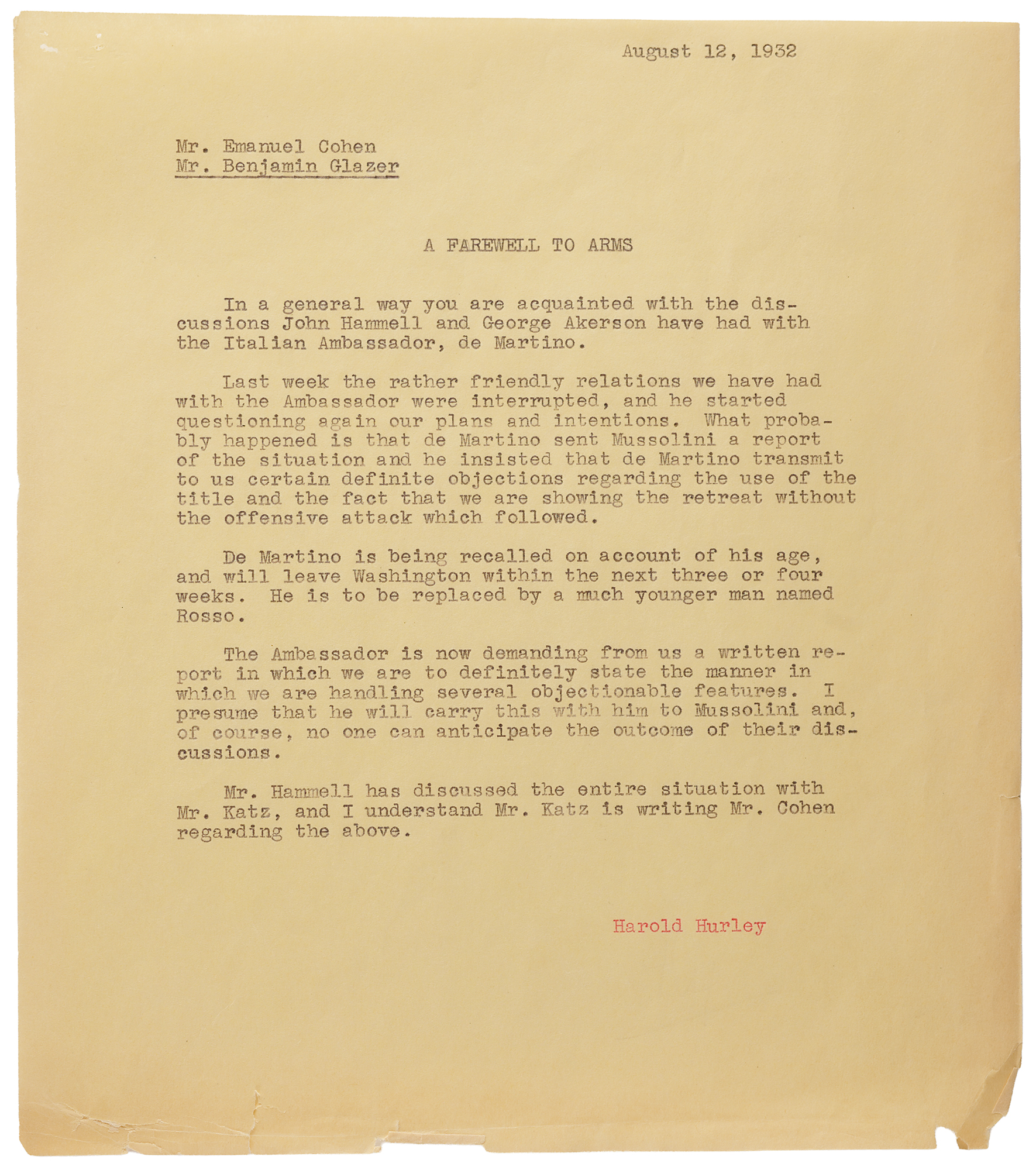
On August 12th, Paramount producer Harold Hurley reports: "Last week the rather friendly relations we have had with the Ambassador were interrupted, and he started questioning again our plans and intentions. What probably happened is that de Martino sent Mussolini a report of the situation and he insisted that de Martino transmit to us certain definite objections regarding the use of the title and the fact that we are showing the retreat without the offensive attack which followed. De Martino is being recalled on account of his age, and will leave Washington within the next three or four weeks…The Ambassador is now demanding from us a written report in which we are to definitely state the manner in which we are handling several objectionable features. I presume that he will carry this with him to Mussolini and, of course, no one can anticipate the outcome of their discussions." Two other Paramount inter-officer memoranda document the receipt and forwarding of the ambassador's letters. In fine condition, with small edge tears to bottom edges of the memos, and the last two pages detached from the staple. Accompanied by a custom-made presentation folder bound in one-quarter green morocco.
As biographer Carlos Baker observes in Ernest Hemingway: A Life Story: 'The first film to be made from one of his books…was Paramount's production of A Farewell to Arms, starring Helen Hayes, Gary Cooper, and Adolphe Menjou. Ernest thought it an abomination. He was distressed by the happy ending which the scriptwriters had devised as well as the attempts of the press agents to publicize his wartime heroism and boxing ability. He sent Max Perkins a statement in an effort to counteract the imaginative press releases which were then flooding the country.'
This remarkable archive captures Hemingway’s visceral reaction to the political and diplomatic storm surrounding Hollywood’s adaptation, a controversy that reached the highest levels of the Italian Fascist regime. As the correspondence shows, Italian officials—ultimately acting at the insistence of Benito Mussolini himself—objected strenuously to the film’s depiction of the Italian retreat at Caporetto, viewing it as an affront to national honor. Despite Paramount’s efforts to reassure the Royal Italian Embassy and to emphasize director Frank Borzage’s planned changes, Mussolini’s intervention hardened the embassy’s stance, turning what had been “rather friendly relations” into a diplomatic confrontation. Hemingway’s terse, furious note—“They are butchering Farewell to Arms”—reflects his disdain for Hollywood’s alterations and his anger at seeing his work entangled in censorship and nationalist pressure.
This item is Pre-Certified by PSA/DNA
Buy a third-party letter of authenticity for
$150.00
*This item has been pre-certified by a trusted third-party authentication service, and by placing a bid on this item, you agree to accept the opinion of this authentication service. If you wish to have an opinion rendered by a different authenticator of your choosing, you must do so prior to your placing of any bid. RR Auction is not responsible for differing opinions submitted 30 days after the date of the sale.
Third-party authentication service applies only to signatures and handwriting, and does not cover the addition of sketches, artwork, musical quotations, etc.

