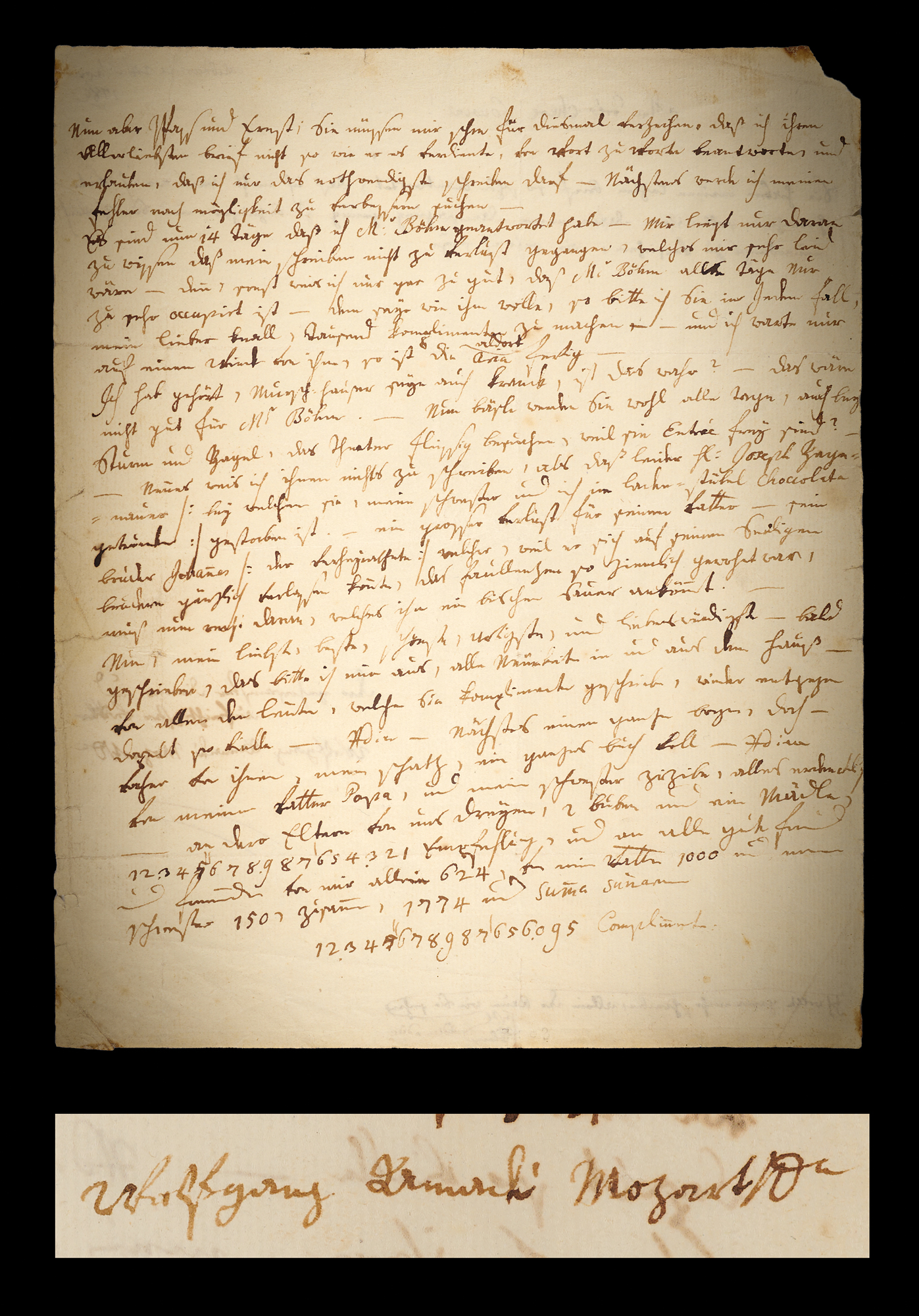
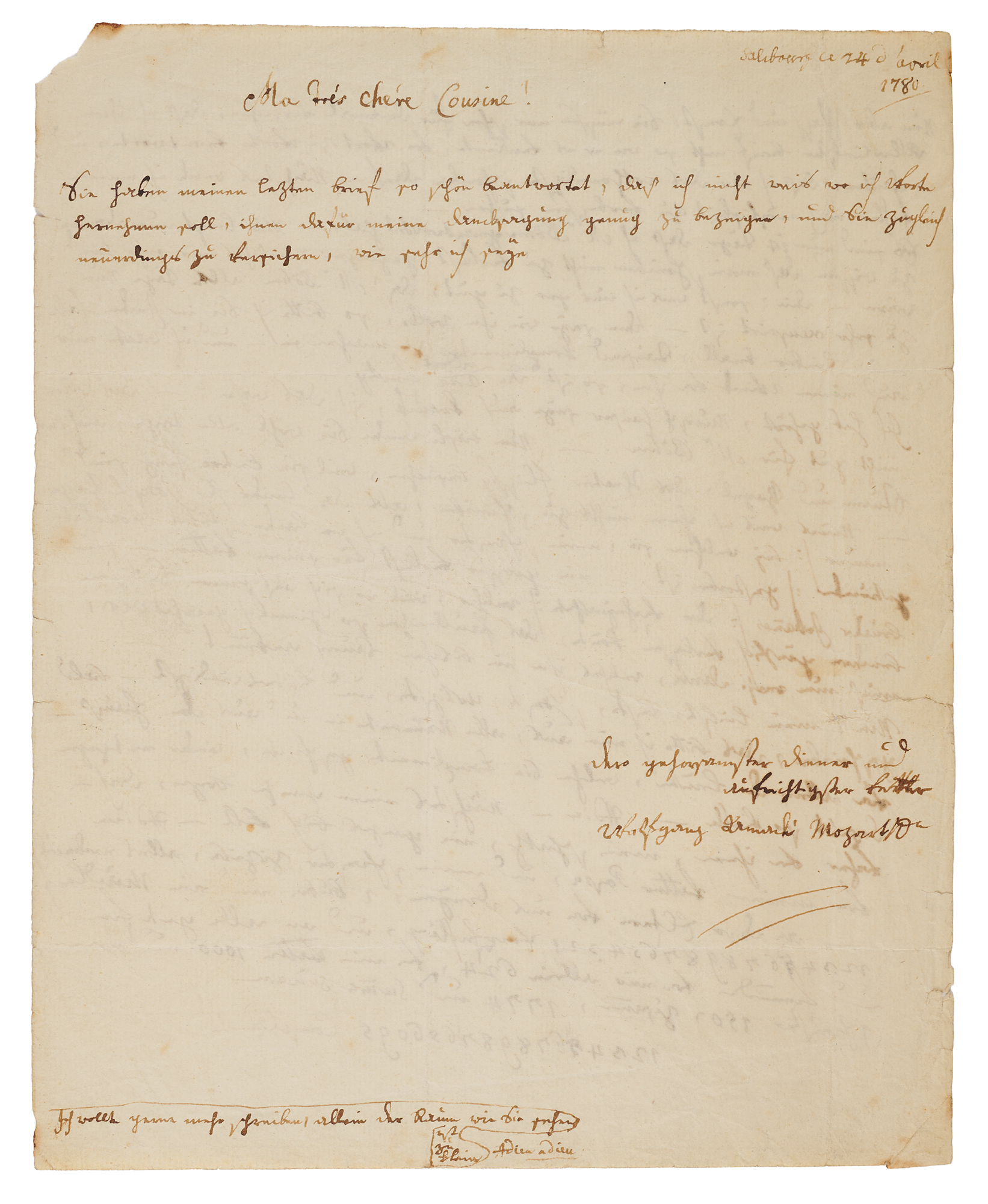

ALS in German, signed “Wolfgang Amadé Mozart,” one page both sides, 7.5 x 9.25, April 24, 1780. Handwritten letter to his cousin, Maria Anna Thekla Mozart, known to him as his beloved 'Bäsle,' being the seventh in a famous series of nine affectionate, playful, and exuberant letters to her. He opens the letter with a courtly tone, thanking her for her previous message in a typically florid fashion (translated): "You answered my last letter so beautifully that I don't know where to find the words to express my gratitude enough, and at the same time to assure you once again how much I am your most obedient servant and most sincere cousin." At the bottom, he playfully adds: "I wanted to write more, but as you can see, the space is too small. Adieu, adieu."
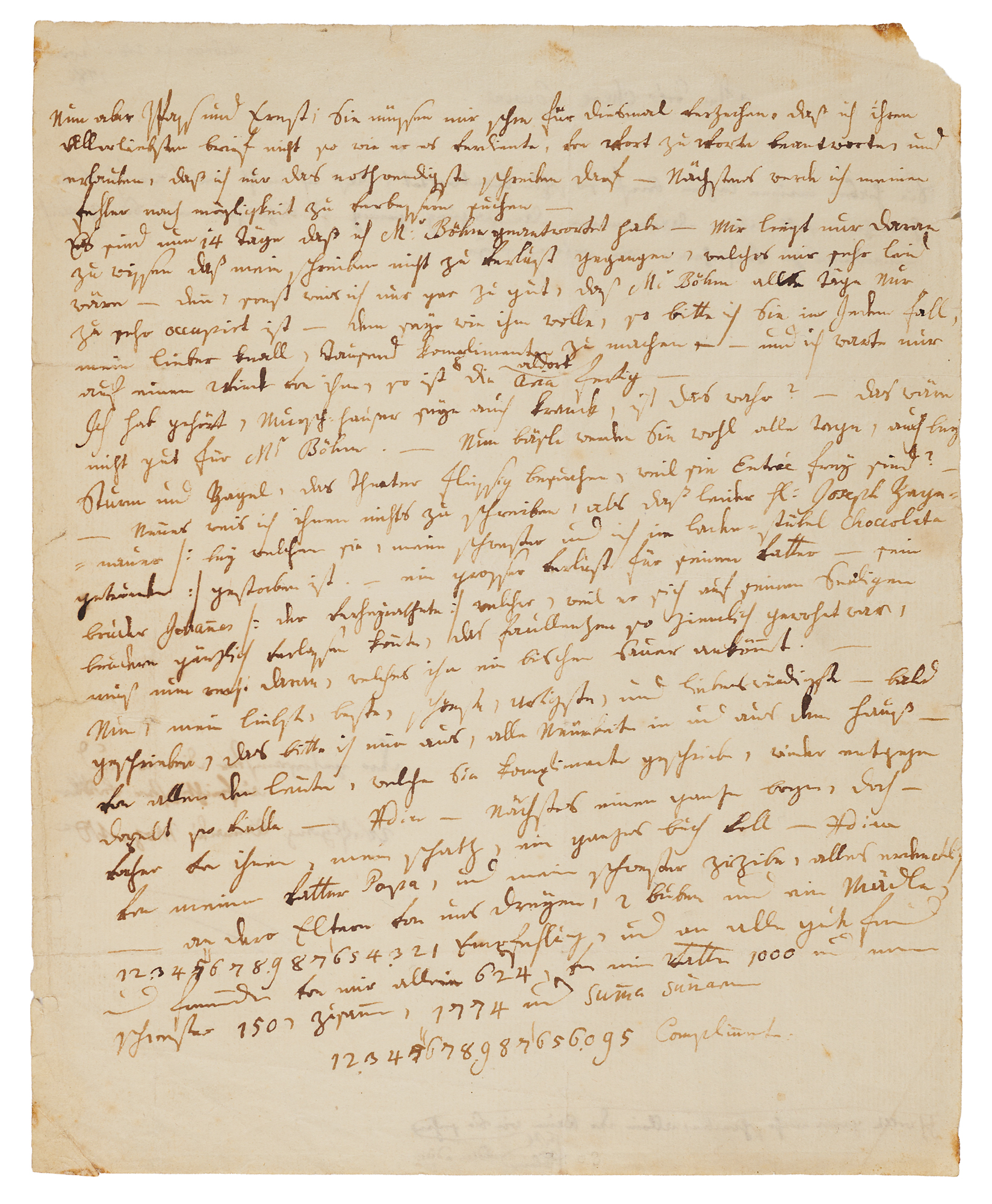
On the reverse, he fills the page with playful prose and practical manners, apologizing for his brief reply, mentioning a letter to the theater director Johann Heinrich Böhm, and expressing his readiness to compose an aria upon request. In part (translated): "Now, let's get down to brass tacks. You must forgive me this time for not answering your dearest letter as it deserves, word for word, and allow me to write only the bare essentials. Next time, I will try to correct my mistake as best I can.
It has now been 14 days since I replied to Mr. Böhm. My only concern is to know that my letter has not been lost, which I would be very sorry about. Otherwise, I know all too well that Mr. Böhm is always far too busy. Be that as it may, I beg you in any case, my dear Mr. Böhm, to send a thousand compliments there. I'm just waiting for a nod from him, and then the aria will be finished. I've heard Munschhauser is also ill, is that true? That wouldn't be good for Mr. Böhm.—Now, dear friends, you will probably diligently attend the theater every day, even in storm and hail, because you have free admission?—
I have nothing new to write to you, except that unfortunately Joseph Hagenauer (with whom you, my sister and I were drinking chocolate in the shop-room) has died.—a great loss for his father—his brother Johannes (who married), who, because he could rely completely on his deceased brother, was quite accustomed to idleness, must now face it, which is a bit of a bitter pill for him to swallow."
He closes with characteristic linguistic exuberance and affection, exaggerating his sentiments to cosmic proportions in a mock-accounting of compliments and greetings: "Well, my dearest, best, most beautiful, kindest, and most lovable…I ask you to send me all the news in and out of the house—from all the people to whom you wrote compliments, in return twice as many—Farewell—Next, a whole sheet, but—before that, my darling, a whole book full of them—Farewell from my father Papa, and my sister Zizibe, everything imaginable—to your parents, from us three, 2 boys and a girl, 12345678987654321 commendations, and to all good friends from me alone 624, from my father 1000 and my sister 150, together 1774 and in total 12345678987656095 compliments." In fine condition, with occasional staining and a few tiny edge tears and losses.
Accompanied by a wrapper inscribed by Josephine Baroni von Cavalcabò, the companion and sole heir of Mozart’s son Franz Xaver Wolfgang Mozart, addressed in German to the conductor Joseph Labitzky (translated): "A handwritten letter from the immortal Mozart. From the estate of W. A. Mozart Jr., who died in Carlsbad, For Mr. Kapellmeister Labitzki as a token of our deepest gratitude," dated at Vienna, April 19, 1845.
Mozart’s correspondence with Maria Anna Thekla Mozart, written between 1777 and 1782, is unparalleled in its personal tone and playful verbal inventiveness. These letters were composed during a pivotal time as Mozart sought to liberate himself from Salzburg’s courtly constraints and establish himself as an independent composer in Vienna. The reference to Johann Heinrich Böhm is particularly significant, as it reveals Mozart’s active pursuit of operatic commissions beyond Salzburg. He would soon be commissioned by Karl Theodor, Elector of Bavaria, to compose the opera Idomeneo for a court carnival.
Of the nine known Bäsle letters, five reside in major institutional collections (four at the British Library and one at the Pierpont Morgan Library). The whereabouts of three others are unknown. The present Letter No. 7 is the only example known to appear at public sale, representing a singular opportunity to acquire one of the most celebrated private letters in Mozart’s corpus.

This item is Pre-Certified by PSA/DNA
Buy a third-party letter of authenticity for
$1,000.00
*This item has been pre-certified by a trusted third-party authentication service, and by placing a bid on this item, you agree to accept the opinion of this authentication service. If you wish to have an opinion rendered by a different authenticator of your choosing, you must do so prior to your placing of any bid. RR Auction is not responsible for differing opinions submitted 30 days after the date of the sale.
Third-party authentication service applies only to signatures and handwriting, and does not cover the addition of sketches, artwork, musical quotations, etc.

