Sold For $8,425
*Includes Buyers Premium
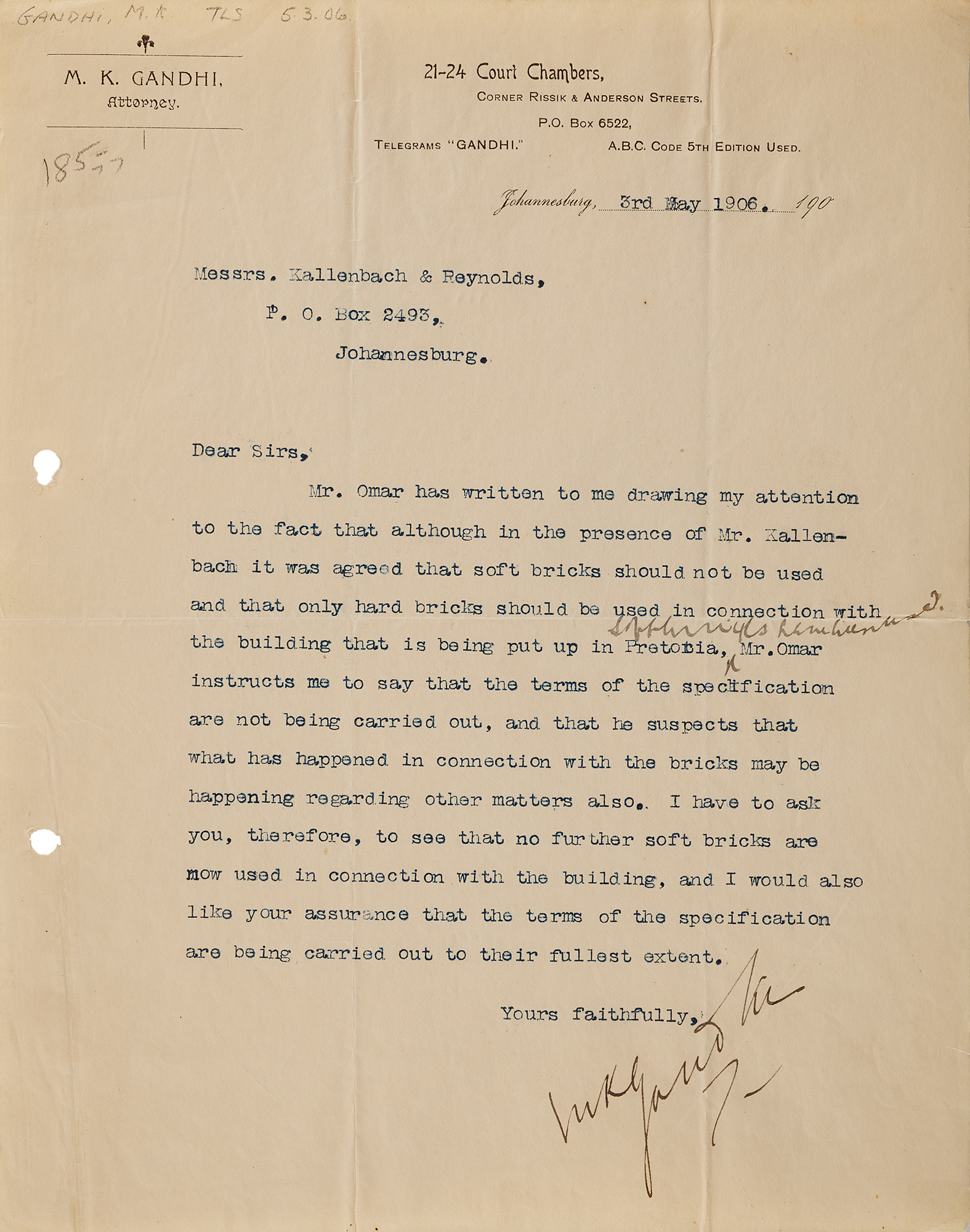
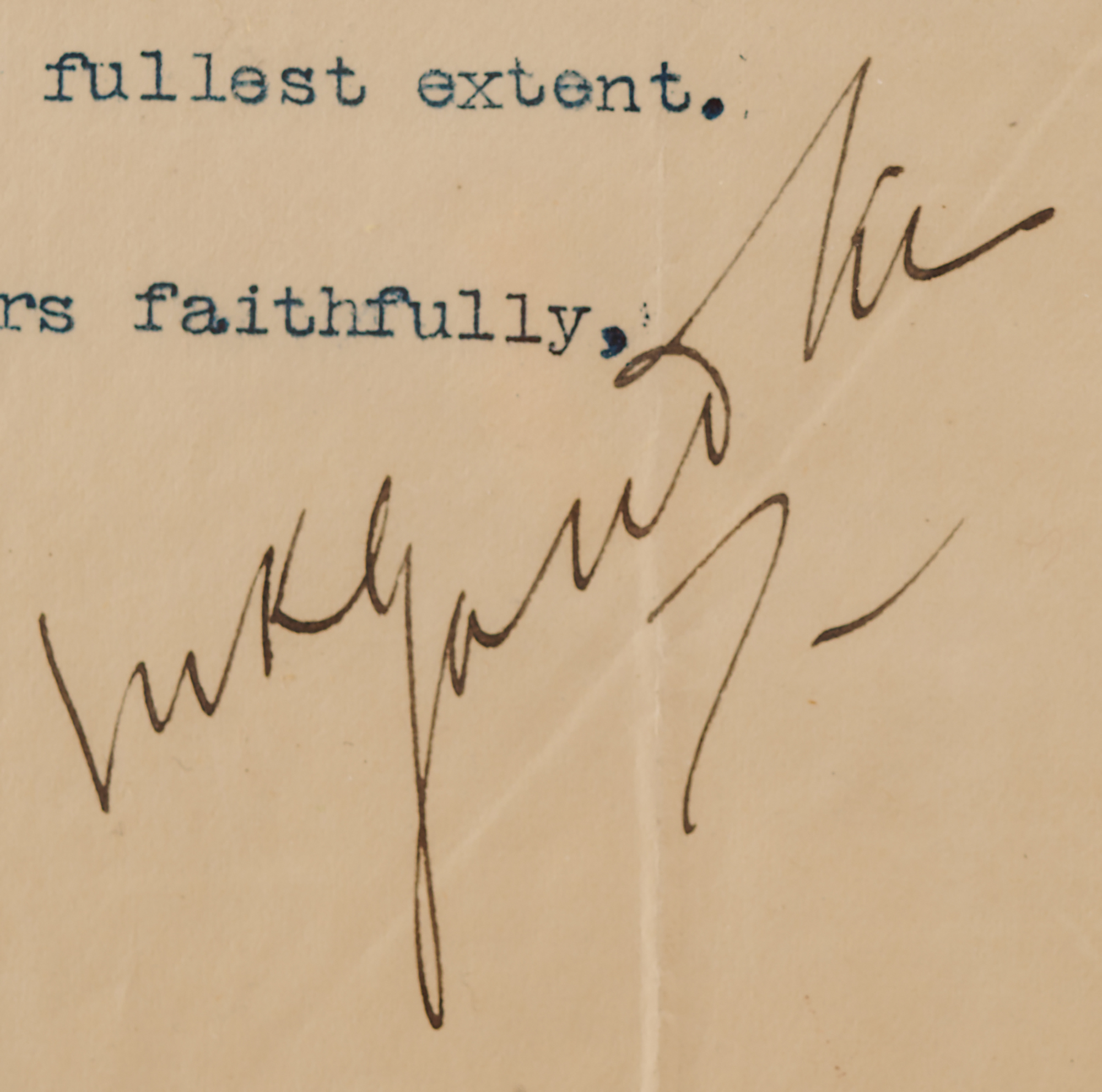
TLS signed “M. K. Gandhi,” one page, 8.25 x 10.5, "M. K. Gandhi, Attorney" letterhead, May 3, 1906. Letter to "Messrs. Kallenbach & Reynolds, Johannesburg," the architectural firm of his close friend Hermann Kallenbach. In full: "Mr. Omar has written to me drawing my attention to the fact that although in the presence of Mr. Kallenbach is was agreed that soft bricks should not be used and that only hard bricks should be used in connection with the building that is being put up in Pretoria, Mr. Omar instructs me to say that the terms of the specification are not being carried out, and that he suspects that what has happened in connection with the bricks may be happening regarding other matters also. I have to ask you, therefore, to see that no further soft bricks are now used in connection with the building, and I would also like your assurance that the terms of the specification are being carried out to their fullest extent."
The letterhead gives the address of Gandhi's office as "21–24 Court Chambers, Corner Rissik & Anderson Streets," in the Central Business District of Johannesburg, South Africa—an area today known as 'Gandhi Square.' In very good to fine condition, with light show-through from a few small pieces of tape on the back.
Gandhi had settled in South Africa in 1893, taking on a one-year contract as an attorney for an Indian merchant there. It was while living in this racially charged environment that Gandhi began to develop his political ideology. While protesting in Johannesburg in 1906, he adopted his famous methodology of 'Satyagraha,' or nonviolent protest, which would become critical to his later fight for Indian independence. The term itself, 'Satyagraha,' was coined and developed by Gandhi, who introduced it in a piece in his 'Indian Opinion' newspaper that year.
Gandhi and Kallenbach became close friends through their association in Johannesburg, for a time living together in what is now known as the 'Satyagraha House.' In 1914, Gandhi left South Africa to return to his native India, bringing with him an international reputation as a leading Indian nationalist, theorist, and community organizer. Though he would not see Kallenbach again, the two maintained a regular correspondence. A significant letter from an early, transformative period in Gandhi's life and career.
From the personal collection of a lifelong collector, teacher, and traveler with a passion for world history. His collecting years ranged from the 1970s to the present day, meaning that several of the premier pieces have not been on the market in decades.

This item is Pre-Certified by PSA/DNA
Buy a third-party letter of authenticity for
$75.00
*This item has been pre-certified by a trusted third-party authentication service, and by placing a bid on this item, you agree to accept the opinion of this authentication service. If you wish to have an opinion rendered by a different authenticator of your choosing, you must do so prior to your placing of any bid. RR Auction is not responsible for differing opinions submitted 30 days after the date of the sale.
Third-party authentication service applies only to signatures and handwriting, and does not cover the addition of sketches, artwork, musical quotations, etc.

