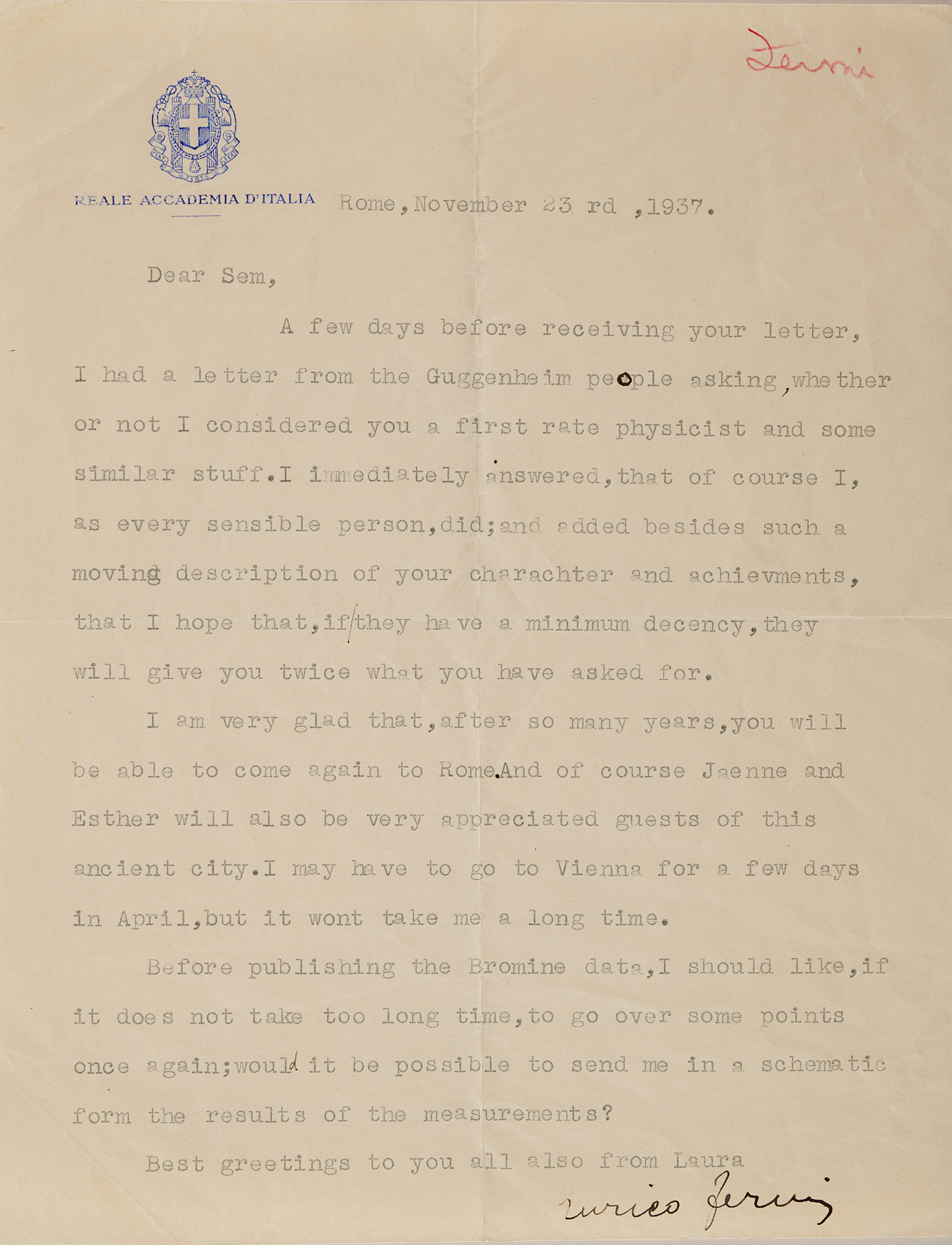
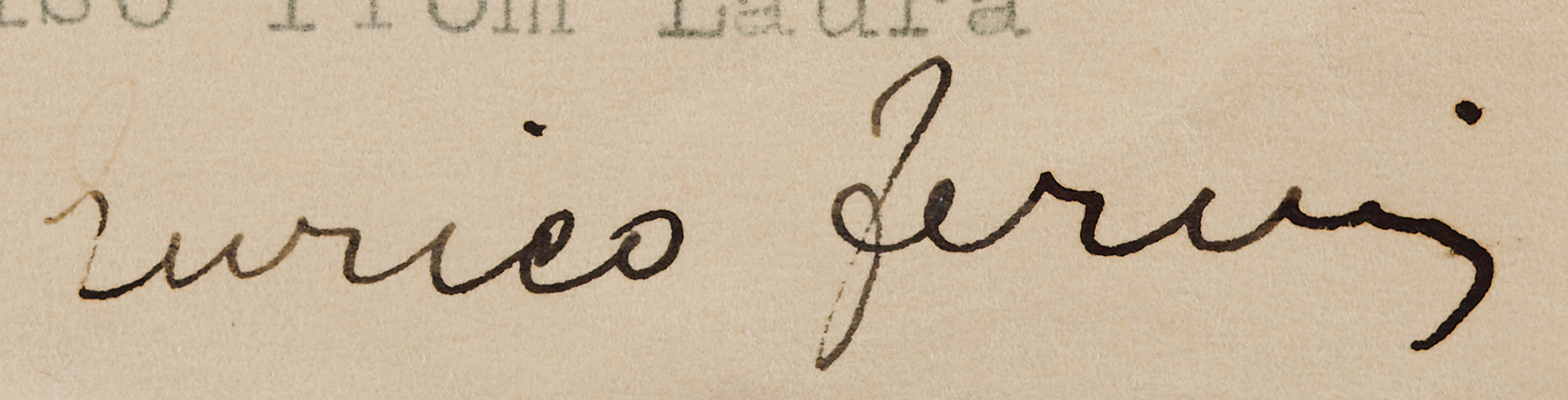
Physicist (1901–1954) who became the first to split the atom and was awarded the Nobel Prize for Physics in 1938 for his developments in harnessing nuclear power. TLS, one page, 6.5 x 8.5, Reale Accademia d'Italia letterhead, November 23, 1937. Letter to "Sem," the physicist Samuel Goudsmit, in full: "A few days before receiving your letter, I had a letter from the Guggenheim people asking, whether or not I considered you a first rate physicist and some similar stuff. I immediately answered, that of course I, as every sensible person, did; and added besides such a moving description of your character and achievements, that I hope that, if they have a minimum decency, they will give you twice what you have asked for.
I am very glad that, after so many years, you will be able to come again to Rome. And of course Jeanne and Esther will also be very appreciated guests of this ancient city. I may have to go to Vienna for a few days in April, but it wont take me a long time.
Before publishing the Bromine data, I should like, if it does not take too long time, to go over some points once again; would it be possible to send me in a schematic form the results of the measurements?" In fine condition, with light creasing.
After studying abroad with Max Born and Paul Ehrenfest, Enrico Fermi held a lectureship at the University of Florence from 1924 to 1926, where he produced his first major experimental work with Franco Rasetti and developed the statistical theory later known as Fermi–Dirac statistics; in 1927 he became Italy’s first professor of theoretical physics at the University of Rome, achieving international recognition that culminated in his election to the Accademia d’Italia in 1929.
Samuel Goudsmit, trained at the University of Leiden under Ehrenfest, made early contributions to spectroscopy and the Zeeman effect that led to his influential electron spin theory, and in 1927 joined the faculty of the University of Michigan, a leading center of theoretical physics. Fermi and Goudsmit became close through Fermi’s repeated visits to Michigan in the 1930s, during which Fermi grew increasingly drawn to the United States; as fascist pressures mounted in Italy, he ultimately left Rome for New York in 1938 after receiving the Nobel Prize.
From the personal collection of a lifelong collector, teacher, and traveler with a passion for world history. His collecting years ranged from the 1970s to the present day, meaning that several of the premier pieces have not been on the market in decades.

This item is Pre-Certified by PSA/DNA
Buy a third-party letter of authenticity for
$150.00
*This item has been pre-certified by a trusted third-party authentication service, and by placing a bid on this item, you agree to accept the opinion of this authentication service. If you wish to have an opinion rendered by a different authenticator of your choosing, you must do so prior to your placing of any bid. RR Auction is not responsible for differing opinions submitted 30 days after the date of the sale.
Third-party authentication service applies only to signatures and handwriting, and does not cover the addition of sketches, artwork, musical quotations, etc.

