Sold For $368
*Includes Buyers Premium
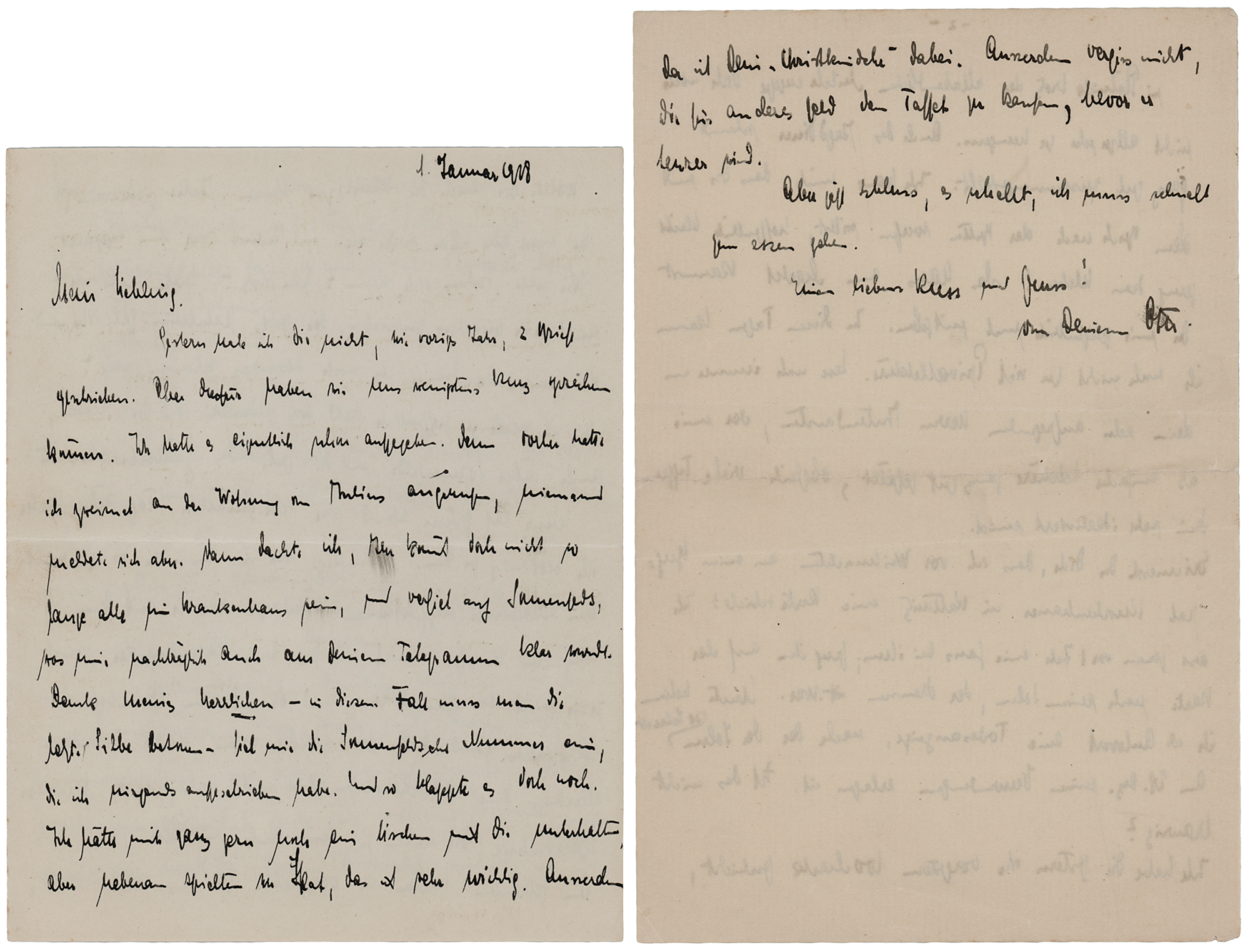
German chemist (1879–1968) who won the 1944 Nobel Prize for the discovery of nuclear fission. ALS in German, six pages, 5.75 x 7.25, January 1, 1918. Handwritten letter to his wife, Edith, written from the Western Front during World War I. In part (translated): "Unlike last year, I did not write two letters to you yesterday. But at least we were able to talk briefly. Actually, I was about to give up, because I had tried to ring Julius' apartment twice before, but nobody picked up. Then I thought you couldn't possibly all be at the hospital that long, and that's when I thought of Sonnenfeld, remembering what you had said in your telegram…I would have loved to talk with you a little longer, but we were playing Skat in the next room, and that is important. Also, the colonel wanted to talk to you and wish you a Happy New Year, but you were already gone again and Julius was on the line. How is Julius feeling? Really proud? I have not written to Grete yet. Yesterday's best wishes were meant for her as well. Or do you think I should write her expressly? Well, I hope I will hear more details from you soon, including about the Sonnenfelds and the quality of the roasted goose, etc.
Our celebration last night was very cozy. I had a crazy amount of work during the day. In the afternoon, I could not leave my desk from 2 to 7:45. Actually, since Dec. 27 I had not gotten out of the house except for one trip to the train station and my haircut today. So we had the usual meal last night, nothing fancy, with the exception of a kind of chocolate dessert with real whipped cream (we do have a cow in the stable!). For drinks with dinner and after, we had planned for the three of us (colonel, medical director, and myself) two bottles of burgundy mixed with one bottle of champagne. There was supposed to follow a punch at midnight, made of:
2 bottles of red wine
1/2 bottle of rum
1 bottle of tea
cinnamon and sugar
But we never got around to the punch because we prolonged our 'Turks' Blood,' so that in the end, between 8 p.m. and 3 a.m. we had consumed:
3 bottles of champagne
2 bottles of burgundy
1/2 bottle of red wine,
totaling about 2 bottles of alcohol each. Quite a lot, but spread over seven hours, it was tolerable. At the same time, with only short interruptions around midnight, we played wonderful Skat (for the first time in weeks). At 12, we lit the tree and interrupted the Skat. Rehfeldt and other soldiers who had not gotten leave to go to town also got wine and cigars…
Your sweet letter of the 30 already arrived yesterday. From Mother, too, there was a long one. For some reason Heiner thought I'd come on the 28. He called early and wanted to come in from Schlossborn. But when he called, I was already in Münster. They are staying in Schlossborn over New Year's. Judging from your mother's letters, they don't appear to be starving in Plötnick, notwithstanding the milk soup every night. Even the hunt dinner seems to be well put together. I am happy that you want to throw the book at the butter and I hope enough of it will stick! When you think of it, you can send along the House on the Market. These days, I haven't had much time for my own reading. I am still reading about the very exciting theater director, even though I find many characters in it very idealized.
Do you recall that I wrote a card to Bergrat Knochenhauer in Kattnitz before Christmas? I had had goose at his place exactly one year ago, and in my note I asked him about his son who was on the front. Today, by way of an answer, I got an obituary. His son, 21, died of his injuries on Dec. 28. Isn't that sad?
Yesterday, or the day before, I sent you 100 marks. That includes your gift from Santa. Also, do not forget to buy yourself, not from this money, the taffeta before it gets more expensive. Well, this is it. The bell is ringing, I have to run and eat." In fine condition.
Otto Hahn was drafted into the German Army at the outbreak of World War I and initially served in a conventional military unit. In 1915, he was transferred to a chemical warfare unit led by Fritz Haber, where he worked on the development and deployment of poison gas on both the Western and Eastern Fronts. After the war, Hahn expressed deep moral regret over his involvement in chemical weapons research.
From the personal collection of a lifelong collector, teacher, and traveler with a passion for world history. His collecting years ranged from the 1970s to the present day, meaning that several of the premier pieces have not been on the market in decades.

This item is Pre-Certified by PSA/DNA
Buy a third-party letter of authenticity for
$25.00
*This item has been pre-certified by a trusted third-party authentication service, and by placing a bid on this item, you agree to accept the opinion of this authentication service. If you wish to have an opinion rendered by a different authenticator of your choosing, you must do so prior to your placing of any bid. RR Auction is not responsible for differing opinions submitted 30 days after the date of the sale.
Third-party authentication service applies only to signatures and handwriting, and does not cover the addition of sketches, artwork, musical quotations, etc.

