Sold For $47,478
*Includes Buyers Premium
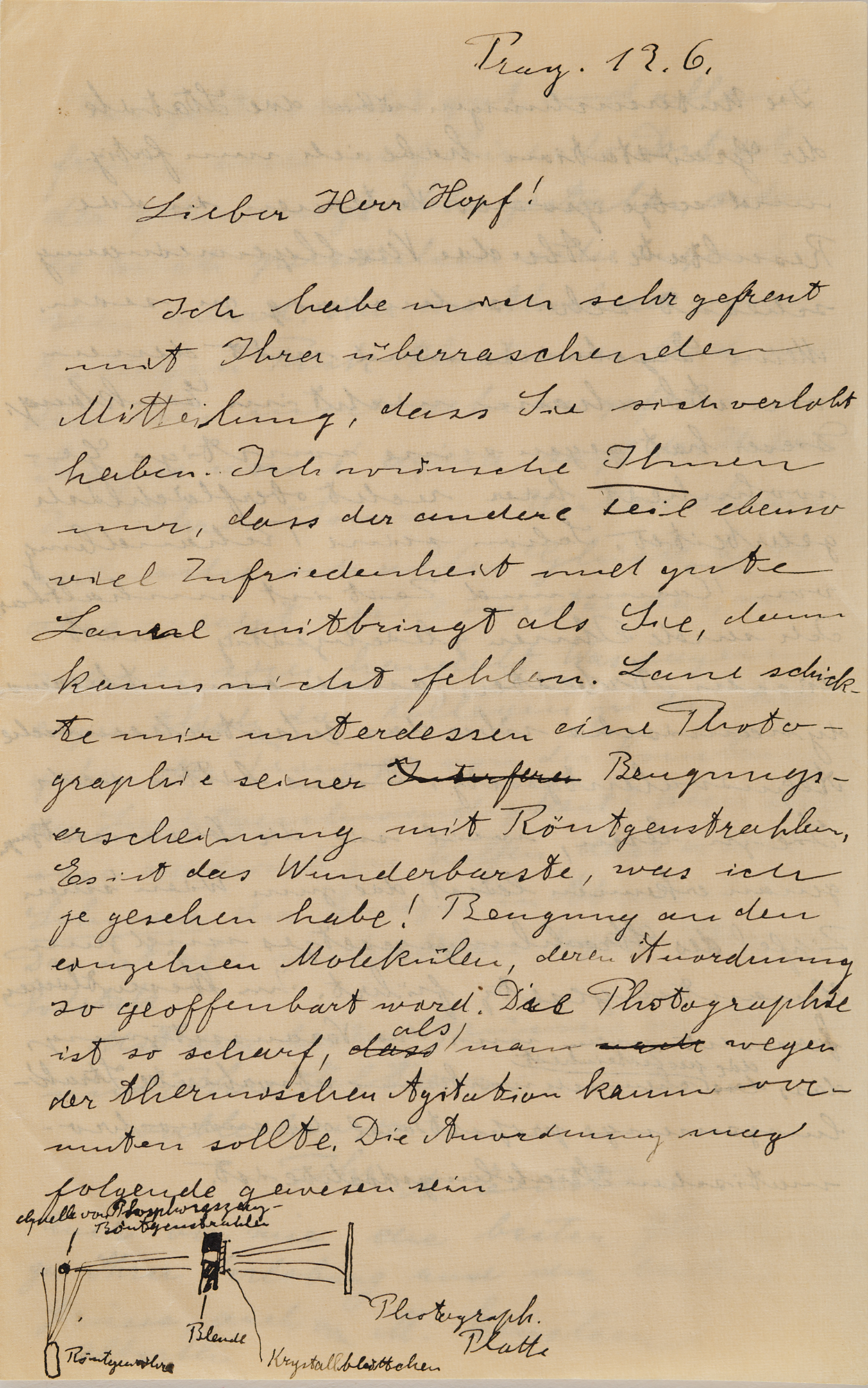
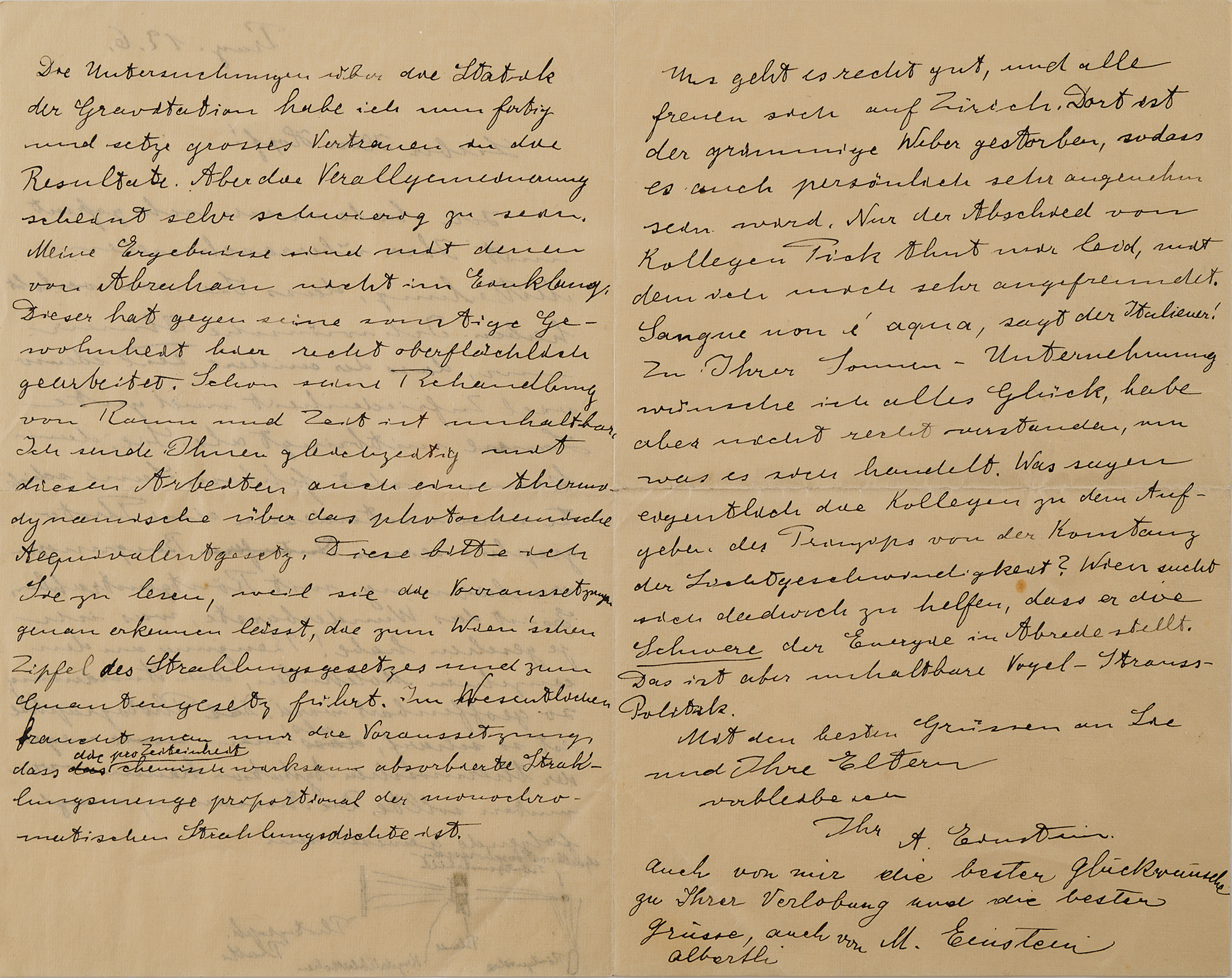
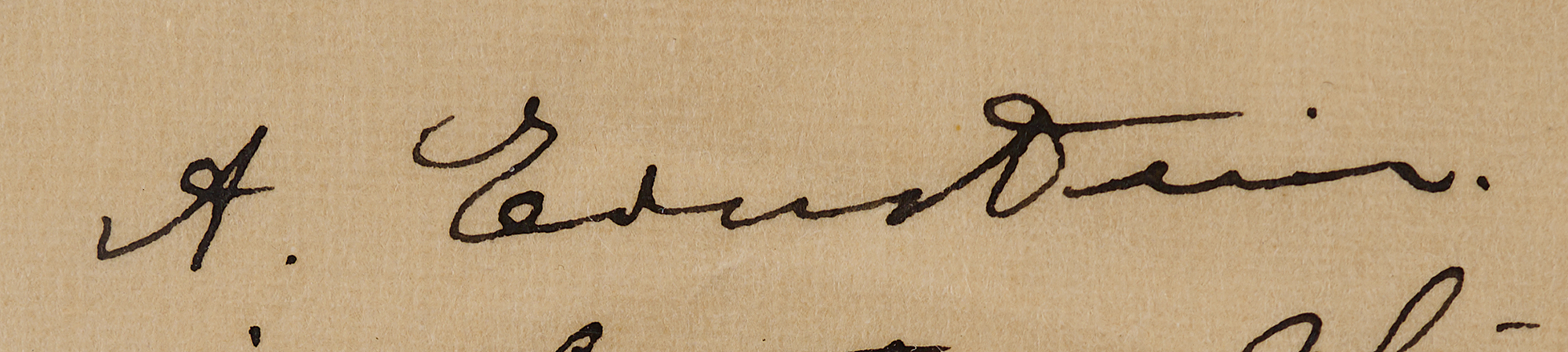
ALS in German, signed “A. Einstein,” three pages on two adjoining sheets, 4.25 x 6.75, June 12, [1912]. Handwritten letter to fellow physicist and collaborator Ludwig Hopf, with remarkable commentary on Max von Laue's discovery of X-ray diffraction, his own work on static gravitational fields, and the recent death of his thesis advisor—and avowed scientific nemesis—Heinrich Friedrich Weber.
In full (translated): "I was very happy to receive your surprising news that you are engaged. I wish for you only that the other party brings as much contentment and good spirits as you do; in that case, you will lack for nothing. Meanwhile, Laue sent me a photograph of his deflection phenomenon with X-rays. It is the most wonderful thing that I have ever seen! Deflection at the individual molecules, whose arrangement is thereby revealed. The photograph is so sharp that one could scarcely imagine it on account of the thermal agitation. The arrangement would have been like this:"
Here, Einstein sketches the experimental apparatus, diagramming the "source of phosphorescence—X-rays," "Röntgen tube," "shutter," "crystal lamina" and "photographic plate."
He continues: "I have finished the investigations of the statics of gravitation and have great confidence in the results, but generalizing them seems to be very difficult. My findings do not agree with those of Abraham. Contrary to his usual custom, he did quite superficial work here. Even his treatment of space and time is untenable. Along with these papers, I am also sending you a thermodynamic one about the photochemical equivalence law, which I ask you to read because it makes it possible to clearly see the presupposition that leads to Wien’s take on the radiation law and to the quantum law. In essence, the only presupposition needed is that the chemically active amount of radiation absorbed per unit of time is proportional to the density of the monochromatic radiation.
We are doing quite well, and everyone is looking forward to Zürich. Grim old Weber has died there, so it will also be very pleasant on a personal level. I’m sorry only about saying goodbye to my colleague Pick, with whom I have become good friends. Sangue non è aqua [blood is thicker than water], the Italians say! I wish you the best for your sun research, but I have not properly understood what it’s about. What are your colleagues really saying about giving up the principle of the constancy of the speed of light? Wien is also trying to help by questioning the weight of energy, but that is just burying one’s head in the sand."
At the conclusion, Einstein's wife, Mileva, pens a message (translated): "Best wishes on your engagement and the best of greetings from me also, and also from Albertli. M. Einstein." In fine condition.
Written in June 1912, this remarkable letter captures Albert Einstein at a pivotal crossroads—personally, intellectually, and historically—just as several of the most transformative developments in modern physics were converging. Einstein was then a professor in Prague, on the cusp of returning to Zürich, and deeply immersed in problems that would soon culminate in the general theory of relativity. His confident remarks on having completed work on the statics of gravitation reflect his intense engagement with gravitational theory in the immediate pre-relativistic phase, when he was struggling to reconcile gravitation with relativity and openly critiquing rivals such as Max Abraham.
At the same time, his astonishment at Max von Laue’s discovery of X-ray diffraction—here described as “the most wonderful thing” he had ever seen—places the letter at the very birth of X-ray crystallography, a breakthrough that would revolutionize physics, chemistry, and structural science and earn Laue the 1914 Nobel Prize. Einstein’s hand-drawn diagram underscores his instinctive grasp of the experiment’s profound implications for modern science.
The letter also vividly situates Einstein within the argumentative and highly personal scientific culture of early 20th-century physics. His comments range freely from quantum theory and Wilhelm Wien’s radiation law to debates over the constancy of the speed of light, revealing a community still wrestling with the full consequences of relativity and quantum ideas. The sharp aside regarding the death of Heinrich Friedrich Weber—Einstein’s former thesis advisor and longtime adversary—adds a strikingly human dimension, underscoring how personal rivalries and institutional politics shaped scientific careers.
Finally, Mileva Einstein’s warm postscript grounds the document in domestic life, reminding us that these epoch-making ideas were forged amid friendships, marriages, losses, and everyday transitions. Taken as a whole, the letter offers an unusually intimate snapshot of Einstein in motion: alert to revolutionary discoveries, confident yet uncertain about his own path, and embedded in the living fabric of modern physics as it was being made.

This item is Pre-Certified by PSA/DNA
Buy a third-party letter of authenticity for
$150.00
*This item has been pre-certified by a trusted third-party authentication service, and by placing a bid on this item, you agree to accept the opinion of this authentication service. If you wish to have an opinion rendered by a different authenticator of your choosing, you must do so prior to your placing of any bid. RR Auction is not responsible for differing opinions submitted 30 days after the date of the sale.
Third-party authentication service applies only to signatures and handwriting, and does not cover the addition of sketches, artwork, musical quotations, etc.

