Sold For $6,504
*Includes Buyers Premium
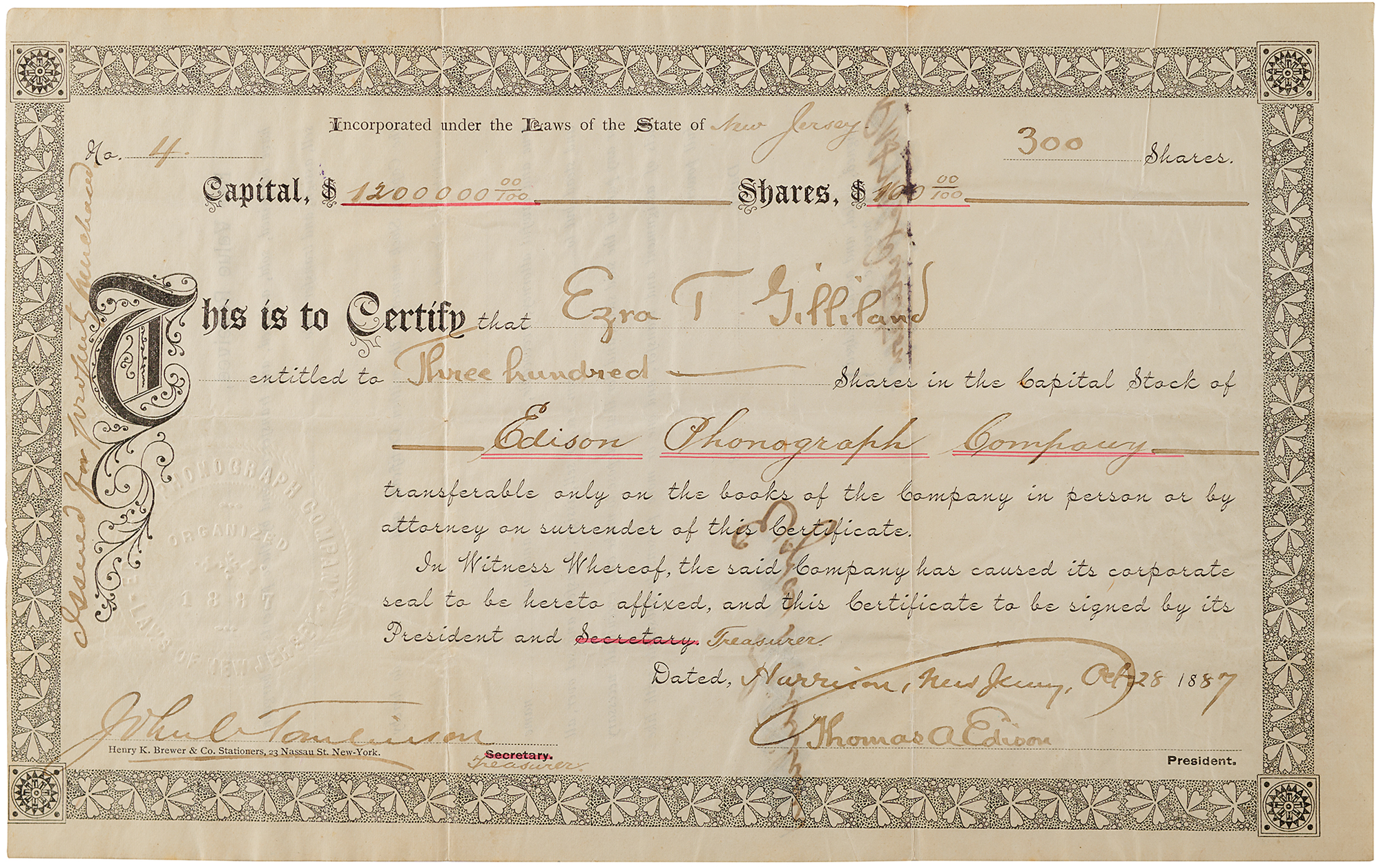
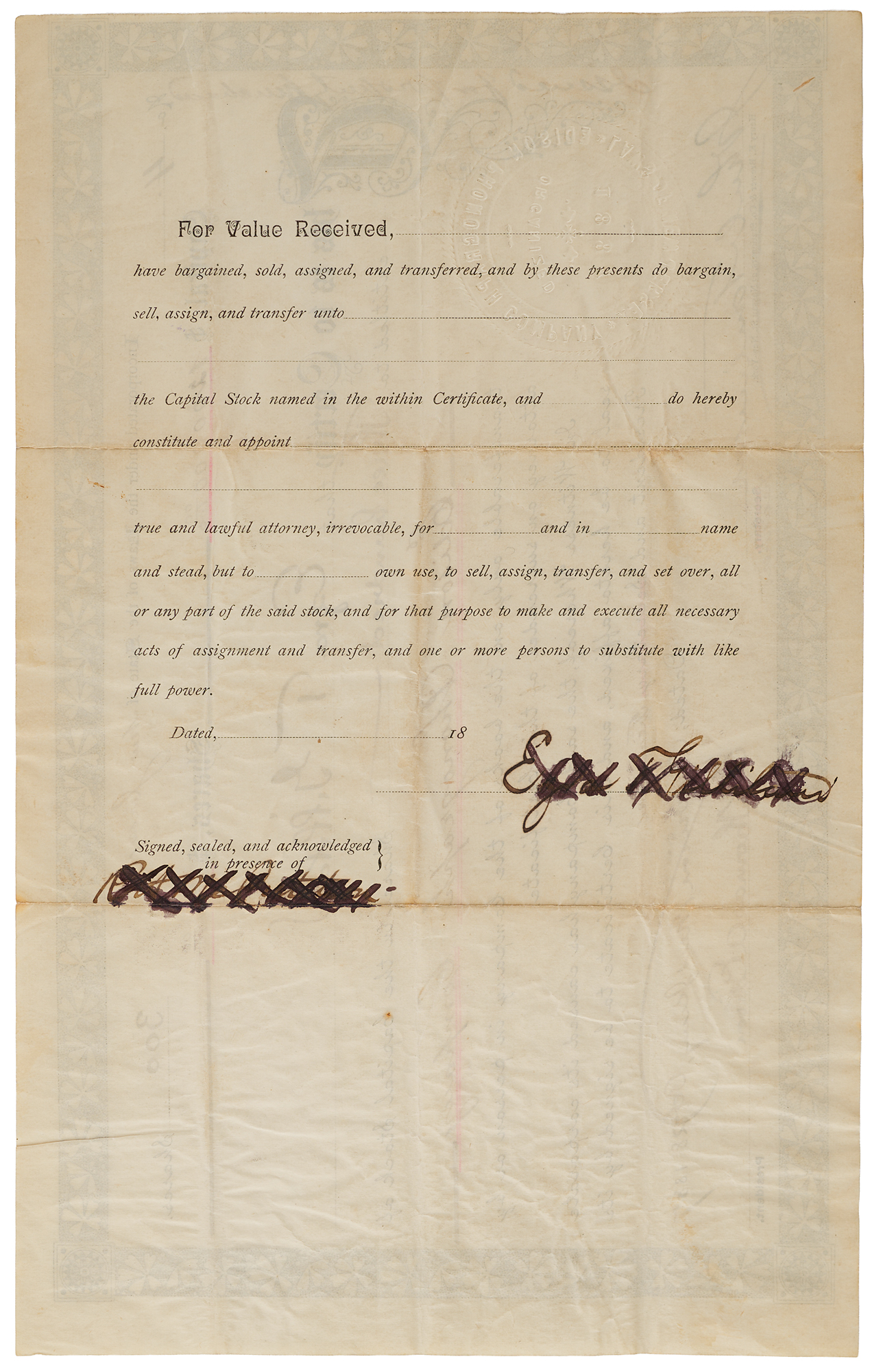
Partly-printed DS, signed “Thomas A. Edison,” one page, 10.25 x 6.5, October 28, 1887. Stock certificate for 300 shares in the Edison Phonograph Company issued to Ezra T. Gilliland, signed at the conclusion by Thomas Edison as president, and countersigned by John C. Tomlinson as treasurer. Ezra T. Gilliland's endorsement signature on the reverse has been heavily canceled in ink. In very good to fine condition, with overall creasing.
The Edison Phonograph Company was incorporated in New Jersey on October 10 1887, to hold and control the patents and manufacturing rights for Edison's phonograph. The recipient of these shares, Ezra T. Gilliland, was an inventor who designed the telephone switchboard and the magneto bell; he was a friend and colleague of Thomas Edison, working with him on many of his innovative projects including the refining of the phonograph. Soon, Gilliland was acting as Edison's 'mouthpiece' and lead marketer for the phonograph.
From 'Who was Ezra Gilliland?' by Matt Andres, curatorial registrar of the Edison and Ford Winter Estates: 'The end came fast and furious in 1888, when entities revolving around Edison’s phonograph as well as his competitor’s Graphophone clashed in an effort to gain control of the marketplace. A new 'player' appeared almost out of nowhere, Jesse Lippincott, a wealthy businessman who made millions in the glass industry, manufacturing tumblers and such. Looking for another lucrative trade to conquer, he negotiated an exclusive license to market the Graphophone, but feared Edison’s machine would prevent him from monopolizing this industry. Gilliland invited Lippincott to examine Edison’s phonograph and what transpired from this meeting eventually destroyed his friendship with 'America’s inventor.'
Lippincott opened negotiations with Gilliland on the purchase of the Edison Phonograph Company for a sum of $500,000. Ezra took it upon himself to act as Edison’s representative, hosting meetings and working out many of the finite details. Enlisting Tomlinson as his liaison and legal counsel, Edison was effectively 'in the dark' during this early stage. Tomlinson began feeding bits and pieces of information to Edison and trying to complete a deal with Lippincott that would give the latter entire control, all while Gilliland and Tomlinson profited financially for their contributions in accomplishing this mighty task.
Edison was astute enough to demand he retain manufacturing rights and overall product control; however, he finally agreed to a contract in June of 1888 that would essentially grant Lippincott all marketing rights, which in turn gave him the ability to greatly influence its direction. A side deal, unknown to Edison, was created between Lippincott, Gilliland, and Tomlinson whereas the former would purchase Ezra’s contract previously signed with Edison, and in exchange for canceling its terms, provide Gilliland $250,000 worth of capital stock with cash options in a new company designed to promote, market, sell and exploit both machines. Tomlinson was also supposed to receive a portion for his role in finalizing the process with Edison. Over the next few months their scheme began to unravel. Lippincott had difficulties making his initial payment to Edison in regards to their agreed upon contract. In meeting with Edison directly, he began divulging everything; his pursuit of obtaining various rights, contract setup, the unspecified side arrangement, cash and stock with Gilliland and Tomlinson.
A furious Edison, hurt and betrayed, sent a message to his soon to be ex-friend Gilliland, who was in Europe promoting his phonograph, terminating his employment and basically their friendship. The same was done with his lawyer, Tomlinson. Edison would file a lawsuit against both men in 1889, alleging fraud in negotiations involving Jesse Lippincott and Edison’s company.'

This item is Pre-Certified by PSA/DNA
Buy a third-party letter of authenticity for
$150.00
*This item has been pre-certified by a trusted third-party authentication service, and by placing a bid on this item, you agree to accept the opinion of this authentication service. If you wish to have an opinion rendered by a different authenticator of your choosing, you must do so prior to your placing of any bid. RR Auction is not responsible for differing opinions submitted 30 days after the date of the sale.
Third-party authentication service applies only to signatures and handwriting, and does not cover the addition of sketches, artwork, musical quotations, etc.

