Sold For $14,815
*Includes Buyers Premium
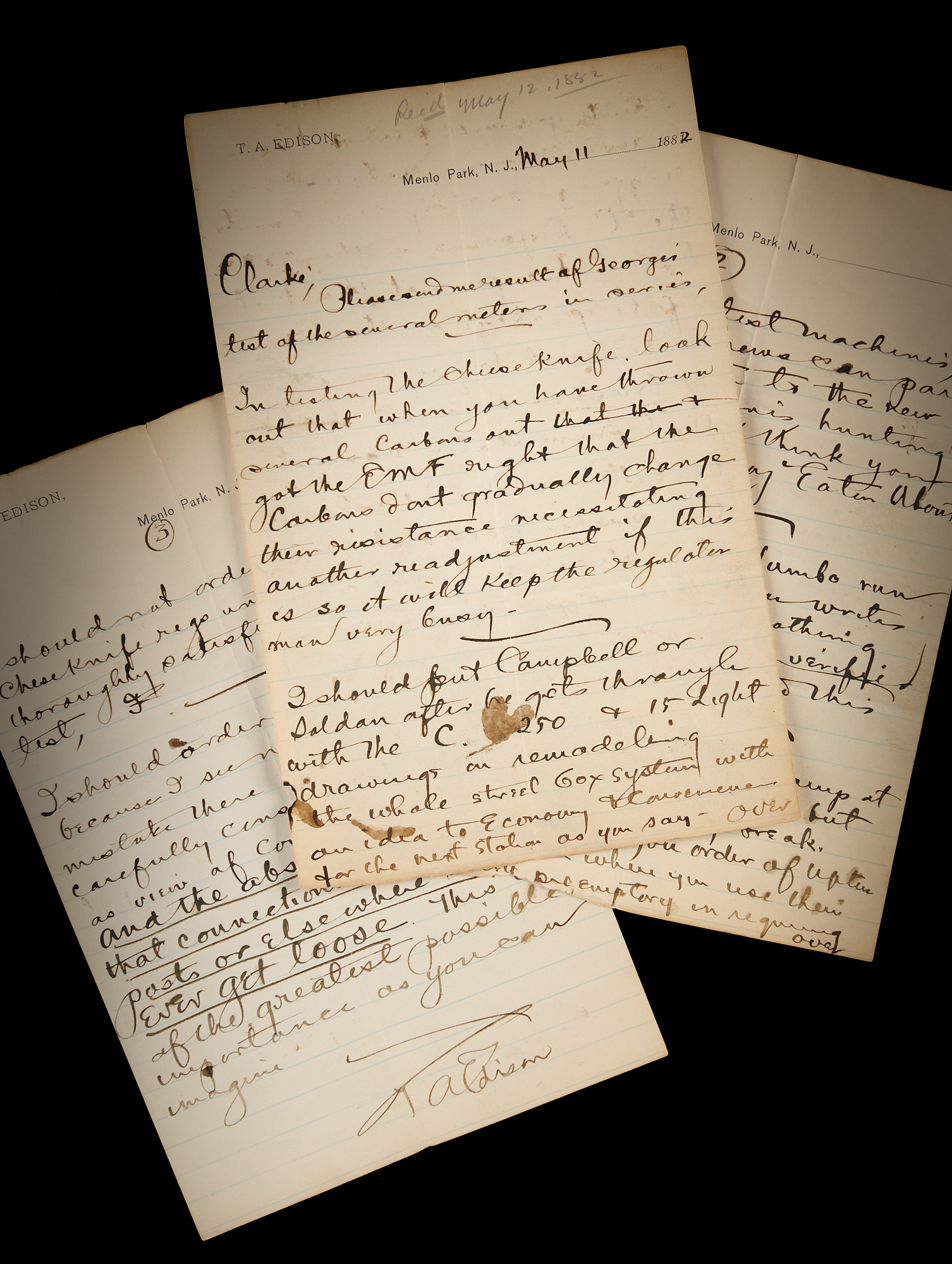
ALS signed “T. A. Edison,” five pages on three sheets, 5.75 x 8.75, personal letterhead, May 11, 1882. Handwritten letter to Charles L. Clarke, chief engineer of the Edison Electric Illuminating Company, concerning the installation of electric lighting in New York City. In 1881, the New York City Board of Aldermen had granted Edison the franchise to 'lay tubes, wires, conductors, and insulators, and to erect lamp posts within the lines of…the City of New York, for conveying and using electricity or electrical currents for purposes of illumination.' At the time this letter was written, the laying of the mains in the First (Pearl Street) District near the city's financial and newspaper center (and the site of the Brooklyn Bridge) was well under way.
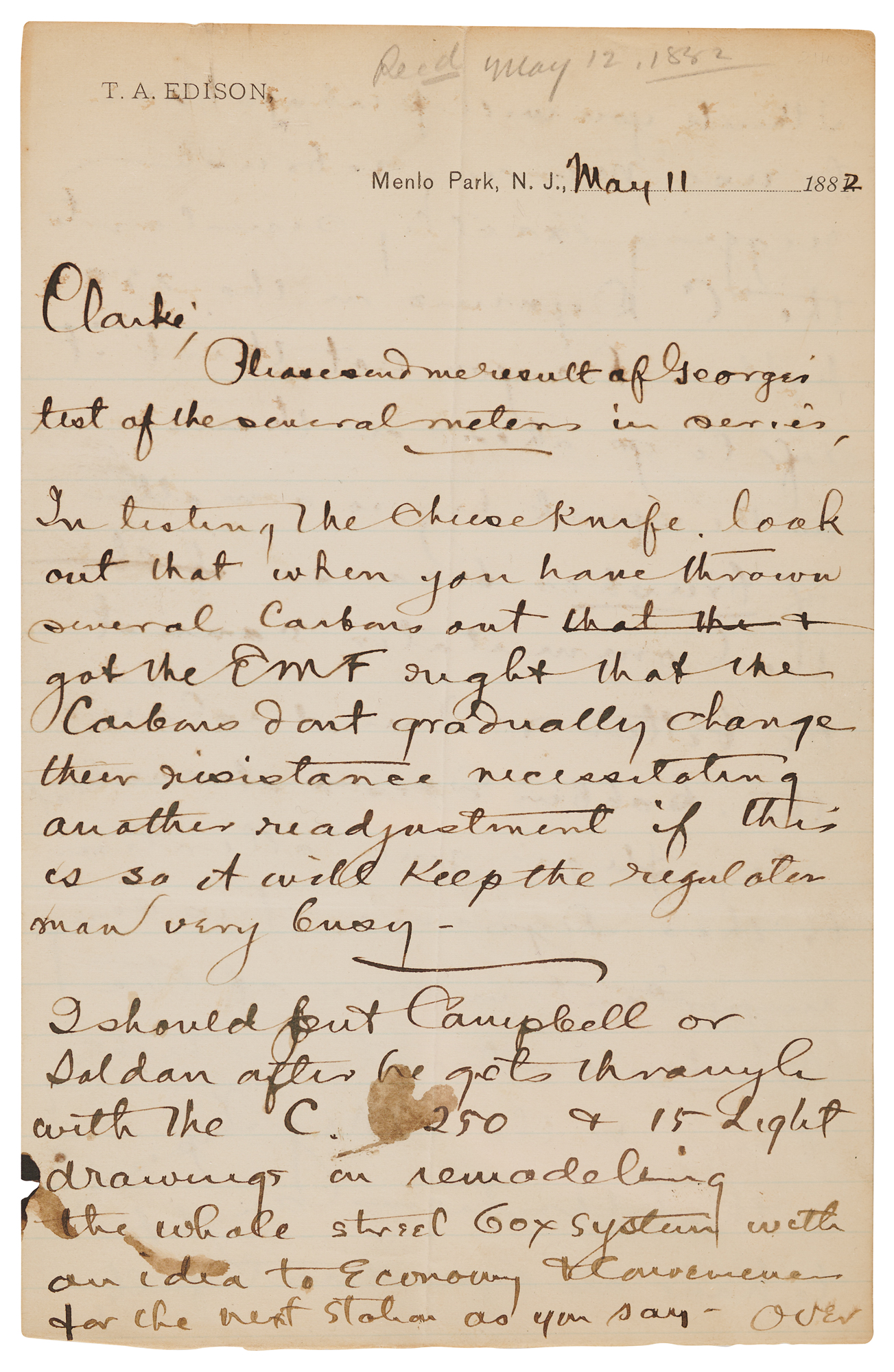
Edison writes, in full: "Please send me result of George's test of several meters in series. In testing the Cheese Knife [used to cut filaments], look out that when you have thrown several Carbons out & got the EMF [Electro Magnetic Field] right that the Carbons don't gradually change their resistance necessitating another readjustment. If this is so it will keep the regulator man very busy.
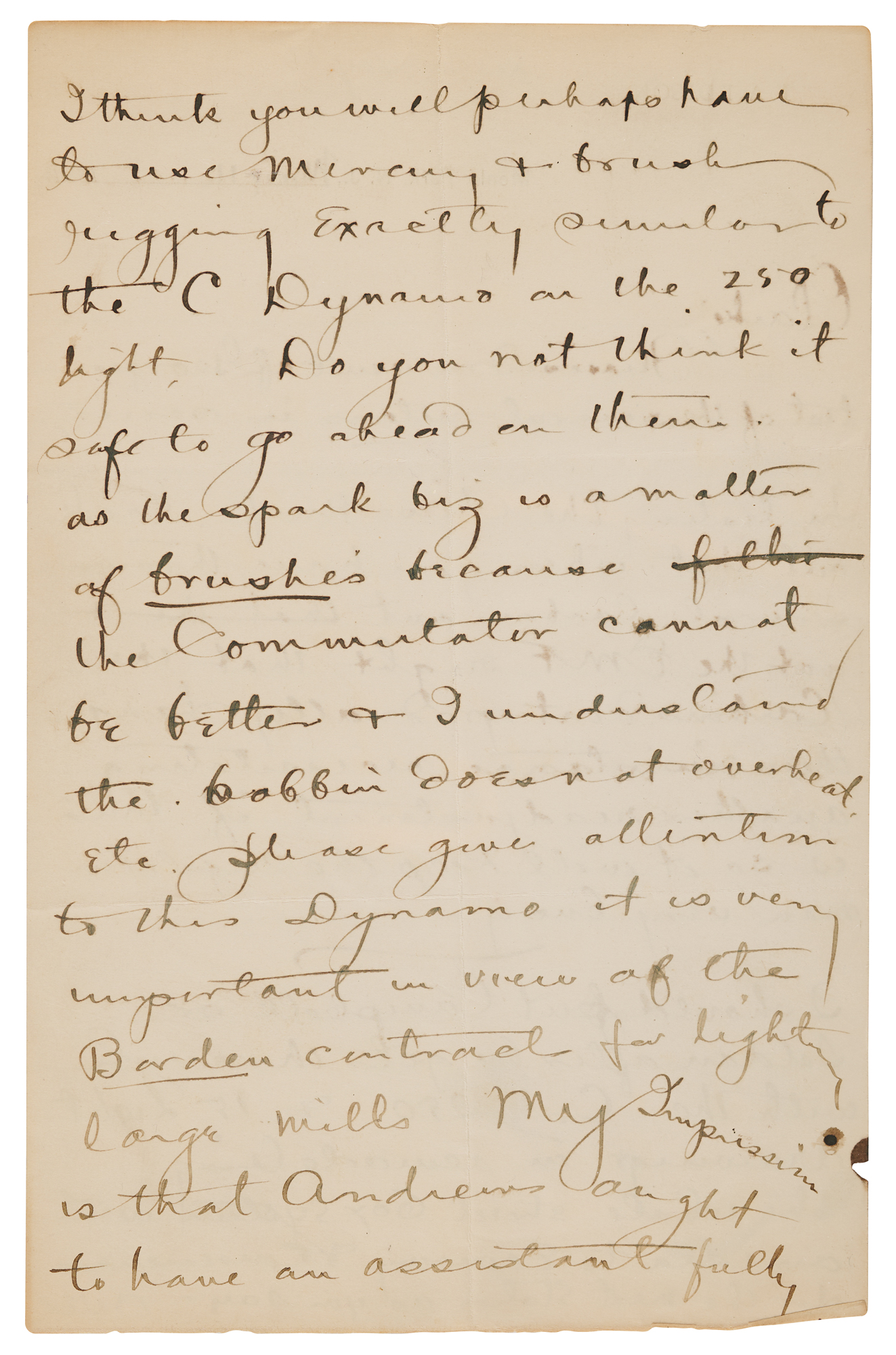
I should put Campbell or Soldan after he gets through with C. 250 & 15 Light drawings on remodeling the whole street box system with an idea to Economy & Convenience for the next station as you say. I think you will perhaps have to use Mercury & brush rigging exactly similar to the C Dynamo on the 250 light. Do you not think it safe to go ahead on them as the spark biz is a matter of brushes because the Commutator cannot be better & I understand the bobbin does not overheat, etc. Please give attention to this Dynamo it is very important in view of the Borden contracts for lighting large mills.
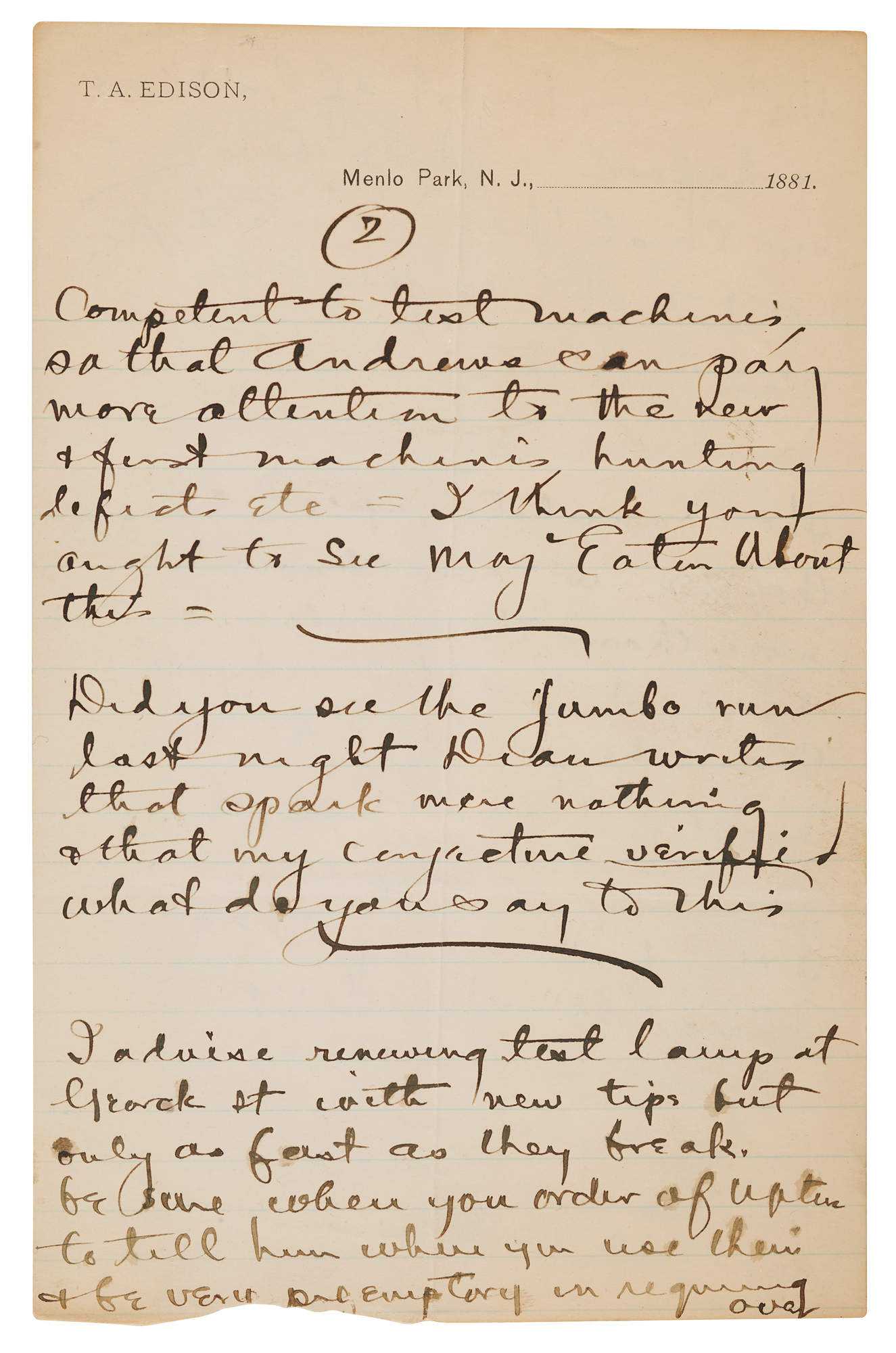
My impression is that Andrews ought to have an assistant fully competent to test machines, so that Andrews can pay more attention to the new & first machines, hunting defects, etc. I think you ought to see Maj. Eaton about that.
Did you see the Jumbo run last night. Dean writes that spark were nothing & that my conjecture verified. What do you say to this?
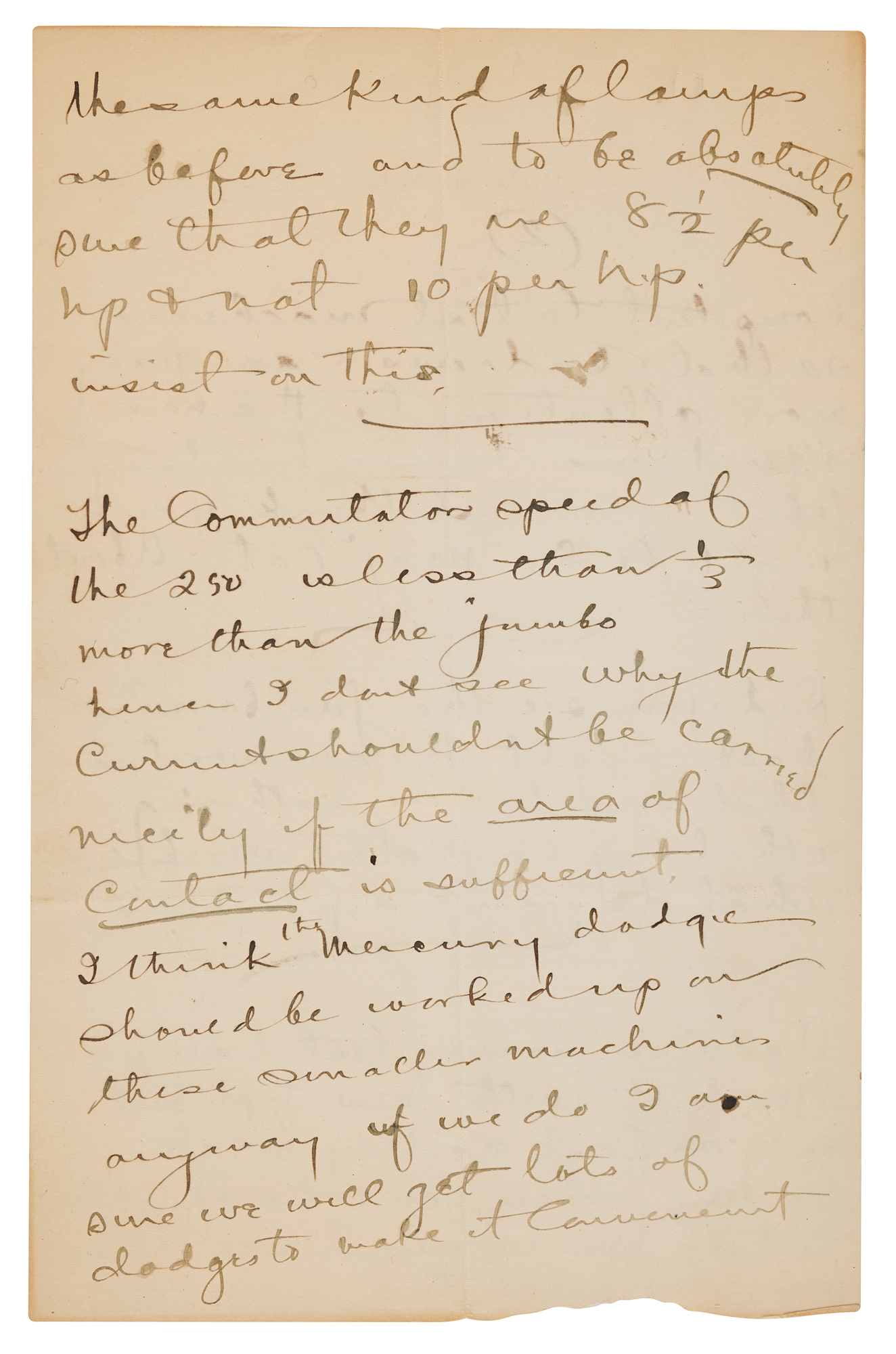
I advise renewing test lamp at Goerck St. with new tips but only as fast as they break. Be sure when you order of Upton to tell him where you use them & be very preemptory in requiring the same kind of lamps as before and to be absolutely sure that they are 8 1/2 per hp & not 10 per hp. Insist on this.
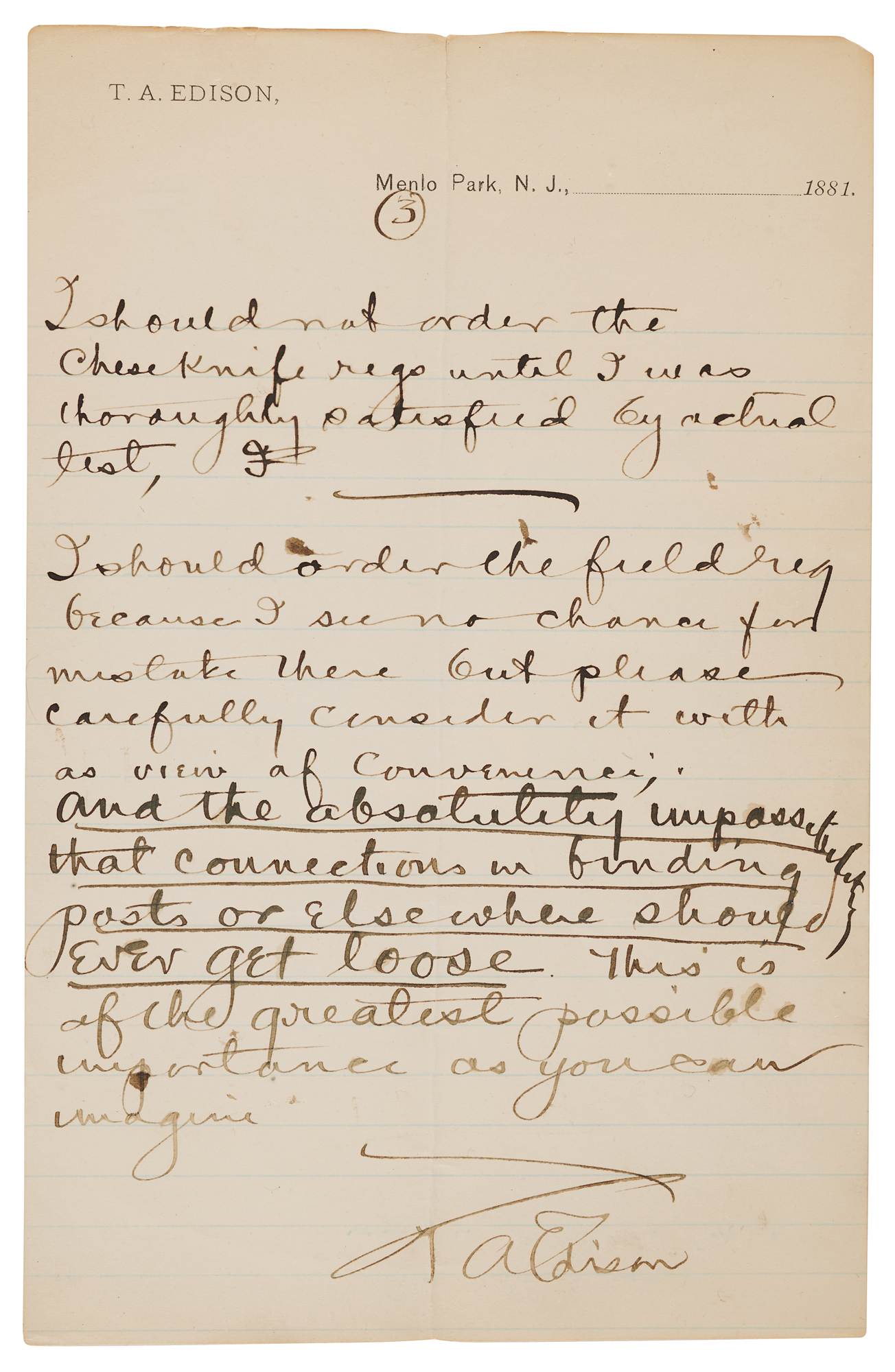
The Commutator speed of the 250 is less than 1/3 more than the jumbo hence I don't see why the current shouldn't be carried nicely if the area of contact is sufficient. I think the Mercury dodge should be worked up on these small machines anyway if we do I am sure we will get lots of dodges to make it convenient. I should not order the cheese knife regs until I was thoroughly satisfied by actual test.
I should order the field reg because I see no chance for mistake there but please carefully consider it with as view of convenience; and the absolute impossibility that connections in binding posts or elsewhere should ever get loose. This is of the greatest possible importance as you can imagine." In fine condition, with a few stains, and some minor edge loss.
Dated only months before the Pearl Street Station began supplying power in Lower Manhattan, this handwritten letter shows Thomas Edison deeply engaged in transforming electric lighting from an experimental success into a dependable urban utility. Writing to Charles L. Clarke as underground mains were being installed in the First District (bounded by Spruce Street, the East River, Wall Street, and Nassau Street), Edison focuses on practical engineering problems such as meter testing, filament reliability, commutator sparking, regulator design, and the durability of street boxes and connections. His attention to standardization, economy, and maintenance—especially in anticipation of large commercial contracts—highlights the challenges of scaling electrical power in a dense city environment. The letter is significant as a firsthand record of the critical transition from invention to infrastructure, documenting the technical decisions that helped make New York City the first major metropolis illuminated by centralized electric power.

This item is Pre-Certified by PSA/DNA
Buy a third-party letter of authenticity for
$150.00
*This item has been pre-certified by a trusted third-party authentication service, and by placing a bid on this item, you agree to accept the opinion of this authentication service. If you wish to have an opinion rendered by a different authenticator of your choosing, you must do so prior to your placing of any bid. RR Auction is not responsible for differing opinions submitted 30 days after the date of the sale.

