Sold For $37,000
*Includes Buyers Premium
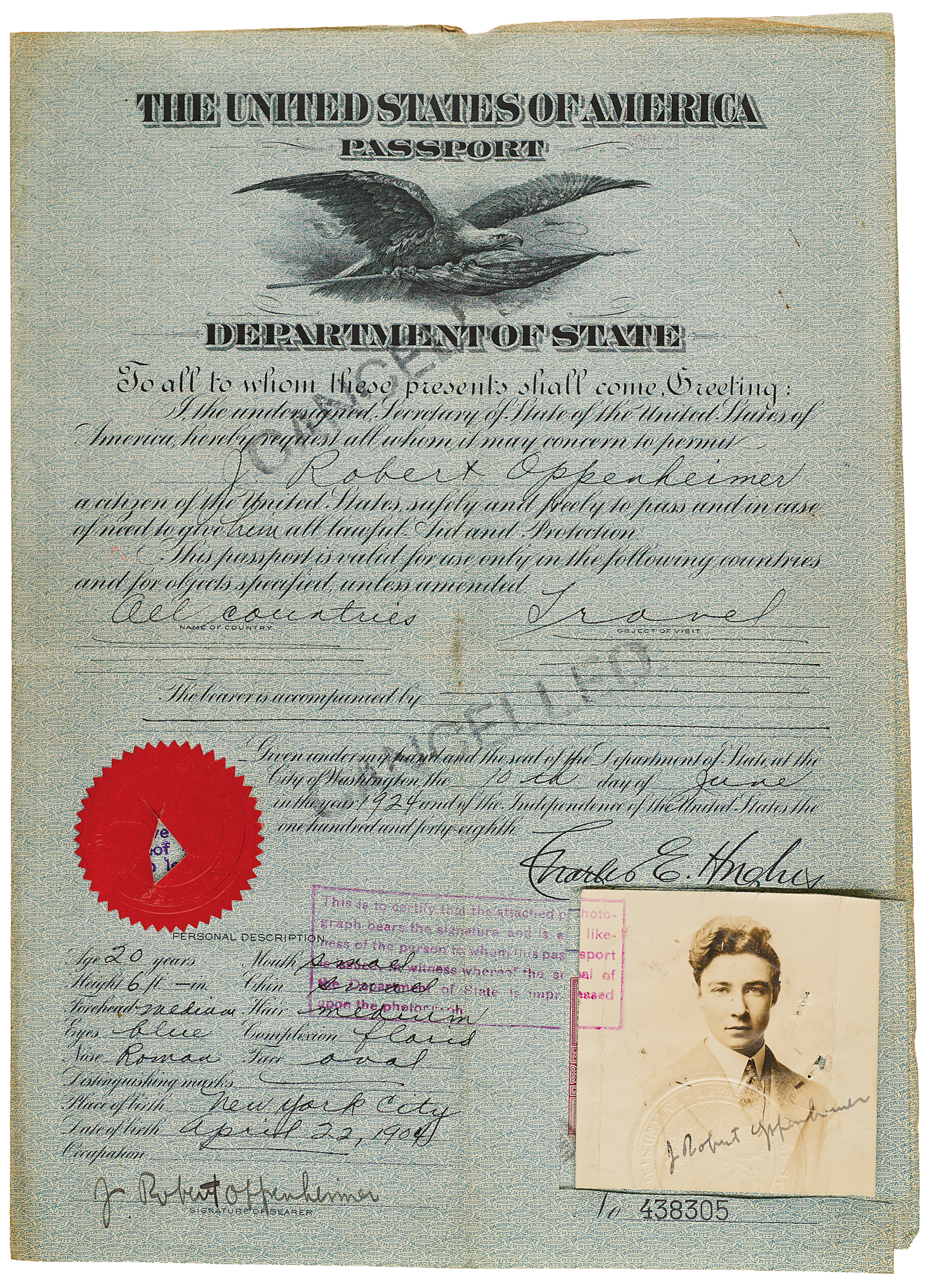
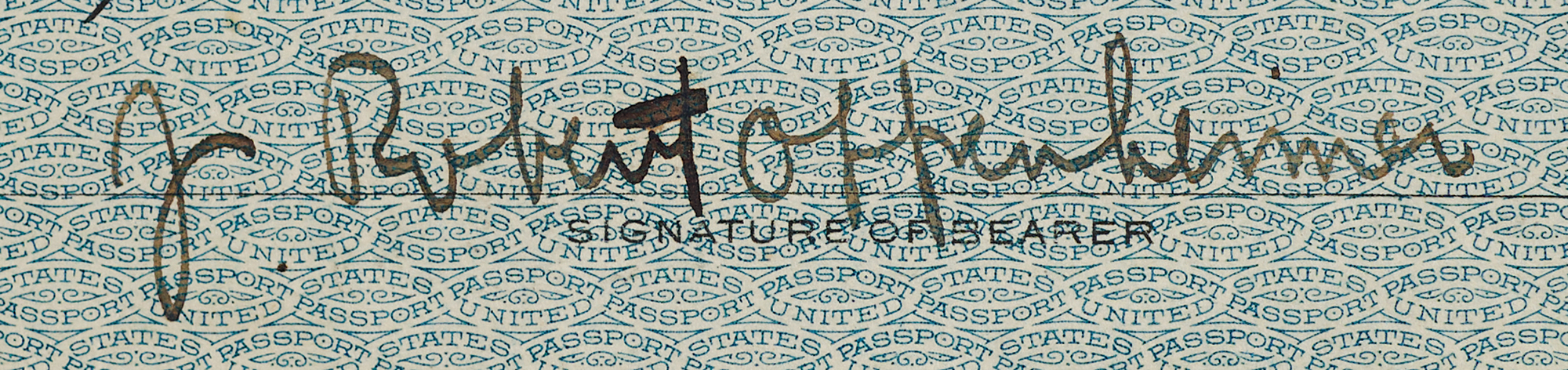
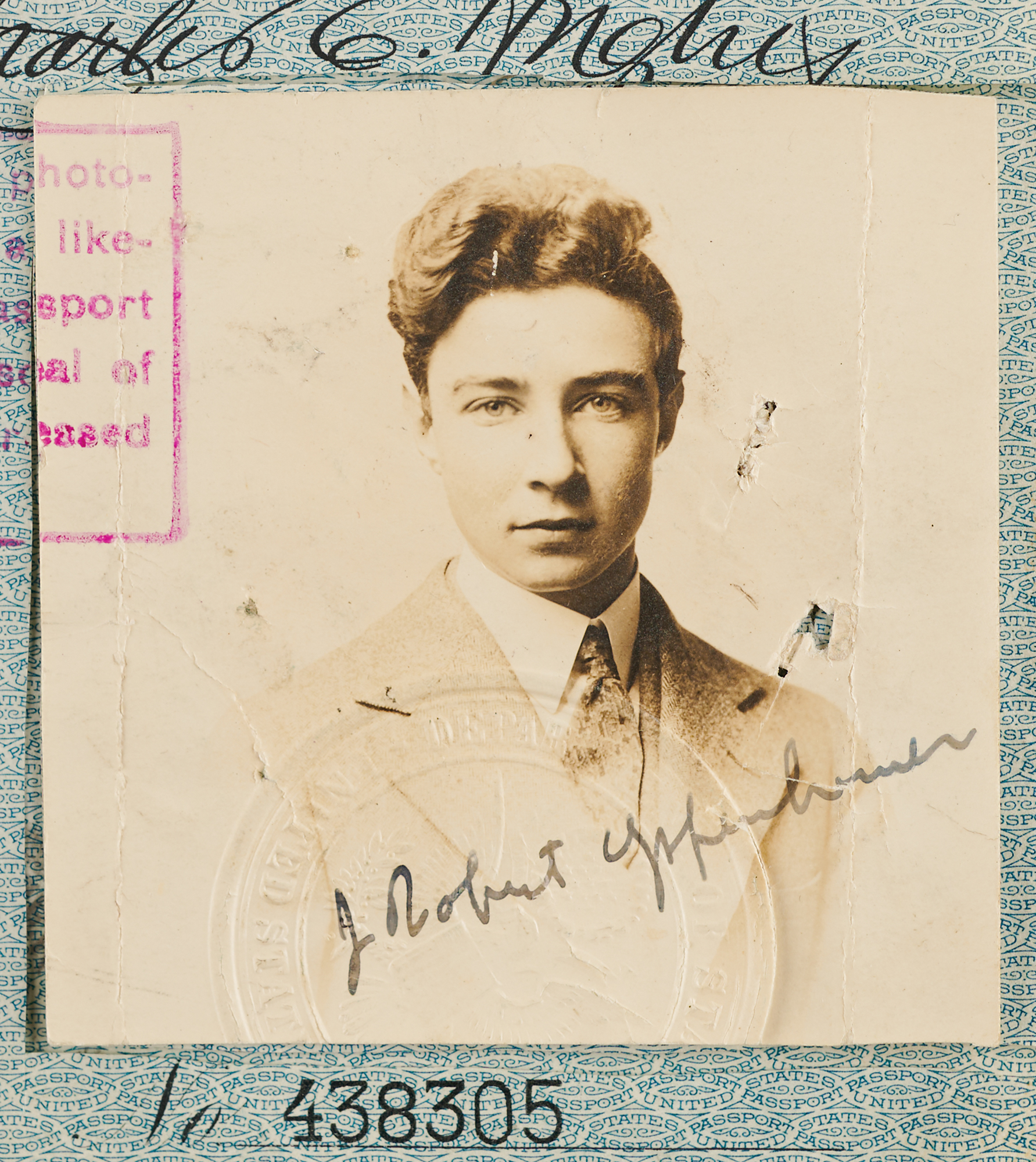
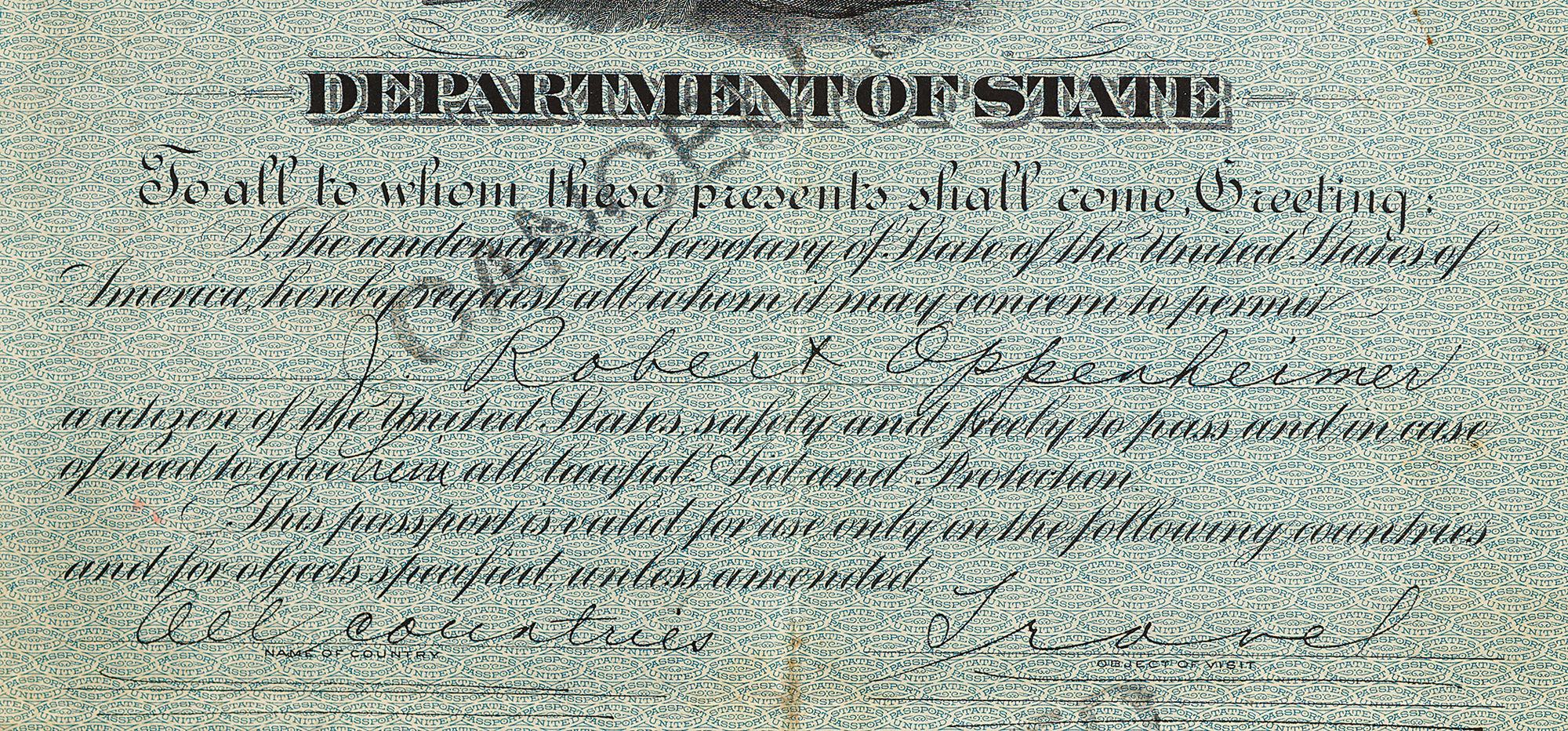
Historic partly-printed DS, signed twice as “J. Robert Oppenheimer,” four pages on two adjoining sheets, 8.75 x 12, June 10, 1924. United States of America passport issued by the Department of State to “J. Robert Oppenheimer, a citizen of the United States,” permitting him to “safely and freely pass and in case of need to give him all lawful Aid and Protection.” The passport is valid for “All countries,” with the object of visit designated as “Travel.” Signed at the conclusion in fountain pen by Oppenheimer, who has also signed his official 2.75 x 2.75 passport photograph, “J. Robert Oppenheimer,” which has been neatly excised from the lower right corner; the photograph, which pictures Oppenheimer at the age of 17, is similar to the one used for his 1921 passport application.
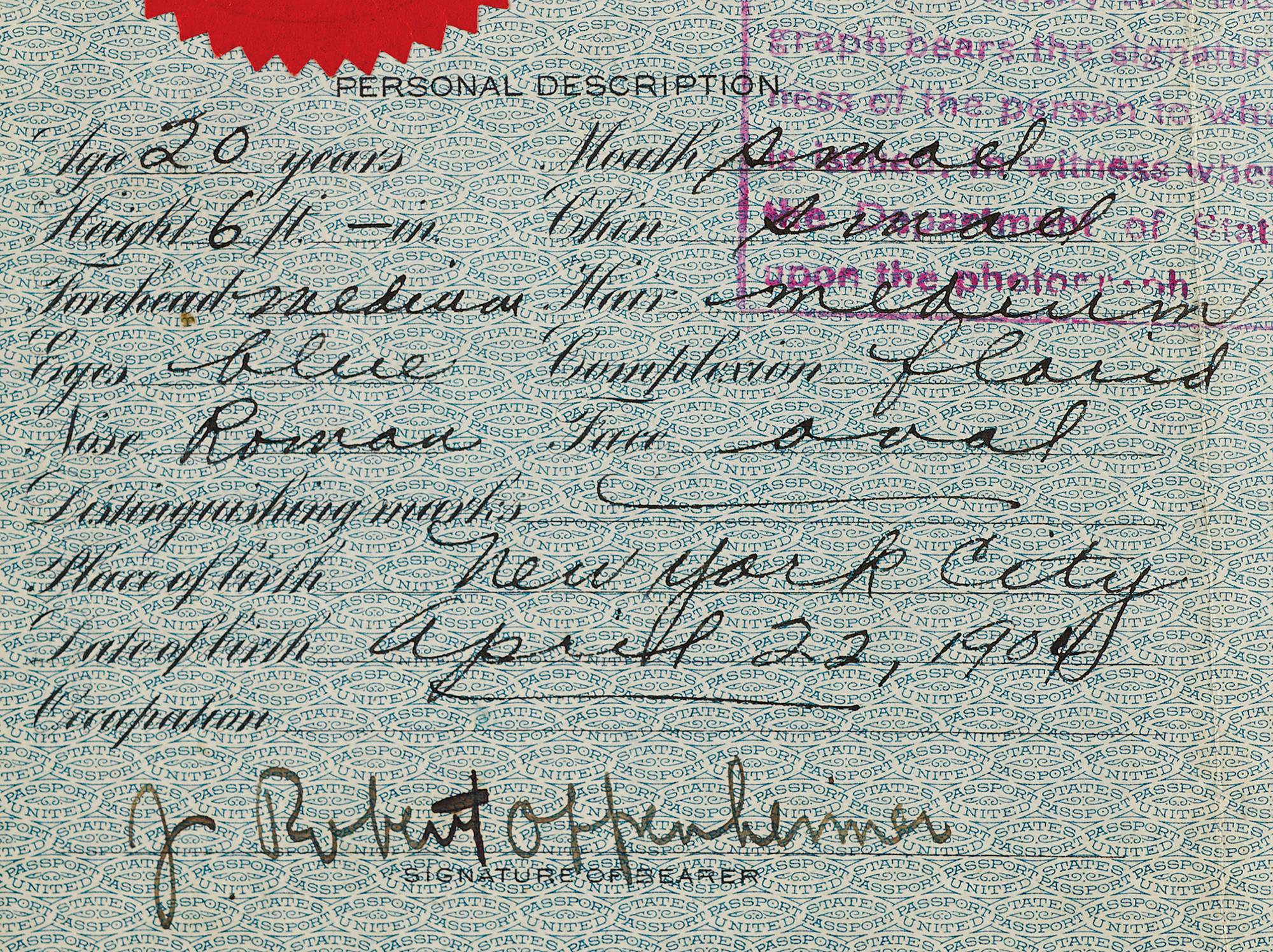
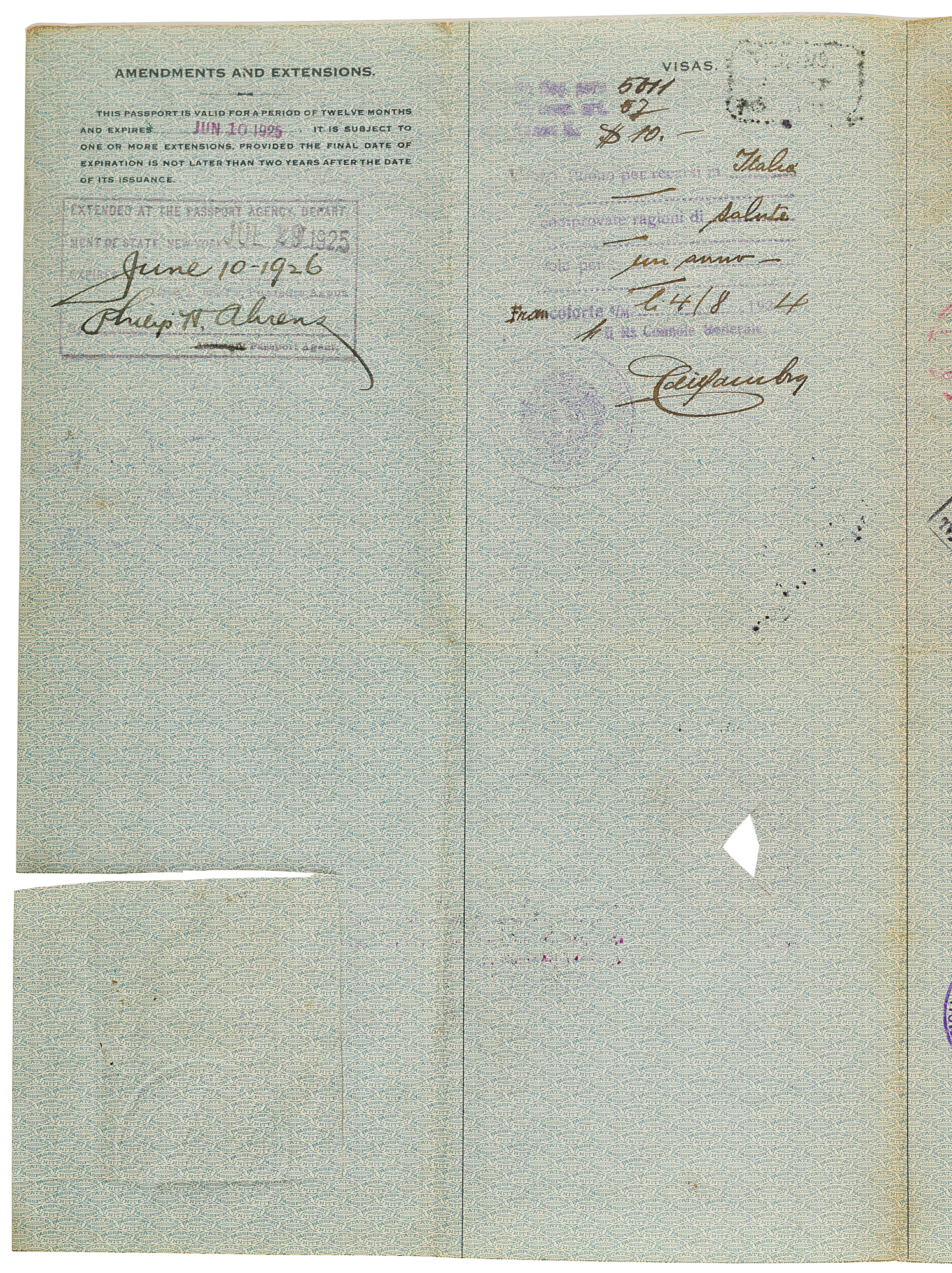
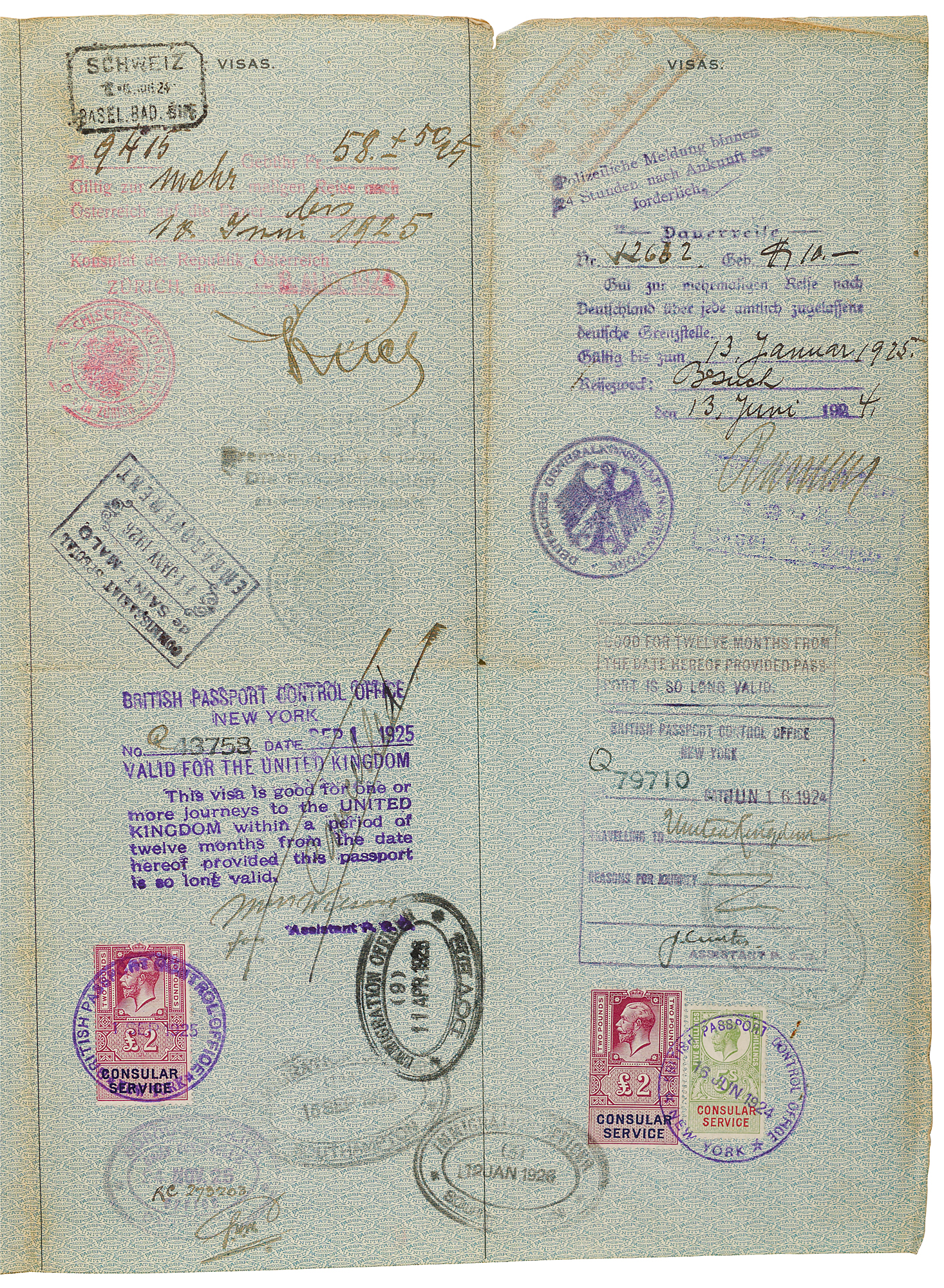
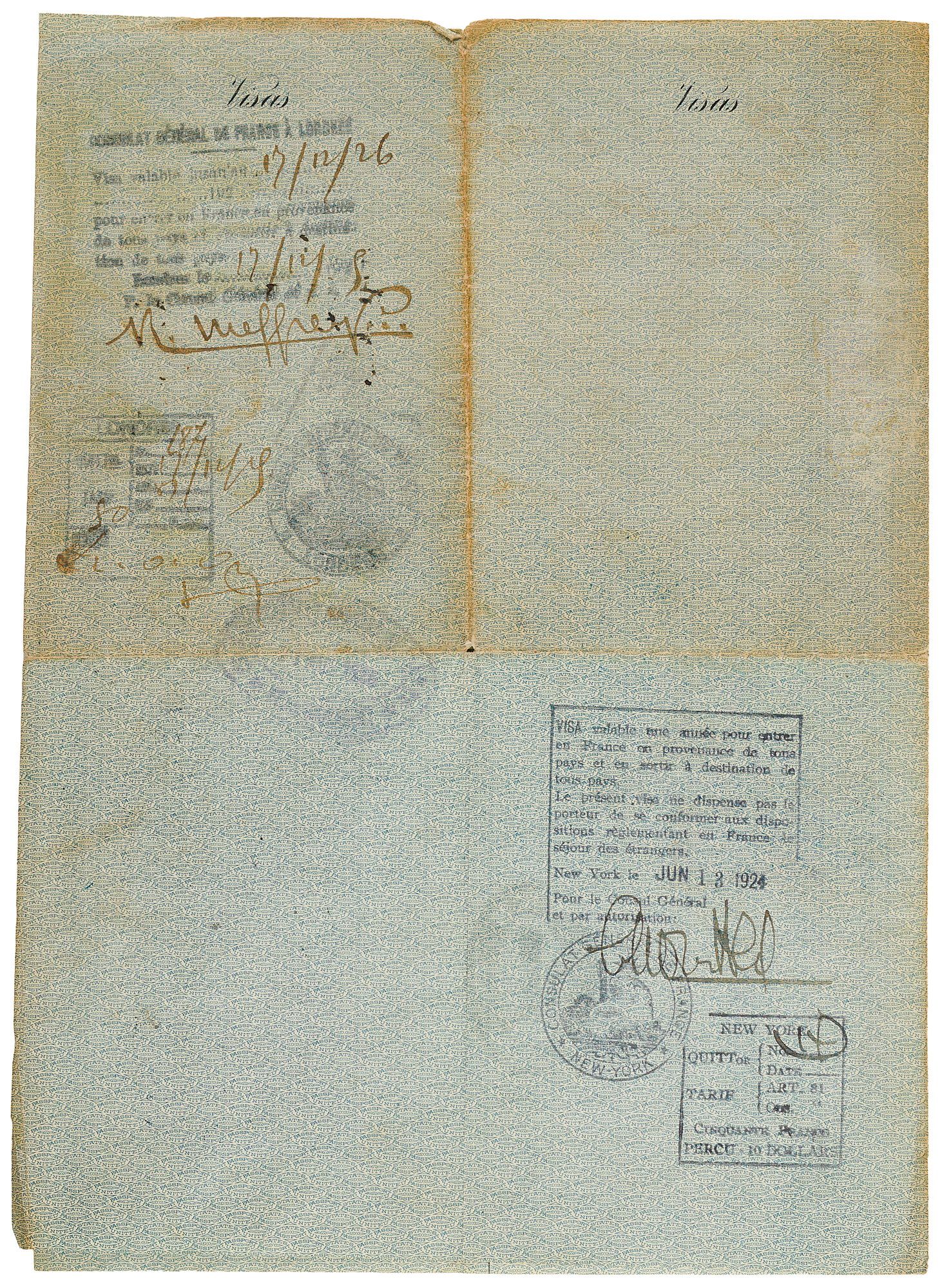
The lower left corner of the document features Oppenheimer’s ‘Personal Description’ section, which has been filled out in another hand and includes fields like: Age (20 years), Mouth (small), Height (6 ft, -in), Chin (small), Forehead (medium), Hair (medium), Eyes (blue), Complexion (florid), Nose (Roman), Face (oval), Place of birth (New York City), and Date of birth (April 22, 1904). The passport has been canceled twice, bears its original red Department of State seal, and is signed in black ink by Secretary of State Charles Evans Hughes. The interior pages and the reverse of the second integral page bear visa stamps dated between 1924 and 1926, which identify Oppenheimer’s various stops in Italy, France, Germany, Switzerland, and the United Kingdom, including his arrival at Southampton on September 16, 1925. In fine condition, with toning and intersecting folds.
In the summer of 1924, a 20-year-old Oppenheimer, eager for life after Harvard University, traveled to Europe with his parents as tourists, but also to prep for the next stage of his academic career. This passport allowed Oppenheimer not only to make this family trip but also to remain abroad to begin formal study at Cambridge University, which he would do the following September. Once at the Cavendish Laboratory, Oppenheimer worked under Ralph Fowler and was exposed to the exciting and emerging ideas of quantum mechanics. But Oppenheimer struggled with the lab’s experimental focus, and he found little satisfaction in the requisite hands-on work. Cambridge quickly became a source of deep emotional strain: he suffered from anxiety, depression, and isolation, all intensified by a tense relationship with his tutor, Patrick Blackett, culminating in the notorious cyanide-apple incident that revealed the severity of his inner turmoil.
Seeking a better environment for theoretical work, Oppenheimer moved in 1926 to the University of Göttingen, where he studied under Max Born. There, he entered one of the most vibrant centers of modern physics, forming friendships with future luminaries such as Werner Heisenberg, Pascual Jordan, Wolfgang Pauli, Enrico Fermi, Edward Teller, and Paul Dirac. In Göttingen, he finally flourished—publishing significant early papers and completing his doctorate—marking the true beginning of his rise as one of the foremost theoretical physicists of the twentieth century. A rare and significant artifact from a most turbulent and formative period of Oppenheimer’s young life.
From the collection of Bert G. Reynolds (1894-1970), an electrician from Cambridge who, in 1936, on the death of his aunt, moved to Grantchester Meadows, where it is believed the passport was discovered. ‘I was living in a miserable hole…Then in the spring I moved out to a place along the river halfway to Grantchester, which was less miserable,’ Oppenheimer, as quoted on pg. 89 in the 1980 book Robert Oppenheimer: Letters and Recollections. The passport was then passed to Colin Reynolds (1930-2023).

This item is Pre-Certified by PSA/DNA
Buy a third-party letter of authenticity for
$75.00
*This item has been pre-certified by a trusted third-party authentication service, and by placing a bid on this item, you agree to accept the opinion of this authentication service. If you wish to have an opinion rendered by a different authenticator of your choosing, you must do so prior to your placing of any bid. RR Auction is not responsible for differing opinions submitted 30 days after the date of the sale.
Third-party authentication service applies only to signatures and handwriting, and does not cover the addition of sketches, artwork, musical quotations, etc.

