Sold For $9,390
*Includes Buyers Premium
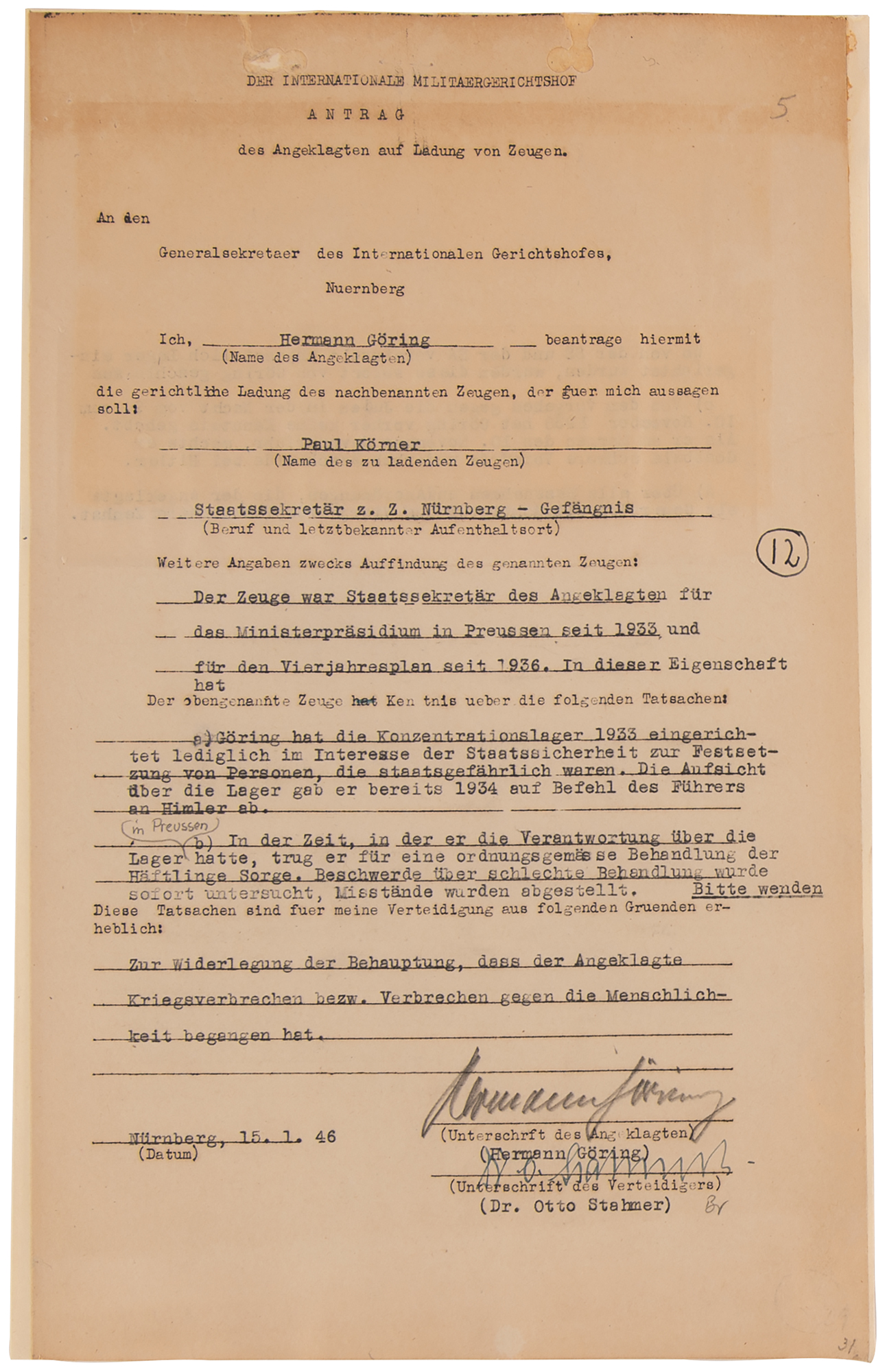
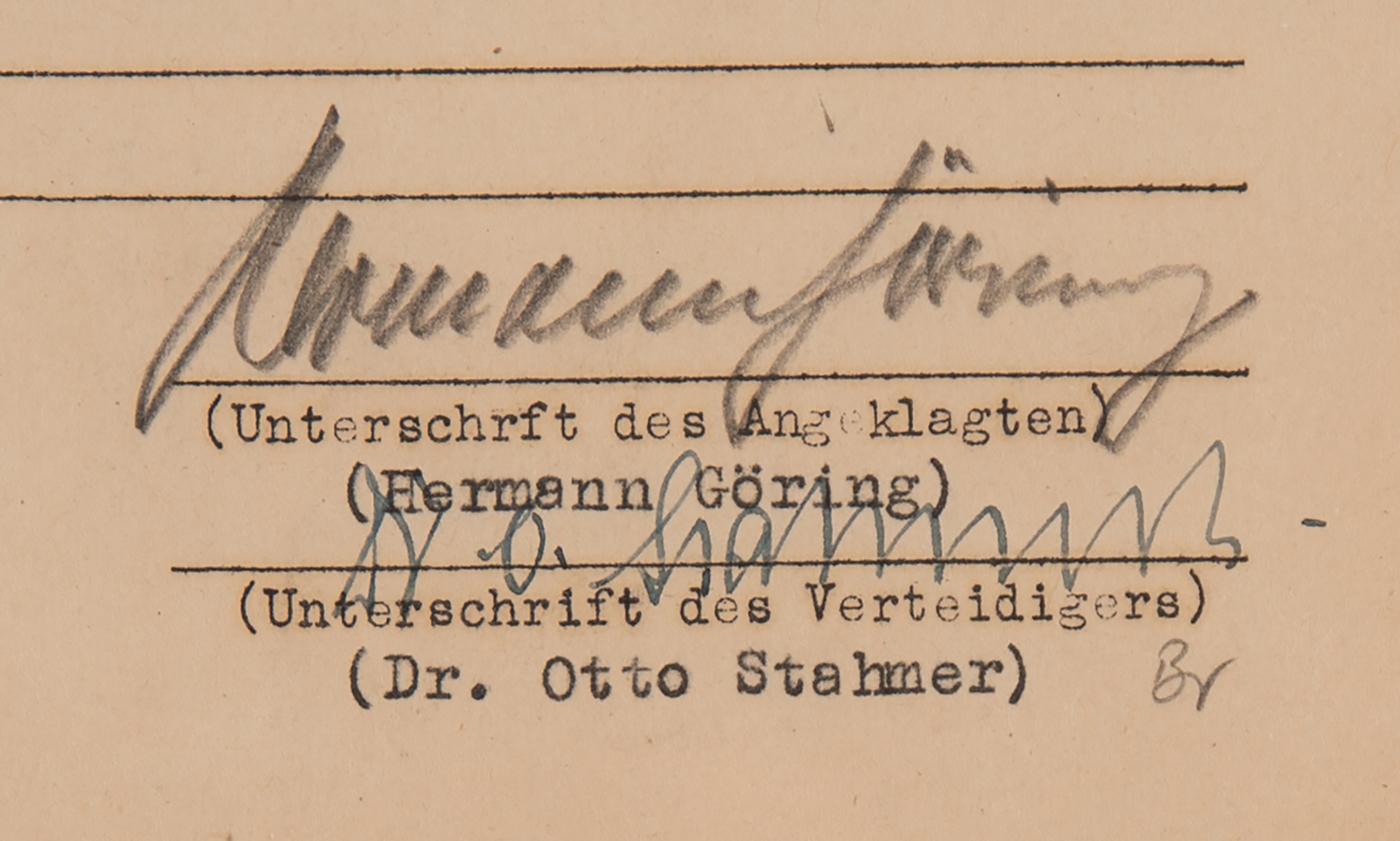
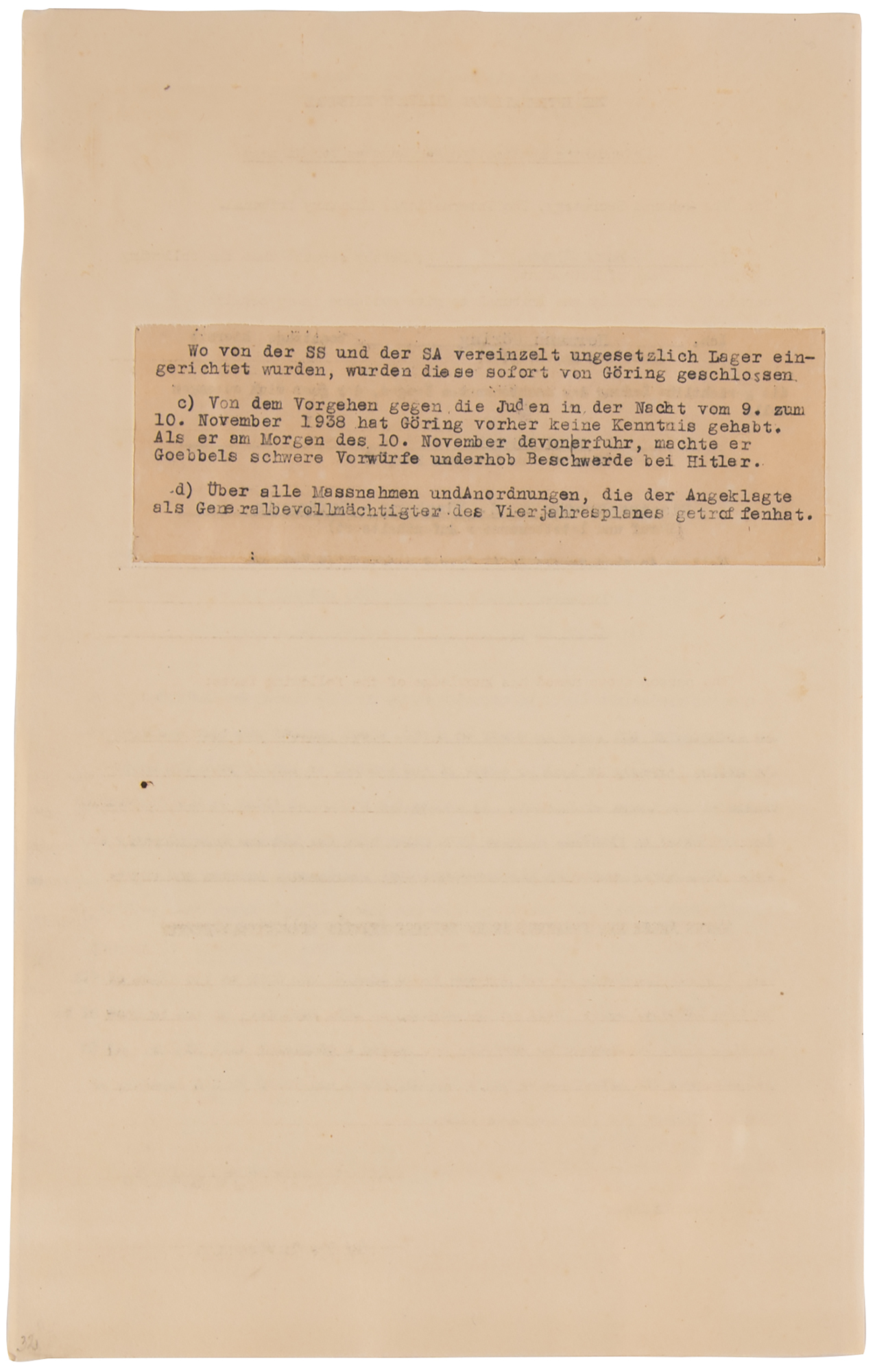
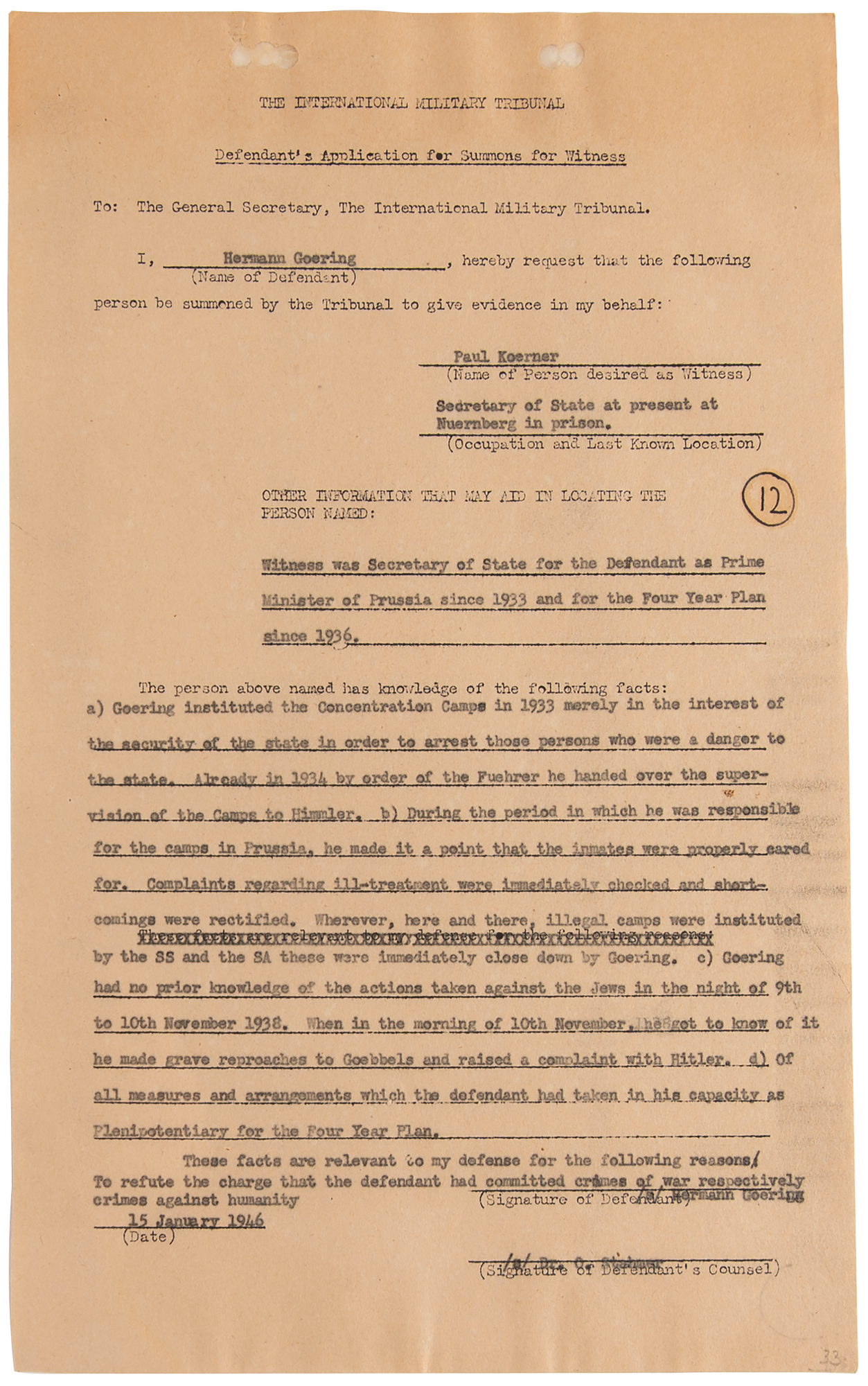
Partly-printed DS in German, signed in pencil, "Hermann Göring," one page both sides, 7.75 x 12.75, January 15, 1946. Document headed (translated), "The International Military Tribunal, Defendant's Application for Summons for Witness," made while preparing his defense for the Nuremberg trials. Göring and his defense lawyer, Otto Stahmer, request testimony from Paul Körner—then imprisoned at Nuremberg—who had knowledge of the following facts: "a) Goering instituted the Concentration Camps in 1933 merely in the interest of the security of the state in order to arrest those who were a danger to the state. Already in 1934 by order of the Fuehrer he handed over the supervision of the camps to Himmler. b) During the period in which he was responsible for the camps in Prussia, he made it a point that the inmates were properly cared for. Complaints regarding ill-treatment were immediately checked and shortcomings were rectified. Wherever, here and there, illegal camps were instituted by the SS and the SA these were immediately closed down by Goering. c) Goering had no prior knowledge of the actions taken against the Jews in the night of 9th to 10th November 1938. When in the morning of 10th November, he got to know of it he made grave reproaches to Goebbels and raised a complaint with Hitler. d) Of all measures and arrangements which the defendant had taken in his capacity as Plenipotentiary for the Four Year Plan." Affixed to a slightly larger sheet, with a section of the rear excised for viewing the complete text. In fine condition. Accompanied by a contemporary English translation.
Kristallnacht, or the 'Night of Broken Glass,' occurred on November 9–10, 1938, when Nazi forces and sympathizers carried out a coordinated attack against Jews across Germany and Austria. Synagogues were burned, Jewish-owned businesses and homes were vandalized and ransacked, and tens of thousands of Jewish men were arrested and sent to concentration camps. The name derives from the shattered glass that littered streets after the widespread destruction. This event marked a dramatic escalation in Nazi anti-Jewish policies, signaling the transition from discrimination and intimidation to organized, state-sponsored violence that would culminate in the Holocaust. Göring had indeed complained to Hitler about the pogrom—but only because he planned to confiscate Jewish property, and was livid that it had been destroyed.
Hermann Göring—the most infamous surviving Nazi and the main target of the International Military Tribunal—stood trial at Nuremberg as a chief architect of Germany’s war of aggression and the regime’s crimes against humanity. As Reichsmarschall and head of the Luftwaffe, he was accused of orchestrating war plans, exploiting occupied territories, and overseeing institutions that enabled mass murder, including the concentration camps. Throughout the trial, Göring attempted to portray himself as a loyal bureaucrat who acted in the interest of the state and was unaware of the full extent of atrocities, seeking witness testimony to support his claims. Despite his defenses and attempts to manipulate the proceedings, he was convicted on multiple counts, including crimes against peace, war crimes, and crimes against humanity. Sentenced to death, he committed suicide by ingesting cyanide the night before his scheduled execution.

This item is Pre-Certified by PSA/DNA
Buy a third-party letter of authenticity for
(inquire for price)
*This item has been pre-certified by a trusted third-party authentication service, and by placing a bid on this item, you agree to accept the opinion of this authentication service. If you wish to have an opinion rendered by a different authenticator of your choosing, you must do so prior to your placing of any bid. RR Auction is not responsible for differing opinions submitted 30 days after the date of the sale.
Third-party authentication service applies only to signatures and handwriting, and does not cover the addition of sketches, artwork, musical quotations, etc.

