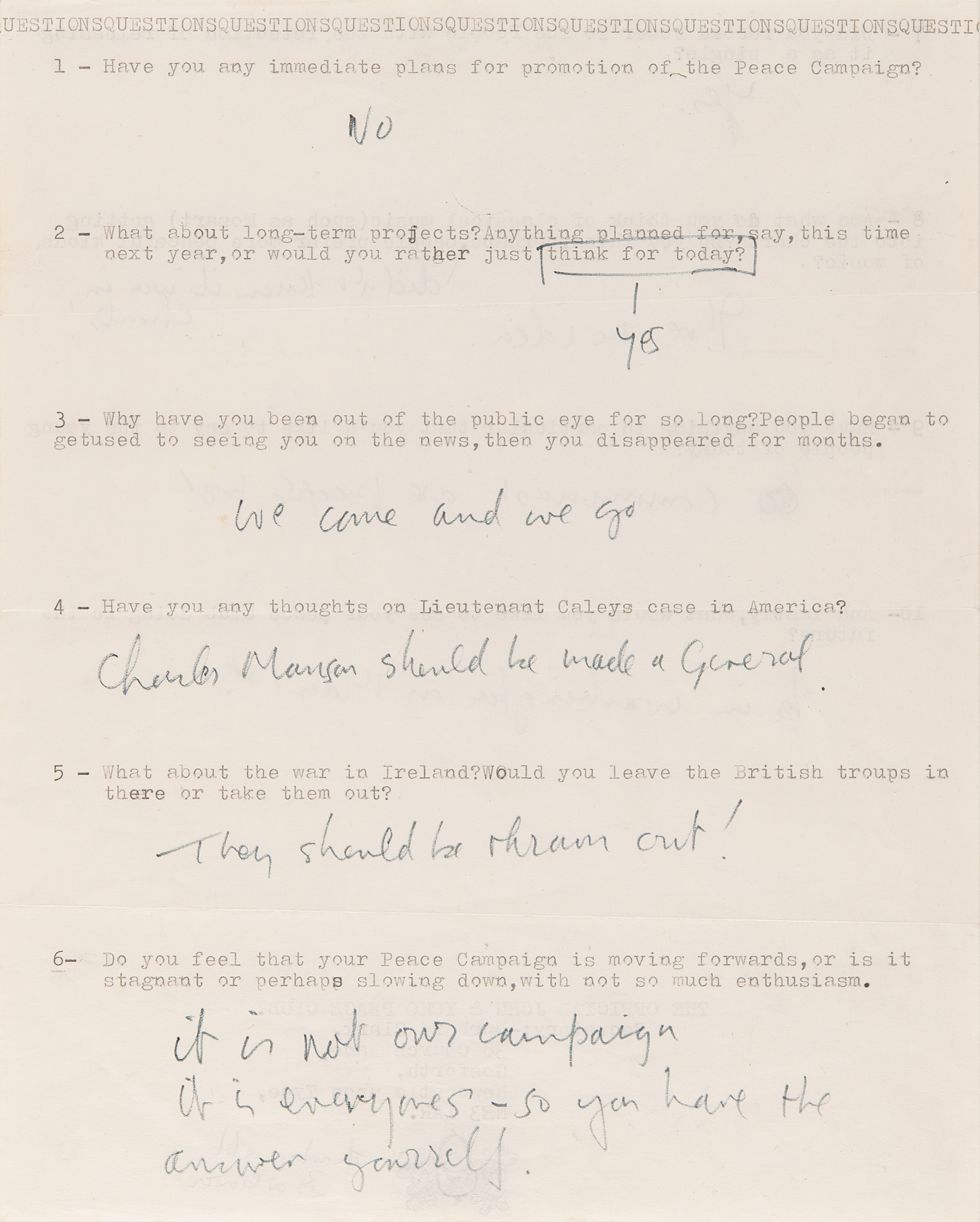
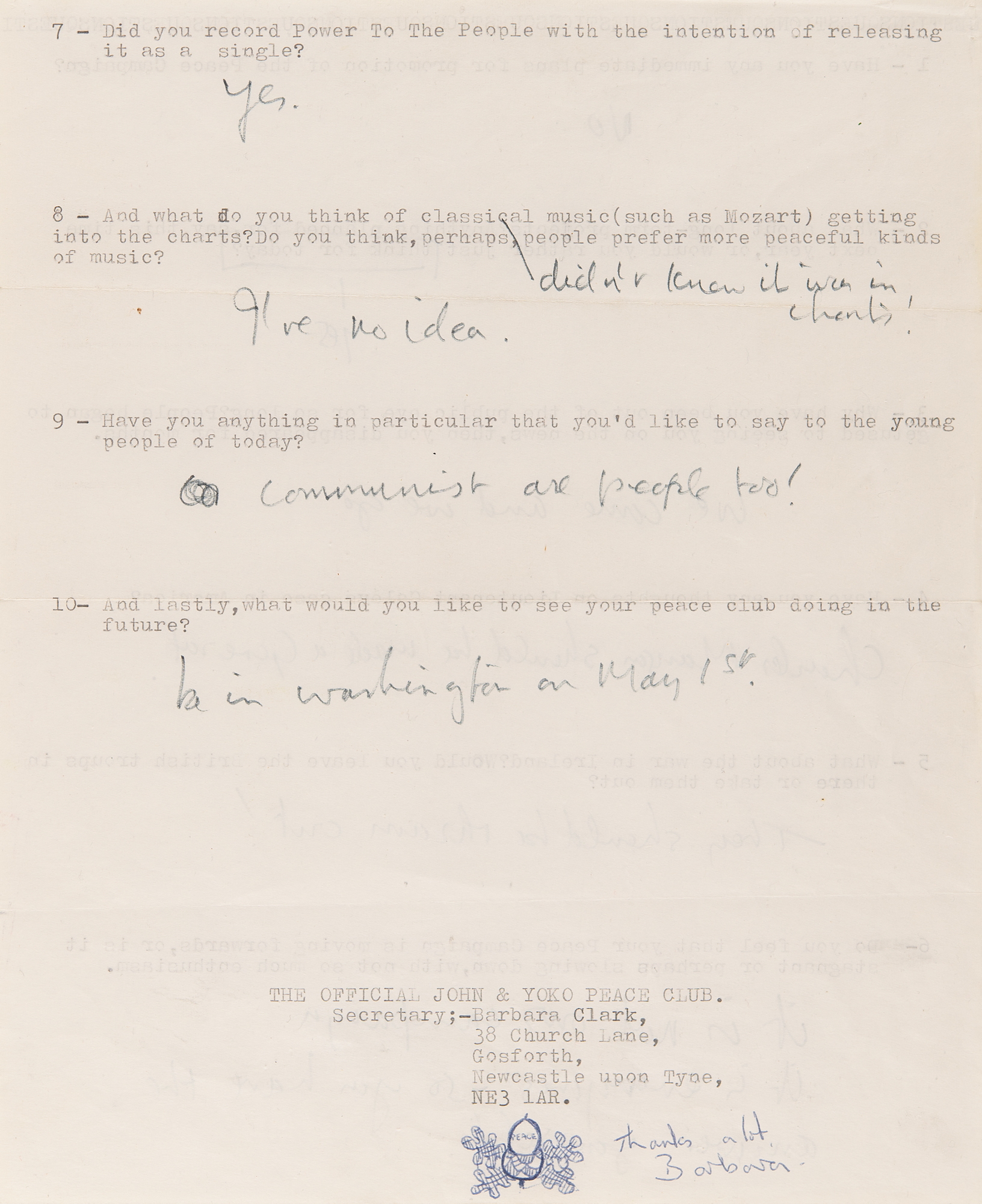
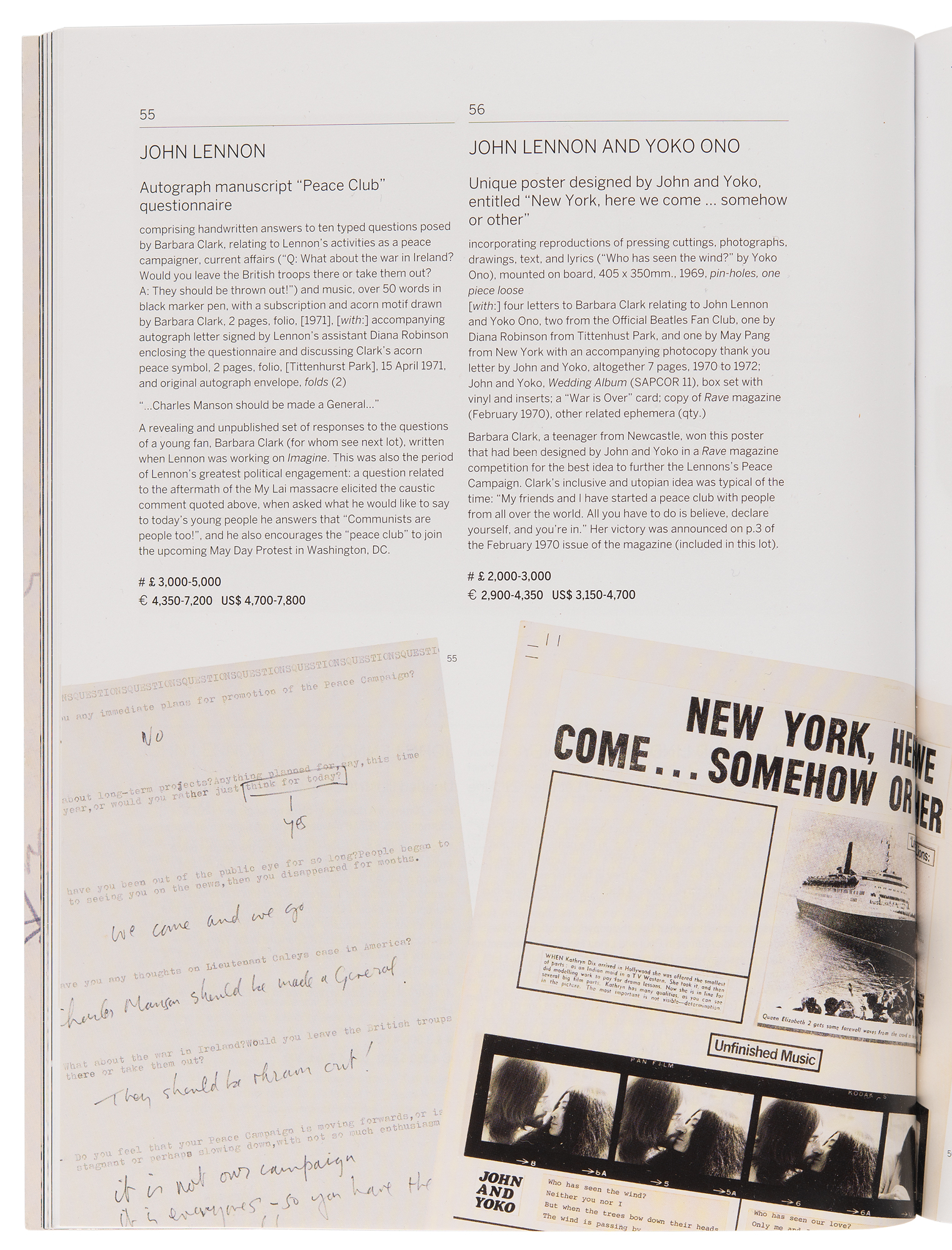
Typed 'John & Yoko Peace Club' questionnaire filled out by John Lennon and returned to a young fan and club secretary, Barbara Clark, one page both sides, 8 x 10, no date but circa 1971. Lennon responds to ten typed questions posed by Clark, relating to his activities as a peace campaigner, current affairs, and music. Asked why he and Yoko has been out of the public eye for so long, Lennon writes: "We come and we go." Asked for thoughts on "Lieutenant Caley's case in America," Lennon writes: "Charles Manson should be made a General." Replying to a question about British troops in Ireland, he writes: "They should be thrown out!"
Asked if the 'Peace Campaign' is moving forward, he notes: "It is not our campaign, it is everyone's—so you have the answer yourself." Asked if he recorded 'Power to the People' with the intention of releasing it as a single, he writes: "Yes." Commenting on classical music (such as Mozart) getting into the charts, Lennon reacts: "Didn't know it was in charts! I've no idea." Asked if he has anything to say to the young people, Lennon writes: "Communist[s] are people too!" Finally, asked what he would like the peace club to be doing in the future, Lennon writes: "Be in Washington on May 1st." At the bottom, Clark has sketched an acorn "Peace" emblem and signed her name. In fine condition.
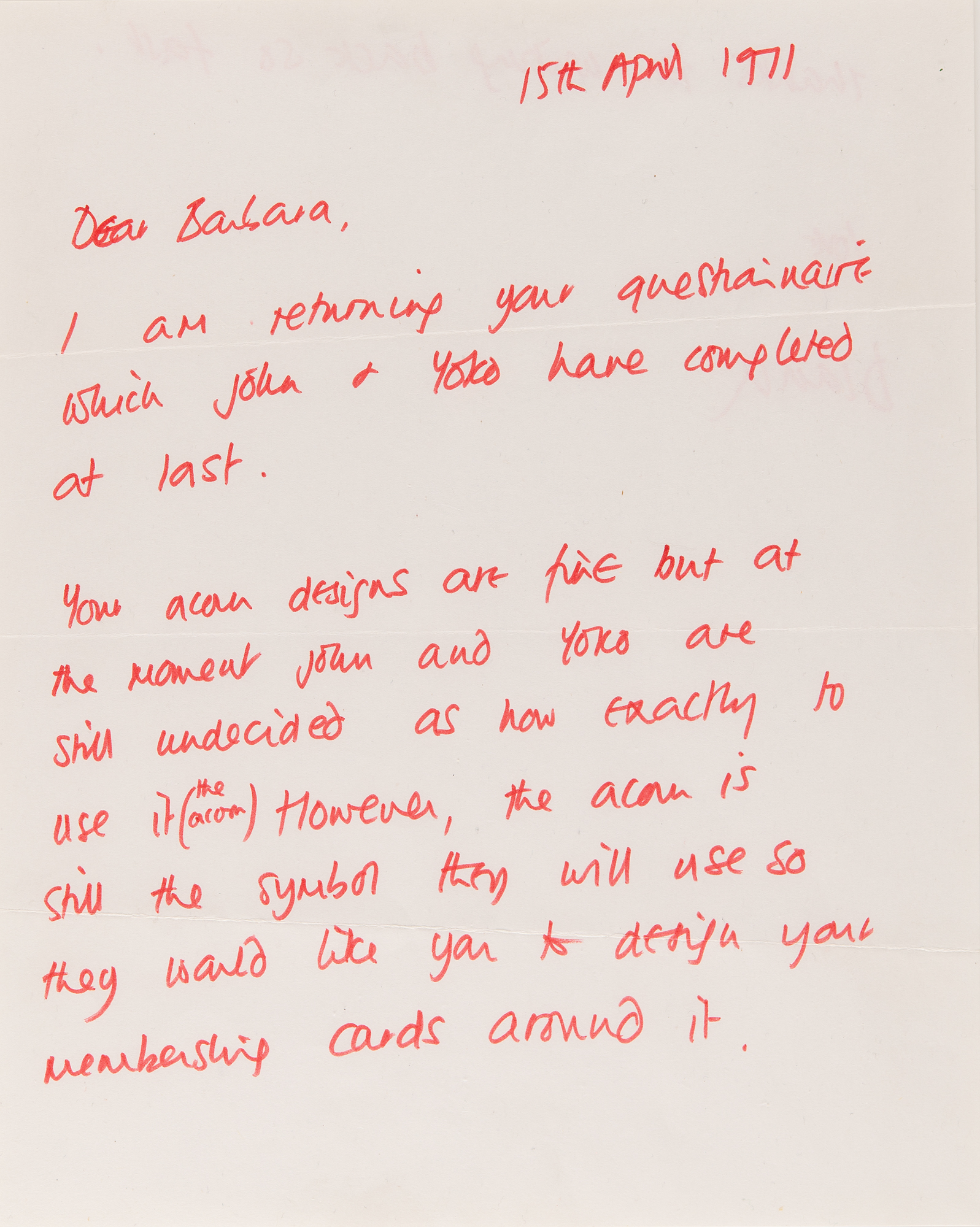
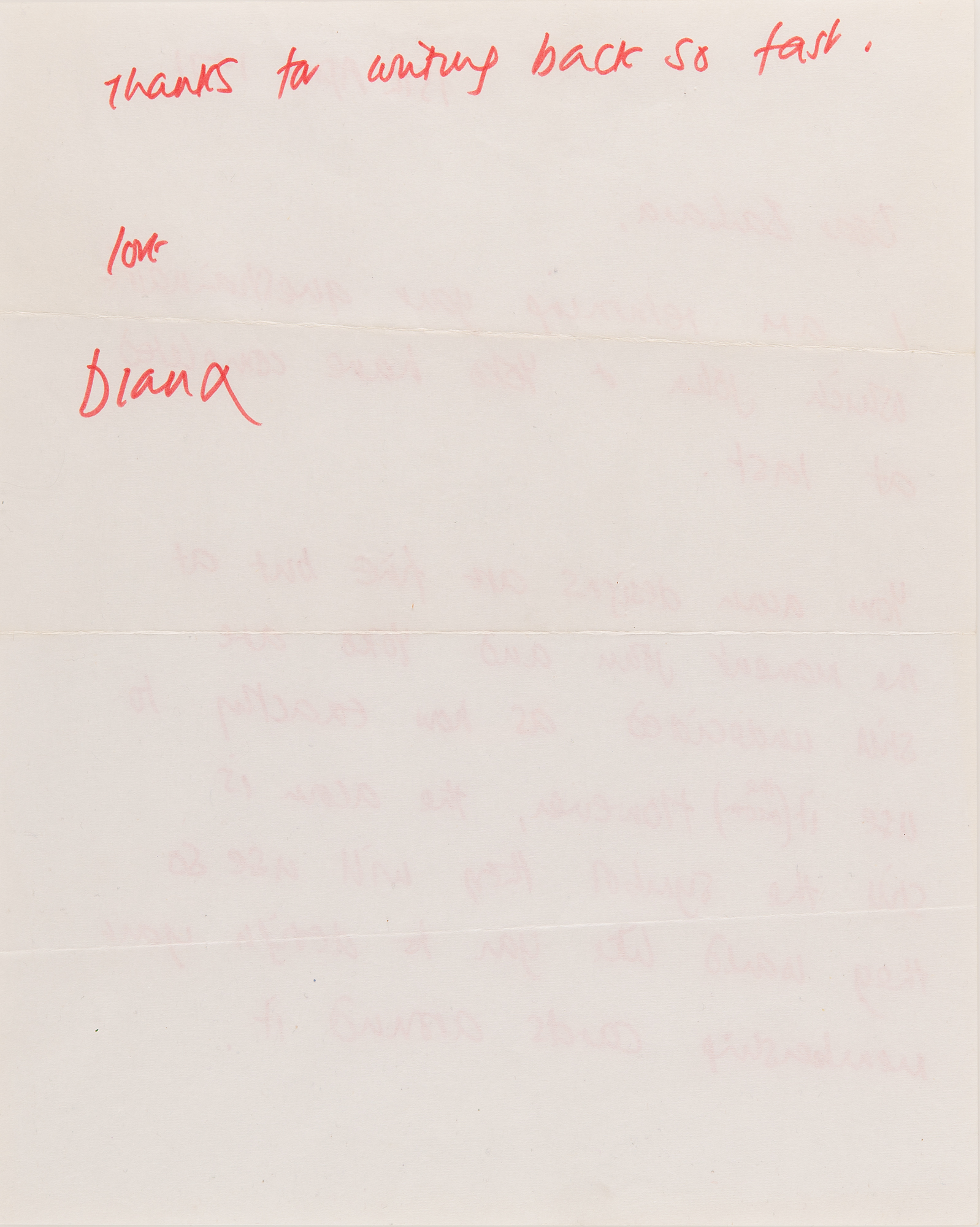
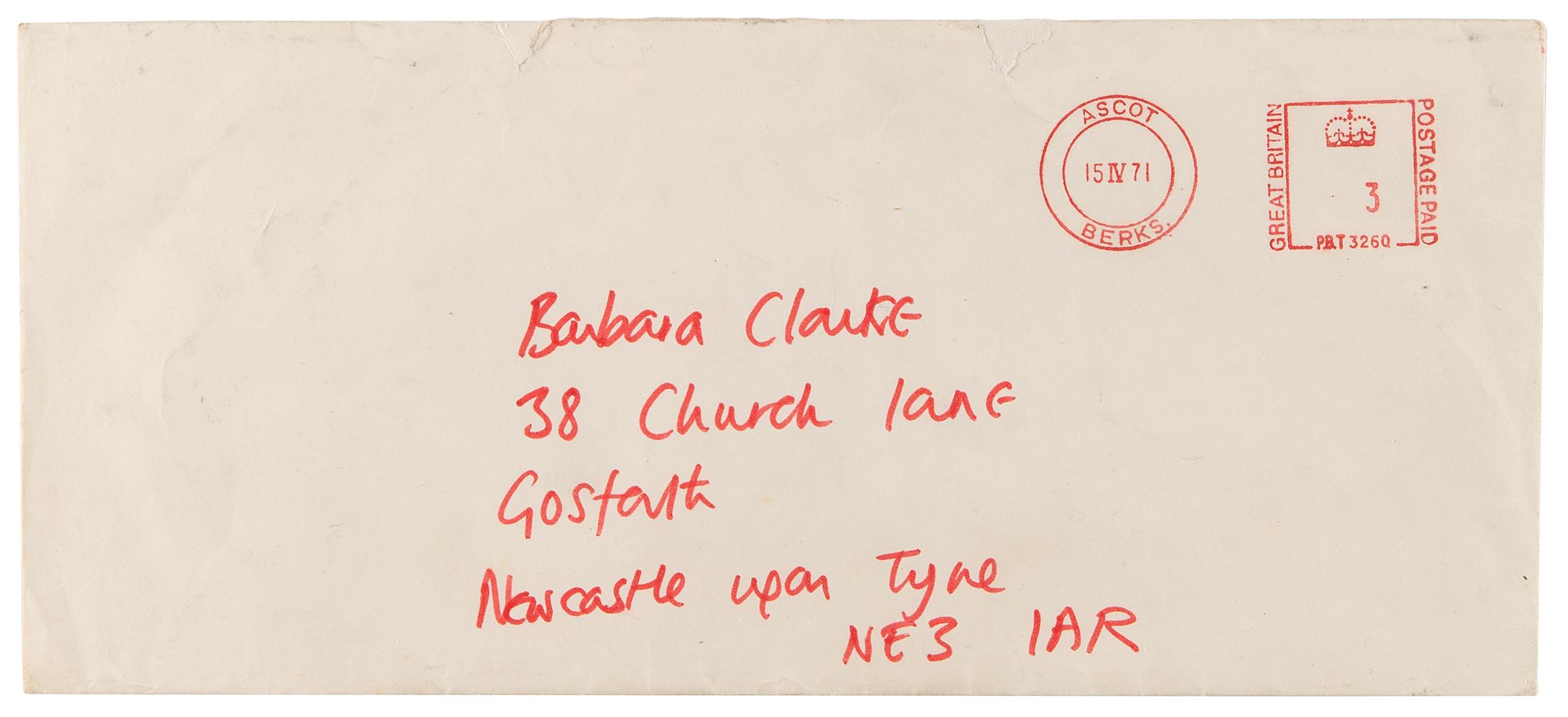
Accompanied by the original mailing envelope and a transmittal letter signed by "Diana" (probably Lennon's assistant, Diana Robertson), dated April 15, 1971, in part: "I am returning your questionnaire which John & Yoko have completed at last. Your acorn designs are fine but at the moment John and Yoko are still undecided as how exactly to use it (the acorn). However, the acorn is still the symbol they will use so they would like you to design your membership cards around it."
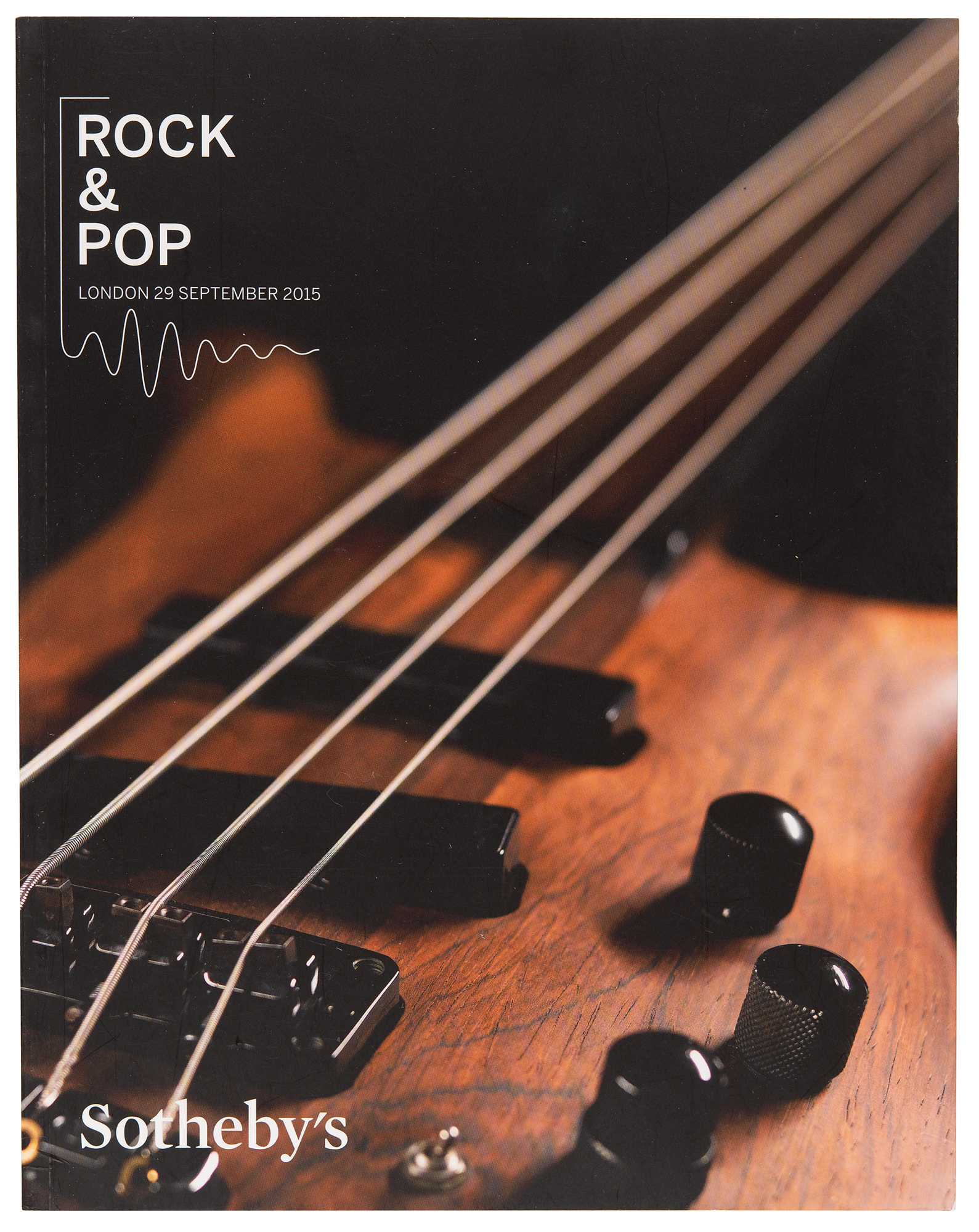
Provenance: Lot 55, Rock & Pop, Sotheby's, September 29, 2015; original auction catalog included.
In 1969, John Lennon and Yoko Ono held two 'bed-ins for peace'—one in Amsterdam and another in Montreal—as a form of nonviolent protest against the Vietnam War. Instead of marching, they invited the press to their hotel room to discuss peace while they stayed in bed for a week. During the Montreal bed-in, they recorded the anthem 'Give Peace a Chance,' which became a rallying cry for the anti-war movement. Lennon continued his activism with songs like 'Power to the People,' released as a single in 1971, further amplifying his call for peace and social change and cementing his image as a symbol of countercultural resistance. His caustic remarks about Charles Manson—prompted by an inquiry about William Calley, convicted of murder for his role in the My Lai massacre—are typical of Lennon's acerbic wit and irreverent sense of humor. On a more serious note, he encourages the youth to show up for the 1971 May Day protests against the Vietnam War—a march that would result in the arrest of 12,000 participants, marking the largest mass arrest in U.S. history.
This item is Pre-Certified by Real
Buy a third-party letter of authenticity for
$250.00
*This item has been pre-certified by a trusted third-party authentication service, and by placing a bid on this item, you agree to accept the opinion of this authentication service. If you wish to have an opinion rendered by a different authenticator of your choosing, you must do so prior to your placing of any bid. RR Auction is not responsible for differing opinions submitted 30 days after the date of the sale.
Third-party authentication service applies only to signatures and handwriting, and does not cover the addition of sketches, artwork, musical quotations, etc.

