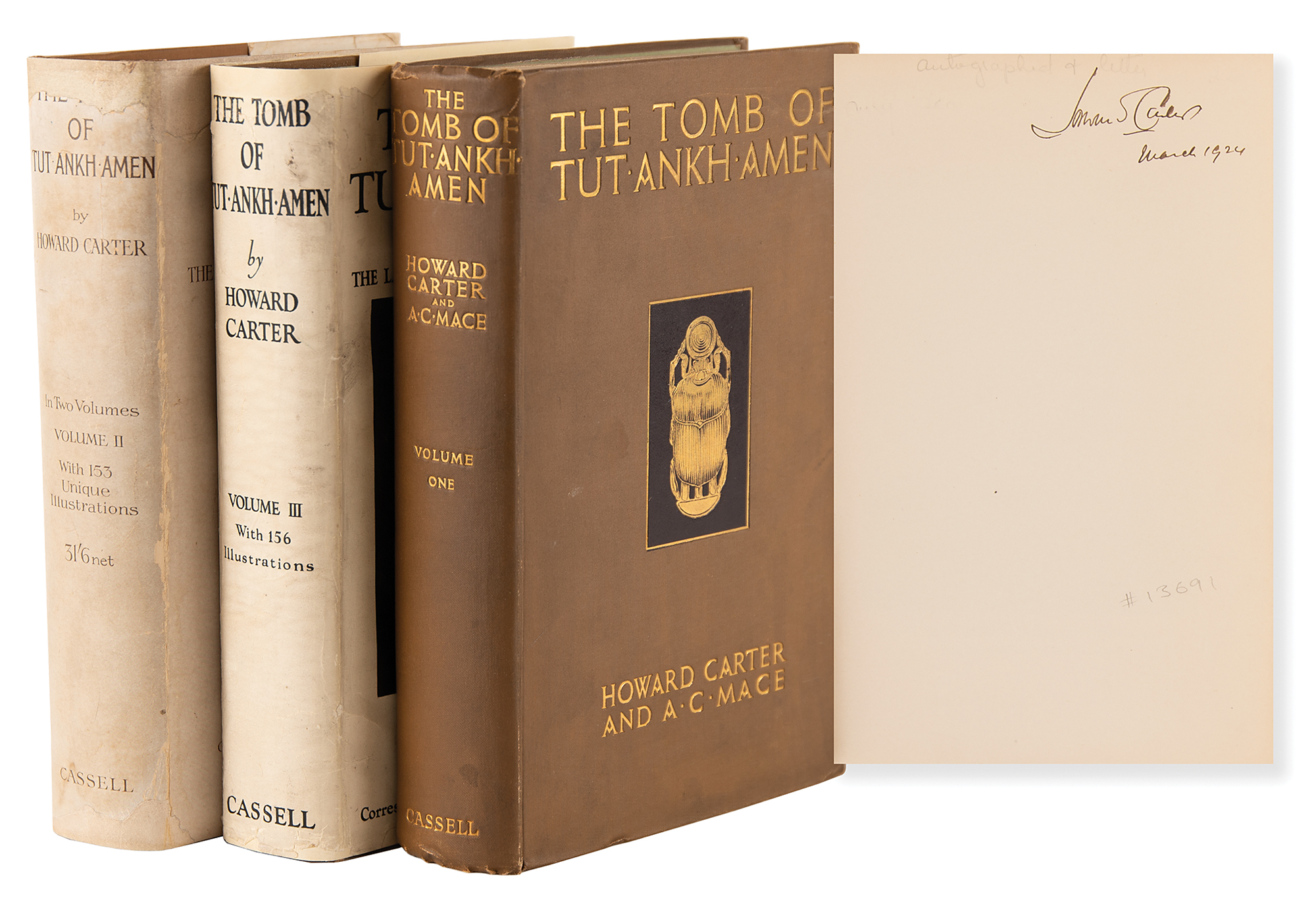
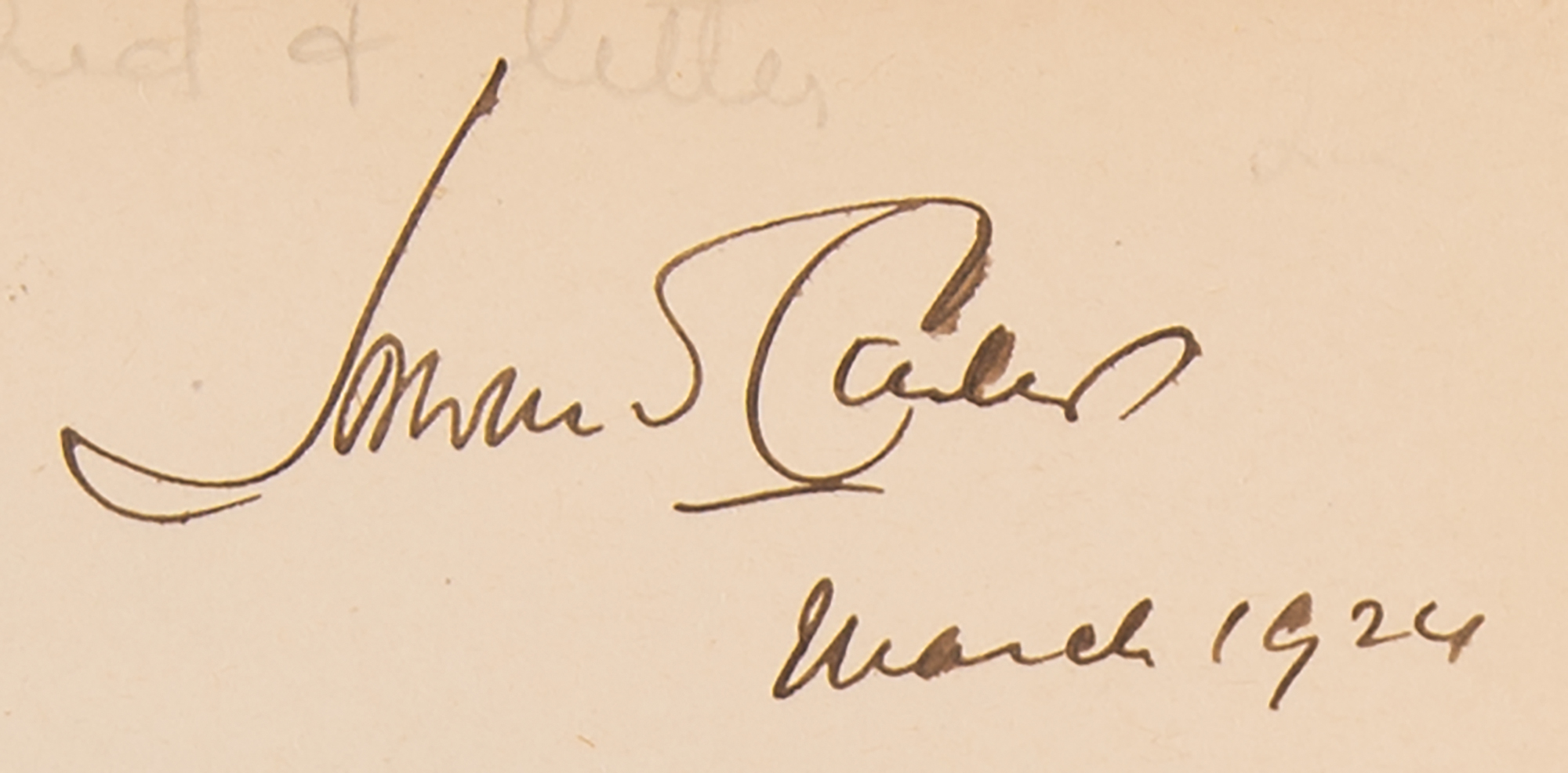
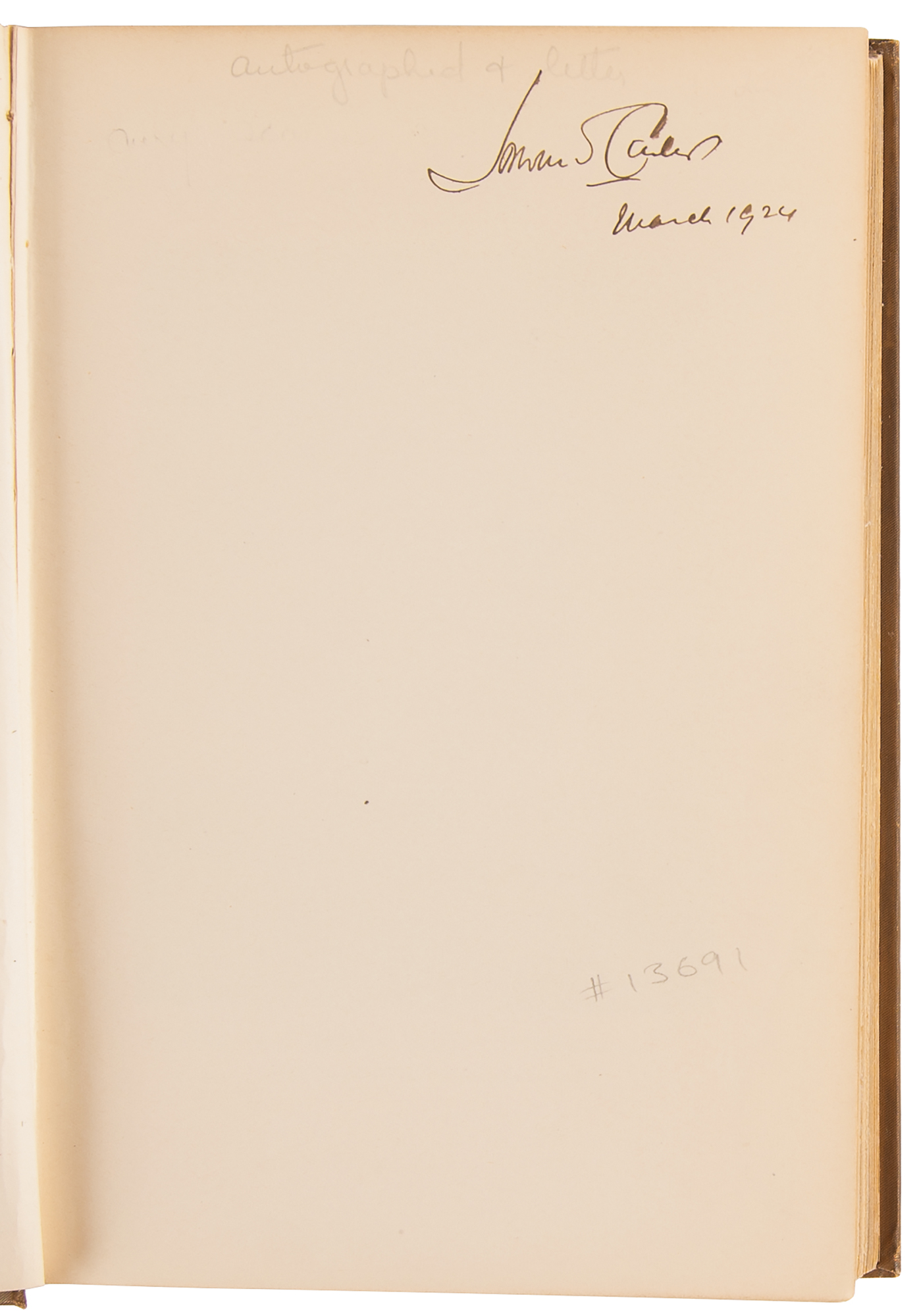
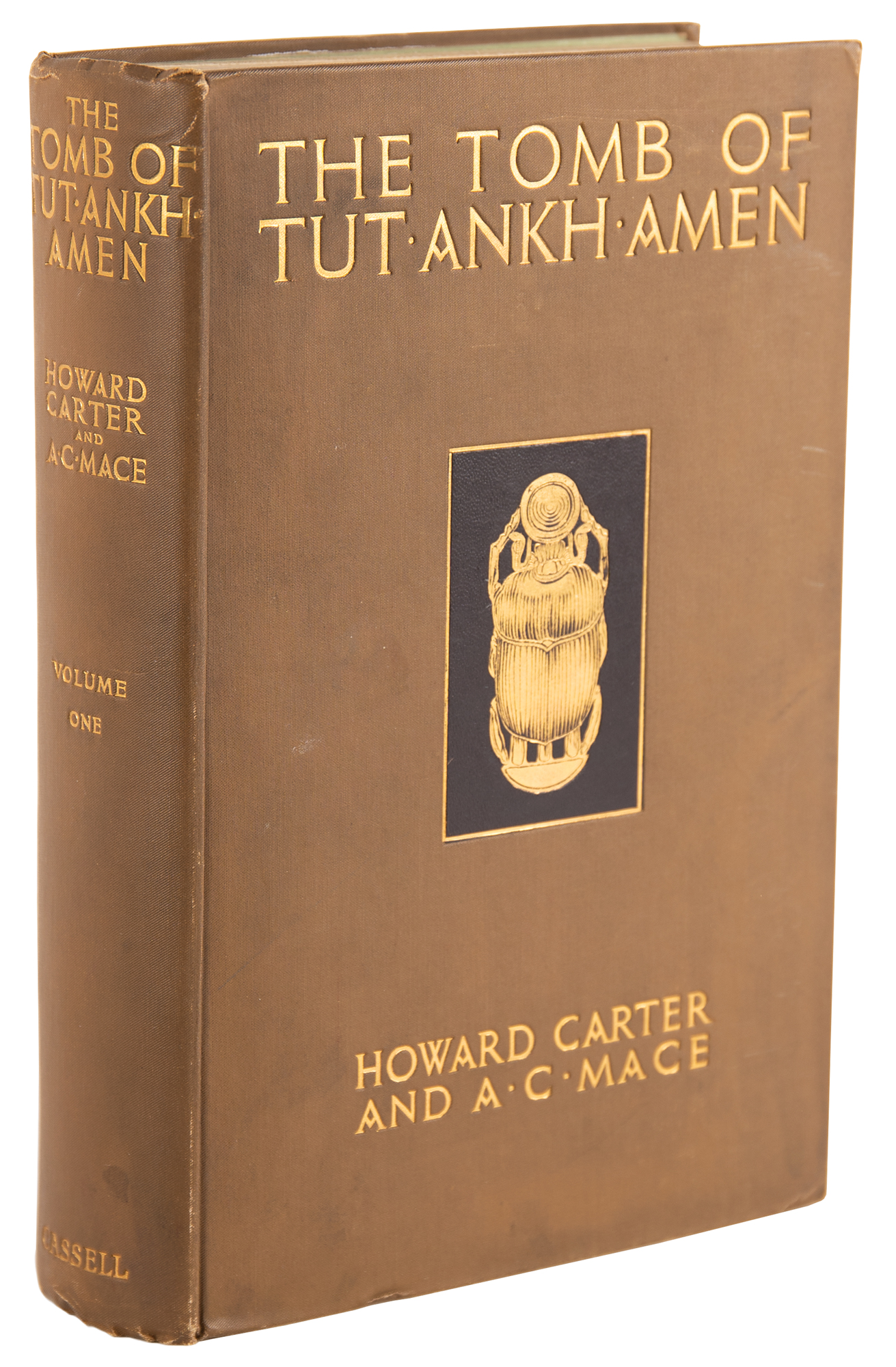
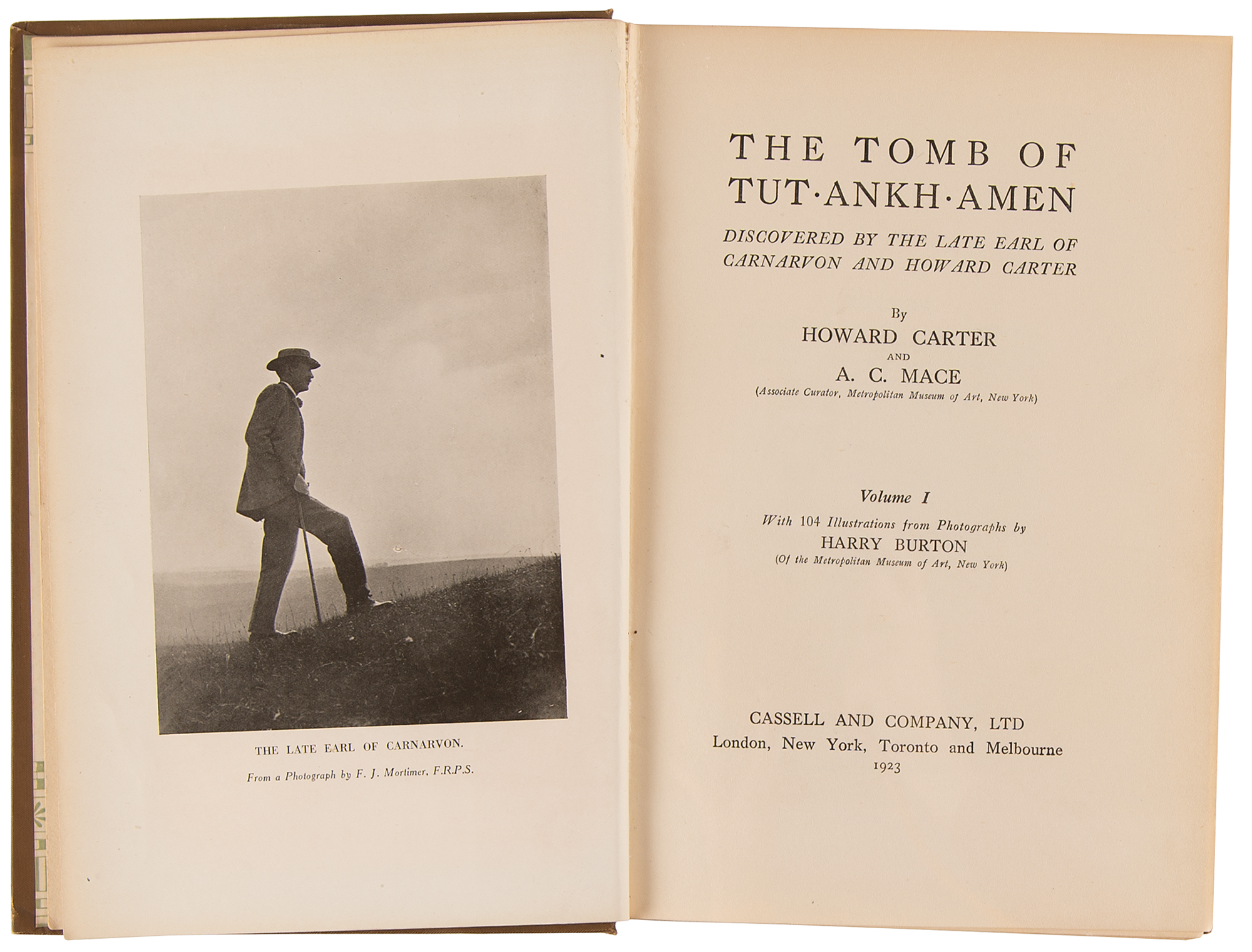
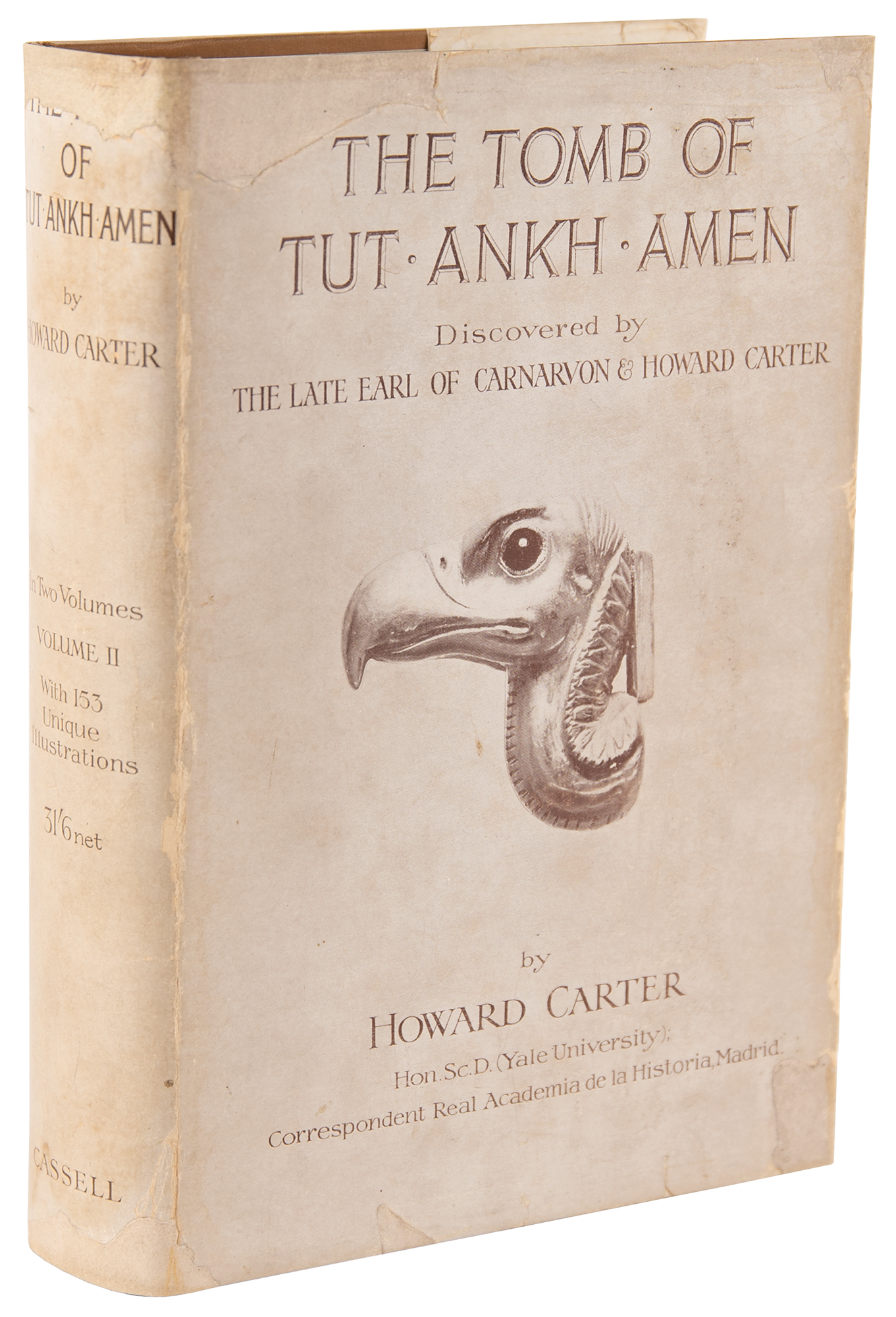
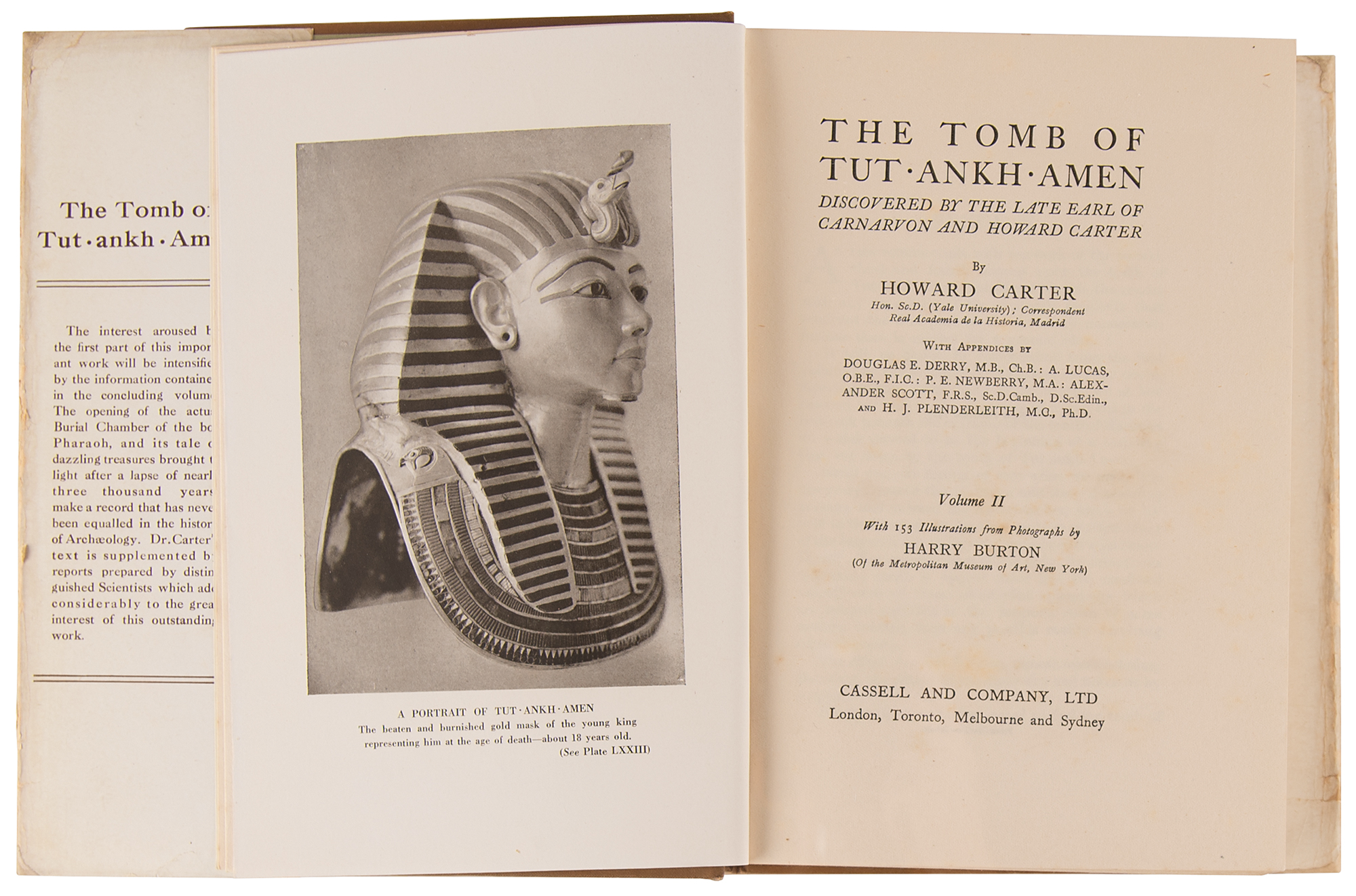
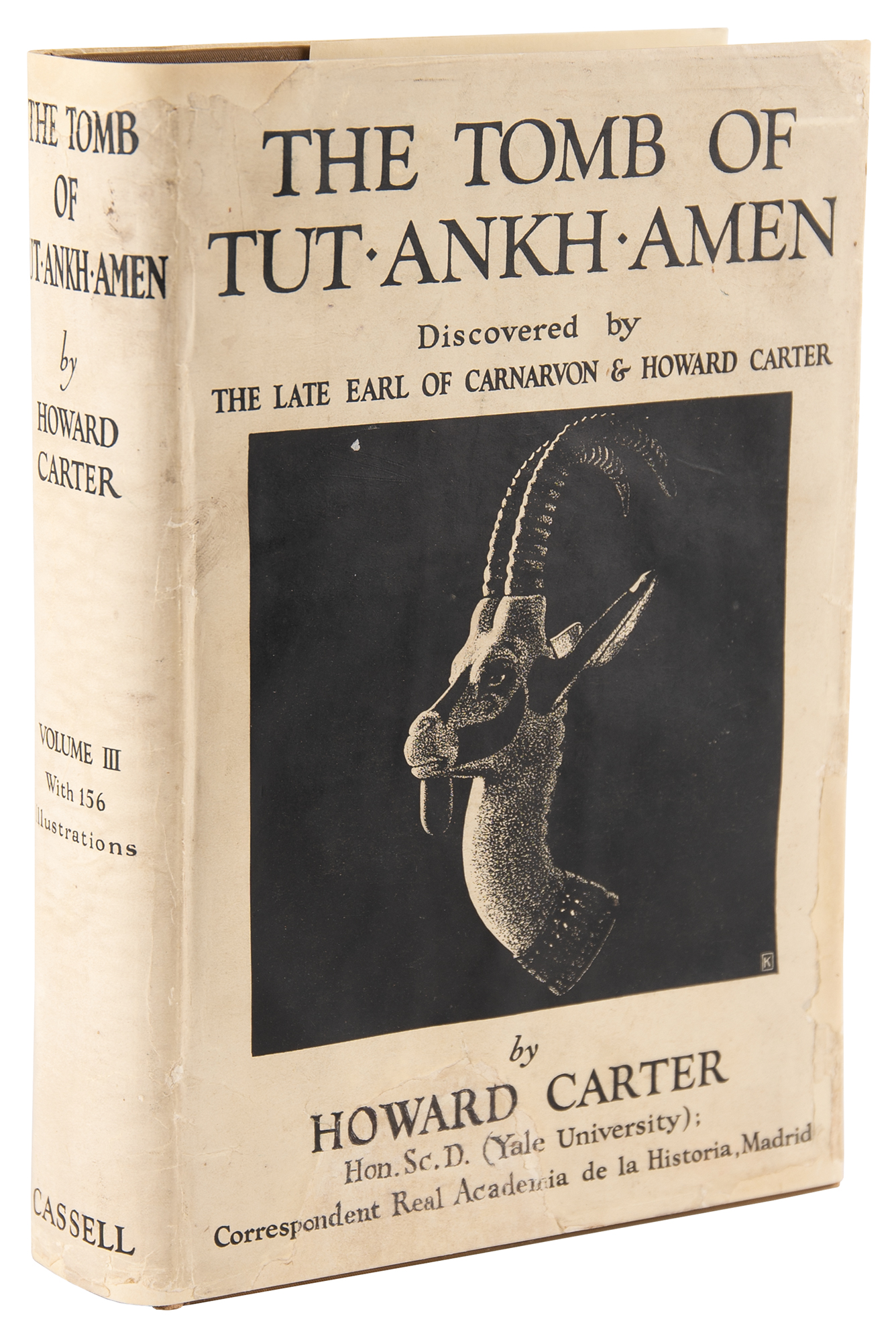
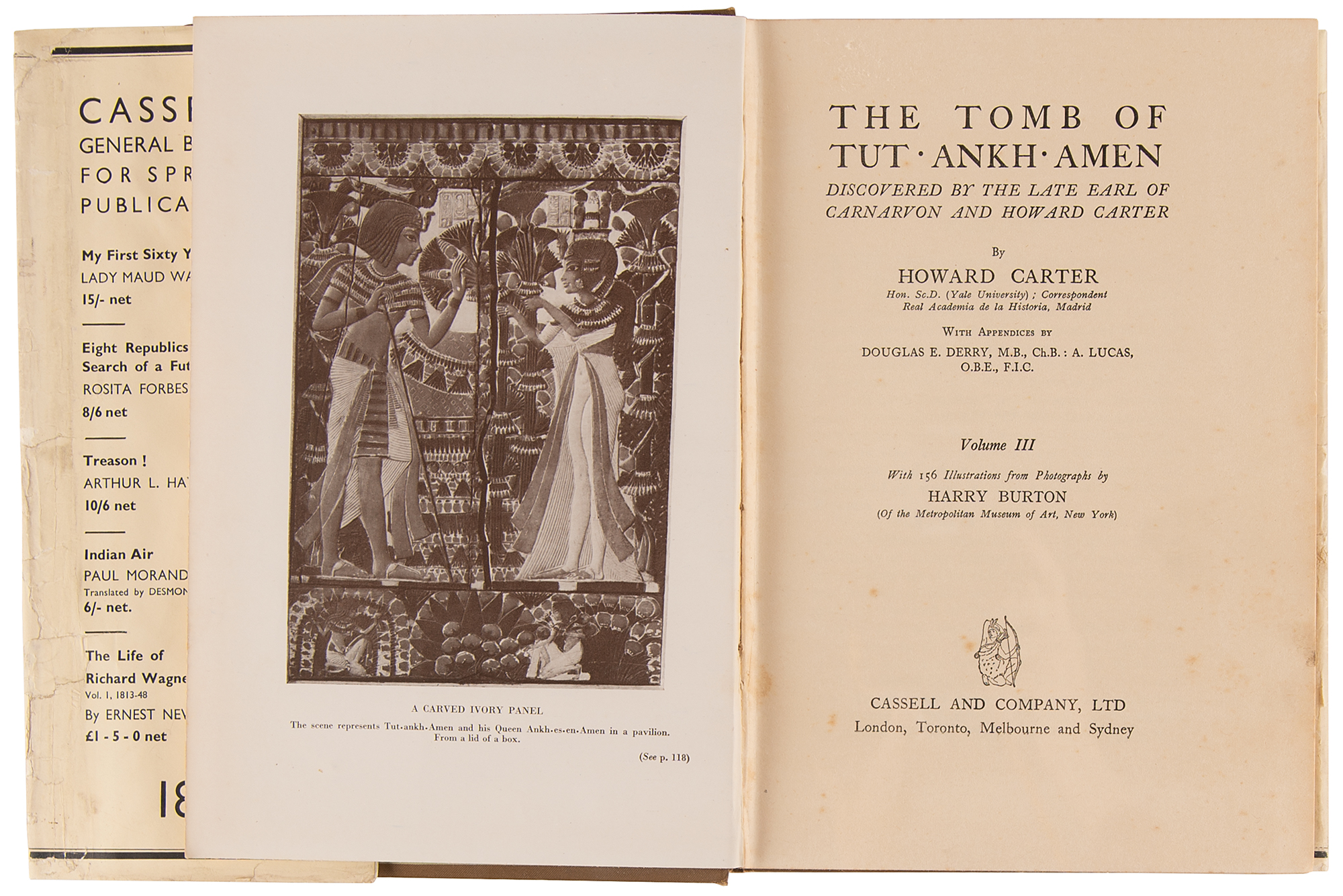
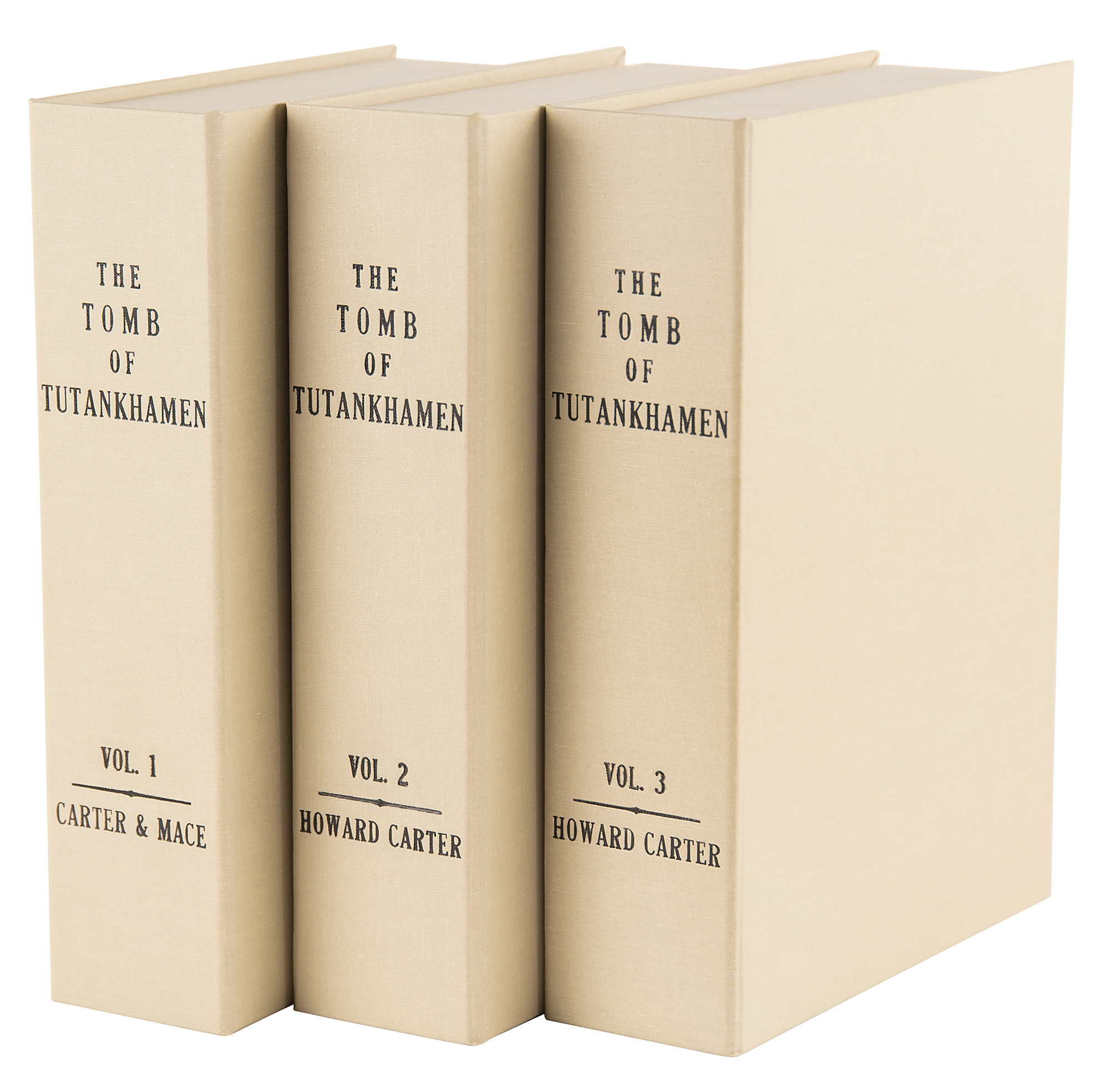
British archaeologist and Egyptologist (1874-1939) whose discovery of the tomb of Tutankhamun in Egypt's 'Valley of the Kings' proved to be one of the signal events in the history of archaeology. Signed book set: The Tomb of Tutankhamen, Vols. I–III. First editions. London: Cassell and Company, Ltd., 1923–1933. Hardcovers (Vols. II and III with dust jackets) bound in the publisher's original brown cloth, brightly gilt-stamped with titles and an Egyptian scarab device, 6.5 x 9.5, totaling 756 pages plus 247 dramatic illustration plates. Signed on the first free end page of Vol. I in fountain pen, "Howard Carter, March 1924." Autographic condition: fine. Books are in overall very good condition, with the front hinge of Vol. I starting to crack at the top, a small piece of toned tape to the first free end page, and some subtle foxing to textblocks; the dust jackets for Vols. II and II have been restored, with repairs to edge loss and creases. Each volume is housed in a clamshell box. A comprehensive, densely illustrated set documenting the greatest archaeological find of the 20th century, rarely found in signed examples.
The Tomb of Tutankhamen (1923–1933) is a three-volume book set by British archaeologist Howard Carter, co-written with A.C. Mace. The series chronicles Carter’s discovery and excavation of the nearly intact tomb of the Egyptian pharaoh Tutankhamun in the Valley of the Kings in 1922. Published over a decade, the books provide a detailed and firsthand account of the discovery, the treasures found, and the painstaking process of excavation and preservation. Beyond its archaeological importance, the work captures the excitement and challenges of one of the most famous finds in the history of Egyptology.
March 1924, when Howard Carter signed this book, was a pivotal month for the Tutankhamun excavation and for Carter himself. On February 12, 1924, Carter posted his 'strike' notice at the Winter Palace Hotel, locking the tomb and refusing to do any further work after the Egyptian government had declined to allow him to do a private showing at the tomb for the wives of the excavators. This was part of a long-standing dispute over who had 'rights' to the tomb. Egypt promptly cancelled Lady Carnarvon’s (and Carter’s) concession, and Carter then filed legal proceedings against the Egyptian government. He remained in Egypt until March 21, when he departed for England, and then began his lecture tour to the United States and Canada. With the cancellation of the concession to excavate, and having been locked out of the tomb, Carter did not know if he would ever return to Egypt to complete the excavation. He did finally return to work on January 25, 1925, with a much stricter contract that forbade him and Lady Carnarvon to receive any artifacts from the tomb.
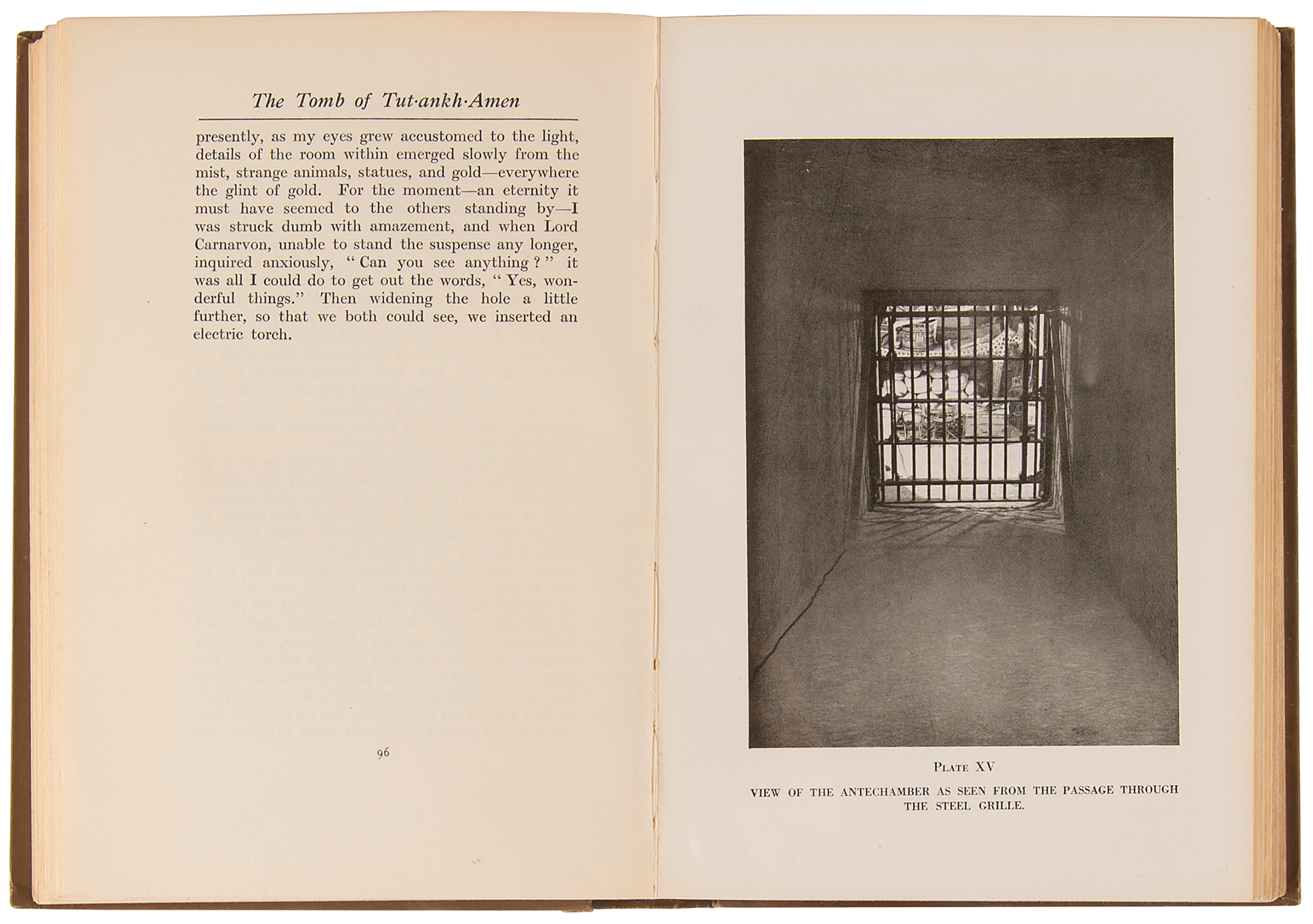
In Vol. I, Carter famously recounts his opening of King Tut's tomb: "Slowly, desperately slowly it seemed to us as we watched, the remains of passage debris that encumbered the lower part of the doorway were removed, until at last we had the whole door clear before us. The decisive moment had arrived. With trembling hands I made a tiny breach in the upper left hand corner. Darkness and blank space, as far as an iron testing-rod could reach, showed that whatever lay beyond was empty, and not filled like the passage we had just cleared. Candle tests were applied as a precaution against possible foul gases, and then, widening the hole a little, I inserted the candle and peered in, Lord Carnarvon, Lady Evelyn and Callender standing anxiously beside me to hear the verdict. At first I could see nothing, the hot air escaping from the chamber causing the candle flame to flicker, but presently, as my eyes grew accustomed to the light, details of the room within emerged slowly from the mist, strange animals, statues, and gold—everywhere the glint of gold. For the moment—an eternity it must have seemed to the others standing by—I was struck dumb with amazement, and when Lord Carnarvon, unable to stand the suspense any longer, inquired anxiously, 'Can you see anything?' it was all I could do to get out the words, 'Yes, wonderful things.'"
Notably, a paraphrase of this quotation was encoded in Jim Sanborn's Kryptos sculpture, installed on the grounds of the Central Intelligence Agency headquarters in 1990.
Ex: Sotheby’s, "Natural History, Travel, Atlases and Maps," London, May 12, 2005.

