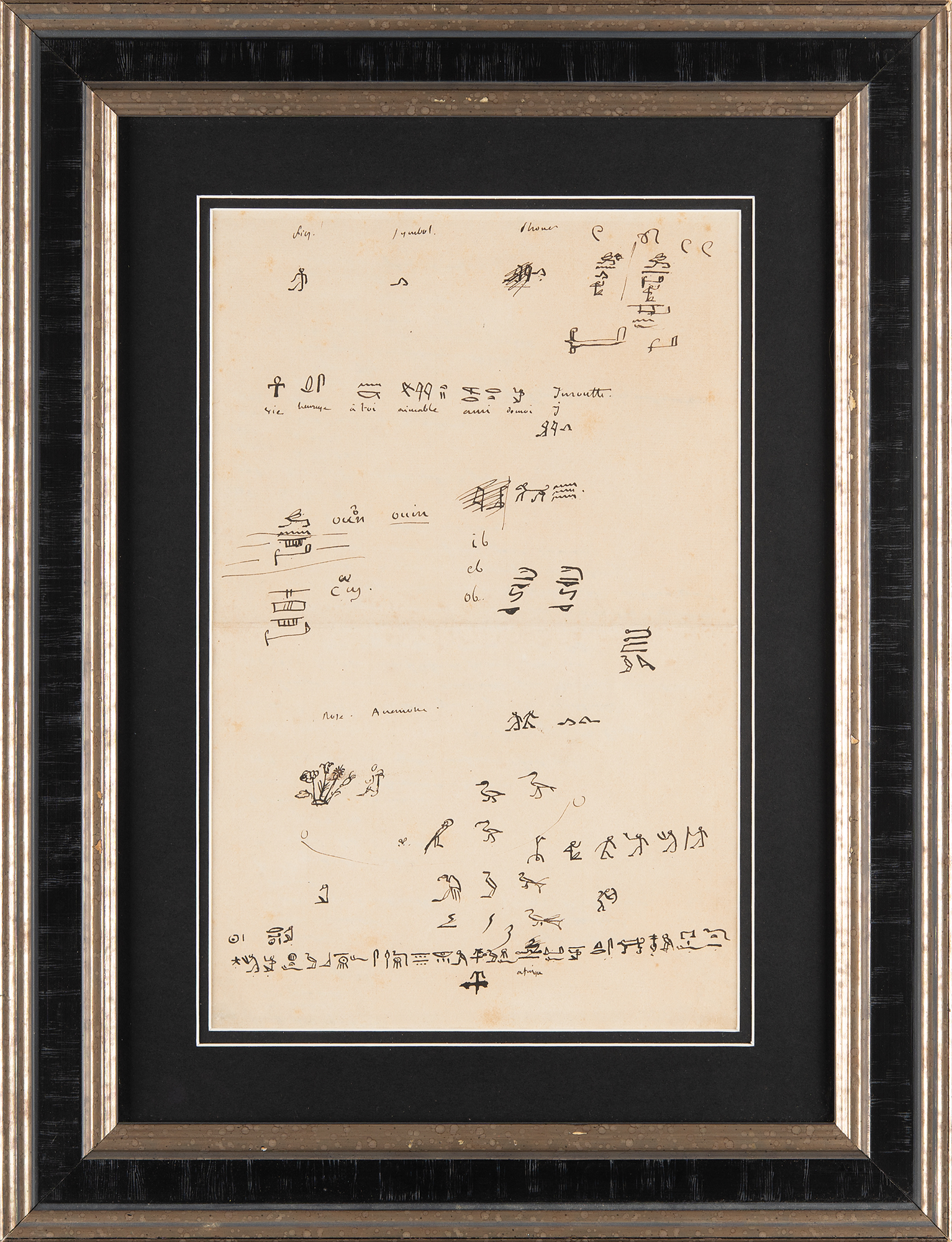
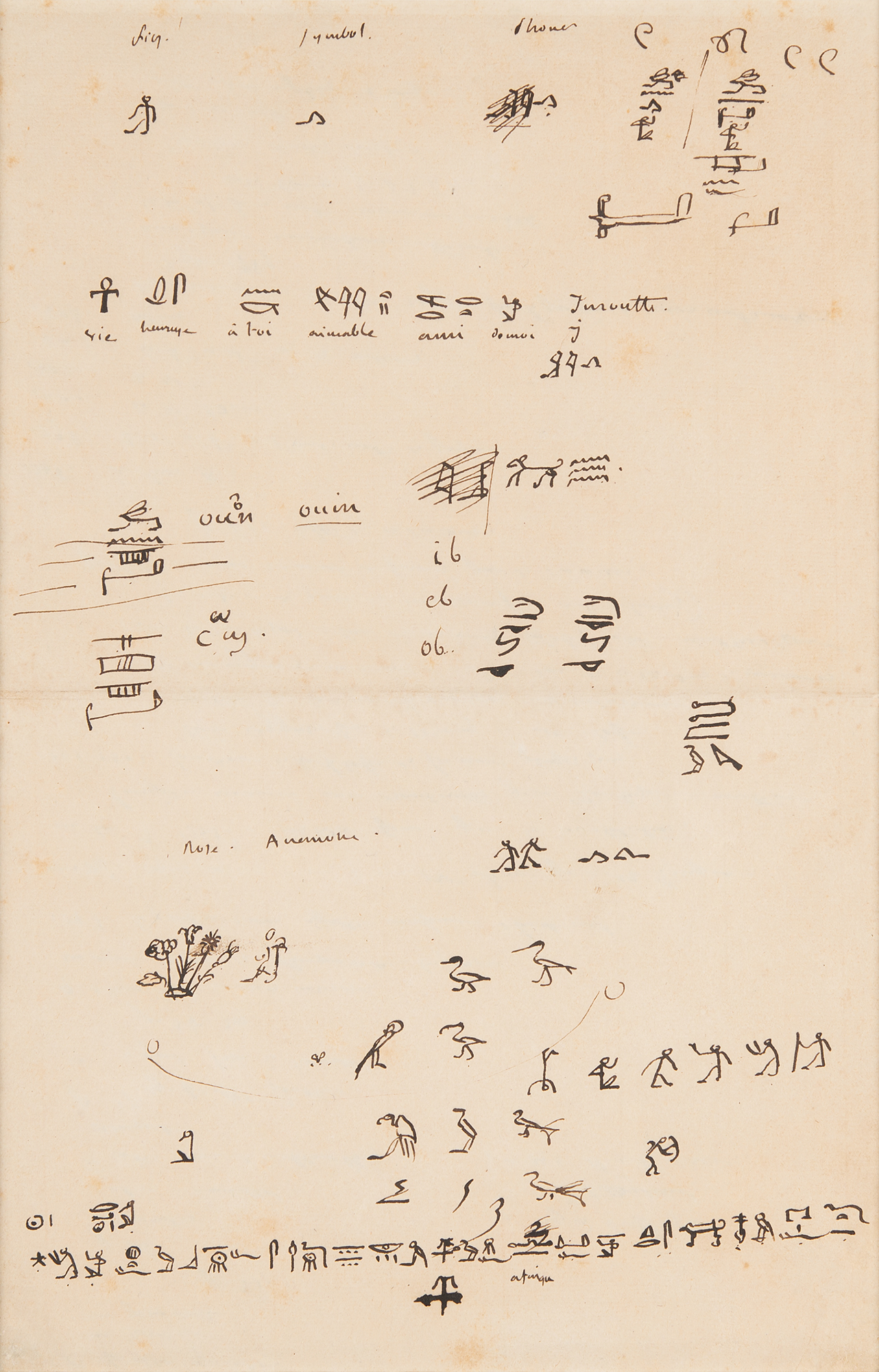
French scholar and founding figure in the field of Egyptology (1790–1832) who published the first translation of the Rosetta Stone hieroglyphs in 1822. Exceptional unsigned handwritten manuscript by Jean-François Champollion, one page, 7.75 x 12, no date but circa 1828-1830, while he was in Egypt to verify in situ the veracity of his discoveries. The leaf originates from the collection of Étienne Pariset, a physician who traveled to Egypt to study the mechanisms of transmission of the plague, and met Champollion there. On the back of a numbered sheet "4" filled with biographical notes written by Pariset on the naturalist Lacépède, Champollion explains the way in which one reads and deciphers the hieroglyphics: at the very top, under the word "fig[uratif]," he draws a walking man; alongside, under the word "symbol[ic]," moving legs; finally, under the word "phone[tic]," the Egyptian verb "to come." Below is a sentence in hieroglyphs with its French translation just below, group by group (translated): "Happy life to you, dear friend of mine."
Further below, the verb "to open," which he transcribes "ouin." This verb appears several times on the sheet, even in hieratic, twice, a little lower on the right, and in Coptic ("sôch"). On the side, the verb "to be thirsty," transcribed next to "ib" with two variants.
At the very bottom is a long hieroglyphic sentence which resembles certain hymns to the sun: "I adore Ra when he rises and illuminates all the lands with his rays." These notes, sketches and drafts suggest preparatory notes for the publication of the Egyptian Grammar. The series of signs representing characters in different attitudes (found in a very similar way at the bottom of page 3 of the 1st volume of the Egyptian Grammar), as well as the two texts with their transliteration into Coptic and the literal translation of one of them, seem to go in this direction. Double-matted and framed to an overall size of 13.75 x 18, with the backing covering Pariset's writing. In fine condition, with some faint foxing and a central horizontal fold.

