Sold For $2,750
*Includes Buyers Premium
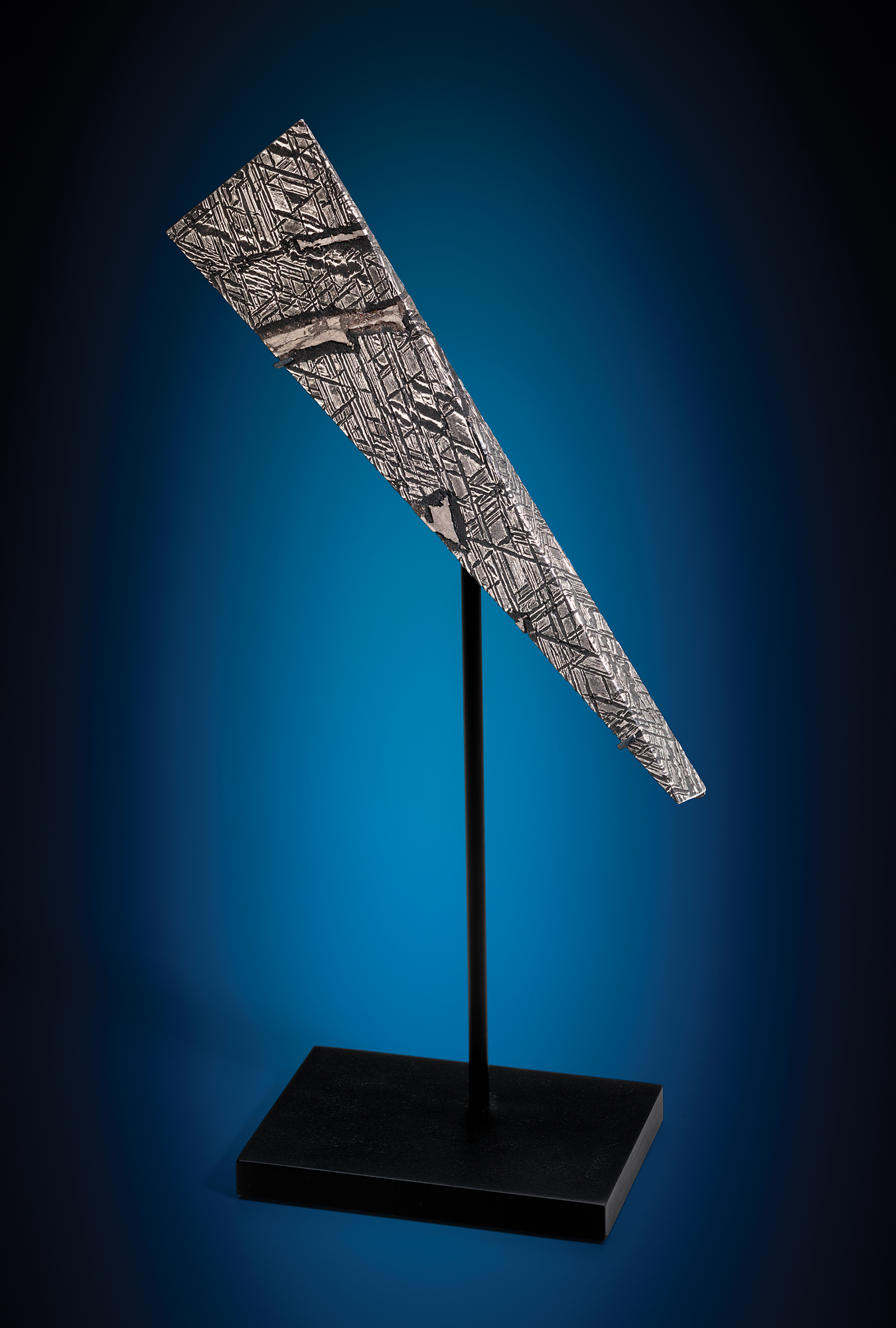
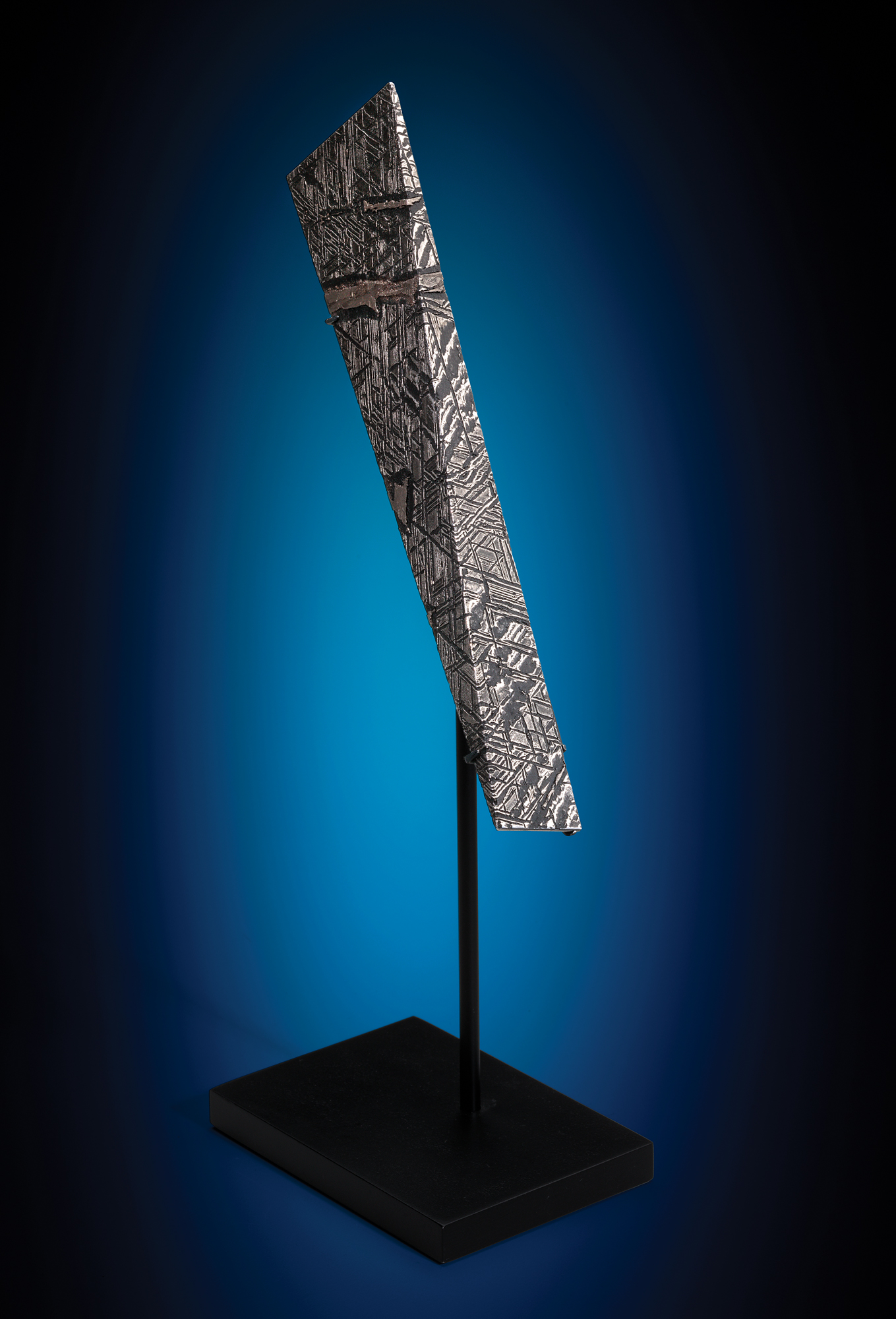
Iron meteorite, medium octahedrite – IIIE-AN
Xinjiang, China
178 mm x 43 mm x 23 mm
287.9 grams
The Aletai meteorite shower landed in the northwest corner of China not far from the border of Mongolia and Kyrgyzstan. It is classified as an exceedingly rare anomalous iron meteorite—and meteorites are rare with which to begin: all meteorites known to exist collectively weigh less than the world’s annual output of gold.
While most iron meteorites are prosaically shaped, their resplendent internal crystalline structure is revealed upon cutting. This is why iron meteorites are fashioned into slices, cubes, spheres—or the unique presentation now offered: a sculptural work of art.
Almost no meteorites are as visually enthralling as Aletai. The otherworldly lattice seen is the result of the molecules of the different metallic alloys having enough time to orient into their crystalline habit. A cooling curve of millions of years is required, and as such a circumstance cannot occur on or near Earth’s surface, such patterns are diagnostic in the identification of a meteorite.
Aletai belongs to one of the smallest subgroups of iron meteorites in scientific literature—there are only 21 IIIE meteorites on record. Only three of the 21 have anomalous chemical abundances and Aletai happens to be one of them. In addition, while it represents only a tiny fraction of its elemental profile, Aletai contains the highest concentration of gold in the IIIE group.
Aletai also contains a relatively large amount of iridium—the second densest element known and the most rust-resistant metal. Because the abundance of iridium in meteorites is much higher than in the Earth's crust, it was the concentration of iridium in the 65 million-year-old Cretaceous-Paleogene boundary which inspired the theory of a massive meteorite impact 65 million years ago having been responsible for the mass distinction of dinosaurs. This in turn provided the opportunity for human life to ultimately evolve.
As it further regards life, this specimen features thick bands of the phosphorus-rich mineral schreibersite which is also not common on Earth. It is believed by many scientists that schreibersite—conveyed to Earth via asteroid impacts billions of years ago—was Earth’s primary source of phosphorus which helped to enable life itself to begin.
It’s a result of its unique chemical signature that Aletai’s pattern is among the very best, and there is arguably no better meteorite from which to render such an abstract form. Given Aletai’s singular attributes combined with the aesthetics of this specific specimen, finding a more compelling extraterrestrial conversation piece would prove challenging. Accompanied by a custom armature.

