Sold For $28,734
*Includes Buyers Premium
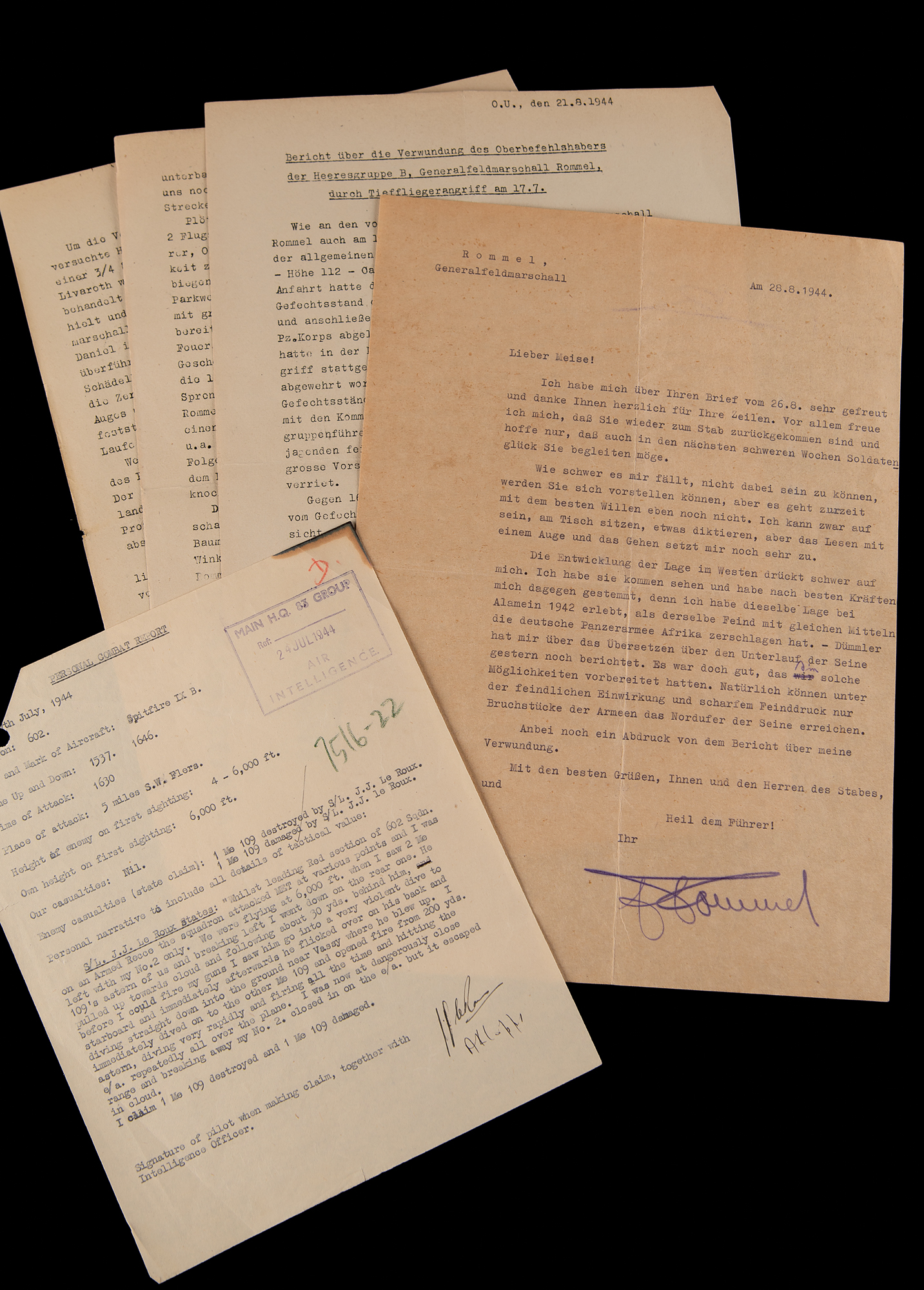
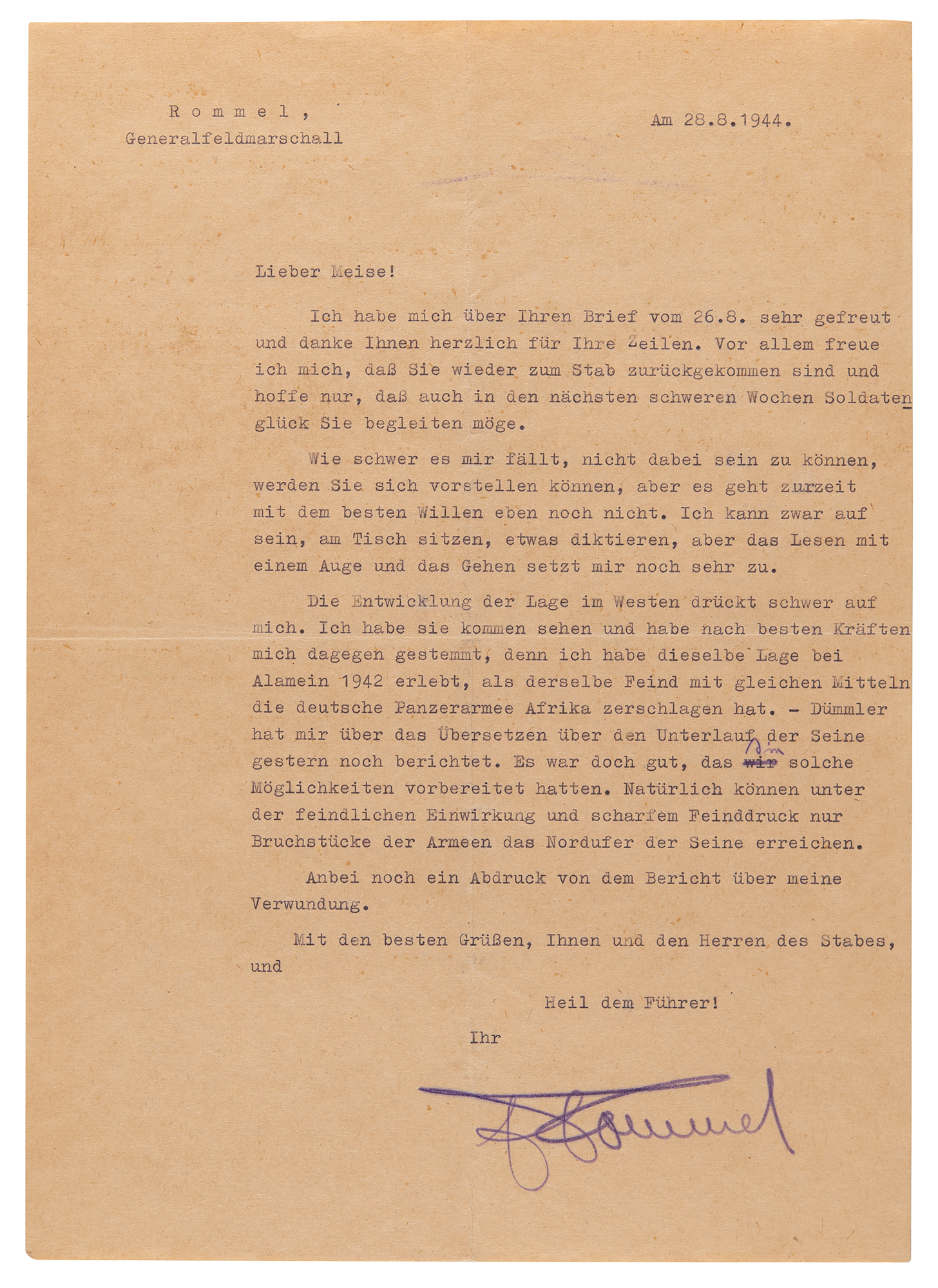
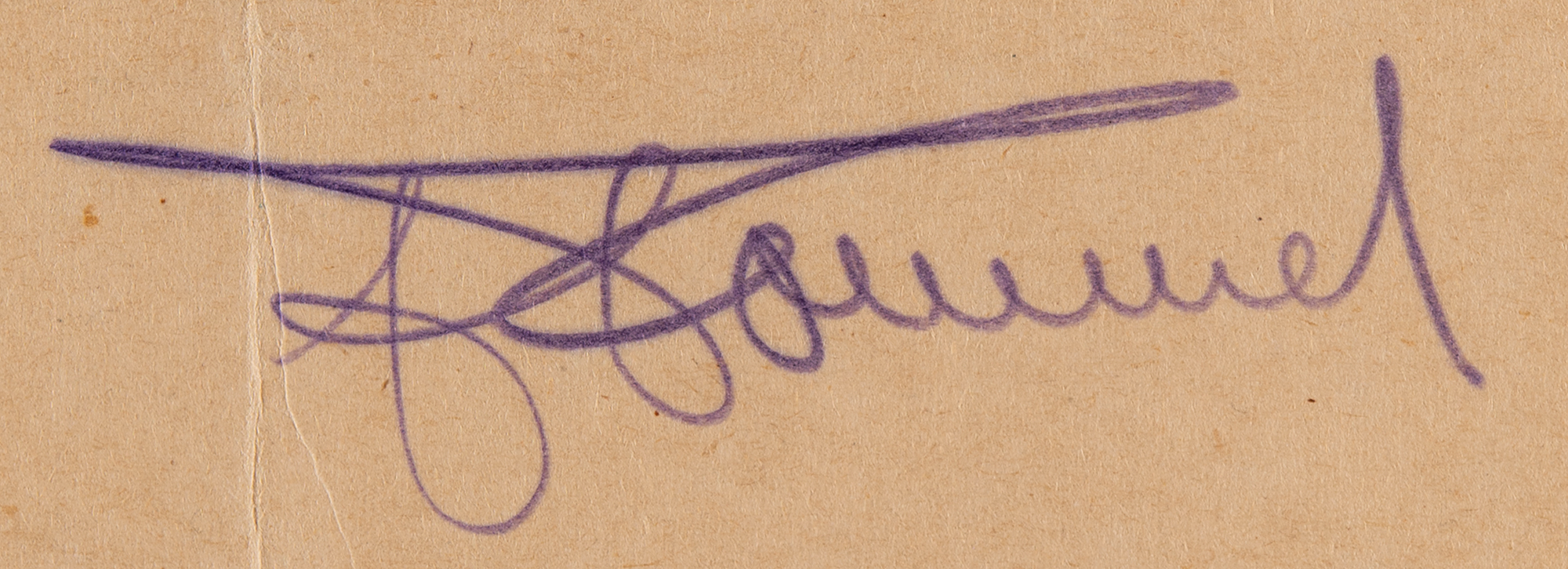
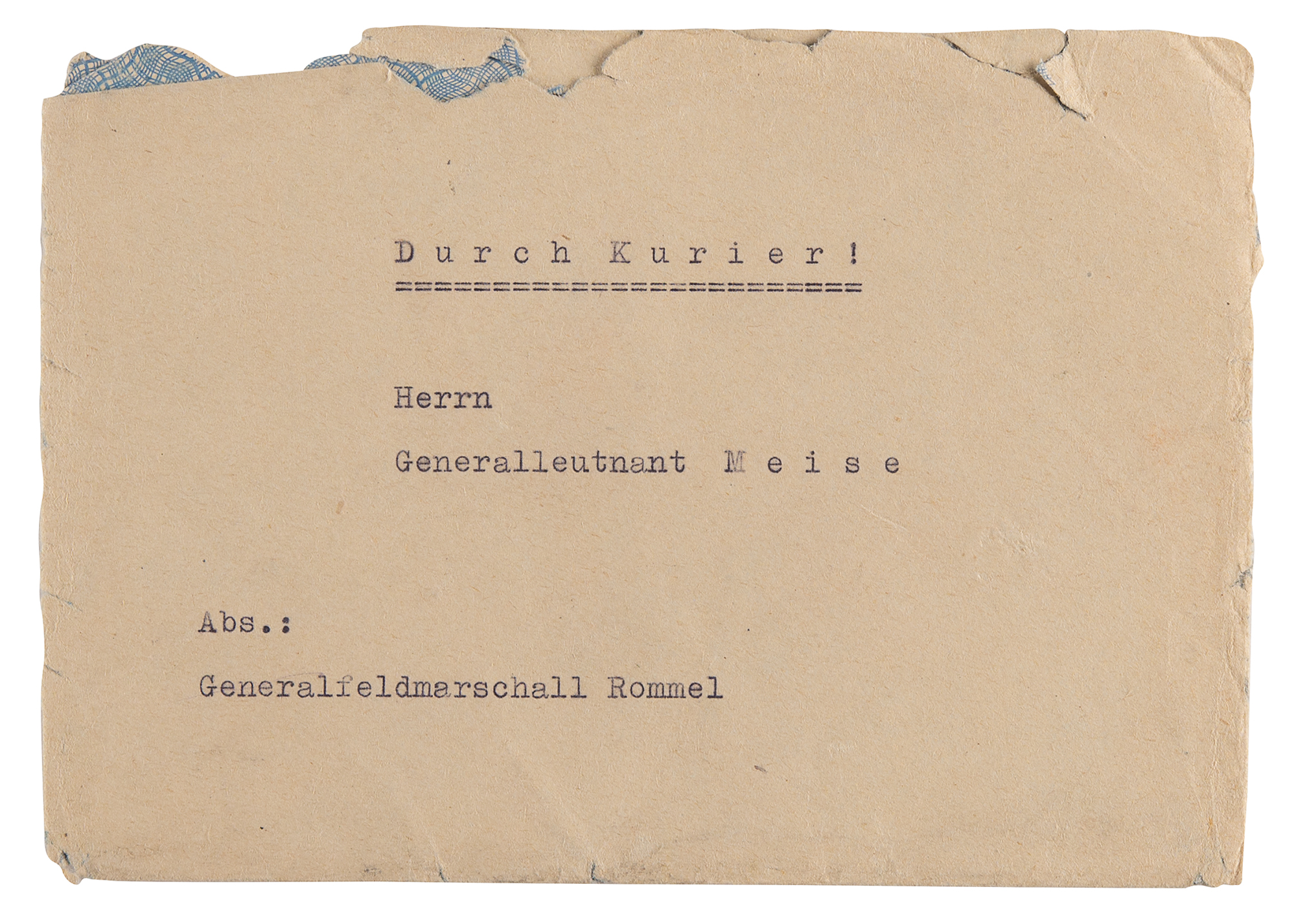
TLS in German, signed in indelible pencil, “Rommel,” one page, 8.25 x 11.75, August 28, 1944. Letter to "Generalleutnant Meise," sent the month after a near-fatal attack on his convoy left him largely incapacitated. In addition to enclosing a report on the incident, Rommel makes reference to General George Patton's Third Army's crossing of the Seine River, completed from August 18–20th in advance of the liberation of Paris.
In full (translated): "I was very happy to receive your letter of 26.8, and thank you warmly for it. I am especially happy that you have returned to headquarters, and hope that in the coming difficult weeks, the luck of the soldier will be with you.
You can imagine how difficult it is for me not to be able to be part of it, but at the moment, even with the best will in the world, that is not yet possible. I can get up, sit at a table, dictate something, but reading with one eye and walking are still very taxing.
The way the situation in the west is developing is very depressing. I saw it coming and tried with all my force to resist it, since I have experienced the very same situation at Alamein in 1942, when the same enemy using the same means destroyed the German Panzer army in Africa. Dummler informed me yesterday of the crossing of the lower reaches of the Seine. It was therefore a good thing that such eventualities had been prepared for. Of course, under such heavy enemy action and pressure, only fragments of our armies will be able to reach the north bank of the Seine.
I am enclosing a copy of the report on my wounding.
With my best wishes to you and the gentlemen at headquarters and, Long live the Führer!" In fine condition.
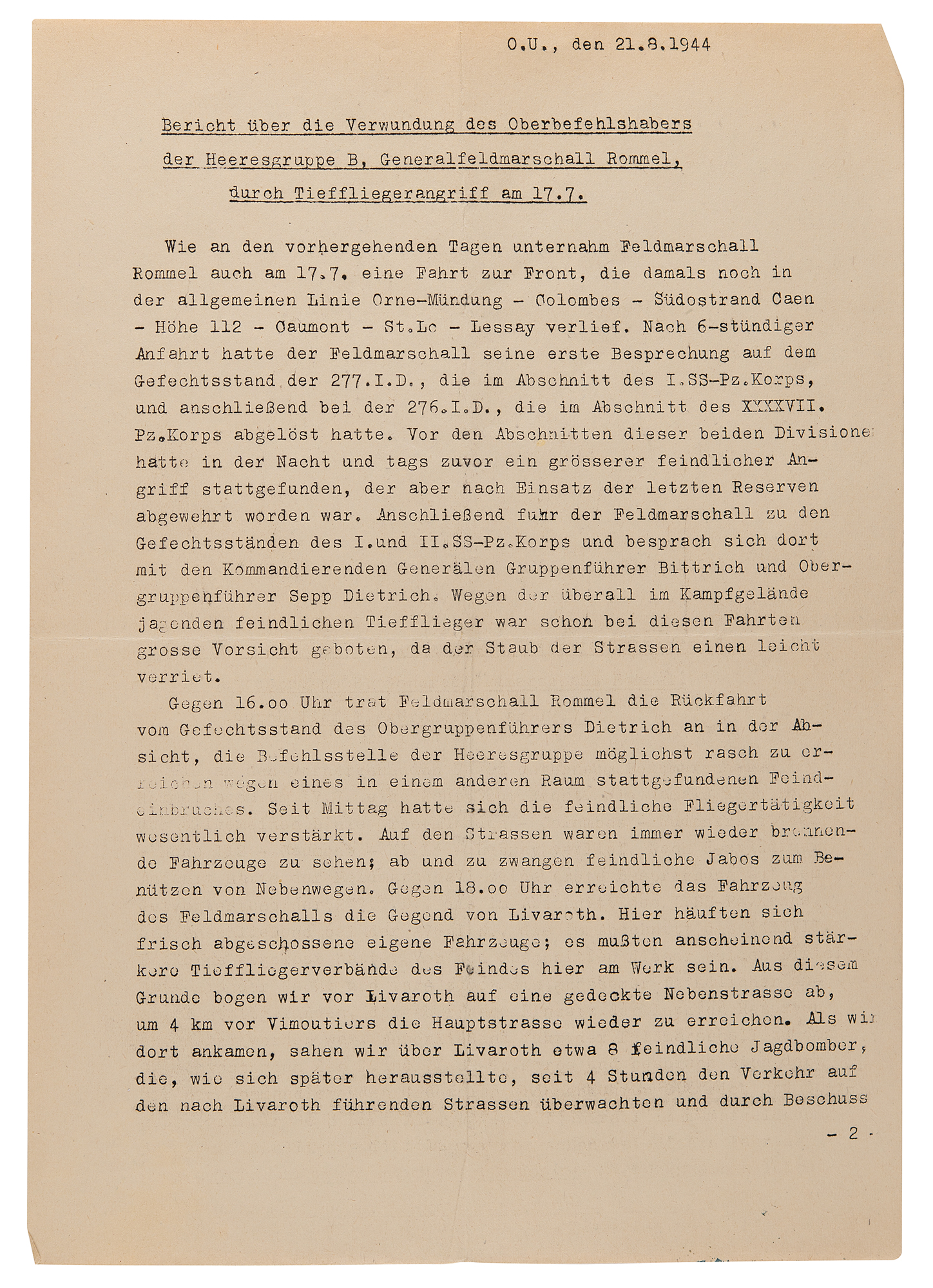
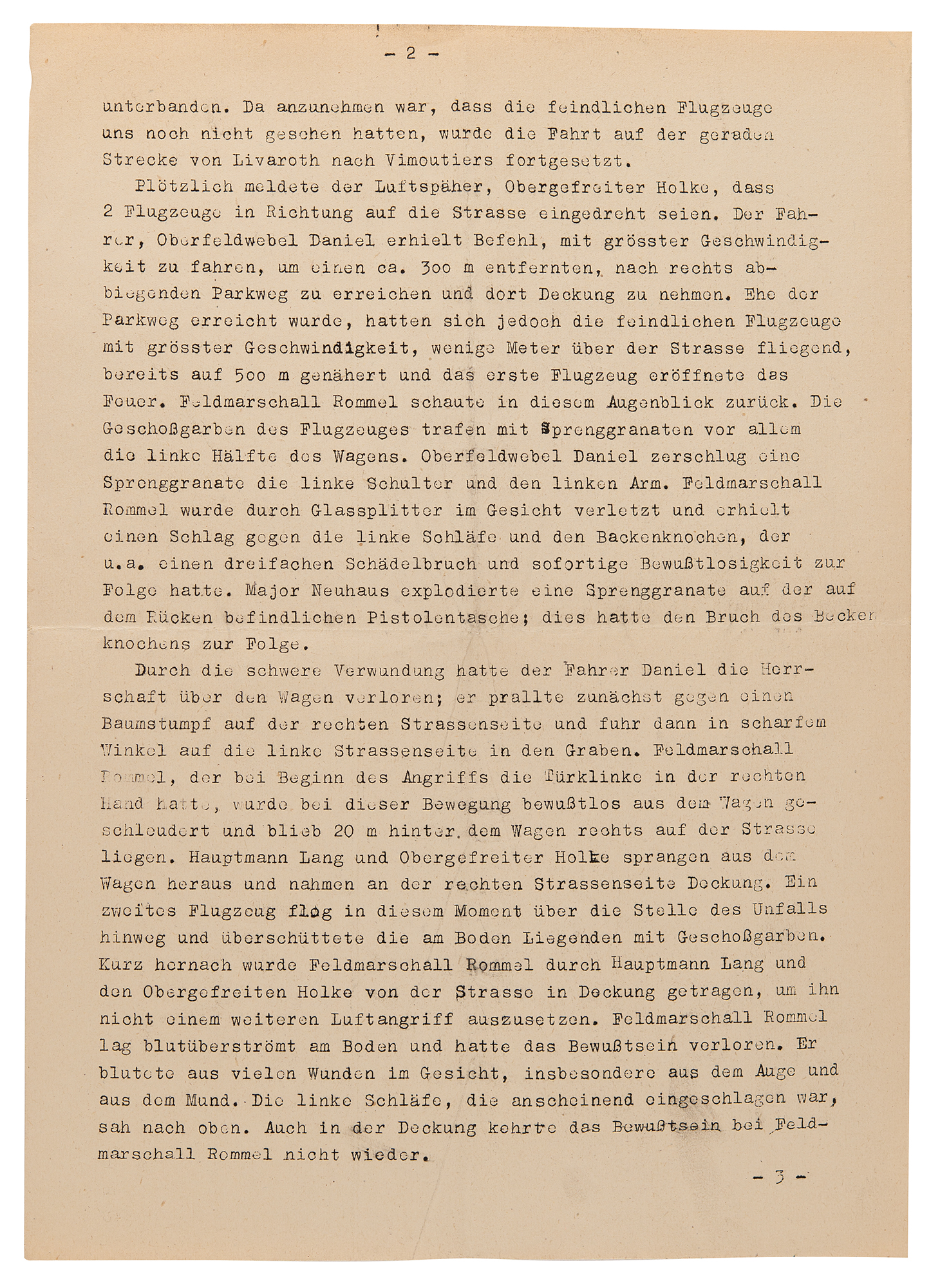
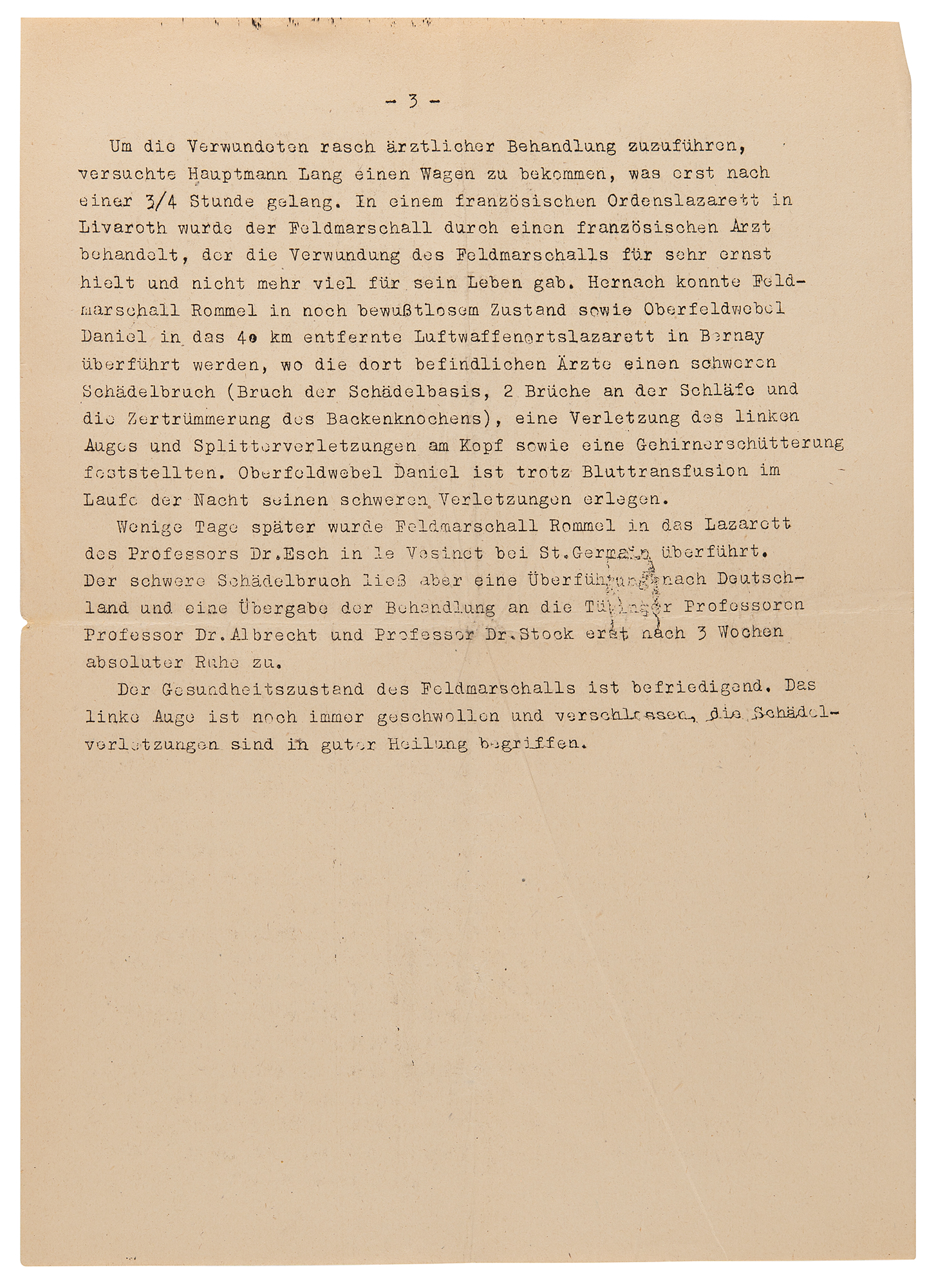
Accompanied by the original enclosure, Rommel's personal copy of the three-page typescript report in German, dated August 21, 1944. In part (translated): "Report on the Wounding of the Commander-in-Chief of the Army Group B, Field Marshal Rommel, in a low-flying air attack on the 17.7. On the 17.7, as on preceding days, Field Marshal Rommel undertook a journey to the front…Great care was advised on these journeys on account of the low-flying enemy aircraft, hunting everywhere above the battlefield—since dust rising from the road would soon betray a moving vehicle.
About 16.00 hours, Field Marshal Rommel began the return journey from the command post of Colonel Dietrich, with the intention of reaching the command post of the army group as quickly as possible, because of an enemy breakthrough in another part of the battlefield. Enemy air activity had increased considerably since noon. More and more burning vehicles were to be seen, blocking the roads, and here and there it was necessary to take evasive action and turn onto side roads to avoid enemy fire.
At about 18.00 hours, the Field Marshal's vehicle reached the region of Livarot. Here, recently shot-up vehicles were piling up: it seemed that squadrons of enemy aircraft were intensifying their work in the area. For this reason, we turned off before Livarot onto a concealed side road, in order to rejoin the main road 4km before Vimoutiers. When we arrived there, we saw about 8 enemy fighter-bombers patrolling over Livarot…Since it seemed fair to assume that the enemy aircraft had not yet seen us, we continued our journey on the straight stretch from Livarot to Vimoutiers. Suddenly, the air lookout, Corporal Holke, announced that two aircraft had turned and were heading for the road. The driver, Regimental Sergeant Major Daniel, was given the instruction to drive at full speed in order to reach a forest track, bending off to the right about 300 metres away, and to seek cover there. Before we reached the track, however, the enemy aircraft, flying at great speed, had come to within 500 metres of us, flying a few metres above the road, and the first aircraft opened fire. At this moment, Field Marshal Rommel was looking backwards. The aircraft's cone of high explosive fire hit mostly the left half of the vehicle. Sergeant Daniel was hit in the left shoulder and left arm. Field Marshal Rommel was wounded by glass splinters in the face, and sustained a hit to the left temple and cheekbone, which, among other things, caused a triple fracture of the skull and immediate loss of consciousness. A charge exploded on the pistol holster Major Neuhaus was wearing on his back, resulting in a broken cheekbone.
On account of his serious injury, Driver Daniel had lost control of the vehicle: it first ricocheted off a tree stump on the right side of the road, then veered sharply over to the left side and into a ditch. Field Marshal Rommel, who at the beginning of this attack was holding the door handle in his right hand, was propelled out of the car by this movement, and lay unconscious 20 metres behind the car on the right of the road. Captain Lang and Corporal Holke jumped out of the car, and took cover on the right hand side of the road. At this moment, a second aircraft flew off over the site of the incident, peppering those lying on the ground with bullets. Shortly after that, Captain Lang and Corporal Holke carried Field Marshal Rommel to cover, in order to remove him from the risk of any further attack.
Field Marshal Rommel lay covered in blood on the ground, and had lost consciousness. He was bleeding from many wounds to his face, particularly from an eye and from the mouth. His left temple, which appeared smashed in, was pointing upwards. The Field Marshal, in cover, still remained unconscious.
In order to take the wounded quickly to a place where they could receive medical attention, Captain Lang tried to get hold of a vehicle, which he managed only after three-quarters of an hour. In the hospital of a religious order in Livarot, the Field Marshal was treated by a French doctor, who considered the Field Marshal's wounds to be very serious, and did not give him much chance of survival. Thereafter, it was possible to transfer Field Marshal Rommel, still in an unconscious state, together with Corporal Daniel, to the Luftwaffe Military Hospital in Bernay, four kilometres away, where the duty doctors were able to confirm his wounds as follows: a severe fracture of the skull (fracture at the base of the skull, two fractures at the temple, disintegration of the cheek bone), a wound to the left eye, splinter wounds to the head, and concussion. In the course of the night, and despite blood transfusions, Corporal Daniel succumbed to his severe wounds.
A few days later, Field Marshal Rommel was transferred to the clinic of Dr. Esch in Le Vesinet, near St. Germain. It was not possible to complete his transfer to Germany, to the clinic of Dr. Albrecht and Dr. Stock in Tubingen, until three weeks later, his serious skull fracture requiring complete rest during that time.
The Field Marshal's state of health is satisfactory. His left eye is still swollen and closed. The wounds to his skull are on the way to recovery."
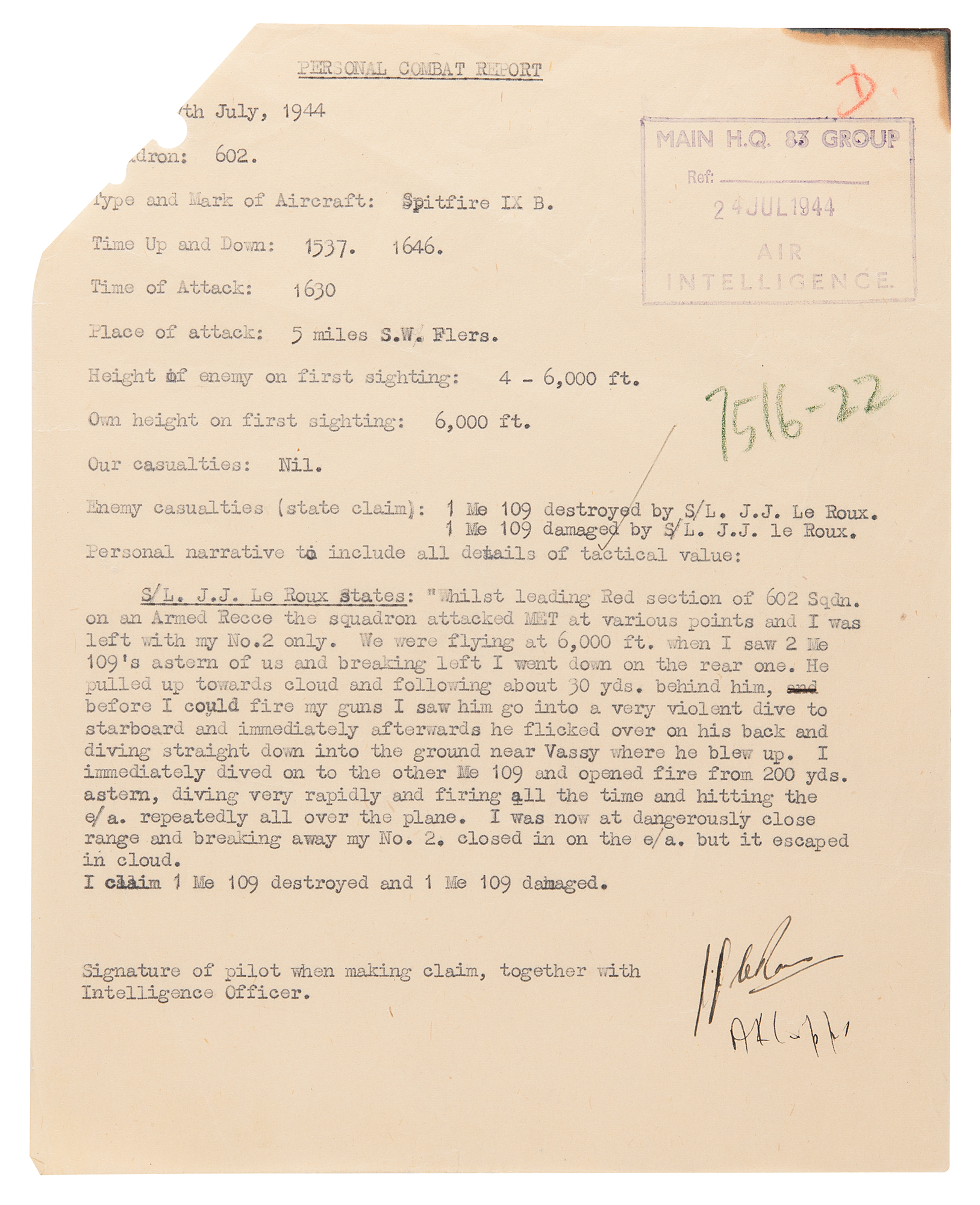
Further includes the personal combat report of South African flying ace Johannes le Roux, signed "J. J. le Roux," one page, 7 x 8.75, for July 17, 1944—the date of the strafing attack on Erwin Rommel. Le Roux, who is credited with having shot down at least eighteen German aircraft during WWII, may have been the fighter pilot that hit Rommel; Canadian 'train buster' Charley Fox has also been credited, and other pilots have claimed responsibility. Le Roux reports hitting two Luftwaffe Me 209 fighters, with one damaged and one destroyed. He would go missing in action mere weeks later, believed to have died in an aircraft accident.
Rommel's wound forced him to withdraw from the battlefield at a critical moment in World War II: Allied troops were advancing into France as part of Operation Overlord, while a certain segment of Wehrmacht officers sought to overthrow the Nazi regime from within. Just three days after the attack on Rommel, a group of German officers made a failed attempt to assassinate Adolf Hitler with a bomb at his East Prussian headquarters. Although Rommel's role remains difficult to ascertain—and, still convalescing in the hospital, he played no direct role—evidence emerged suggesting he had prior knowledge of the '20 July Plot' and supported removing Hitler from power. Rather than face a trial that would endanger his family and tarnish his reputation, Rommel was given a grim choice by Hitler’s emissaries: take his own life and die a hero, or be executed as a traitor. On October 14, 1944, Rommel chose suicide, explained his decision to his wife and son, and swallowed a cyanide capsule. Publicly, the Nazi regime attributed his death to the wounds sustained on July 17th and honored him with a state funeral.

This item is Pre-Certified by PSA/DNA
Buy a third-party letter of authenticity for
$100.00
*This item has been pre-certified by a trusted third-party authentication service, and by placing a bid on this item, you agree to accept the opinion of this authentication service. If you wish to have an opinion rendered by a different authenticator of your choosing, you must do so prior to your placing of any bid. RR Auction is not responsible for differing opinions submitted 30 days after the date of the sale.
Third-party authentication service applies only to signatures and handwriting, and does not cover the addition of sketches, artwork, musical quotations, etc.

