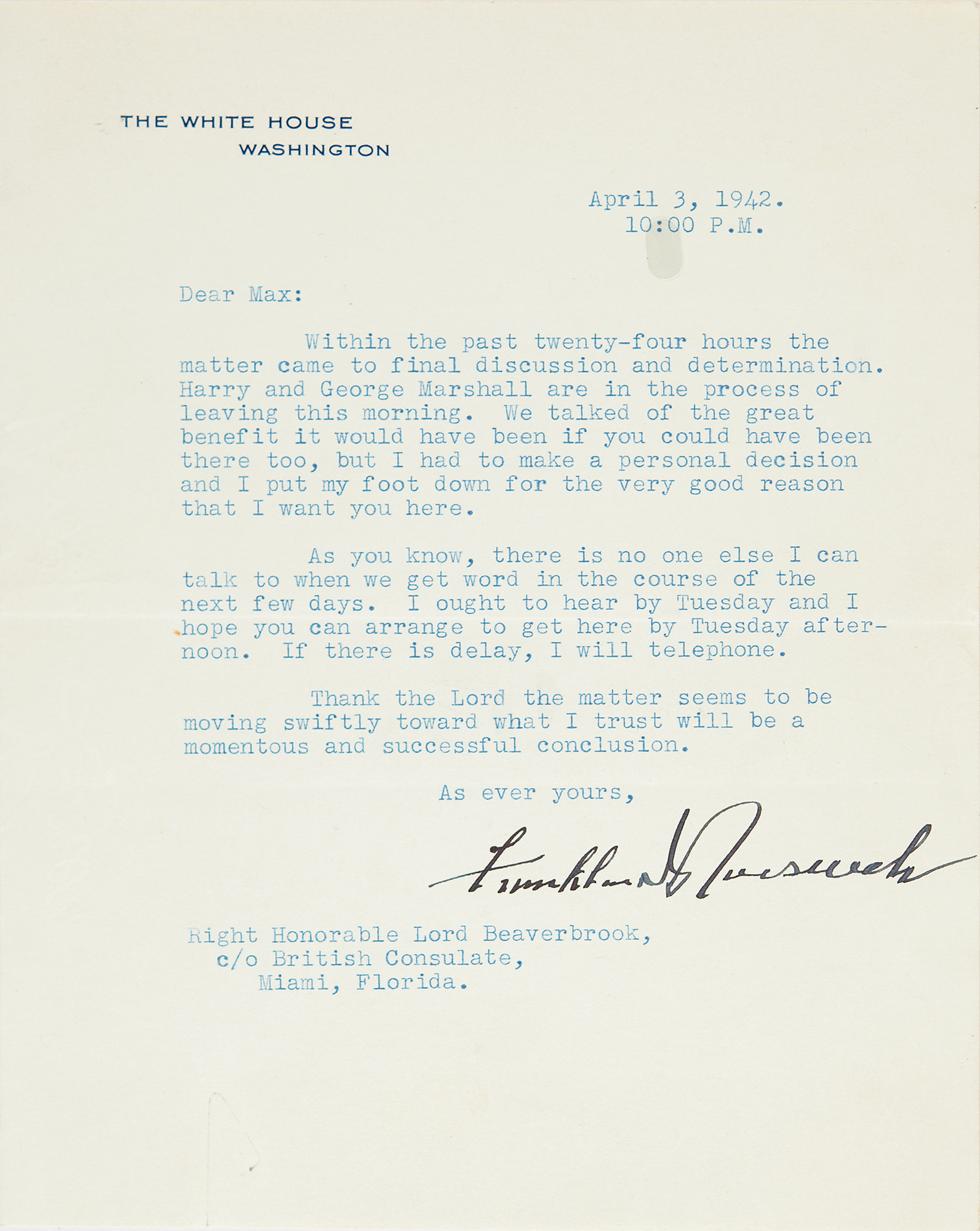
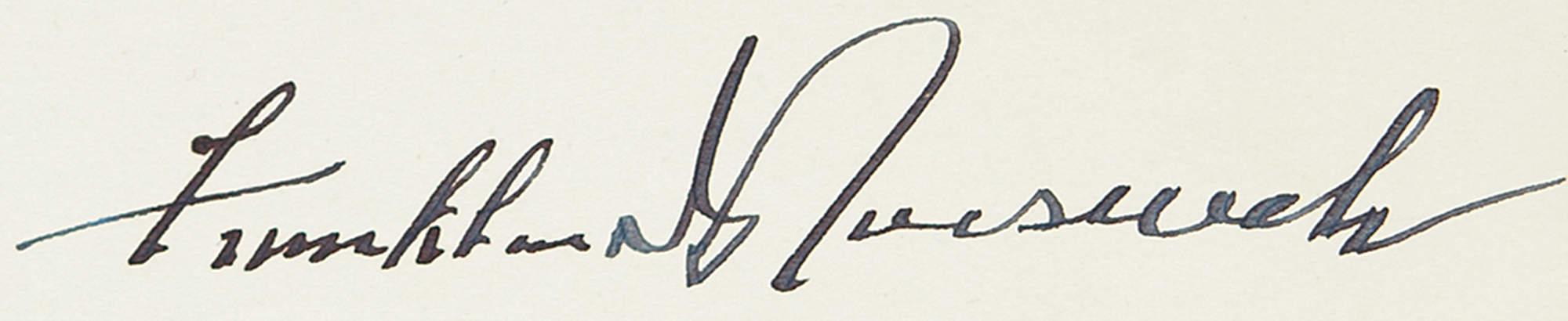
World War II?dated TLS as president, one page, 7 x 8.75, White House letterhead, April 3, 1942. Letter to influential British newspaper publisher Max Aitken, Lord Beaverbrook, alluding to the Allied decision to open a second front against Germany during World War II. In full: "Within the past twenty-four hours the matter came to final discussion and determination. Harry and George Marshall are in the process of leaving this morning. We talked of the great benefit it would have been if you could have been there too, but I had to make a personal decision and I put my foot down for the very good reason that I want you here.
As you know, there is no one else I can talk to when we get word in the course of the next few days. I ought to hear by Tuesday and I hope you can arrange to get here by Tuesday afternoon. If there is delay, I will telephone. Thank the Lord the matter seems to be moving swiftly toward what I trust will be a momentous and successful conclusion." In fine condition.
Beaverbrook played a major role during World War II as an intimate ally of Winston S. Churchill, mobilizing industrial resources as Minister of Aircraft Production and shaping public opinion through the Daily Express?then the newspaper with the largest circulation in the world. In March 1942, Churchill sent him to the United States to meet with President Roosevelt. Publicly, Beaverbrook was there to discuss supplies; privately, he pitched the Americans on the idea of opening a second front against Germany.
In the meantime, a little-known staff officer named Dwight D. Eisenhower had prepared a plan to launch a cross-channel as soon as possible, and had his conclusion endorsed by the Joint Chiefs. Their recommendation was on Roosevelt's desk at the time of Beaverbrook's visit. On April 1st, FDR accepted the plan and dispatched two key aides?Harry Hopkins and George C. Marshall?to England to present it to Churchill and his chiefs of staff.
Writing to Churchill on April 3rd, the same date as this letter, FDR explained: 'What Harry and Geo. Marshall will tell you all about has my heart and mind in it. Your people and mine demand the establishment of a front to draw off pressure on the Russians, and these peoples are wise enough to see that the Russians are today killing more Germans and destroying more equipment than you and I put together. Even if full success is not attained, the big objective will be.'
Some of these circumstances of are documented in The White House Papers of Harry L. Hopkins: An Intimate History, Volume II (pp. 523), which reports that on the next day April 4, 1942, 'Hopkins and Marshall took off for London to propose the invasion of the Continent of Europe.' They brought with them to two plans for the Allied invasion of Northern France: Operation Roundup, a massive cross-channel invasion to land on beachheads between the French ports of Boulogne and Le Havre; and Operation Sledgehammer, a limited operation to be executed more quickly, aiming to capture and hold the French seaports of either Brest or Cherbourg.
In spite of Churchill's cordial and unhesitant acceptance of their 'momentous proposal,' his enthusiastic support was tempered by more immediate concerns in North Africa and the Far East, combined with shortages of supplies that had been earmarked for other operations. Either plan required a buildup of American forces and materiel in the United Kingdom?a time-consuming project known as Operation Bolero?and a large invasion looked to be at least a year away. Resistance in London led to a pivot toward the less ambitious 'Operation Torch,' an invasion of North Africa. Launched in November as the first major joint operation between American and British forces in WWII, the week-long assault was intended to draw Axis forces away from the Eastern Front?offering some relief to the Red Army?and establish a base of operations for the future invasion of Southern Europe.
The canceled plans for Operation Roundup laid the groundwork for what became Operation Overlord?an even more ambitious strategy that culminated in the D-Day landings on June 6, 1944. On that day, Allied forces launched the largest amphibious assault in history, storming the beaches of Normandy, France, to establish a vital foothold in Western Europe. The invasion involved over 150,000 troops from the United States, Britain, Canada, and other Allied nations, supported by thousands of ships and aircraft. D-Day marked a decisive turning point in World War II, opening a Western front against Nazi Germany and accelerating the liberation of occupied Europe.
This item is Pre-Certified by PSA/DNA
Buy a third-party letter of authenticity for
$100.00
*This item has been pre-certified by a trusted third-party authentication service, and by placing a bid on this item, you agree to accept the opinion of this authentication service. If you wish to have an opinion rendered by a different authenticator of your choosing, you must do so prior to your placing of any bid. RR Auction is not responsible for differing opinions submitted 30 days after the date of the sale.
Third-party authentication service applies only to signatures and handwriting, and does not cover the addition of sketches, artwork, musical quotations, etc.

