Sold For $65,000
*Includes Buyers Premium
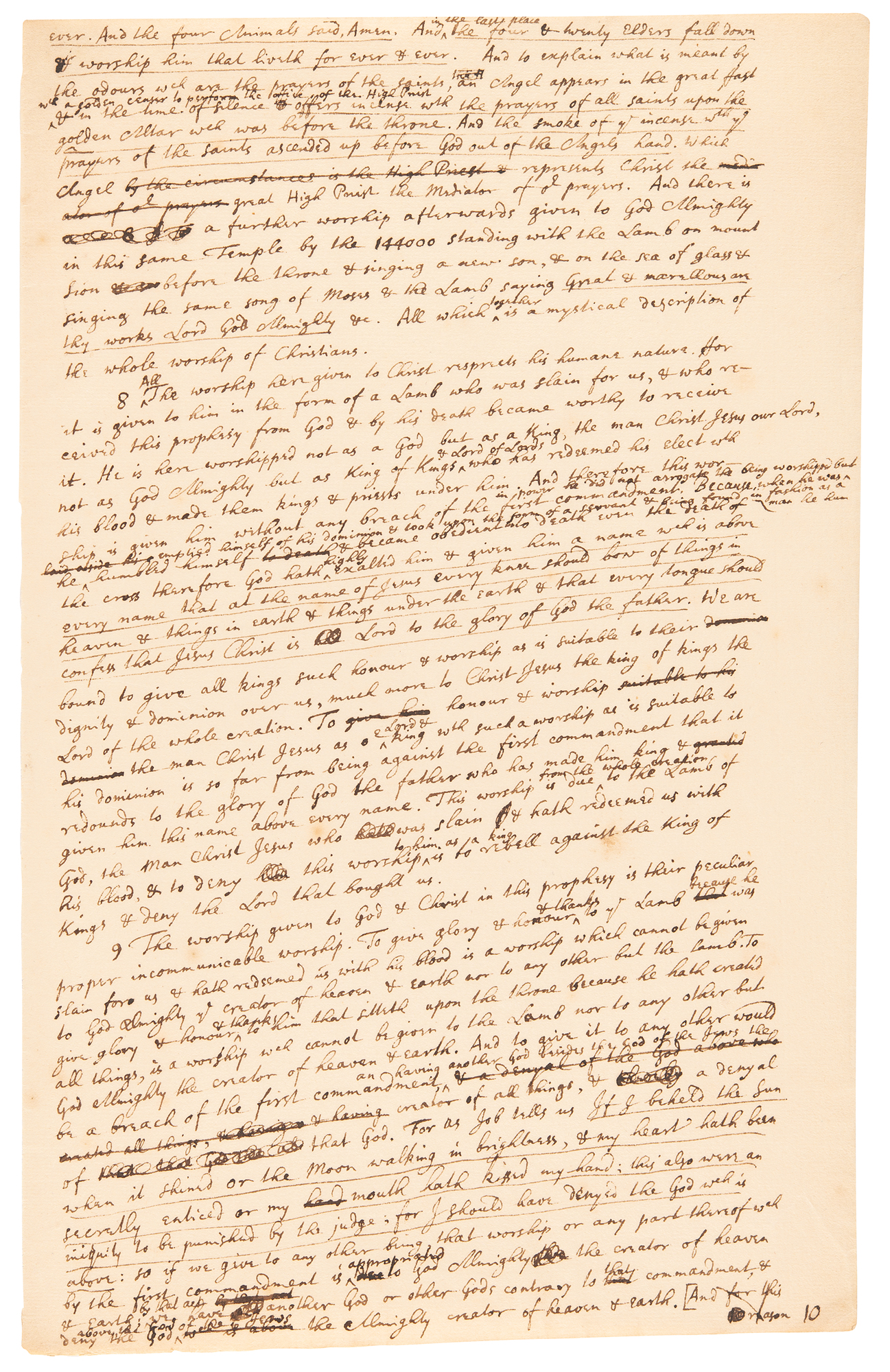
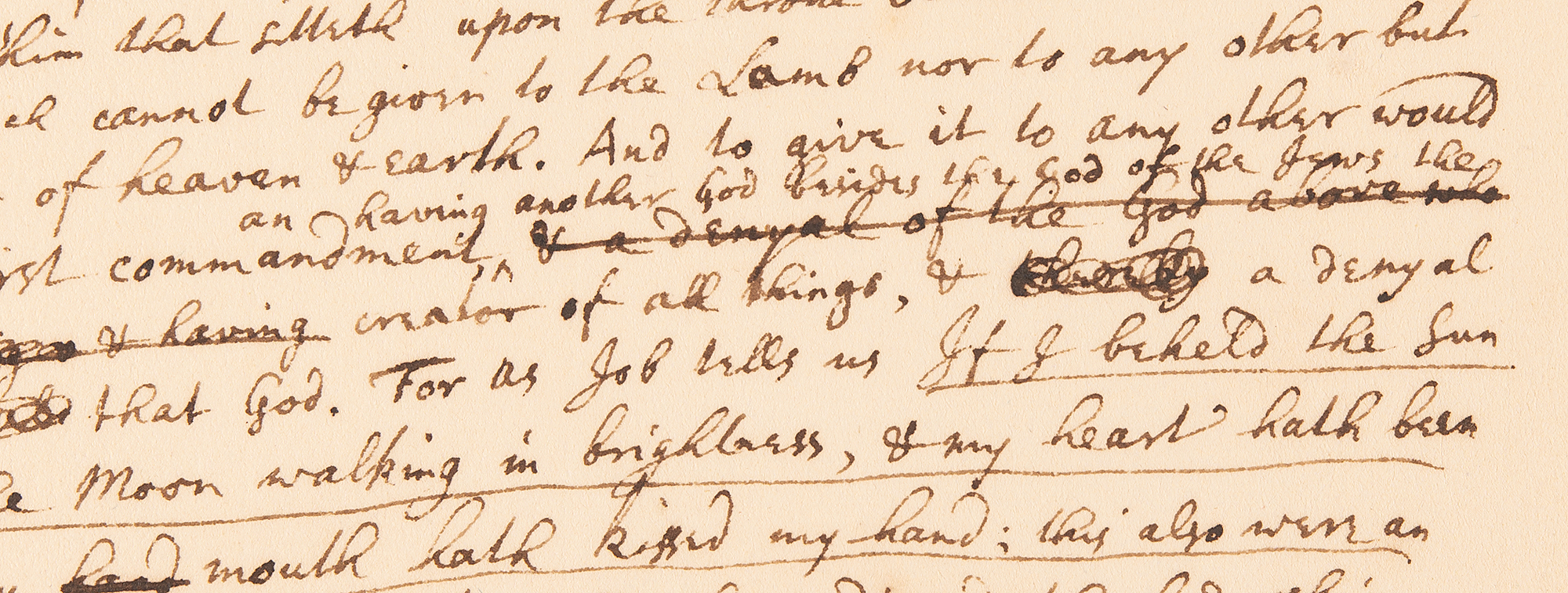
Significant handwritten religious manuscript by Isaac Newton, one page, 7.5 x 11.75, no date. Newton records his observations about Christian worship and outlines his views of the Holy Trinity—a heretical view at variance with the Church of England, punishable by death. In part: "And the four Animals said, Amen. And in the last place four & twenty elders fall down & worship him that liveth for ever & ever. And to explain what is meant by the odours wch are the prayers of the saints, an Angel appears in the great Hall with a golden altar to perform the office of the High Priest and in the time of silence offers...with the praying of all saints upon the golden altar wch was before the throne. And the smoke of ye incense with ye prayers of the saints ascended up before God out of the Angel's hand. Which Angel [by the circumstances is the High Priest &] represents Christ the great High Priest the Mediator of our prayers. And there is a further worship afterwards given to God Almighty in this same Temple by the 144000 standing with the Lamb…singing the same song of Moses & the Lamb saying 'Great & marvellous are thy works Lord God Almighty' &c. All which together is a mystical description of the whole worship of Christians.
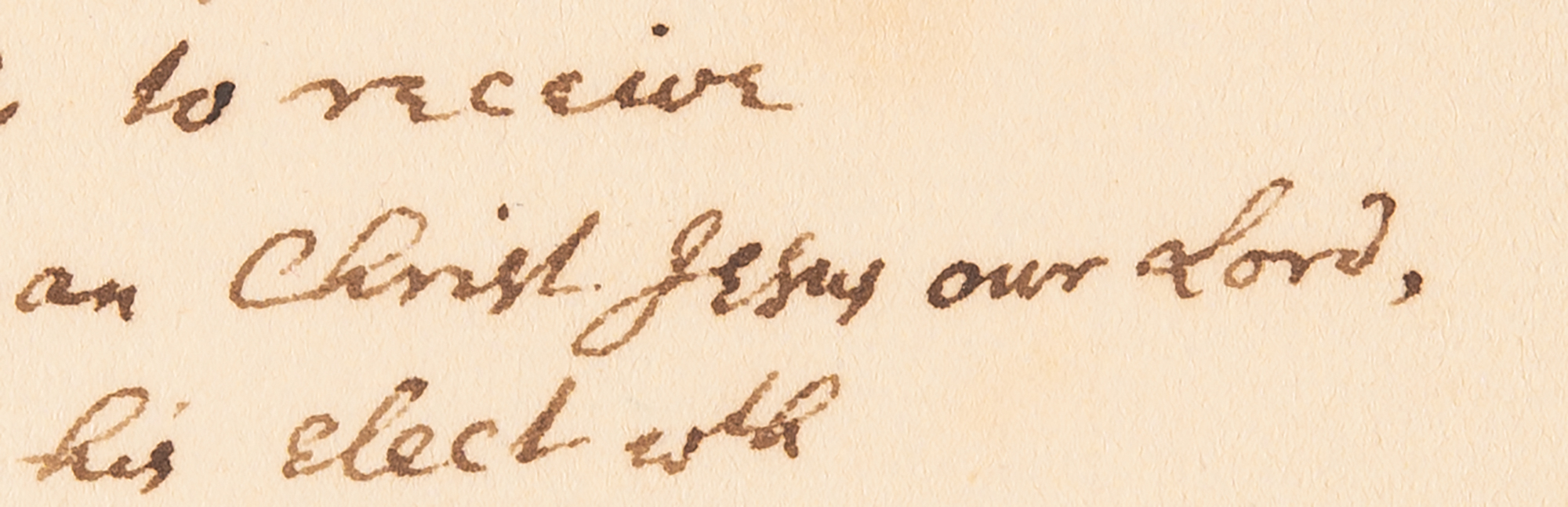
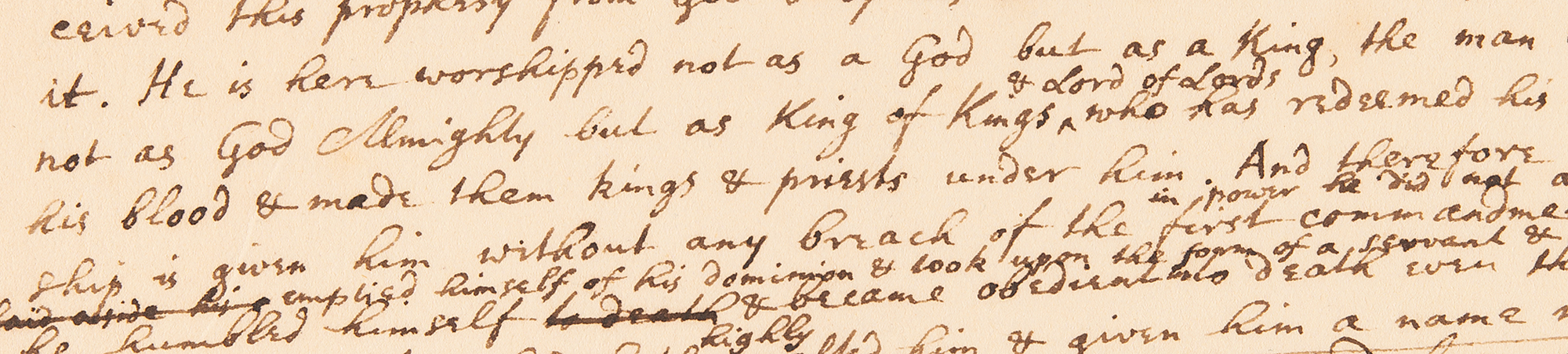
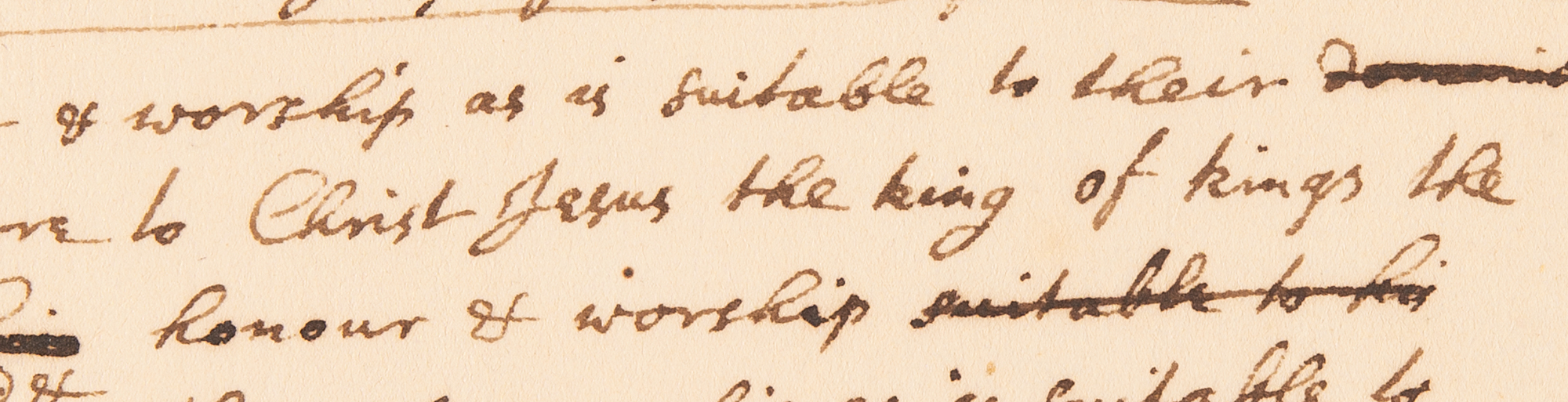
8. All the worship here given to Christ represents his human nature. For it is given to him in the form of a Lamb who was slain for us, & who received this prophesy from God & by his death became worthy to receive it. He is here worshipped not as a God but as a King, the man Christ Jesus our Lord, not as God Almighty but as King of Kings & Lord of Lords who has redeemed his elect with his blood & made them kings & priests under him. And therefore this worship is given him without any breach of the first commandment. Because, when he was in power he…emptied himself of his dominion & tok upon the forming of a servant & being found in fashion as a man he humbled himself…God hath highly exalted him & given him a name wch is above every name that at the name of Jesus…every tongue should confess that Jesus Christ is Lord to the glory of God the father. We are bound to give all Kings such honour & worship as is suitable to their dignity & dominion over us, much more to Christ Jesus the king of kings the Lord of the whole creation. To honour & worship the man Christ Jesus as a Lord & King wth such a worship as is suitable to his dominion is so far from being against the first commandment that it redounds to the glory of God the father who has made him king & given him this name above every name. This worship is due from the whole creation to the Lamb of God, the Man Christ Jesus who was slain & hath redeemed us with his blood, & to deny this worship to him as a king is to rebell against the King of Kings & deny the Lord that bought us.
9. The worship given to God & Christ in this prophesy is their peculiar proper incommunicable worship. To give glory & honour & thanks to the Lamb because he was slain for us & hath redeemed us with his blood is a worship which cannot be given to God Almighty ye creator of heaven & Earth nor to any other but the lamb. To give glory & honour & thanks to him that sitteth upon the throne because he hath created all things, is a worship wch cannot be given to the Lamb nor to any other but God Almighty the creator of heaven & Earth. And to give it to any other would be a breach of the first commandment…For as Job tells us 'If I beheld the sun when it shined or the moon walking in brightness, & my heart hath been secretly enticed or my mouth hath kissed my hand; this also were an iniquity to be punished by the judge; for I should have denyed the God wch is above.' So if we give to any other being, that worship or any part thereof wch by the first commandment is appropriated to God Almighty the creator of heaven & Earth, we have another God or other Gods contrary to that commandment, & deny the God above." In fine condition.
Newton’s theology had correlations with his physics—Newton essentially viewed God the Father as the cause of gravity and Christ the Son as the ruling principle of the natural world. For Newton, Christ was different in substance from God and subject to God’s dominion. The 4th-century Church Council of Nicea, which Newton studied, ruled that Christ and God were one in substance—a ruling that ran counter to Newton’s own 'heretical' anti-trinitarian religious beliefs—and Newton repeatedly returned to the topic and re-examined it anew. The present manuscript may pertain to Newton’s long planned, but unpublished, work on The History of the Church.
Scholars now increasingly recognize the importance of Newton’s theological views for an understanding of the whole man and his science. Newton himself kept his heretical religious views secret, and his heirs suppressed his manuscripts on theology for 200 years after his death—and they are only now beginning to see the light of day. A significant religious manuscript from the hand of the genius, offering a critical account of his personal beliefs.

This item is Pre-Certified by PSA/DNA
Buy a third-party letter of authenticity for
$250.00
*This item has been pre-certified by a trusted third-party authentication service, and by placing a bid on this item, you agree to accept the opinion of this authentication service. If you wish to have an opinion rendered by a different authenticator of your choosing, you must do so prior to your placing of any bid. RR Auction is not responsible for differing opinions submitted 30 days after the date of the sale.
Third-party authentication service applies only to signatures and handwriting, and does not cover the addition of sketches, artwork, musical quotations, etc.

