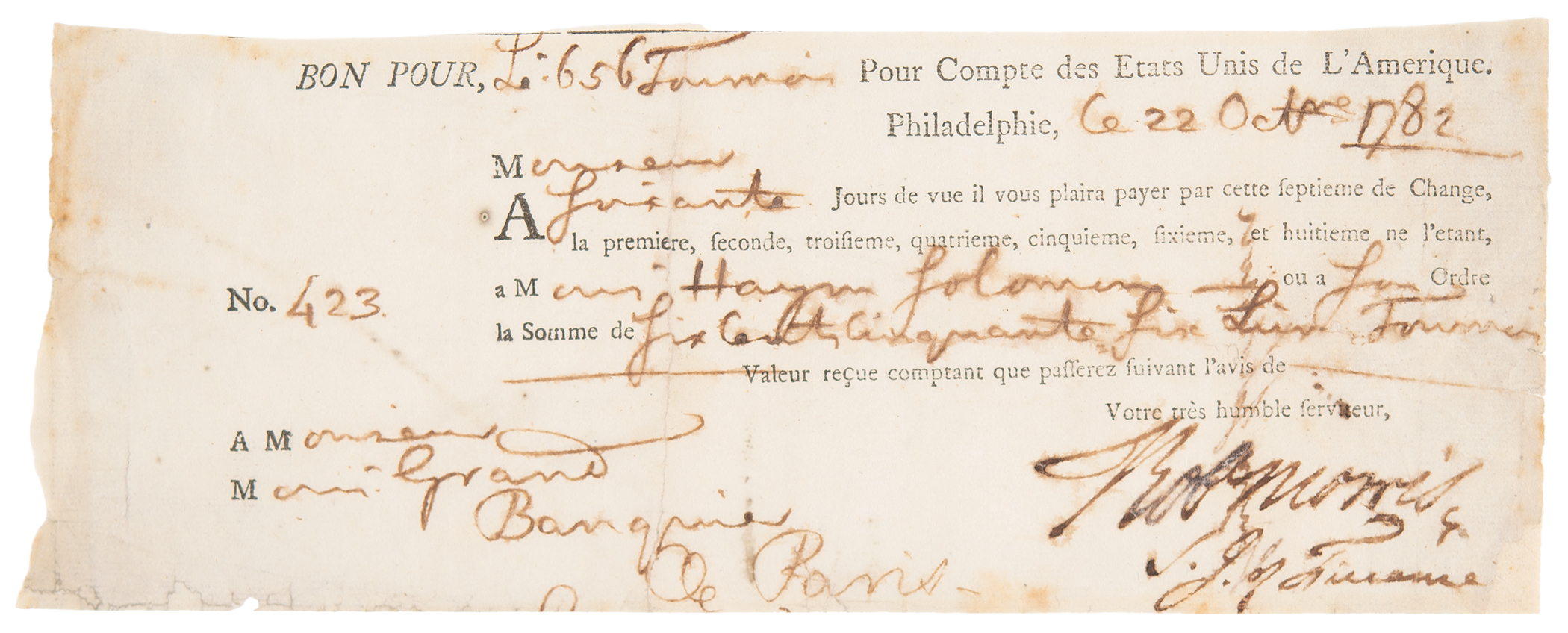
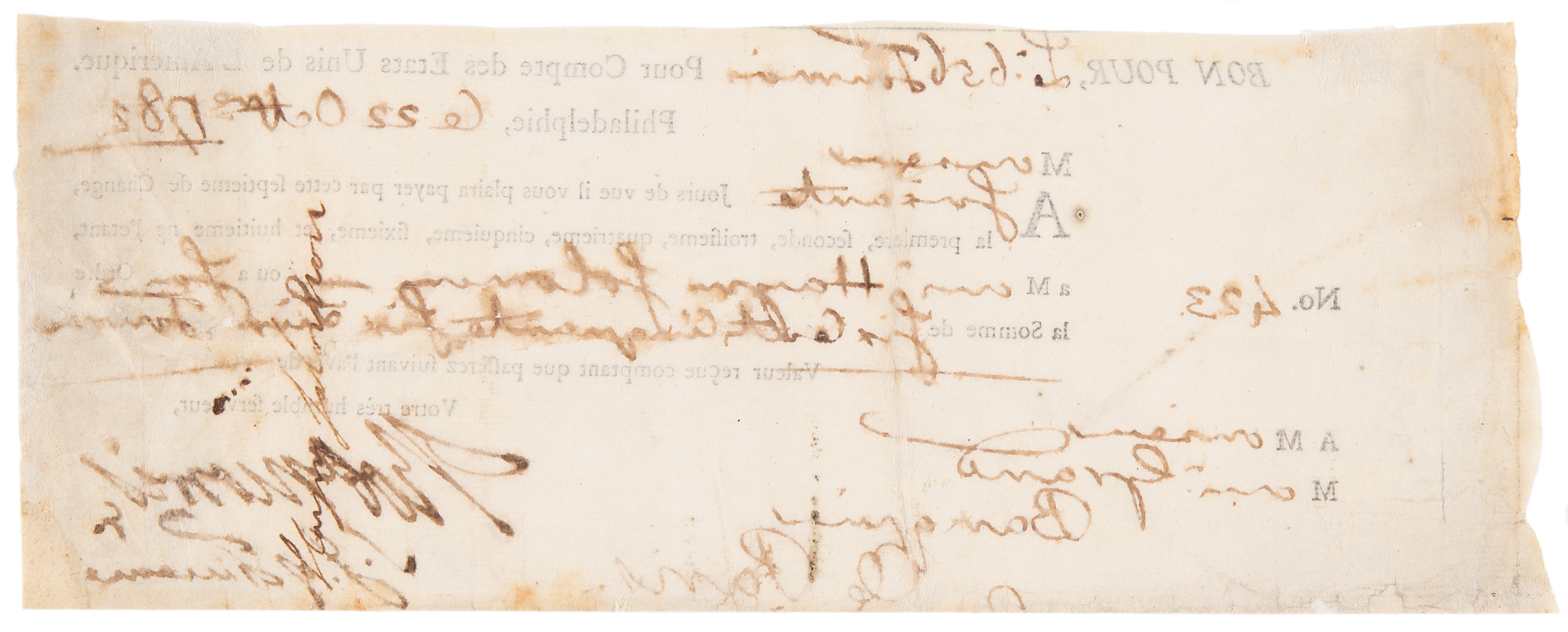
Exceedingly rare Revolutionary War-dated partly-printed DS, in French, signed “Haym Salomon" and "Rob't Morris, S. I. of Finance,” one page, 9.75 x 3.75, October 22, 1782. A seventh bill of exchange issued in Philadelphia, Pennsylvania, to Haym Salomon for 656 Livres Tournois, payable at the Grand Bank of Paris, with the upper right annotated "Pour Compte des Estats Unis de L’Amerique." Signed at the conclusion by Robert Morris as the Superintendent of Finance, and countersigned on the reverse by Salomon. In fine condition, with an unobtrusive professional repair to a vertical tear, and show-through front writing on the front rendering Salomon's signature indistinct but completely legible. An extraordinary historic American financial instrument coveted equally by autograph specialists, numismatists, and historical enthusiasts—Salomon’s legacy as one of the principal financiers of the American cause has been memorialized with plaques, historical markers, and statues across the country, including Chicago’s Heald Square Monument that portrays Salomon standing alongside General George Washington and frequent collaborator Robert Morris.
Exchanges of this type were the method used when unpredictable modes of transportation were used to ship the exchange forms domestically and abroad, often on multiple vessels in case of loss or capture. In nearly all cases with American bills of exchange such as this, the ‘First’ was usually paid, redeemed, or retired before any subsequent ones would be redeemed. Copious record-keeping was necessary, and paying out a rich sum like this was taken seriously at all points of potential redemption. Additionally, such instruments were issued to pay the interest on the domestic debt of the United States and to allow it to draw on its gold reserves in Europe to raise immediate specie in order to purchase supplies and prosecute the War for Independence. Such bills of exchange ‘were the eighteenth-century equivalent of modern checks; they enabled persons having funds available in other places to raise money for local use’ (Edgar J. McManus, in American National Biography).
By the time British troops marched into New York in September 1776, Haym Salomon had cast his lot with the Patriot cause. Not long after the occupation began, British General James Robertson had him arrested on suspicion of spying and confined to the grim Provost prison. It was a place notorious for its cruelty. Yet fate intervened. Hessian commander General Leopold Philip von Heister, recognizing in Salomon a rare gift—fluency in a host of European languages—secured his release, putting him to work as an interpreter and supplier of provisions. Though officially in the service of the Hessians, Salomon carried on his own business, advertising in the New York papers goods for ships—wine and vinegar, bread and rice—sold from his shop on Broad Street.
But beneath this appearance of loyalty to the British cause, Salomon was quietly at work for the Americans. He aided prisoners, American and French alike, in slipping their bonds and making their way to freedom. In 1778, his activities caught up with him. Arrested again, accused of plotting to burn British ships in New York Harbor, he was convicted of espionage and, by report, sentenced to hang. Somehow—exactly how remains unknown—he escaped. Crossing through New Jersey, he reached Philadelphia two weeks later, where in time he would become indispensable to the American cause.
Working closely with Robert Morris, Superintendent of Finance, Salomon proved himself one of the Revolution’s great financiers. Between 1781 and 1784, through tireless fundraising and generous personal loans, he provided the staggering sum of more than $650,000—about $15 million today—to keep Washington’s army in the field. His finest hour came in August 1781, with the fate of the war in the balance. Washington’s troops, bound for Yorktown, were near mutiny for want of food, uniforms, and supplies; Congress’s treasury was empty. When Morris told Washington there was no money, Washington’s reply was immediate: ‘Send for Haym Salomon.’ Within days, Salomon had raised $20,000 through the sale of bills of exchange—enough to move the army south. Yorktown would be the decisive battle of the Revolution, and Haym Salomon had made it possible.

This item is Pre-Certified by PSA/DNA
Buy a third-party letter of authenticity for
(inquire for price)
*This item has been pre-certified by a trusted third-party authentication service, and by placing a bid on this item, you agree to accept the opinion of this authentication service. If you wish to have an opinion rendered by a different authenticator of your choosing, you must do so prior to your placing of any bid. RR Auction is not responsible for differing opinions submitted 30 days after the date of the sale.
Third-party authentication service applies only to signatures and handwriting, and does not cover the addition of sketches, artwork, musical quotations, etc.

