Sold For $4,375
*Includes Buyers Premium
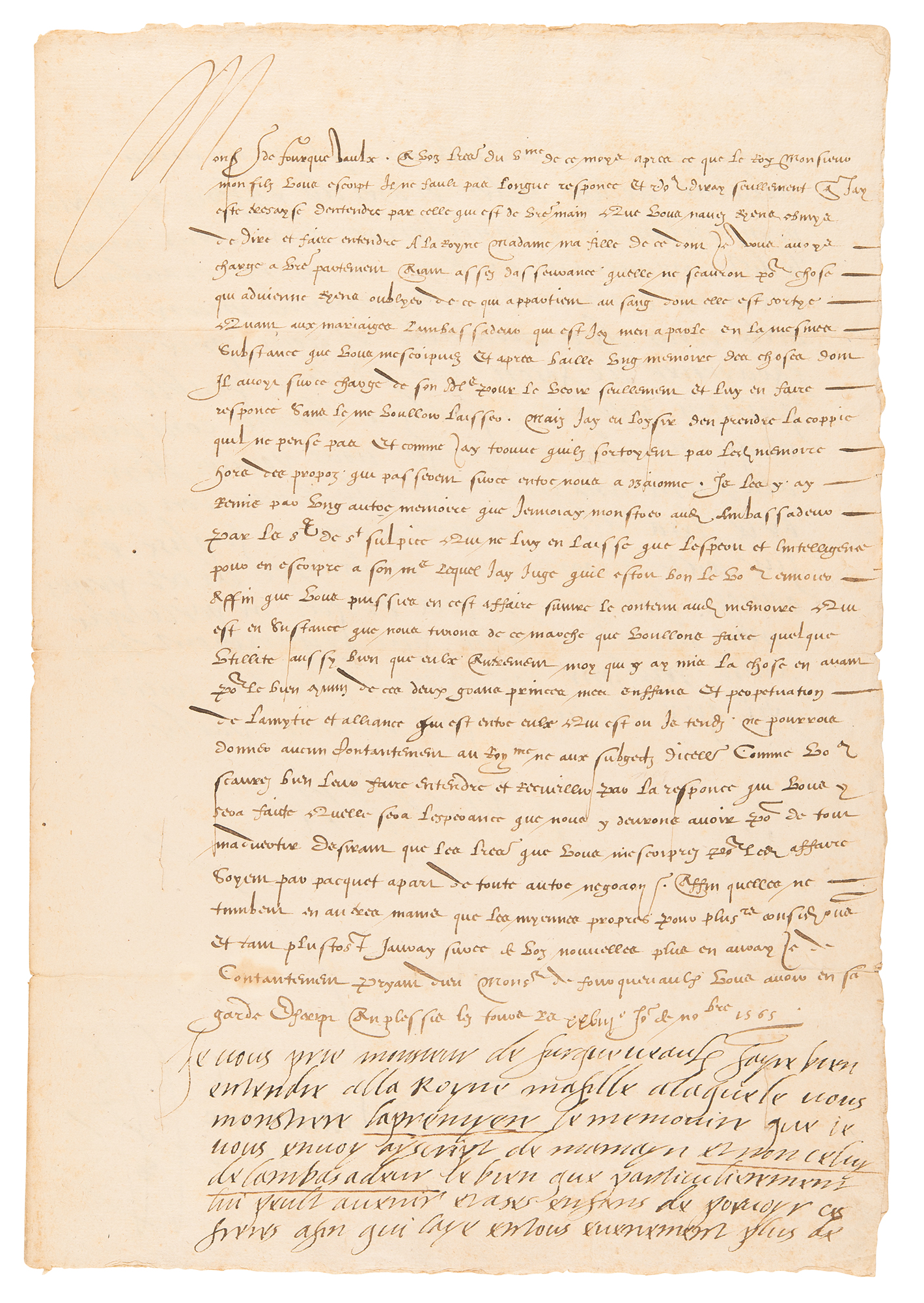
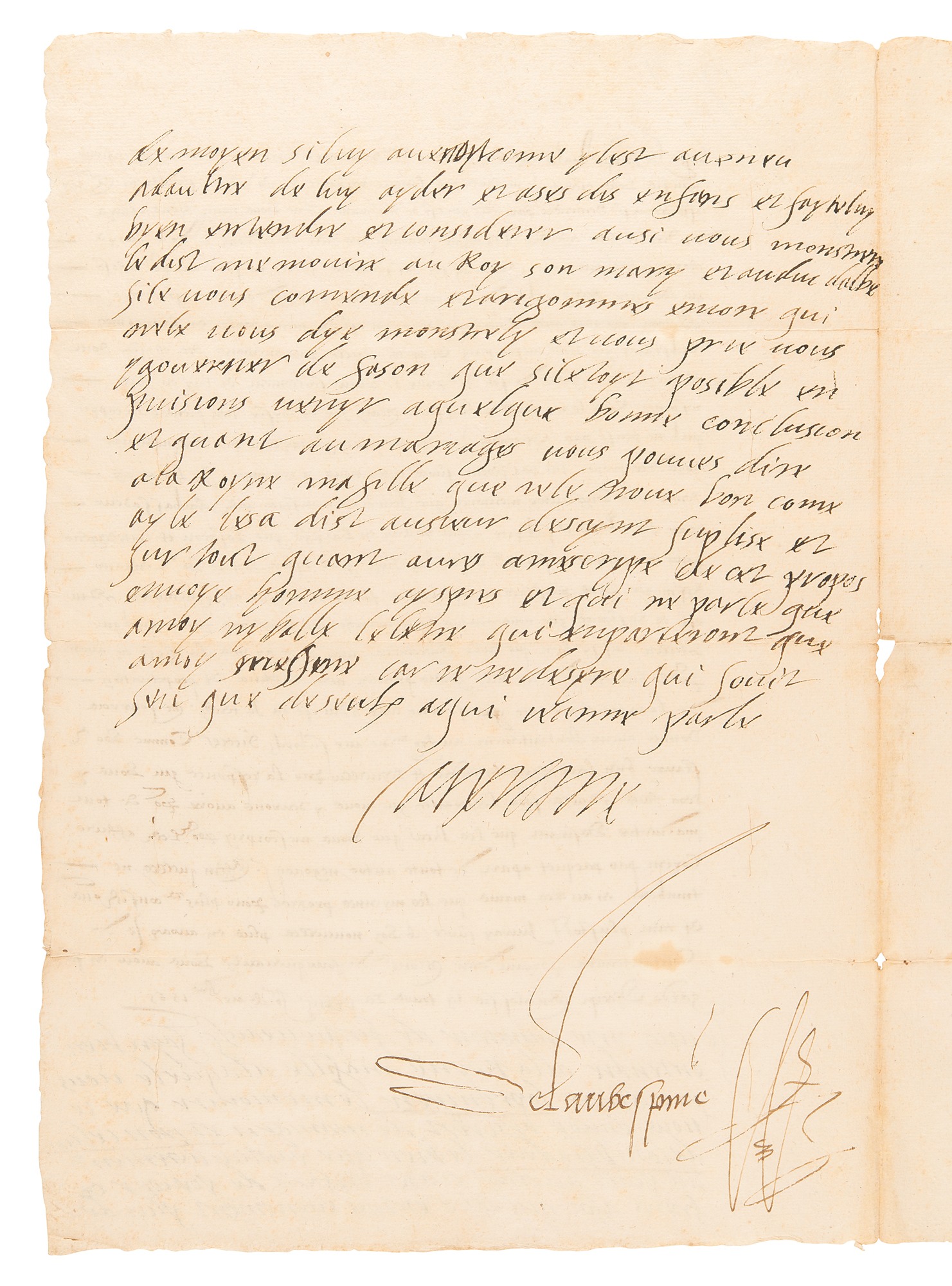
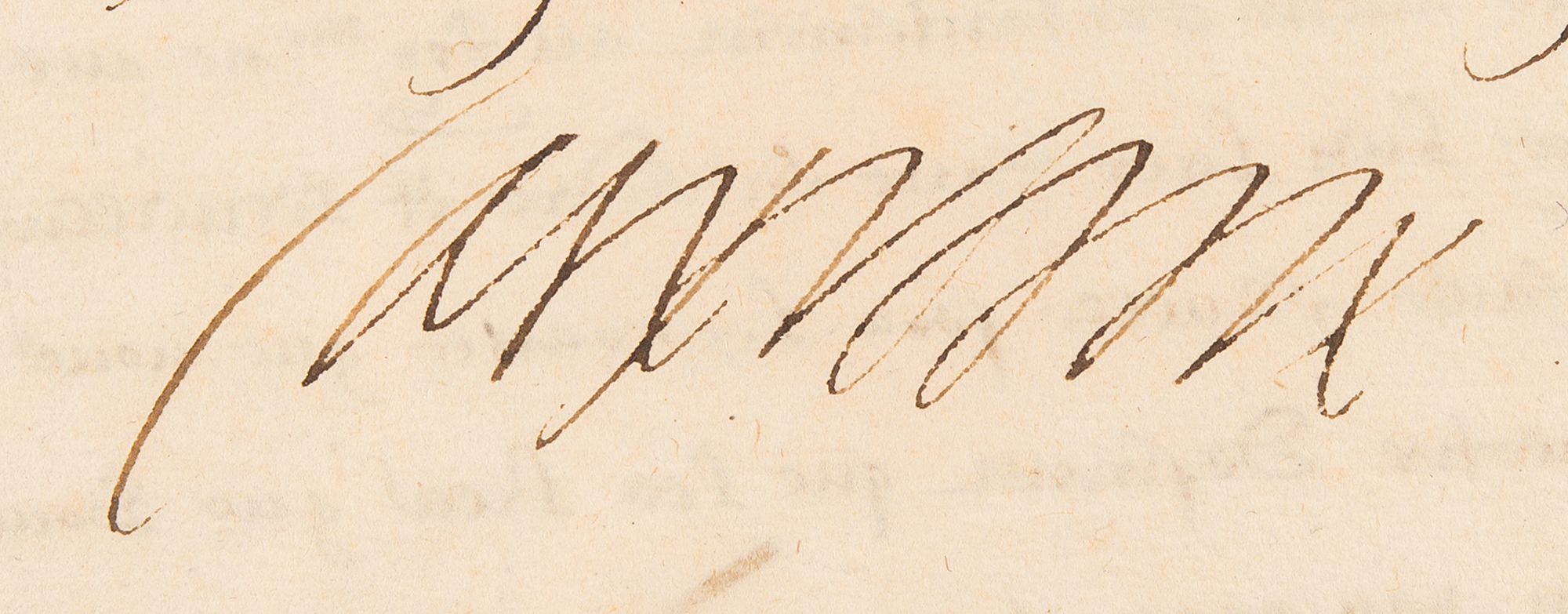
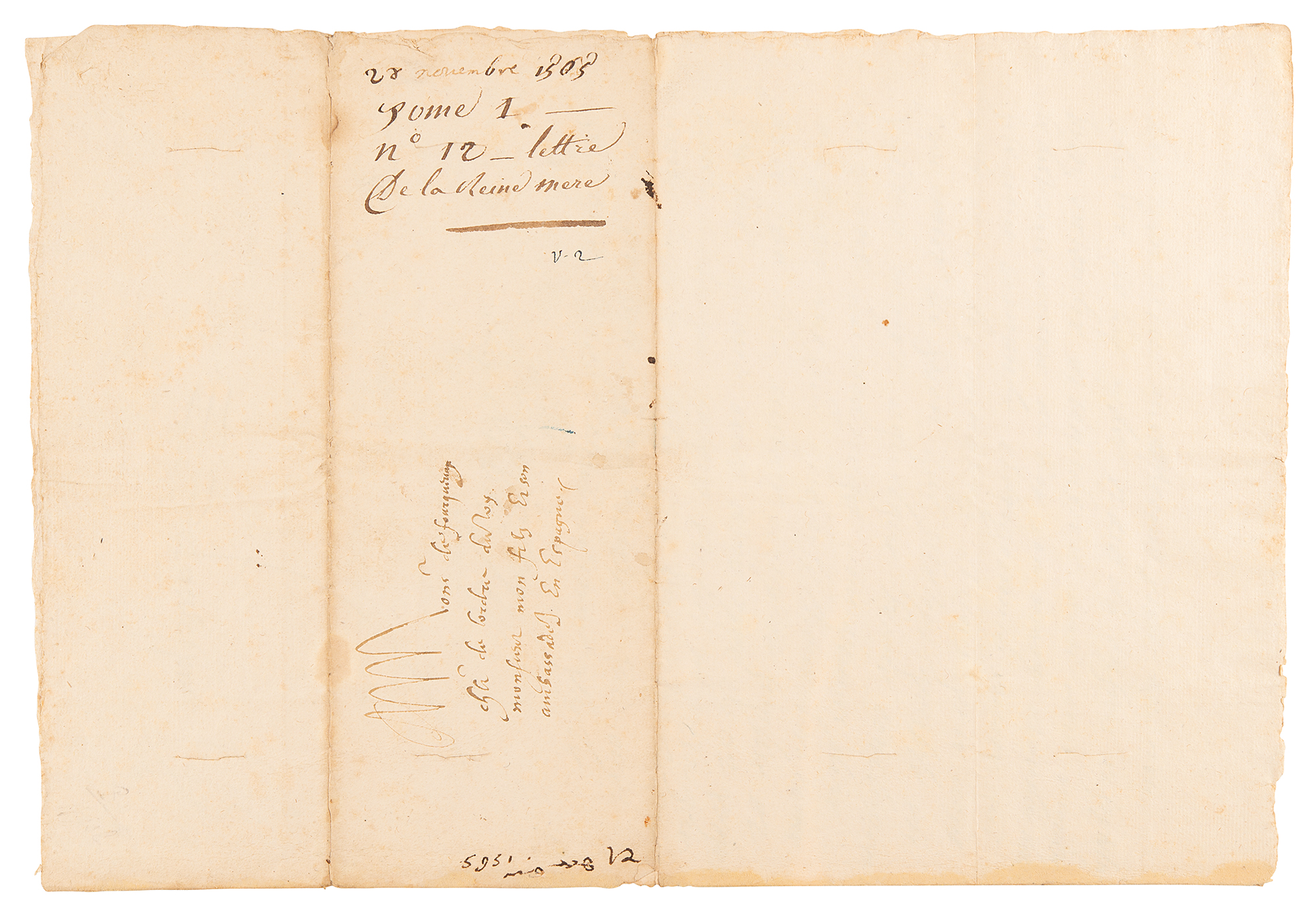
Influential Italian noblewoman (1519–1589) who was queen consort of France from 1547 to 1559 and the mother of three French kings: Francis II, Charles IX, and Henry III. Important ALS from Catherine de Medici, penned at the conclusion of a letter addressed to the French Ambassador to Spain, Raymond de Rouer de Pavie de Beccarie, Baron de Fourquevaux, which finds Catherine attempting to negotiate a political rapprochement between the two countries. The letter, two pages, 8.5 x 12.5, November 28, 1565, addressed from Plessis-les-Tours, contains Catherine’s expressions of gratitude towards Fourquevaux in his capacity as a trustworthy liaison between the two countries. Of considerable import is the topic of marriage negotiations, with Catherine emphasizing that these marriage plans are meant to strengthen ties between her children and to ensure peace and alliance between their realms.
Catherine’s closing portion of the letter, amounting to a total of 23 crisply penned handwritten lines, urges Fourquevaux to convince her daughter, the Queen of Spain, of the interest of a double alliance between France and Spain. She orders that the memorandum be shown to the King of Spain, as well as to Ruy Gomez, an important figure at the Spanish Court, pressing for a prompt and successful conclusion to this affair while encouraging her correspondent to transmit the replies to her in absolute confidence.
Her section, in full (translated): “I beg you, Monsieur de Forquevauls, to make the queen, my daughter, to whom you will first show the memorandum that I am sending you, written by my hand, understand the good that may particularly come to herself and to her children in finding wives for her brothers, so that she may have in all events, as has happened to others, more means of helping herself and her said children, and make it well understood and considered by her. You will also show the memorandum to the king, her husband, and to the Duke of Alba, if he commands you, and to Ruy Gomez, even if he does not tell you. And I beg you to behave yourself in it in such a way that, if possible, you may come to some good conclusion. And as for the marriages, you can tell the queen, my daughter, that I find them good, as she said to the lord of St Supplice, and especially when you have to write to me about this, send a man expressly and who speaks only to me or give letters only to me, because I only want this to be known to those to whom I have spoken.”
The preceding first half of this letter reads, in full: “Monsieur de Forquevauls, to your letters of the fifth of this month, after what the King, my son, wrote to you, I do not need a long response, and I will only tell you that I was very pleased to hear from the one in your own hand that you have not omitted to say or make understood to the Queen, my daughter, anything with which I have charged you when you left, having sufficient assurance that she would not, for anything that might happen, forget anything that belongs to the blood from which she is descended. As for marriages, the ambassador who is here spoke to me about them in the same way that you wrote to me and after giving me a memorandum of the things he had on this charge of his master, only to have a look at it and give him a reply without wanting to leave it to me; but I had the leisure to take copies of it which he did not remark and as I found that they distorted by the said memorandum the words that we exchanged on this subject in Bayonne, I wrote another memorandum that I sent to be shown to the said ambassador by the Sr de St Supplice, who left him only the essence and understanding of it to write to his master, and I judged it was good to send it to you as well, so that you can follow the content of the said memorandum in this matter, which is in substance: we want to take advantage of this deal and make some benefit from it as well as they do. Otherwise, having put forward the common good of these two great princes, my children, and the perpetuation of the friendship and alliance which is between them, which is what I want, I could not give any satisfaction to the kingdom, nor to the subjects of this kingdom, as you will make them understand, and know from the response which will be made to you what will be the hope which we should have there, to inform me of everything, desiring that the letters which you will write to me for the said affair be in a packet separate from any other negotiation, so that they do not fall into other hands than my own for several considerations; and the sooner I have news of you on this, the more satisfaction I will have. Praying God, Monsieur de Forquevauls, to have you in his holy and worthy keeping.” In fine condition, with some trivial paper loss along the hinge.
In 1565, Catherine de Medici was regent of the Kingdom on behalf of her son Charles IX. He was certainly of age, but he had decided to confirm his mother in her duties in order to be supported in running affairs. For nearly two years, Catherine and Charles crisscrossed France to visit all regions of the kingdom. Charles was then able to familiarize himself with its people and discover the extent of his empire.
In June-July 1565, their journey passed through Bayonne, which presented an opportunity for Catherine de Medici to see her daughter Elizabeth of Spain, married to King Philip II, who declined the invitation. He sent instead the Duke of Alba, a formidable minister whose goal was to convince Catherine of the need to fight the Huguenots violently.
Philip II, who had championed Catholicism, was obsessed with hunting down heretics. Catherine, on the other hand, hoped to pacify her kingdom, which was in the throes of religious wars. She therefore did not wish to adopt the expeditious solutions proposed by the Duke of Alba on behalf of his master. Queen Elizabeth of Spain, despite the joy she felt at seeing her mother again, took her husband's side in favor of brutal solutions, which led Catherine to exclaim: ‘How Spanish you are now!’
Although the topic of religion did not allow mutual understanding, Catherine nevertheless hoped to bring the two countries closer together through a dual union. This involved, firstly, marrying her daughter Marguerite – the future Queen Margot – to Philip II's son, the Infante Don Carlos. She also considered proposing her son Henri d'Orléans – the future Henri III – either to Philip II's sister, Jeanne, widow of the King of Portugal, or to one of the daughters of the Holy Roman Emperor, Philip II's brother-in-law, in order to create a greater political union.
It was this diplomatic and matrimonial ambition that was the aim of the letter we are offering, which was written a few months after the meeting in Bayonne, while Catherine and Charles were visiting Touraine. The Bayonne meeting did not produce the expected results. In the 2006 article ‘The Bayonne Meeting According to the Correspondence of Saint-Sulpice,’ historian Jean-Michel Ribera writes: ‘The meeting, which was supposed to provide striking evidence of the friendship between the two crowns, made the various protagonists feel the superficiality of the ties between the two kingdoms. The peace, which was so eagerly sought to be highlighted through the royal meeting, appeared to be a peace of circumstance and not a sincere expression of fraternal relations. Rivalries certainly existed; they could not disappear with a simple meeting.’
However, Catherine managed to seal a union with the Holy Roman Empire, marrying her son Charles IX in 1570 to Elizabeth of Austria, daughter of the Emperor. This letter was published in the book Letters of Catherine de Medicis, Vol. II, published by Count Hector de la Ferrière (1885).
A highly desirable autograph letter from a major figure in world history.

This item is Pre-Certified by PSA/DNA
Buy a third-party letter of authenticity for
(inquire for price)
*This item has been pre-certified by a trusted third-party authentication service, and by placing a bid on this item, you agree to accept the opinion of this authentication service. If you wish to have an opinion rendered by a different authenticator of your choosing, you must do so prior to your placing of any bid. RR Auction is not responsible for differing opinions submitted 30 days after the date of the sale.
Third-party authentication service applies only to signatures and handwriting, and does not cover the addition of sketches, artwork, musical quotations, etc.

