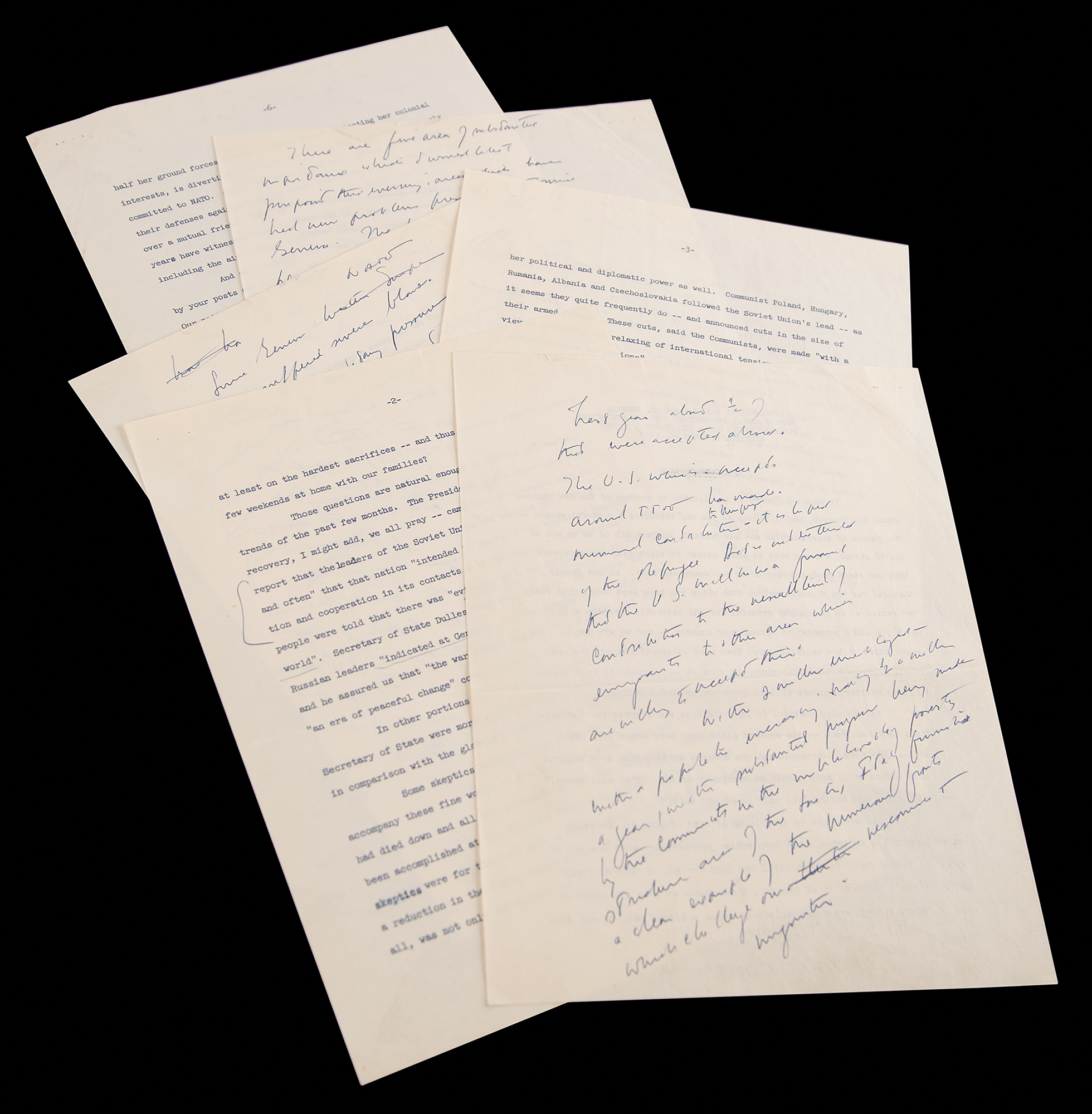
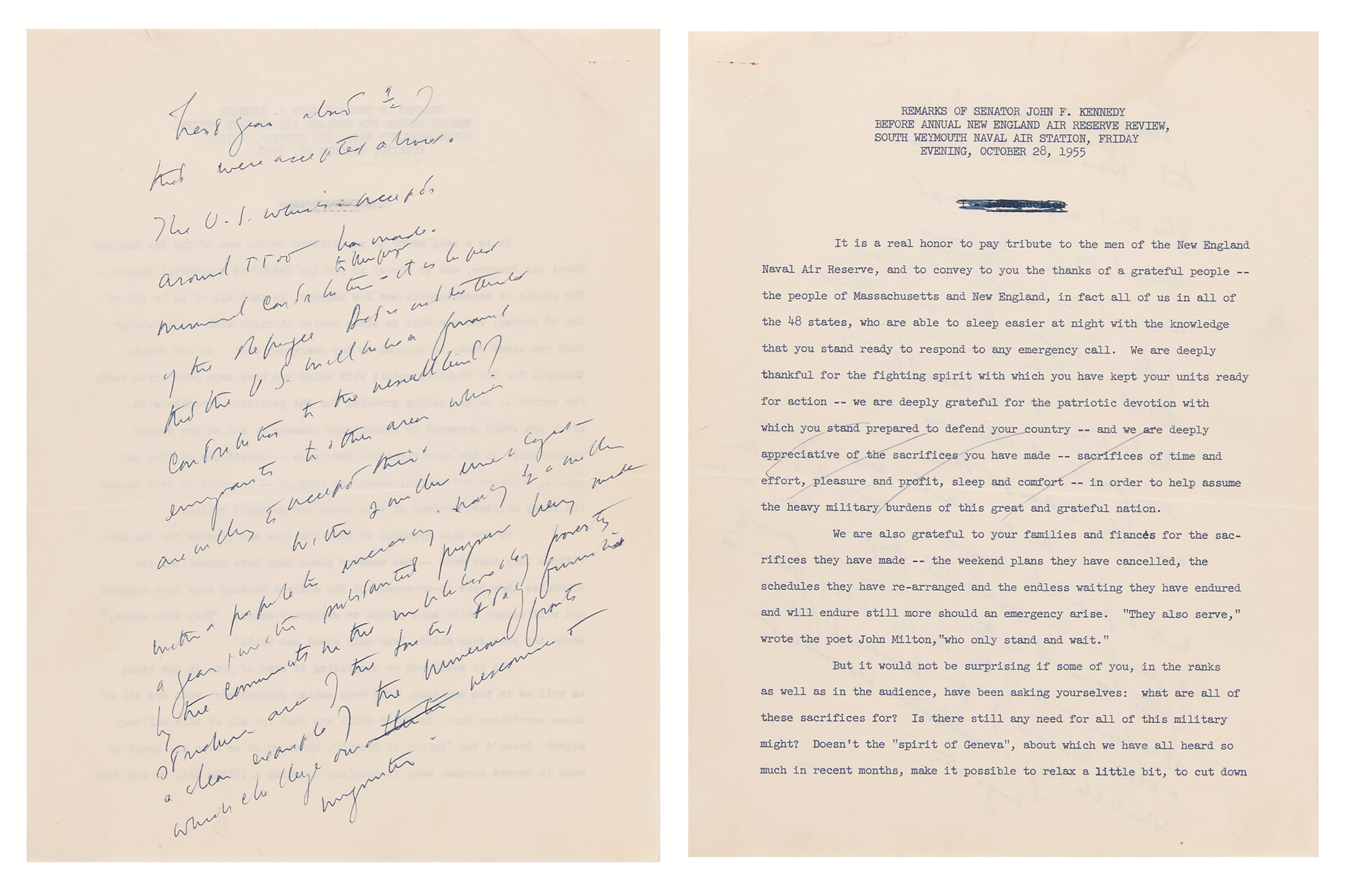
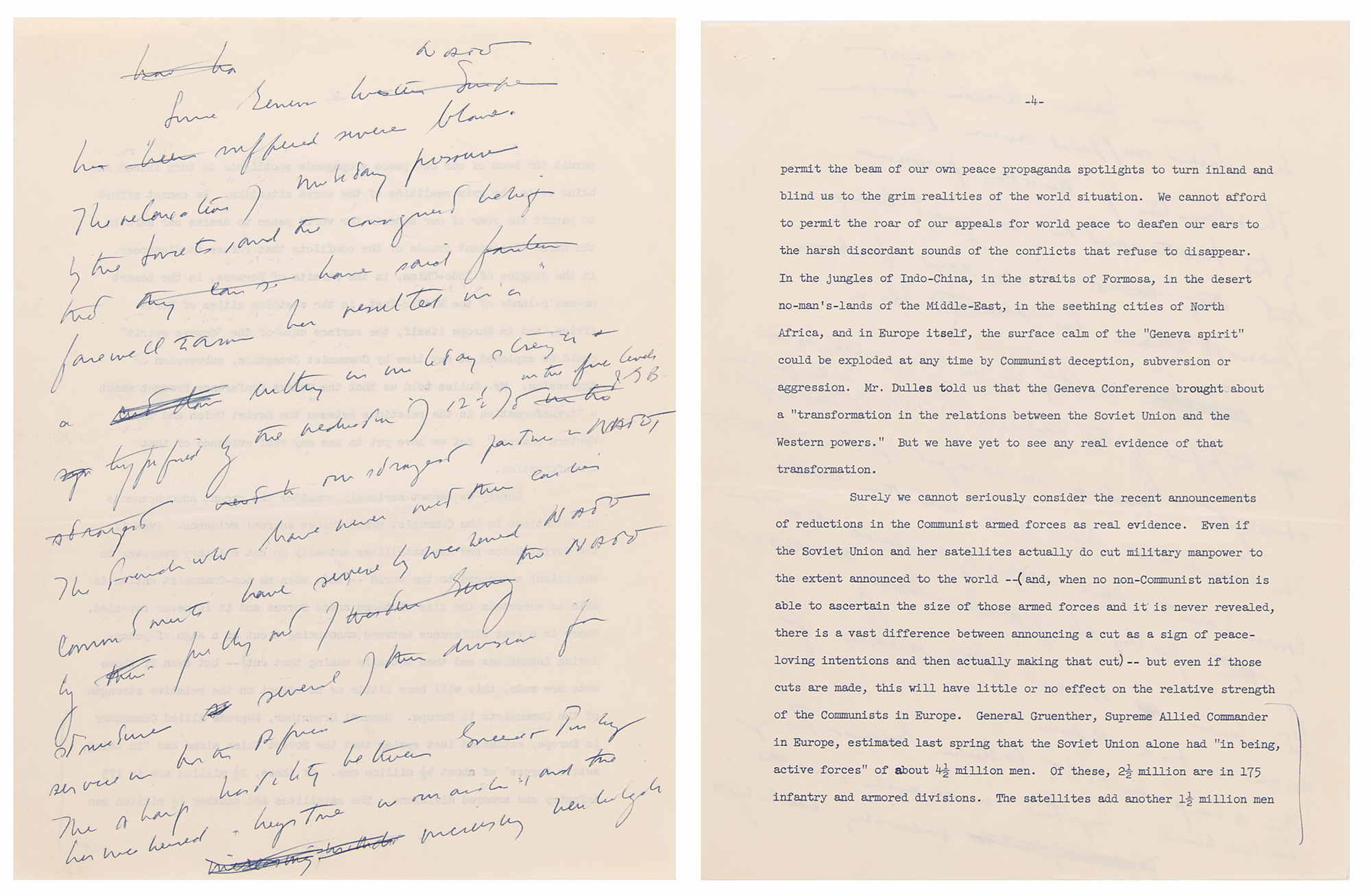
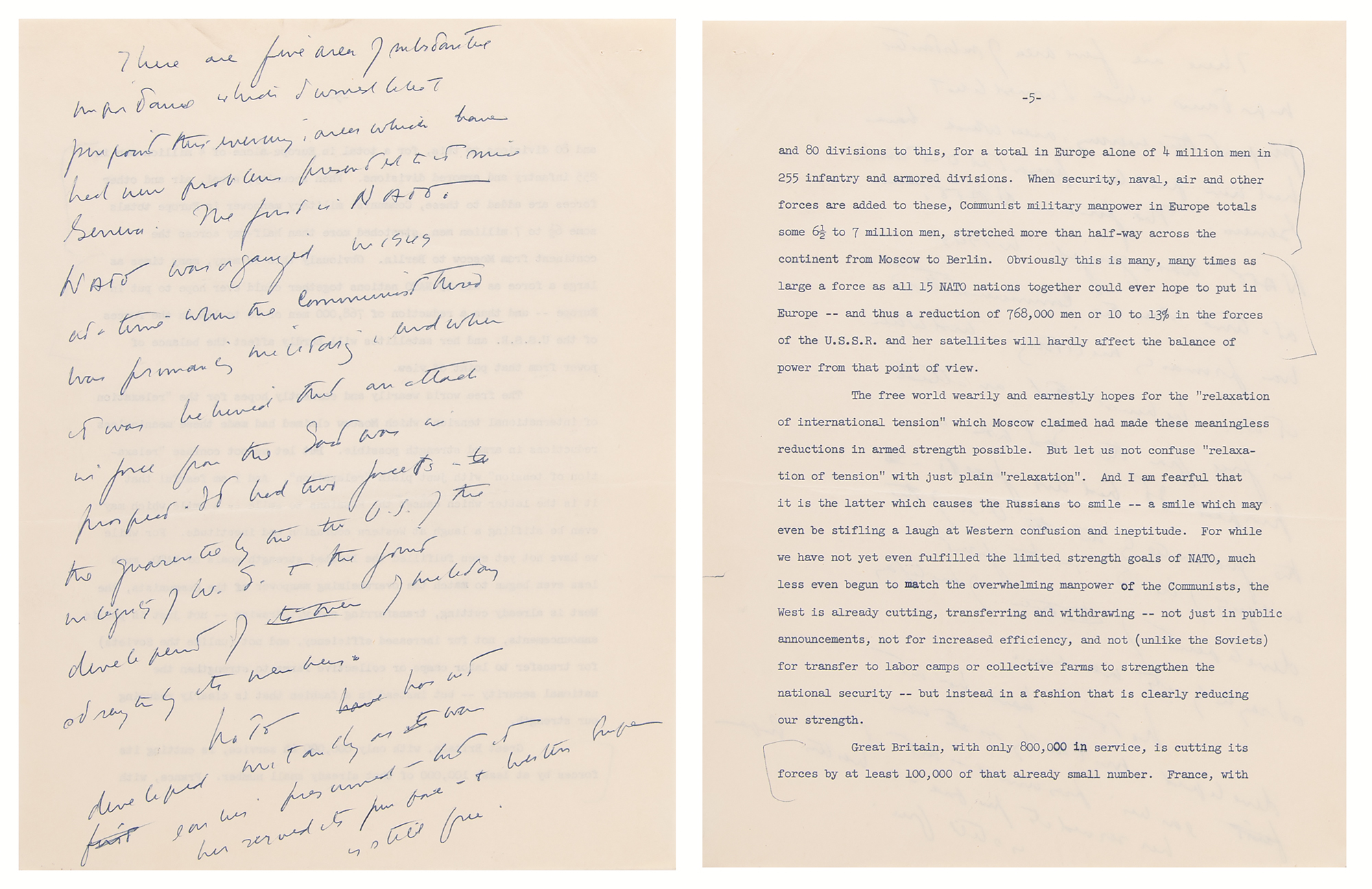
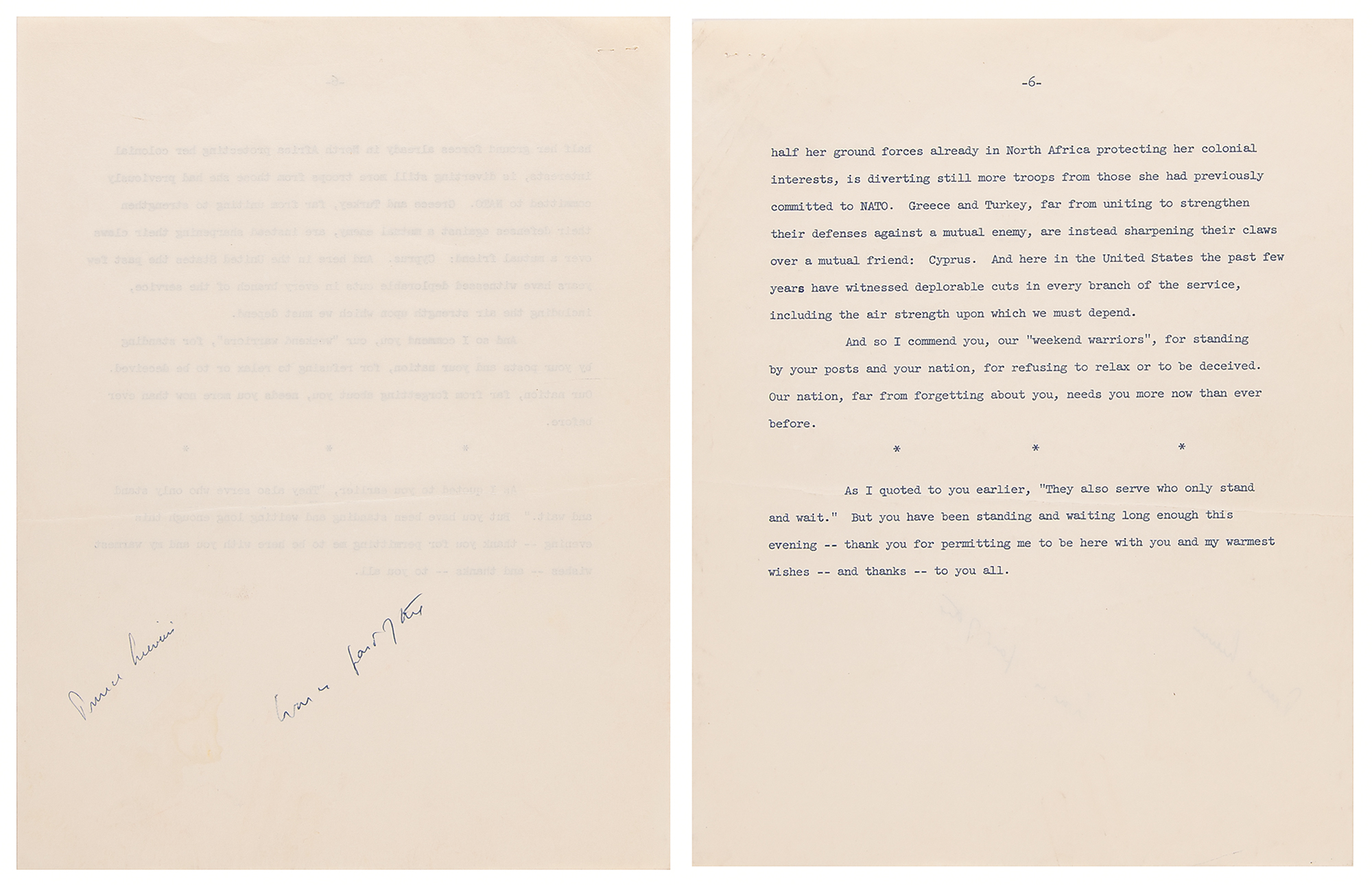
Unique double autograph manuscript and typescript drafts of John F. Kennedy's speeches delivered at South Weymouth Naval Air Station on October 28, 1955, and at Holy Cross College on November 15, 1955, 8 x 10.5, totaling six double-sided pages. On the front is a hand-corrected typescript draft of Kennedy's address at the Naval Air Station, cautioning Americans not to be lulled by Soviet gestures of peace, such as troop reductions announced after the Geneva Conference. He warns that behind Moscow’s friendly rhetoric lay unresolved threats, and urges the West to remain vigilant and avoid weakening its defenses in the face of Communist power.
In part: "It is a real honor to pay tribute to the men of the New England Naval Air Reserve, and to convey to you the thanks of a grateful people—the people of Massachusetts and New England, in fact all of us in all of the 48 states, who are able to sleep easier at night with the knowledge that you stand ready to respond to any emergency call…
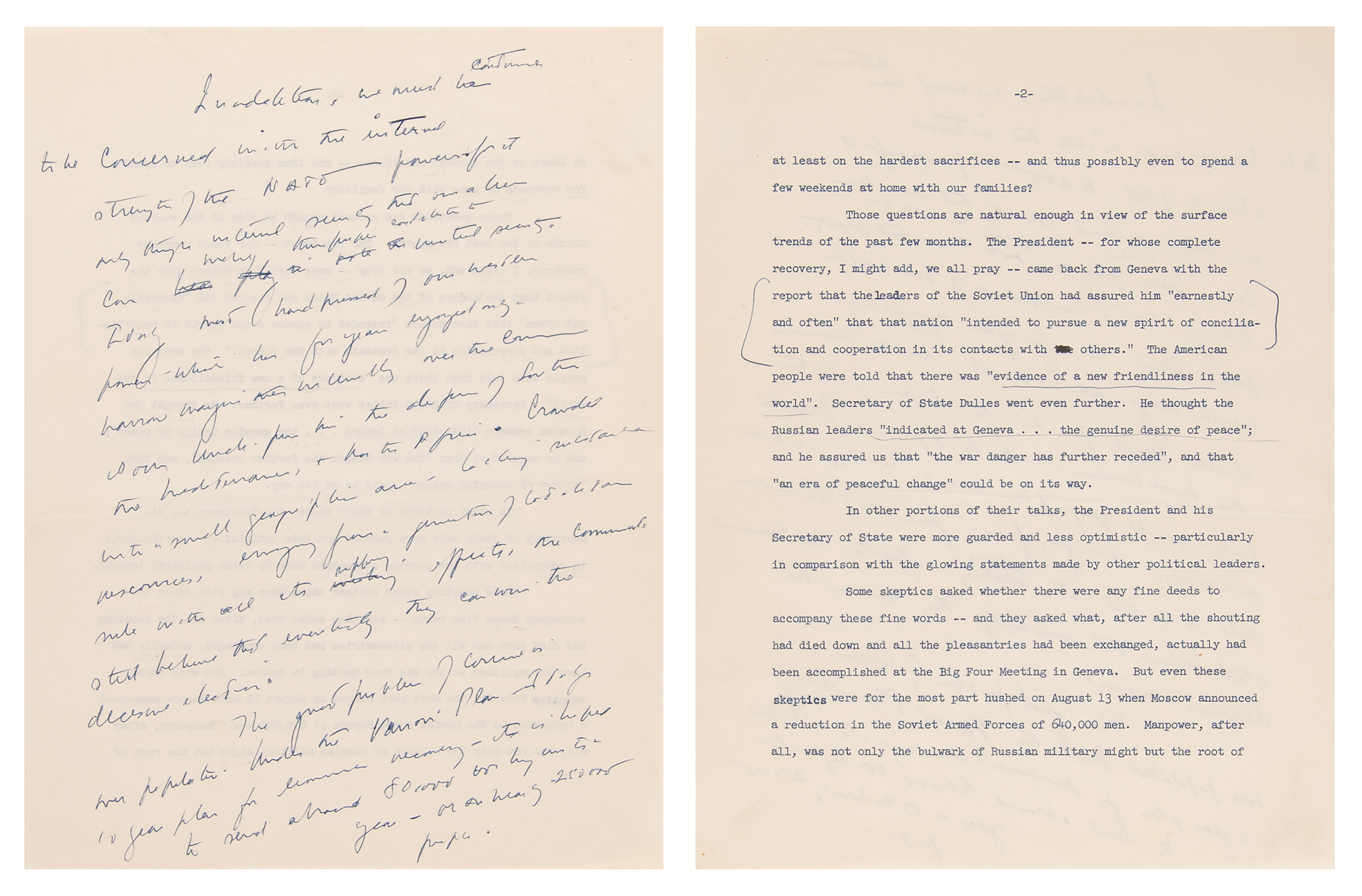
The President…came back from Geneva with the report that the leaders of the Soviet Union had assured him 'earnestly and often' that the nation 'intended to pursue a new spirit of conciliation and cooperation in its contacts with others.' The American people were told that there was 'evidence of a new friendliness in the world.' Secretary Dulles went even further. He thought the Russian leaders 'indicated at Geneva…the genuine desire of peace'; and he assured us that 'the war danger has further receded,' and that 'an era of peaceful change' could be on its way…Some skeptics asked whether there were any fine deeds to accompany these fine words—and they asked what, after all the shouting had died down and all the pleasantries had been exchanged, actually had been accomplished at the Big Four Meeting in Geneva. But even these skeptics were for the most part hushed on August 13 when Moscow announced a reduction in the Soviet Armed Forces of 640,000 men. Manpower, after all, was not only the bulwark of Russian military might but the root of her political and diplomatic power as well…These cuts, said the Communists, were made 'with a view to promoting the relaxing of international tension and establishing confidence among the nations'…
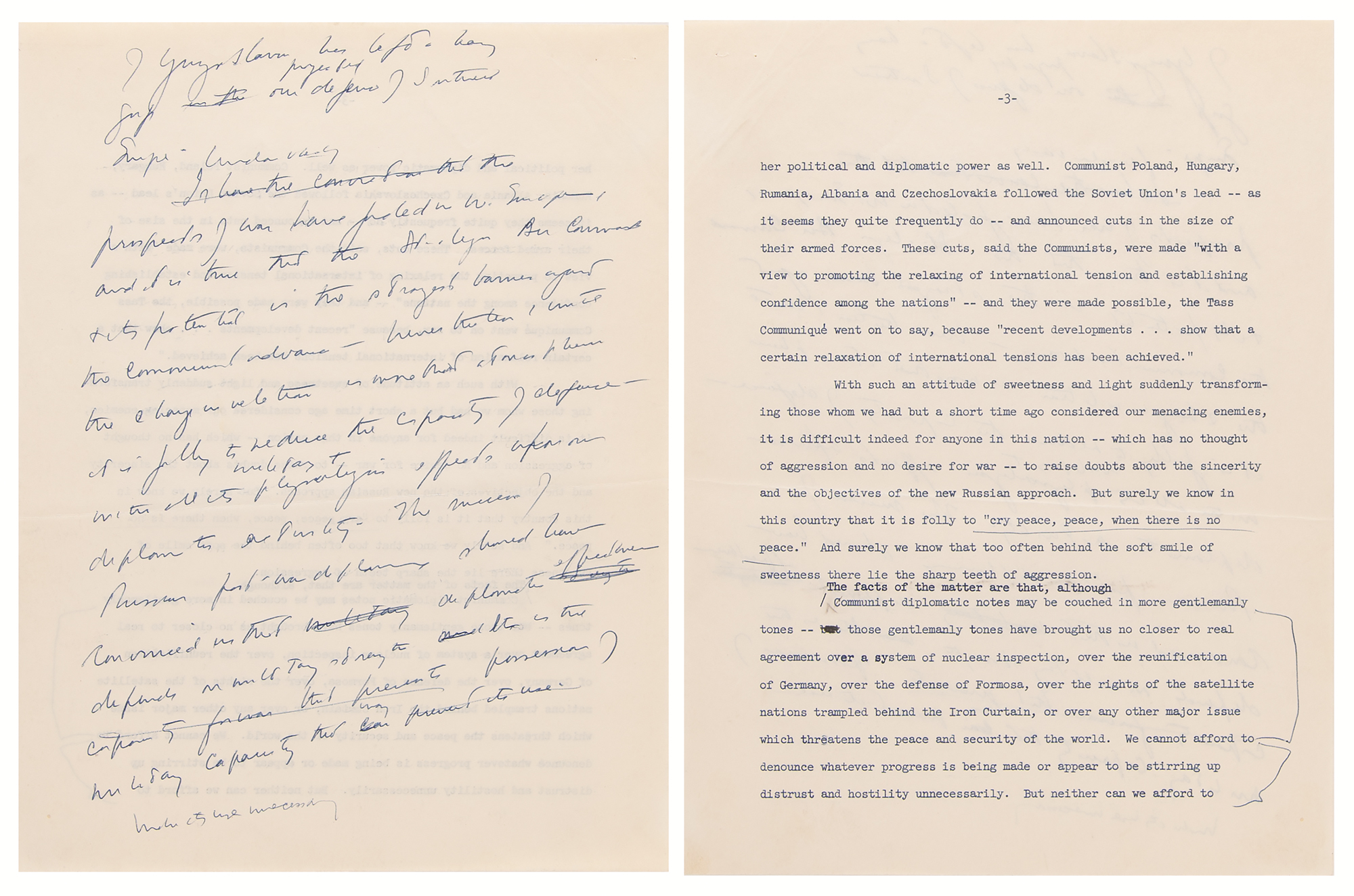
With such an attitude of sweetness and light suddenly transforming those whom we had but a short time ago considered our menacing enemies, it is difficult indeed for anyone in this nation—which has no thought of aggression or desire for war—to raise doubts about the sincerity and the objectives of the new Russian approach. But surely we know in this country that it is folly to 'cry peace, peace, when there is no peace.' And surely we know that too often behind the soft smile of sweetness there lie the sharp teeth of aggression.
The facts of the matter are that, although Communist diplomatic notes may be couched in more gentlemanly tones—those gentlemanly tones have brought us no closer to real agreement over a system of nuclear inspection, over the reunification of Germany over the defense of Formosa, over the rights of the satellite nations trampled behind the Iron Curtain, or over any other major issue which threatens the peace and security of the world. We cannot afford to denounce whatever progress is being made or appear to be stirring up distrust and hostility unnecessarily. But neither can we afford to permit the beam of our own peace propaganda spotlights to turn inland and. blind us to the grim realities of the world situation…
The free world wearily and earnestly hopes for the 'relaxation of international tension' which Moscow claimed had made these meaningless reductions in armed strength possible. But let us not confuse 'relaxation of tension' with just plain 'relaxation.' And I am fearful that it is the latter which causes the Russians to smile—a smile which may even be stifling a laugh at Western confusion and ineptitude. For while we have not yet even fulfilled the limited strength goals of NATO, much less even begun to match the overwhelming manpower of the Committee, the West is already cutting, transferring and withdrawing—not just in public announcements, not for increased efficiency, and not (unlike the Soviets) for transfer to labor camps or collective farms to strengthen the national security—but instead in a fashion that is clearly reducing our strength." A few sections of the text are struck through, underlined, or otherwise emphasized in blue ballpoint.
On the reverse of five pages, in his distinctive, upward-slanting script, Kennedy has rapidly drafted another address, delivered at Holy Cross on November 15th, offering commentary on similar issues—namely, the relative balance of power between the NATO allies and the Communist Bloc. Kennedy details new problems raised by the recent Geneva summit, observing, "NATO was organized in 1949 at a time when the Communist threat was primarily military, and when it was believed that an attack in force from the East was a prospect…NATO has not developed militarily as was earlier presumed—but it has served its purpose—& Western Europe is still free." He asserts that "since Geneva NATO has suffered severe blows," and although "prospects of war have faded in W. Europe," it is a mistake to reduce the West's capacity for defense. He also briefly discusses problems involving refugees and immigration policy. In fine condition.
This item is Pre-Certified by PSA/DNA
Buy a third-party letter of authenticity for
$200.00
*This item has been pre-certified by a trusted third-party authentication service, and by placing a bid on this item, you agree to accept the opinion of this authentication service. If you wish to have an opinion rendered by a different authenticator of your choosing, you must do so prior to your placing of any bid. RR Auction is not responsible for differing opinions submitted 30 days after the date of the sale.
Third-party authentication service applies only to signatures and handwriting, and does not cover the addition of sketches, artwork, musical quotations, etc.

